Reading all the fine and moving 9/11 contributions from colleagues who covered the events of 25 years ago brought memories flooding back. That news shock was a turning point for many of us, including a Middle East reporter like me.
So here’s what I experienced. I hope that it will help explain some of the truths believed and mistakes made by many people, including me, back in those first years of this century – some which endure until today. This post is mostly excerpts from my account of that tumultuous period in Dining with al-Qaeda, a book first published in US hardback in 2010 and in paperback in 2020. I’ll start on the day itself, when I was on assignment in Israel.
On September 11, 2001, I was vainly working on interesting the front page in what I hoped was an irresistible, original story: some Israeli companies, perhaps nervous about long-term prospects in Israel, were hedging their bets and moving back into the Eastern European towns from where they or their parents had been forced out in the 1930s and 1940s. I had gone to Tel Aviv to interview one entrepreneur, who, in a subtle act of coming to terms, was building a shopping centre overlooking the Polish town square where his parents and family had been rounded up for the Nazi gas chambers sixty years before. When I arrived in his office overlooking the Israeli Ministry of Defence, however, the television beside his desk was showing the flames leaping out from the first tower of the World Trade Center.
I didn’t know it then, but my editor Bill Spindle was at that minute sitting at his desk in the next-door World Financial Center wondering what do with another of my ideas to change American attitudes, a story about a conflicted Palestinian refugee soccer team in Jordan. As bits of burning building and jumping people from the World Trade Center flashed past Bill’s window, and were relayed to the desk TV beside me in Tel Aviv, I tried to restart my hard-to-arrange interview about Israeli investors heading back into Eastern Europe. Then a plane hit the second tower and even I realised that today was not the day to talk about shopping centres in Poland. Bill never mentioned my Palestinian soccer team again, either. This was not the time to explore Arab agonies: America was in pain and shock and Arab terrorism was now the issue. Before I left the entrepreneur, however, I asked him what he thought the attacks meant for U.S.-Israeli relations. He smiled serenely and his hand described a sharp, upward take-off.
(Dining with al-Qaeda, p. 88)
You should bear in mind, though, that for Middle East reporters like me, 2001 was just one data point in a long timeline. Already back in 1983, I was watching from my office window when a column of smoke barrelled up into the Beirut sky after a suicide bomber blew up the nearby US Embassy.
Much more was to come. When the same violence hit America itself on 9/11, it took me a while to wake up to the new reality. That’s why on that day in Jerusalem, in one way the epicentre of what caused the crisis, it seemed banal to go out and report on what people all around me were saying and doing. I was also paralysed by the panicked stream of messages on my computer from my Wall Street Journal colleagues who were in the World Financial Centre next door to the twin towers.
It seems relevant to point out that the world was not watching the Middle East in 2001. Here’s how one of the biggest US newspapers treated the region.
It was in the summer of 2000 that an old dream came true. I was working for the Wall Street Journal, living in Istanbul with an already romantic remit to report on anything that seemed unusual from Albania to the borders of China. Now the Journal began to reorganise its coverage of the Middle East. The Jerusalem correspondent had left two years before and had not been replaced. The Arab world reporter wanted to move on, frustrated after years of trying and failing to interest the newspaper in the Arab-Israeli stalemate. It was then that my foreign editor, John Bussey, chose to telephone me.
“Hugh ! We’ve been thinking about Middle East. Could you expand your beat ?” John enthused, rushing to the point as always.
Three years before, John had hired me over a hasty cup of coffee in a Berlin mall where he’d just lunched. I’d had to take a plane all the way from Turkey for the audience. He never visited me in Istanbul, but he did once telephone from an airplane when he noticed that he was flying overhead. He preferred Asia, where things got built and done. Legend had it that in his years posted to Japan as the Journal’s bureau chief, he’d worked so hard that he’d never taken the time to completely unpack.
“I’d love to,” I replied, thrilled. Becoming the Middle East reporter for a great American newspaper was the closest thing I had to a life-long ambition.
John had given me a good run in the paper with stories explaining how Turkey and the newly independent states in the south of the former Soviet Union were making their mark. But when I’d reported once about each of these countries, I’d noticed a distinct drop in the editors’ appetite for more.
“Obviously you’d stay put in Istanbul and keep an eye on Turkey, the Caucasus and Central Asia. But could you do Iran for us ?”
“Sure. If they ever give me a visa.”
“And of course there would be Saudi Arabia and the Gulf. Just a story or two per year. Syria, Jordan and stuff. Egypt. North Africa.”
“Fine,” I said, wondering how I would cope. This was already more than thirty countries. Individually they were mostly unimportant and underdeveloped in the great scheme of the globe, but all were awkward, complicated and hard to get into. Events there were veiled by ignorance, disinformation and authoritarian rule.
“And Hugh,” Bussey finished up, “can you also keep an eye on the whole Arab-Israel thing?”
In retrospect, knowing about the September 11 attacks on America and the U.S.-led Middle East wars that followed, such a scaling back of coverage by one of the biggest U.S. newspapers looks ill-advised. But it seemed logical to the Journal at the time and wasn’t just forced by an advertising crunch after the dot-com share price bubble popped in 2000. Seven years after the signing of the Oslo Accords between Israel and the Palestinians, all seemed quiet, even humdrum on the Middle Eastern front. Americans had little interest in the complaints of the losing Arab side. Oil prices had been rock-bottom for years. I had enough trouble interesting the Journal in stories about Turkey, since its economy was barely as big and arguably less innovative than that of a mid-sized U.S. city; as for the Middle East and North Africa, all those countries together managed to produce only twice what Turkey did, and were almost entirely disconnected from each other. A new front-page editor had also abandoned the international outlook of his predecessor in favour of an approach that appealed more directly to what he saw as American interests. This ruled out many a potential Middle Eastern story. One reporter was enough, they decided, to inform the two million subscribers of the Journal about events in the heartlands of the Muslim world. I felt flattered that they thought I could do it. I didn’t even have an assistant.
(Dining with al-Qaeda, pp 67-68)
My journalistic paralysis in Jerusalem didn’t last long. I was soon one of the first reporters to knock on the door of the family house of one of the suicide jet pilots in an obscure Gulf emirate. Two months later, I even tracked down someone from the al-Qaeda camps in Afghanistan. The chapter that features the banter we had about his initial desire to kill me can be read here – only later did we go out together for the meal that gave the publisher the title he wanted, Dining with al-Qaeda.
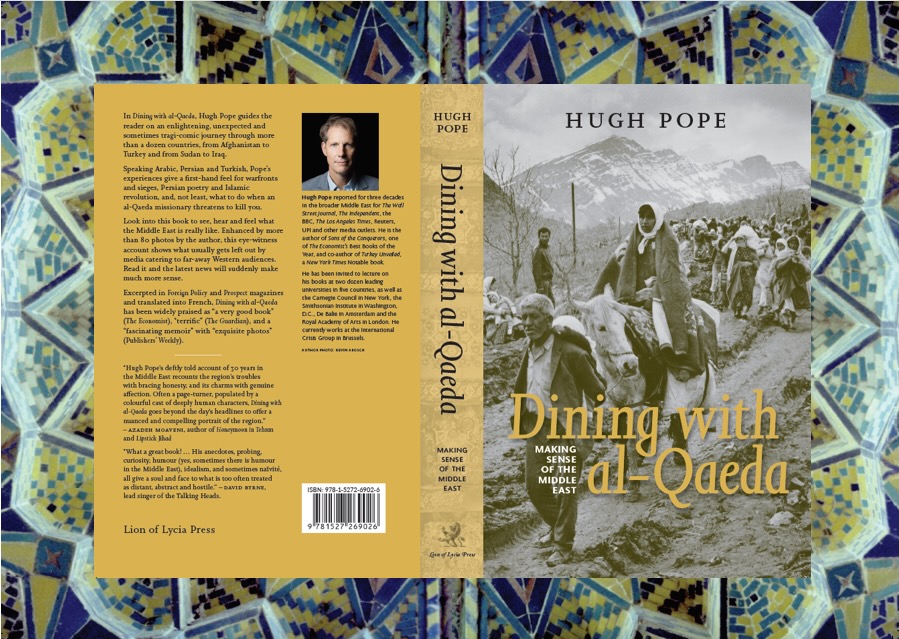
The 2020 paperback of “Dining with al-Qaeda” with many more photos and a couple of small updates is available on Amazon.com
Many people forget that there was a window of a few weeks after 9/11 when the US public, reeling from their first direct contact with our Middle Eastern reality, wanted new answers to the old questions. One of the punchiest of the Journal’s US reporters, Peter Waldman, asked me to join him in trying to explain why this awful event had happened.
Published ten days after September 11, our article focused on President Bush’s slip in announcing a Western “crusade.” We warned that it “had already reinforced the anxiety of some Muslims that the war on terrorism is really a war on them. It also pointed up the vast gulf between two world views. In Washington, the violent attack spawned ringing vows to defend American values. In much of the Muslim world, it was viewed as a desperate call to America to rethink its support of Israel and, more subliminally, of authoritarian Mideast rulers who deny democracy to ordinary Muslims.” It went on to warn of trouble being compounded if the United States did not reconsider this wayward Middle Eastern policy. The unusually frank tone of this piece – a front-page news article, not a commentary – reflected America’s brief moment of free-thinking and self-questioning about its policy after September 11. We both wanted to seize the chance once more.
Working together again had advantages. Pushing from the American side, Waldman helped the story rise to the top spot. It pulled no punches. “For two centuries, foreign powers have been conquering Mideast lands for their own purposes, promising to uplift Arab societies along the way. Sometimes they have modernised cities, taught new ideas and brought technologies. But in nearly every incursion, both sides have endured a raft of unintended consequences … Middle East nations have tempted conquerors only to send them reeling.”
The two-thousand-word story led the front page of a newspaper whose editorial pages had done much to whip up support for the war. For once I got dozens of e-mails thanking us for doing our best. The state of Oregon reprinted the article for use in its school system. Musician David Byrne of Talking Heads bought the rights to distribute it as a flyer for all who attended a concert. [We tried another joint article a month before the US invasion of Iraq in March 2003.] But starting a project about the folly of the impending Iraq War in early February had almost no prospect of actually stopping the war juggernaut. Our warning was only published six weeks after we started, the day before the tanks began to roll into Iraq.
(Dining with al-Qaeda, pp 319-20).
The patrician point of view of a grand US newspaper was understandable. But someone like me – back then a speaker of serviceable Arabic and Persian, who had studied the region for years – should have known better than to miss the signs. For instance, I had been in Kabul in 1998 exactly when al-Qaeda murderously blew up two US embassies in east Africa. My story laboured the point about how much could be gained by normalising with the Taliban, even though they tolerated al-Qaeda’s presence at a base outside Kabul: but bin Laden’s east African attack was in part a cynical and successful attempt to make sure that neither the US nor the Taliban could ever let that happen.
Still, I wanted American readers to see the context of Middle East news better, filling in blanks that reporters like me had been leaving out in order to get published. As I remark in the book (pp 71-72) about the impact of US pro-Israel lobby: “the tactic of lobby-organised write-ins tempted a busy correspondent to err on the side of caution. This was the first step toward perpetuation of the real error, the acceptance of powerful lobby-speak as truth. With each omission or white lie, we laid another brick in the great wall of misconception that now separates America and the Middle East.”
Even so, the way my “truths” contributed to my failure to anticipate something like 9/11, or to really get on top of the story when it happened, remain at least in part a mistake that I regret. I tried my best, but perhaps sometimes I should also have listened more to my editors.
In early 2001, supposedly wise in the ways of the Middle East, I pooh-poohed my foreign editor, John Bussey, who pressed me to go to Pakistan to discover more about fundamentalists threatening to attack America. My “truth” was that they were a marginal and well-known element. I also thought their Islamist monomania distorted what most Muslims felt about Islam and that any stories profiling them would feed the vicious circle in which Westerners thought that such fundamentalists represented the whole of Islam. As for the threat to America, I saw little new or surprising in it. I had seen American targets attacked by all kinds of people as long as I had been working in the Middle East and felt that predicting more of the same lacked dramatic punch. But on September 11, my editor found himself on the front line as he hunkered down in a doorway, clinging on for dear life after these same extremists brought down the World Trade Center right next to my newspaper’s New York offices. Bussey was the one proved right and it was my turn to be bewildered.
(Dining with al-Qaeda, p 413)


Leave a Reply