I. Into Nairobi’s Central Business District
Walking in central Nairobi is not for the timid. It’s not just the nerves of steel you need to weave across occasional multiple lanes of fast-moving traffic, or the thick skin required to pass by the cheek-by-jowl inequalities of a fast-growing country. Nairobi also challenges the visitor with its disconnects and tangled incompleteness.
I set out to explore part of what’s known as the Central Business District partly out of sheer curiosity. In five visits to relatives in Kenya over the past twenty years, I have only even driven past central Nairobi once or twice. This time I would do it properly: the roughly ten kilometres only take a few hours to walk, but I allowed the best part of a day to make the most of museums, markets and, it turned out, matatu buses.
Time from Brussels: 9 hours by plane
Where to where: Nairobi National Museum | Norfolk Hotel | Nairobi University | Jevanjee Park | Nairobi City Market | Jamia Mosque | Macmillan Library | Jomo Kenyatta Mausoleum | Kenyan Parliament | Government district | 7 August US Embassy Memorial Park | Central Railway Station | Railway Museum | National Archives | Kenneth Matiba Road shops
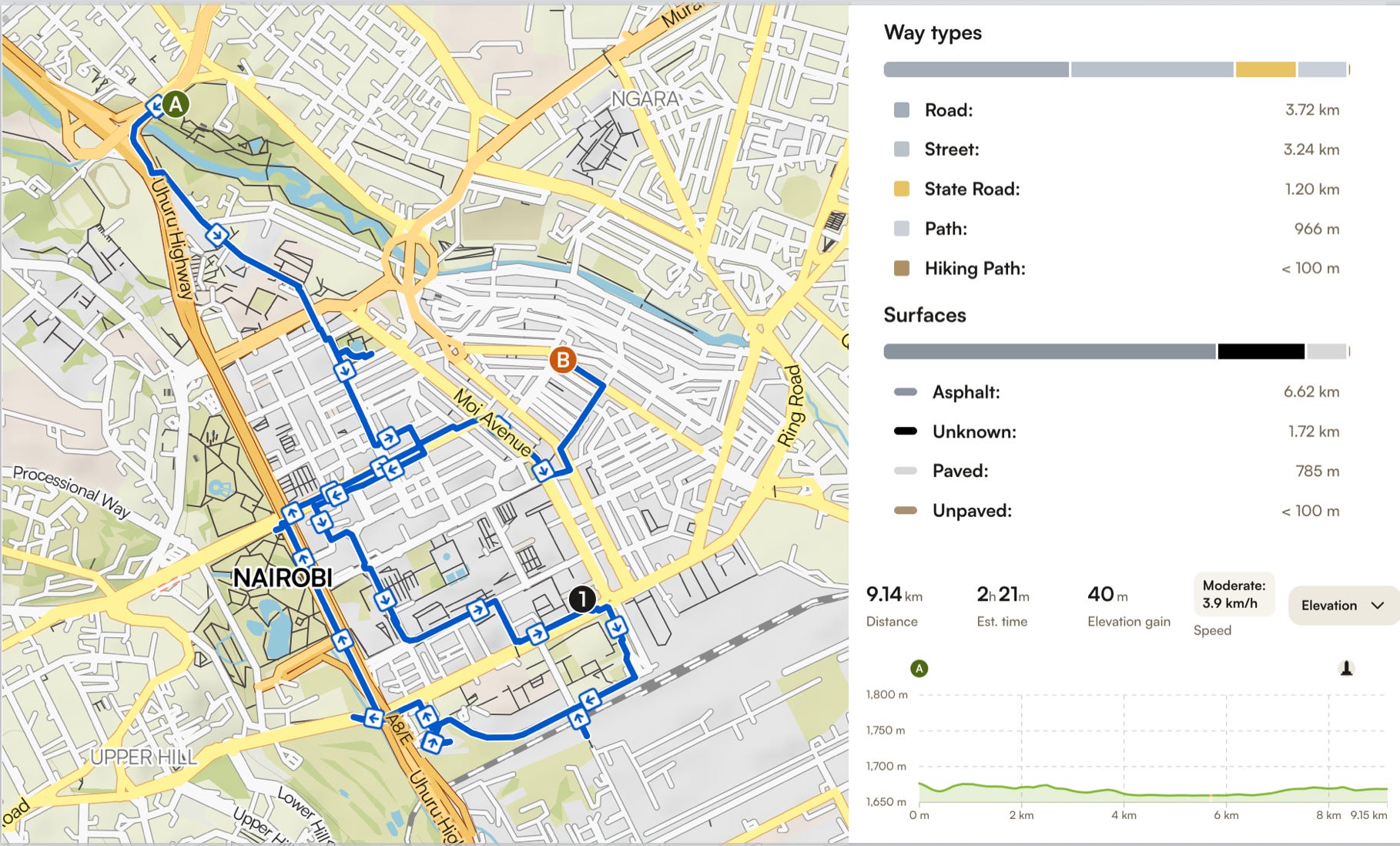
Distance to walk: 9.14 km (with possible 2 km extension)
Time needed: 3 hours walking plus 3-4 hours for visits
If you want: there’s an array of guides and Nairobi walking tours bookable online
To see: 🌴 🌳 🏛️ 🏙️ 🛣️ 🕌 🚂 🚌 🏍️
Questions have been building up in my mind as I visited other parts of Kenya. Is there a meeting place for all Kenya’s overlapping classes, tribes, narratives, aspirations, eras and 60-plus different languages? Or to put it another way: is there a core or culture to be found in the centre of it all that can help me better understand the country as a whole?
When I was a reporter, I often preferred to visit a new place with a fixer as a guide. Everyone I’m staying with says I must explore in the company of Stanley Kabata, a six-foot-tall, widely travelled driver with an often-amused twinkle in his eyes. It’s a great suggestion. We find a day that he’s free and decide to start at the National Museum.
We arrive long before the museum doors open. On a tarmac terrace, half a dozen museum guards are lined up for a morning parade. Somehow the gates swing open, we park our car, and, promising to return later, we start off on a route I’ve laid out to see several landmarks. The museum stands in a peaceful oasis of trees and pleasantly arranged buildings on the north-eastrn corner of the Central Business District. But as we leave the main gate, I see just how close it is to the new Chinese-built elevated expressway that runs on thick columns along the length of the district’s eastern edge.
If we want to get down to the road leading to the university, as my route demands, we have to get over two fast-flowing lanes of traffic to reach a concrete wall that divides it from another two lanes. I look around. There’s no other way to go. Indeed, I’ve seen that after the expressway ends farther to the north, the highway goes a whole two kilometres through a heavily built-up area that has absolutely nowhere for pedestrians to cross.
We are not the only people doing this dance with destiny. On the half-hour drive into town, we have already passed thousands of people quietly walking to work by the side of the road. Sometimes there is a path for them, more often not. But even when there is one, quite a few people just take their chances on the tarmac.
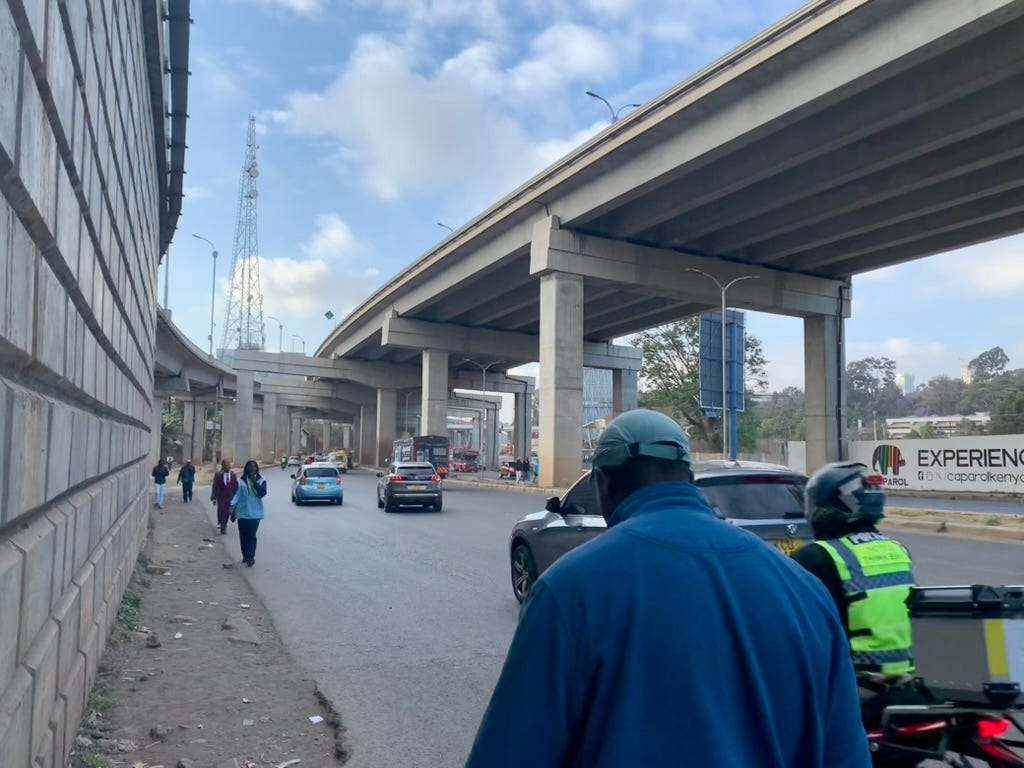
Stanley somehow carves us a way through the traffic and we reach the concrete barrier at the half-way point. Then we head on down a metre-wide, dusty hard verge between the concrete wall and the roadway. Cars and motorbikes zip by. Stanley turns to me with a big smile and gestures to the right. “The Nairobi River,” he announces. Indeed, there between the roadways is a fetid, rubbish-strewn stream, a few metres wide. An expressway column is planted in the middle, with a long-leafed reed making a valiant attempt to grow round it.
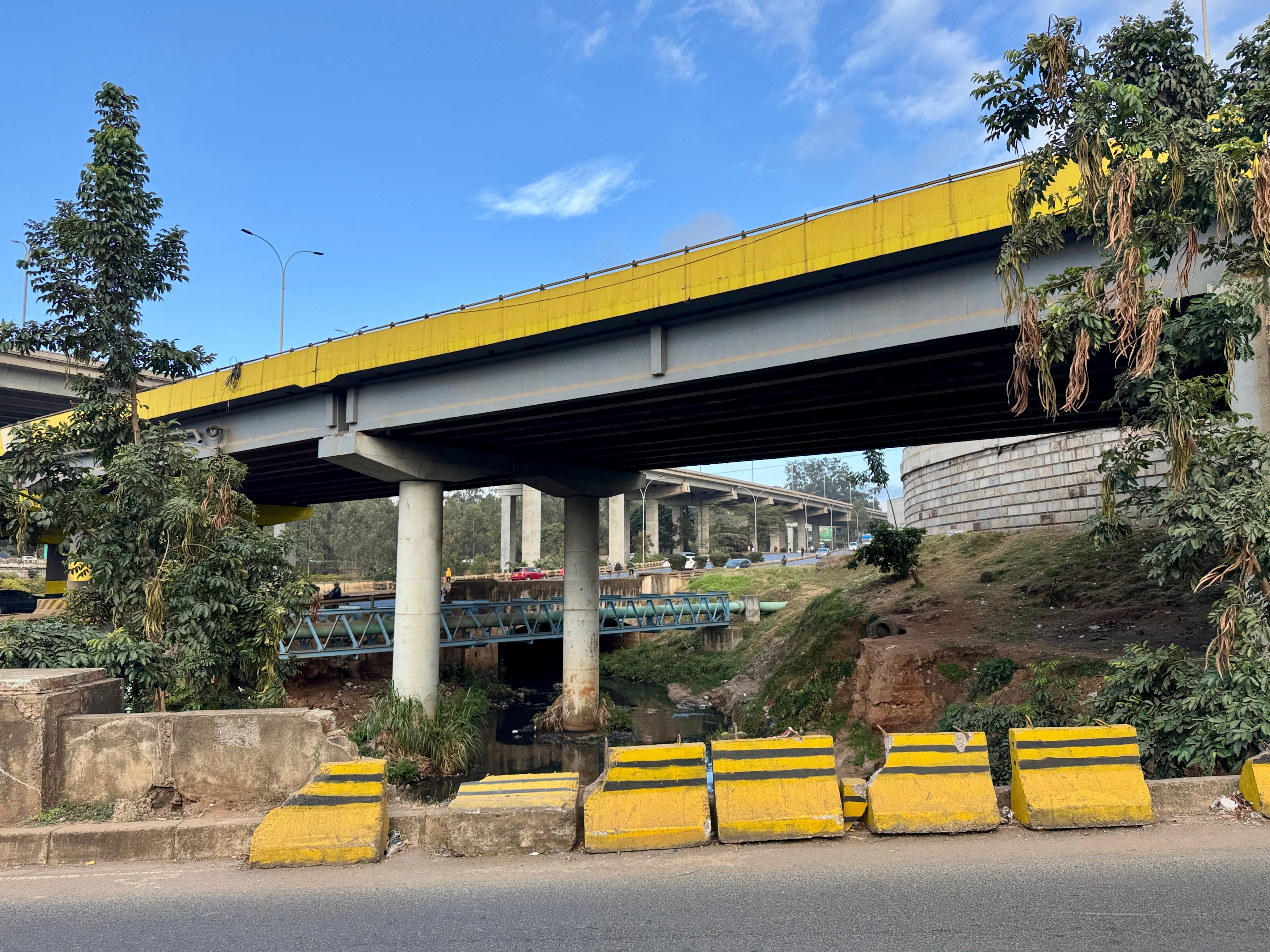
This, I suppose, is just about all that is left of the uninhabited swamp where the the British imperial rulers of East Africa chose to build a first railway-side depot in 1899. Up to then Nairobi – part of a local phrase meaning “cool waters” – had been mainly used by Maasai tribespeople to graze their cattle. It only became a formal city in 1950.
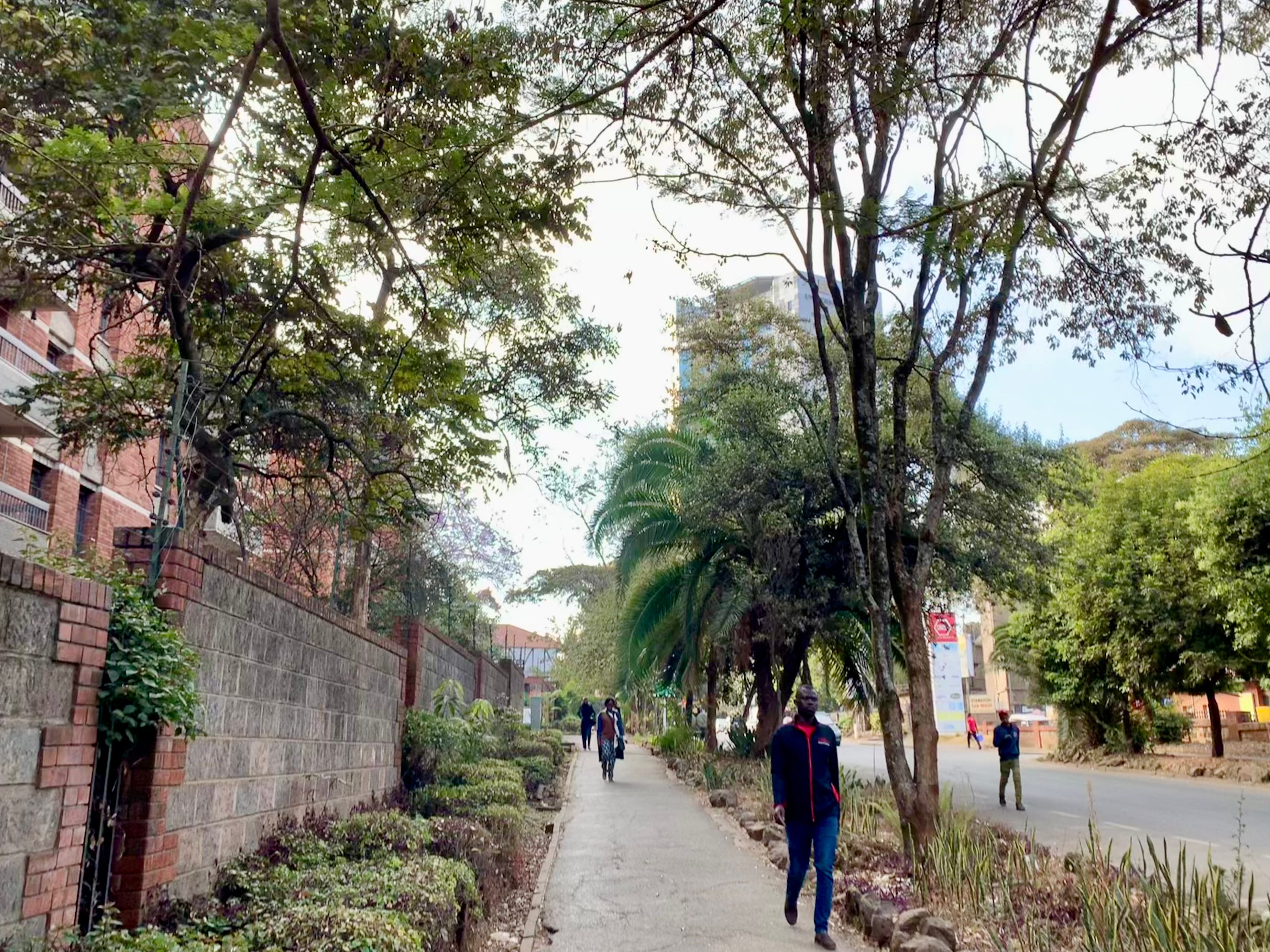
We cross another line of traffic and onto Henry Thuku Road, an attractive street with a real pavement, palm trees, acacias and jacarandas (0.4 km). We pass the low-rise entrance to KBC, the Kenyan Broadcasting Corporation, the strangely corporate skyscraper known as the University of Nairobi Towers and then the Norfolk Hotel (0.85 km).
The latter luxury establishment looks a bit low and squashed behind its pseudo-mediaeval half-timbering, but still well cared for. Next time, I would stop for a coffee to see inside. When the Norfolk was set up in the early 1900s, the era before Chinese expressways, this was doubtless the right fit for a scenic spot. Stanley makes sure I remember that it once had guests like Princess Elizabeth, who learned she would soon be the UK’s Queen Elizabeth II on her visit to Kenya in 1952.
Soon Kenya Highways gives us a fortress-like footbridge over University Way to go deeper into the business district (1.16 km). In the middle distance is the Central Bank of Kenya’s remarkable Pension Towers, whose opposing vertical curves look like two slim figures stretching upward after waking. Finished four years ago with features like grey water recycling and rainwater collection, the shiny symbol of modernity was paid for entirely by the country’s pension fund. Who knows what the return on investment is, but there is something reassuring in this physical use of all that money.
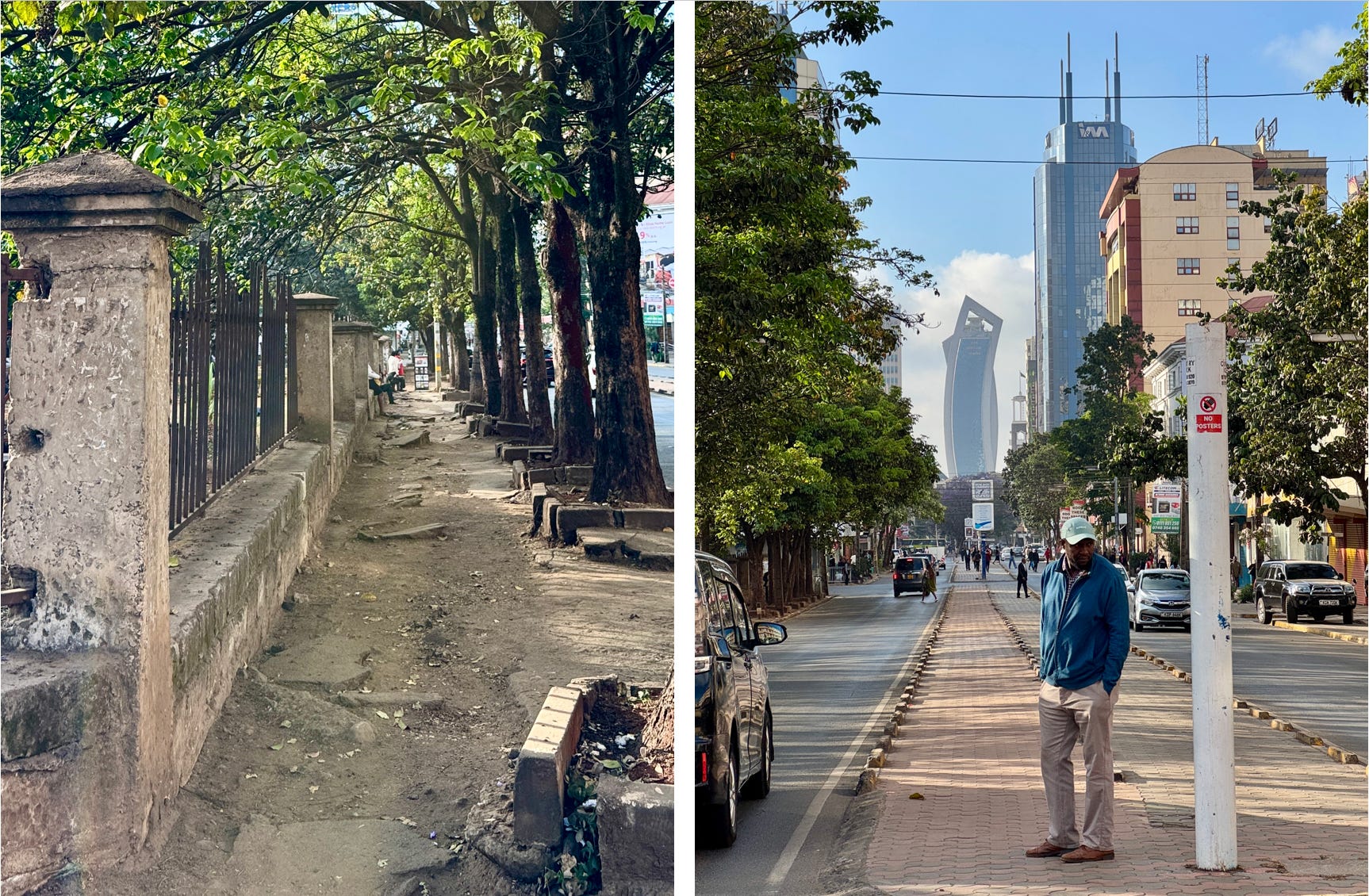
I don’t have much time to admire the skyline, though. The pavement I’m walking on is like a derelict obstacle course. Broken chunks of concrete and stone come a foot out of the ground. The sidewalk runs alongside a park called Jevanjee Gardens, gifted to the people of Nairobi in 1906 by the country’s wealthiest Indian entrepreneur so that ‘the people could rest’. And rest they do. The bald grass is peppered with people sleeping rough. The park looks exhausted as well, even if it is filled with trees. Stanley says there are constant rumours of new bids by today’s entrepreneurs to seize the land and turn it into a multi-story carpark or business centre.
Returning to the main Muindi Muringu Street, I pass by four or five-story buildings overlooking the park put up in the 1950s, part of the last gasps of the British Empire’s rule of Kenya that ended in 1963. The rectangular concrete structures bear names of other Indians who played a big role in the country’s economy. Jevanjee, for instance, arranged for the tens of thousands of Indian labourers who built the most critical piece of Kenyan imperial infrastructure, the railway from the port town of Mombasa through Nairobi to Lake Victoria. Even today, Kenyans of Indian heritage represent perhaps two-thirds of the country’s business people and taxpayers.
II. Art deco meets national aspiration
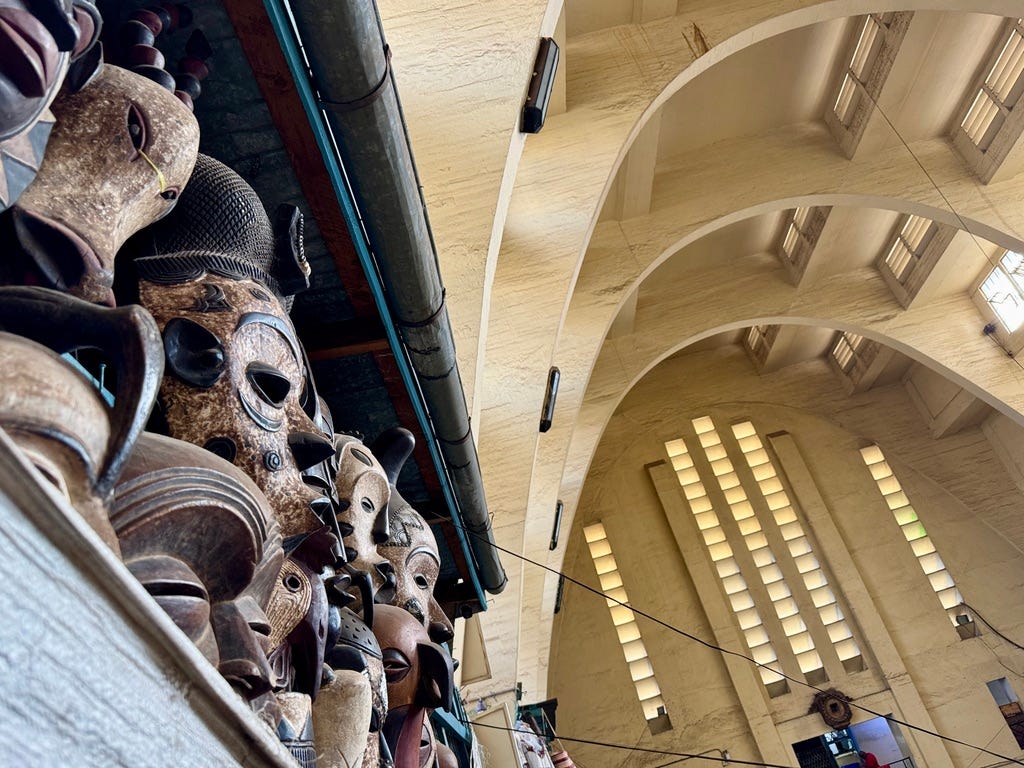
Nairobi City Market sits incongruously on the right (1.88 km). The market was built in 1932 along striking Art Deco lines, like the curved vault of the central hall’s ceiling to keep the place cool on hot days. The vibrantly colourful paintings on the outside aim to entice passers by with a jamboree of symbols of Kenyan modernity: a tarmac road, a hospital, a ship in port, a skyscraper skyline, children walking to school. Buy it doesn’t really fit with the architect’s austere vision of seven stepped vertical bands inset with five strict columns of ventilation openings.
At the front are fishmongers and butchers’ shops attended by men in white coats. Behind are shops with bouquets left over from Kenya’s large daily exports of cut flowers to the world. Inside are stores filled with African masks, baskets, beadwork, and touristic tat. At home we eat off plates that remember all the cities we have visited, so I set about finding my plate from Nairobi. There’s Kenya-branded merchandise everywhere but, in shop after shop, zero plates in honour of the country’s capital city.
None of the shopkeepers can explain why nobody makes or buys Nairobi plates: it’s as if I am the first person to make this odd request. To me, though, this seems like evidence that Nairobi and its Central Business District are a kind of empty hole in the heart of the country. ‘What do you want it to say about Nairobi on the plate?’ one eager shopkeeper asks me. ‘I can get you one made in a few hours!’ But I’ve lost interest. My planned route does not return this way and the plates are carved from soapstone, which will definitely be too absorbent to eat off.
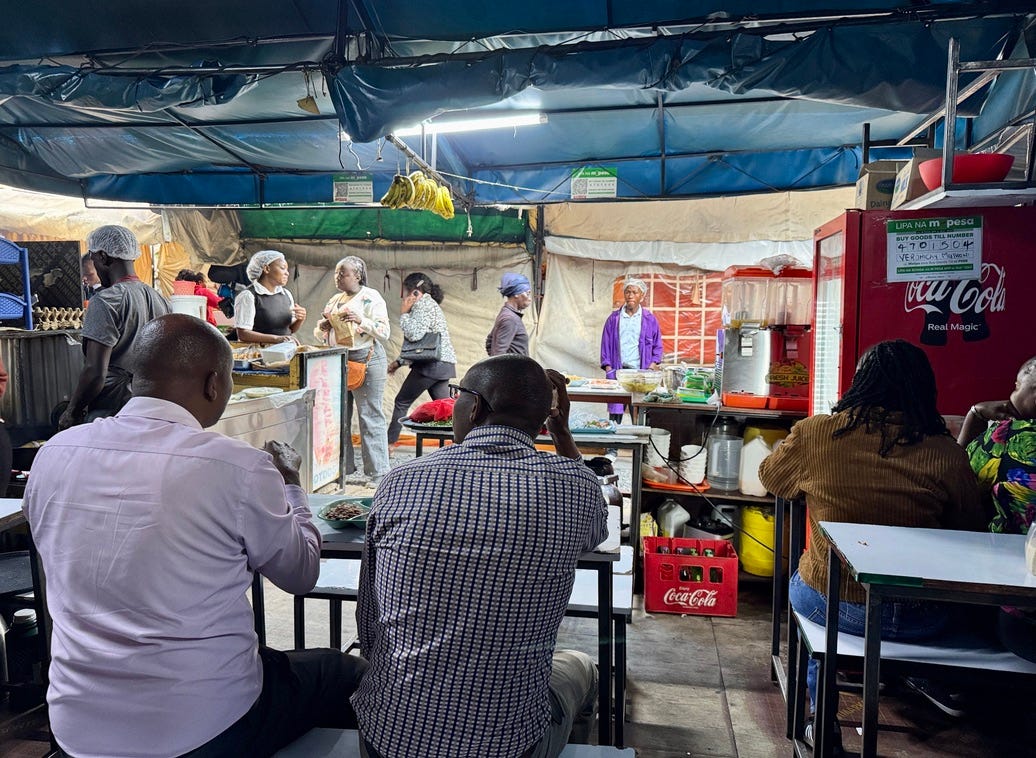
It’s still early and Stanley calls a halt for refreshments. We cross a road into a maze of street food stalls made of woven plastic coverings draped over spindly metal frames. We slip into one with tables and benches in neat rows, everyone sitting beside whoever happens to be there. Along comes tea – brewed with milk, in the style of the Indian subcontinent – and deep-fried plain pockets of dough called mandazi.
People pop in from many walks of life. Opposite us an anxious boy, who looks as though he’s just slept out rough, sips some tea. There are also people in suits. Most people are taking great care over their clothes and appearance, especially the women with elaborately knotted braids of hair. I’m struck that the chief source of energy for the tea and frying pans is that most rural, ancient fuel, charcoal. “Gas and electricity are too expensive,” Stanley explains.
More imperial legacies follow. An immaculate Indian Muslim mosque (2.11 km). The neo-classical façade next door of the Macmillan Library, closed for renovation. Then another neoclassical building, the Bank of India’s headquarters in Nairobi, formerly the colonial-era legislature and later modernised with a partial façade overlay of grotesque 1950s plain concrete and vertical fins (2.2 km). Opposite, Standard Chartered, a British bank with its roots deep in the empire, holds its nose and conforms to the modernist era with its name on a long blue beam and a coat of white paint on its Palladian pillars.
III. From abused colony to independent republic
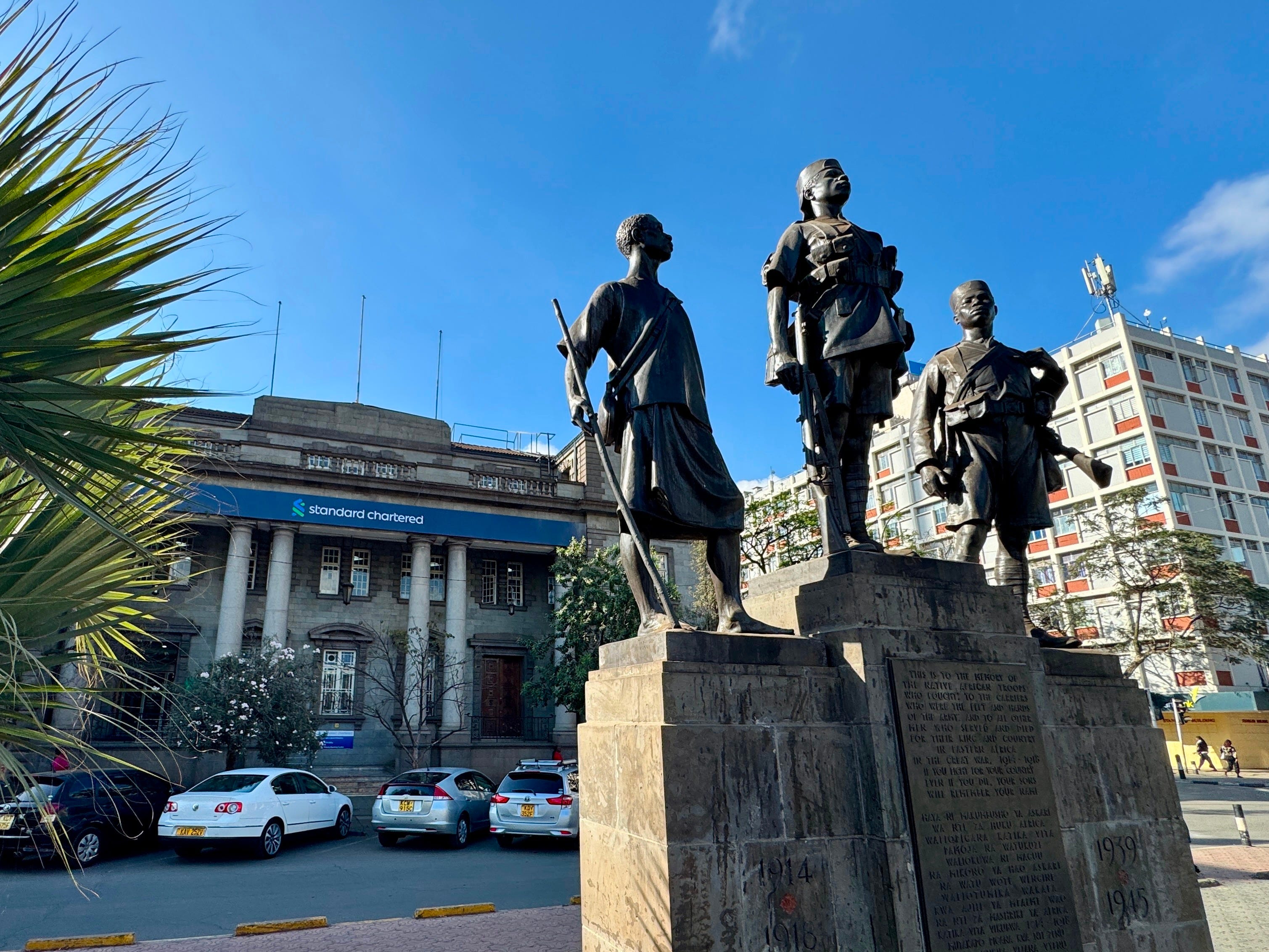
In front of the bank stands a more uncomfortable colonial legacy, the Askari Monument put up by the British to honour the Kenyans’ contribution to the First World War. As a patronising dedication puts it, “this is to the memory of the native African troops who fought, to the carriers who were the hands and feet of the army … if you fight for your country, even if you die, your sons will remember your name.” Independent Kenya has left it there, perhaps because of its accommodating attitude towards its British former overlords. Or perhaps because the monument’s two African soldiers and a bearer stand in proud, dignified poses. A panel I stumble across in the National Museum afterwards puts the record straight.
“In 1914, the First World War broke out with serious consequences. Many Kenyans were forcibly recruited to support the British. Others were required to provide the army with food free of charge. Worse still, out of the 195,000 Kenyans who served in the Carrier Corps, 50,000 of them died. Although many were killed on the battle field, the high death-rate was also caused by: Poor living conditions, lack of adequate food and lack of adequate medical facilities.
“This was followed by an epidemic of influenza in 1918 and 1919, which killed many people. For example, in Kikuyu-land alone, the death toll from the disease was 120,000. The matter was made worse by a famine that followed. Food shortage was caused by poor harvest due to the absence of the young men, who had traditionally taken a major part in farming activities.
“After the war, the traumatic war experience was made worse by a number of factors. Under pressure from the settlers, the Government introduced measures to ensure that there was adequate supply of labour for the settlers. For instance, the chiefs were instructed to regard the recruitment of labour for the settlers as one of their official duties. Strict measures were also introduced under the kipande (identity document) system, used to control the movement of labour more effectively in order to minimize absconding of duties. Equally, matters were made worse by the fact that many African ex-soldiers did not receive their bonus payments from the British Government while European ex-soldiers were rewarded with land taken from the Africans. These measures bred bitterness and the situation was made worse by the various difficulties that Kenyans had to endure under the colonial Government.”
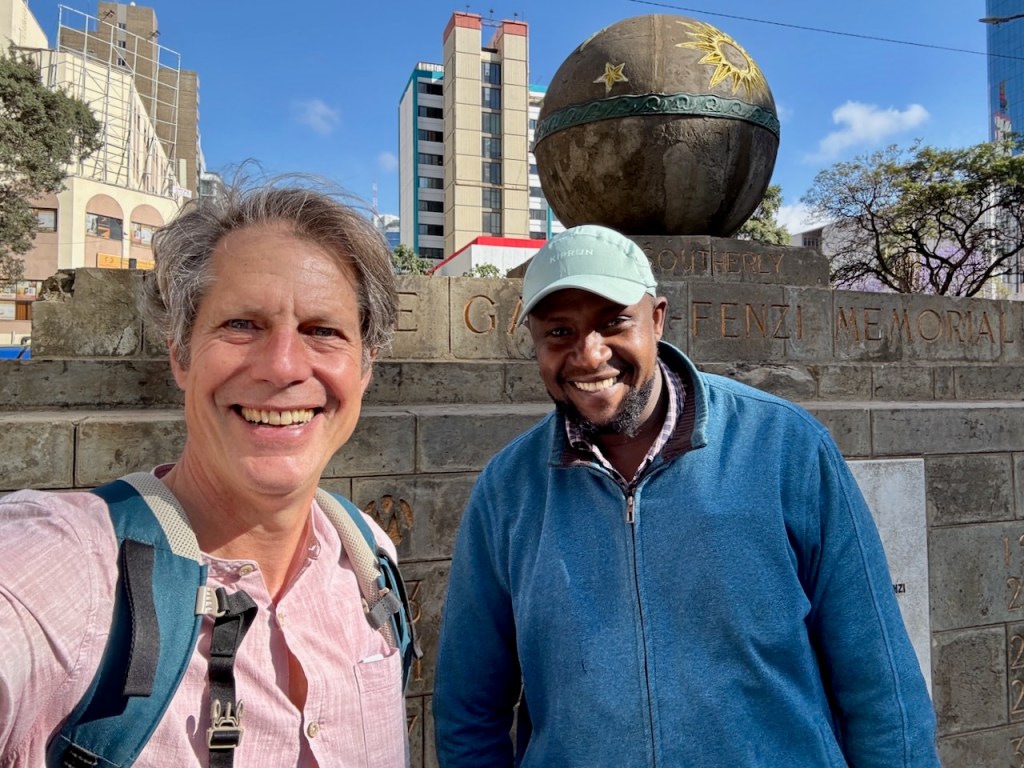
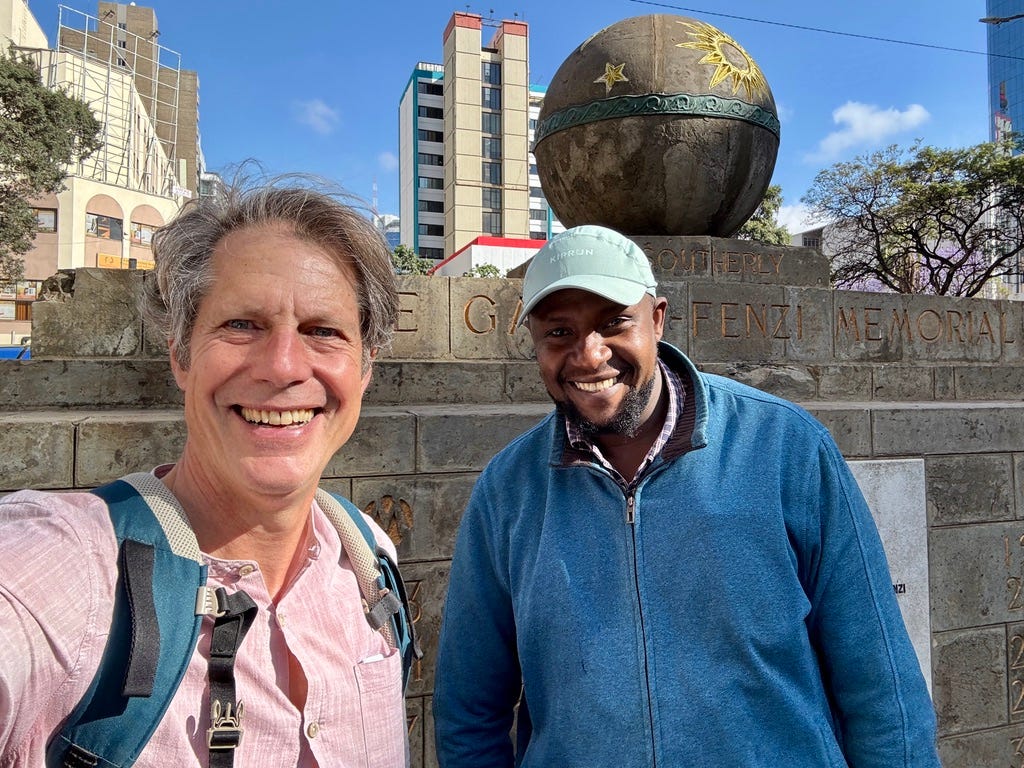
The empire is not done with me yet. Stanley takes me on to see Nairobi’s Milliary Stone, the point from which all distances are measured in the country and much of East Africa beyond (2.48 km). It’s named in honour of Lionel ‘Dougie’ Galton-Fenzi, an ex-British officer, coffee planter and motoring enthusiast who became the first man to drive a car from Nairobi to Mombasa from this very spot in 1926. On one 60-mile section of the journey his men had to hack through dense bush, “wait-a-bit” thorns and trees up to six metres high. The journey to Mombasa took 15 days and his tyres had 56 punctures on the way.
We walk on, past the empty husk of the old Intercontinental Hotel, closed since 2020 when it collapsed under the weight of its debts and Covid-19 (2.9 km). A flicker of recognition makes me realise this is the hotel I stayed in on the one occasion I really spent time in central Nairobi. Back in 1986, my then employers at Reuters news agency generously gave me three weeks’ rest and recuperation in Kenya. I had been on a short reporting trip to the town of Wau in neighbouring south Sudan when a rebel group laid siege to it, leaving me perilously stuck there for ten weeks. Wau had very few brick or stone buildings, and after my miraculous flight out on a small plane, Nairobi seemed like New York. (You can read a chapter about that episode here, from my book Dining with al-Qaeda).
It turns out that Stanley was a logistics officer in Wau and other South Sudanese towns in the late 2000s, the heyday of the country’s journey to independence in 2011. “It was a great experience,” he says. After 2015, though, the country collapsed into acute turmoil. Stanley has memories of the Nairobi Intercontinental too: he was once a security guard at the hotel. I remember how back in 1986, I was cautioned against walking the streets round here at night. Now it’s the middle of the day and as we walk into the real government district, there’s a different kind of tension. There are almost no pedestrian visitors like us on the streets.
We pause at the mausoleum of Jomo Kenyatta, the first president of independent Kenya, a few dozen metres from one of the gates into the grounds round parliament (3.05 km). I ask if I can take a snap but, as Stanley predicts, the guards warn: “No photos!”. Then comes the rest of parliament, a low campus dating back to the 1950s. The big dial on its square clock tower looks a lot like the one on London’s Big Ben. The complex is overshadowed by a bulging-bellied modern office tower for the parliamentarians’ offices. As we pass, big black SUVs with tinted glass are sliding into the building’s underground car park.
We turn left on Harambee Avenue – the word is from the motto President Kenyatta adopted for the country, meaning ‘all pulling together’ – and survey other centres of Kenyan power. There are more plush Central Bank buildings, offices for the president, the deputy president, the foreign ministry, and the national police headquarters (3.63 km). The last is called “Vigilance House”, and there’s a tyre-worn zebra crossing right in front of its gate. We need to cross somewhere so I gingerly step out and test it. Not a single car pauses.
We debate going up the observation deck of the tower of the nearby Kenyatta International Conference Centre to look at Nairobi from above, but I prefer to keep going at ground level. We end up walking right past the modest 7 August memorial park set up on the grounds of the old US Embassy (4.13 km). Al-Qaeda blew it up and killed more than 220 people on 7 August, 1998, along with another US embassy in next door Tanzania. I was a reporter in Kabul that day, trying to make sense of al-Qaeda’s Afghan hosts, the Taliban. Those embassy attacks changed everything, as al-Qaeda leader Osama bin Laden knew they would.
IV. A Lunatic Express on a Lunatic Line
We turn right in search of the Nairobi Central Railway Station. The arrival of the line from Mombasa on the coast in 1899 made the rail depot buildings here the first permanent structures in what would become the future city.
The railway line remains one of Nairobi’s defining legends. Friends and family still remember the slow old Nairobi-Mombasa sleeper train that rattled on until 2017, with its soup tureens and unsteady, white-clad waiters. You can’t go far in Kenya without seeing a quote posted up from British commissioner Sir Charles Eliot saying: “It is not an uncommon thing for a line to open up a country, but this line literally created a country.” Ruling the imperial protectorate from 1901-4, it was Sir Charles who initiated the policy of granting huge highland tracts of land to white farmers, thus dispossessing local people.
The railway eventually extended more than 1,000 kilometres from Mombasa to Lake Victoria, from where boats could reach British-ruled Uganda. British media, mocking the huge costs and engineering difficulties, dubbed it the ‘Lunatic Line’ for a ‘Lunatic Express’. According to ‘Dougie’ Galton-Fenzi, the pioneering motorist and extravagant promoter of all things East African, the line made Nairobi into Africa’s Clapham Junction, the London rail intersection with the heaviest train traffic in Europe.
The actual station is hard to spot among all the other structures – inspectorates, railway police and other underused outbuildings – and I only realise we’re at the terminal because colourful matatu minibuses are waiting patiently in a holding area outside (4.56 km). As we approach the stone building, a diesel locomotive slowly shunts what looks like some dusty, empty 1950s carriages past a platform.
There’s almost no signage, but an online schedule says a couple of dozen commuter trains leave the station each day on six lines, including a ‘safari train’ that does just one round trip per week. That’s less than a one-hundredth of the train traffic at Clapham Junction today. The trains carry a tiny number of passengers compared to Nairobi’s congested roads, and no passengers are to be seen right now. Instead, many of the narrow-gauge tracks at the station are filled with long lines of rusting, disused freight cars from what looks like before the Second World War. “No photos,” Stanley warns me.
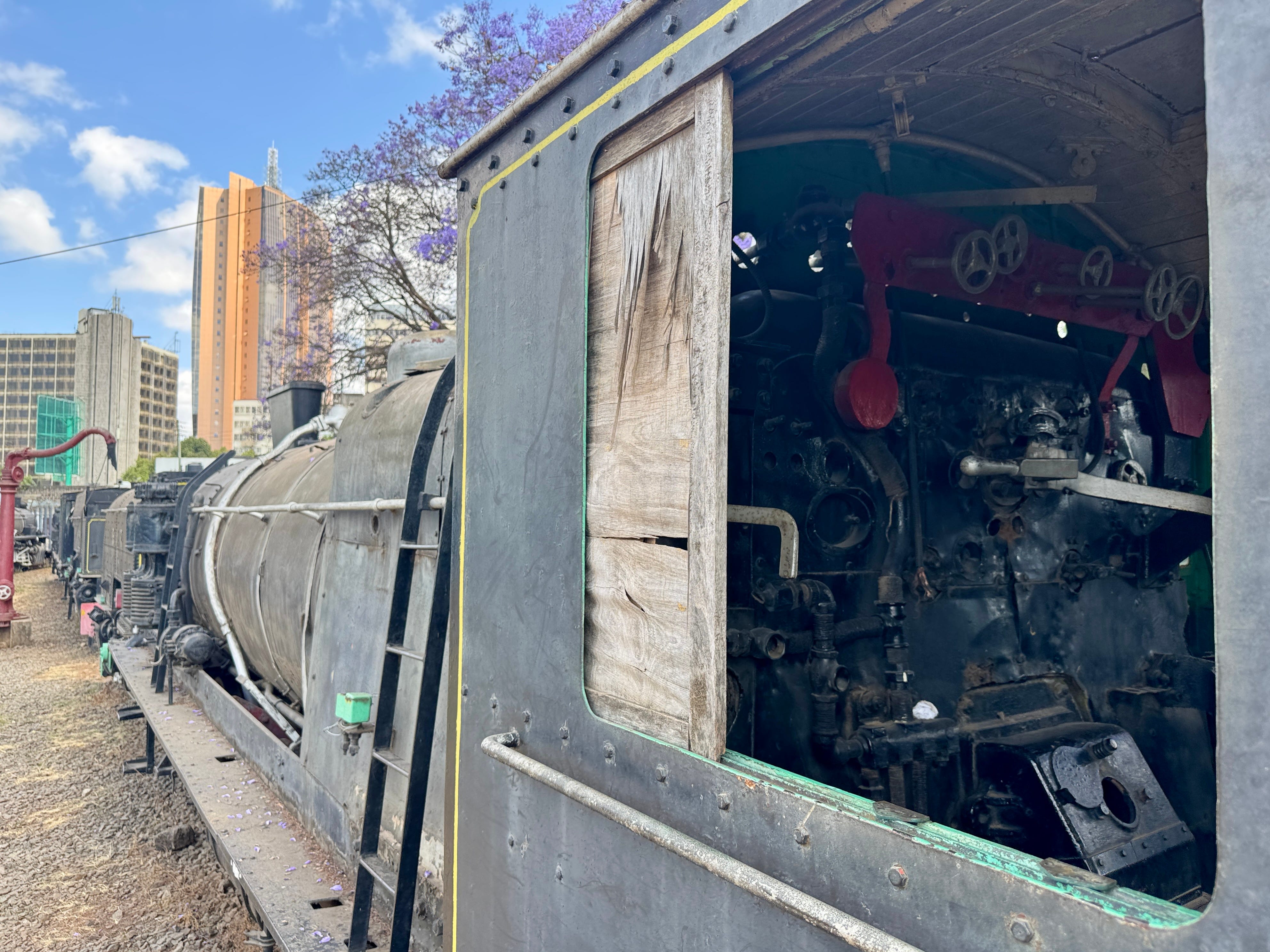
Off we go again. Perhaps I can photograph trains in the Railway Museum. After a long, pretty sweep under jacaranda trees, just losing the last of their pale violet flowers, we find the museum entrance (5.6 km). Stanley fills out a long paper form about our identities at the first gate. At the museum door another five-minute to-and-fro ensues to pay the fee by mpesa, Kenya’s digital currency.
Outside, the old trains seem so much better kept than the actual rolling stock in front of the station that Stanley waxes lyrical. If Kenya only maintained all these simple, sturdy locomotives, he proposes, Kenyan Railways would be working miracles today. I am dubious. These beaten-up steam engines look little like the masterpieces of engineering to be seen in the train museum in my home town of Brussels.
Even Stanley comments that two pale grey box-cars look primitive, but one of them has achieved fame nevertheless. One night in June 1900, a lion was terrorising rail construction workers and a brave British police officer decided to lie in ambush inside the carriage. He wanted to stamp out this echo of the man-eating lions of Tsavo, which two years earlier had killed and consumed at least two dozen of more than 2,500 workers who died building the ‘Lunatic Line’. But the would-be sharpshooter fell asleep. The lion found a back door into this very carriage, dragged the young superintendent out and ate him up.
The post-independence collapse of the old railway system has not prevented the emergence of the new. A Chinese built, wider, or ‘standard’ gauge express now takes passengers to and from Mombasa, using a new terminal near Nairobi next to the international airport. After 30 minutes by a connecting train from the Central Station, the journey to Mombasa takes just four hours. That’s half the time of an inter-city bus and less than a quarter of the time taken by the old narrow-gauge sleeper train.
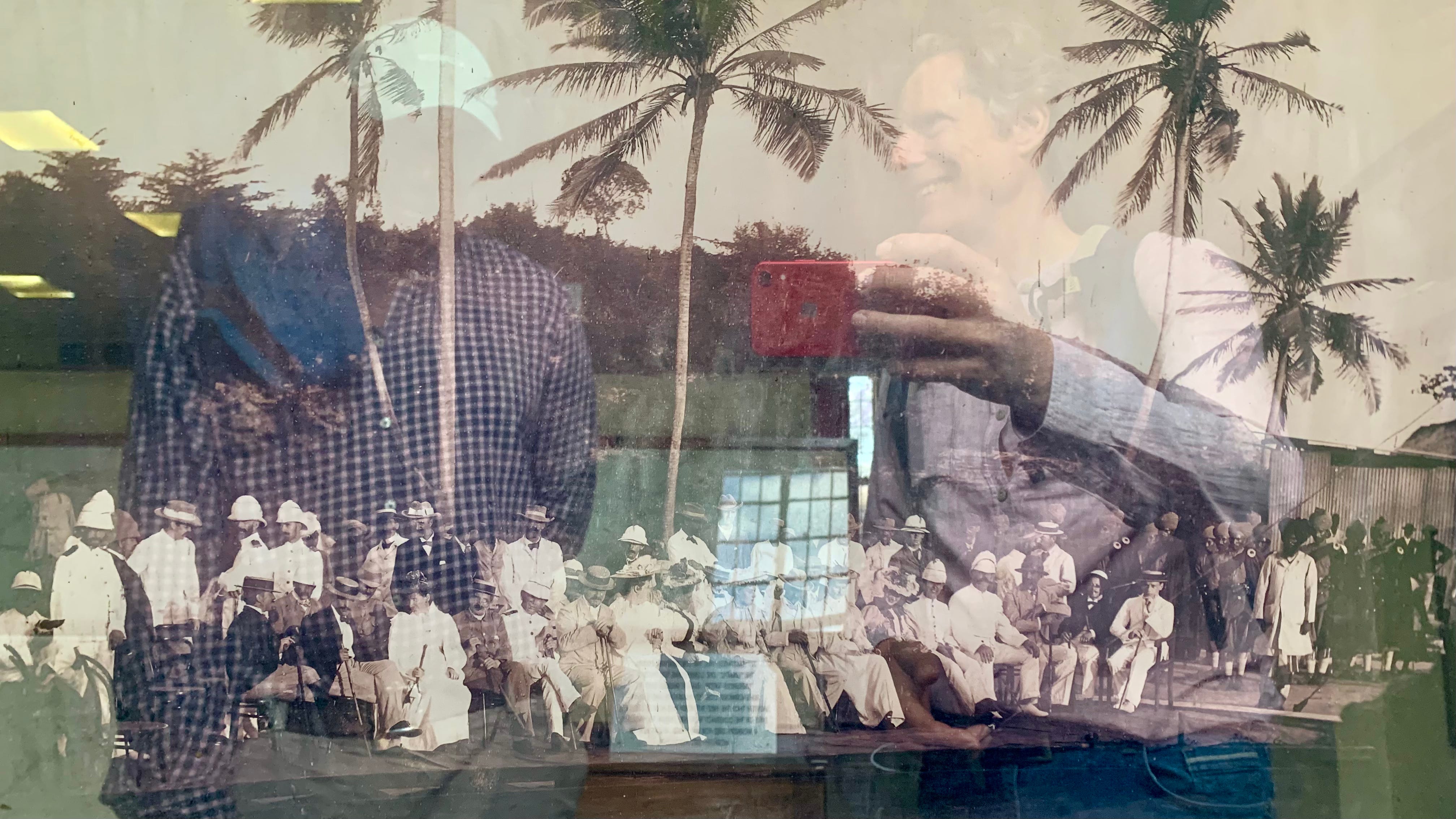
Still, I have to say something for the British Empire. Its history has survivability. The collection of objects on the inside of the museum is a bit weird – it includes the officers’ dining table suite from a German cruiser sunk off the east African coast during the First World War – but the station benches and pith helmets lend a certain atmosphere. Black-and-white photos of the opening of the Nairobi-Mombasa line look as crisp and elegant as when they were taken more than a century ago. In the last room of the museum, the photos of Chinese rolling stock from the opening of their line a decade ago are already curled and faded.
V. Pulling it all together
As I planned this walk, I thought I would end it by going through the big Uhuru (Independence) park featured on the Nairobi city map. Stanley tries to stop me, but I insist. We spend ten minutes trying to get across the multilane highway underneath the Chinese expressway (6.5 km). What bleached greenery that can be seen of Uhuru Park eludes us, however. Renovation is in progress and we walk nearly a kilometre alongside a high fence without finding a gate. I hope any who follow me will find a way in, or at least have a tunnel under the highway. It looks nearly finished and a construction worker I ask promises it will be open within a few months.
Back at the Kenyatta Avenue crossroad, we plunge back across the highway traffic to get back in the district (7.47 km). Stanley, determined that I should experience everything Nairobean, bundles me into the front cab of a matatu bus. This is the equivalent of a seat in an airline’s business class. As we careen up Kenyatta Avenue, I am transfixed by how little the driver can possibly see from his windscreen, whose edges are plastered with artwork. Right in front of me is a picture of British actor Rowan ‘Mr Bean’ Atkinson, head cocked up defiantly so I can look up his nose.
After a kilometre, Stanley allows us off again. It’s midday and the district is now really crowded, including some street performers in mock British colonial-era shorts. We however are heading into the gloomy cool of the National Archives building (8.6 km). With the photos and exhibitions of Kenya’s inter-related tribe of ex-presidents, it’s a good way to get familiar with the modern politics of the country. Luckily, it is a small museum, with something but not too much of everything. The photo that sticks with me is the one that is supposed to represent ‘harambee’, that Kenyan ‘pulling together’: it shows President Kenyatta urging his entourage and bystanders on as they pull his Mercedes-Benz limousine out of the mud in a national park.
We’re soon back out on the streets, crossing Moi Avenue out of the Central Business District and into a close-packed district of shops. There is now real competition for space on the pavement as we duck and dodge up Kenneth Matiba Road, where goods spill out of the stores, people struggle to get past, matatu jockeys hustle for custom, and the occasional corner is piled high with a jumble of white nylon-weave sacks. Stanley says are mostly supplies sent by city wage-earners to their families way back home – the names and destination scribbled on the outside – and they will soon end up on the top of a long-distance bus.
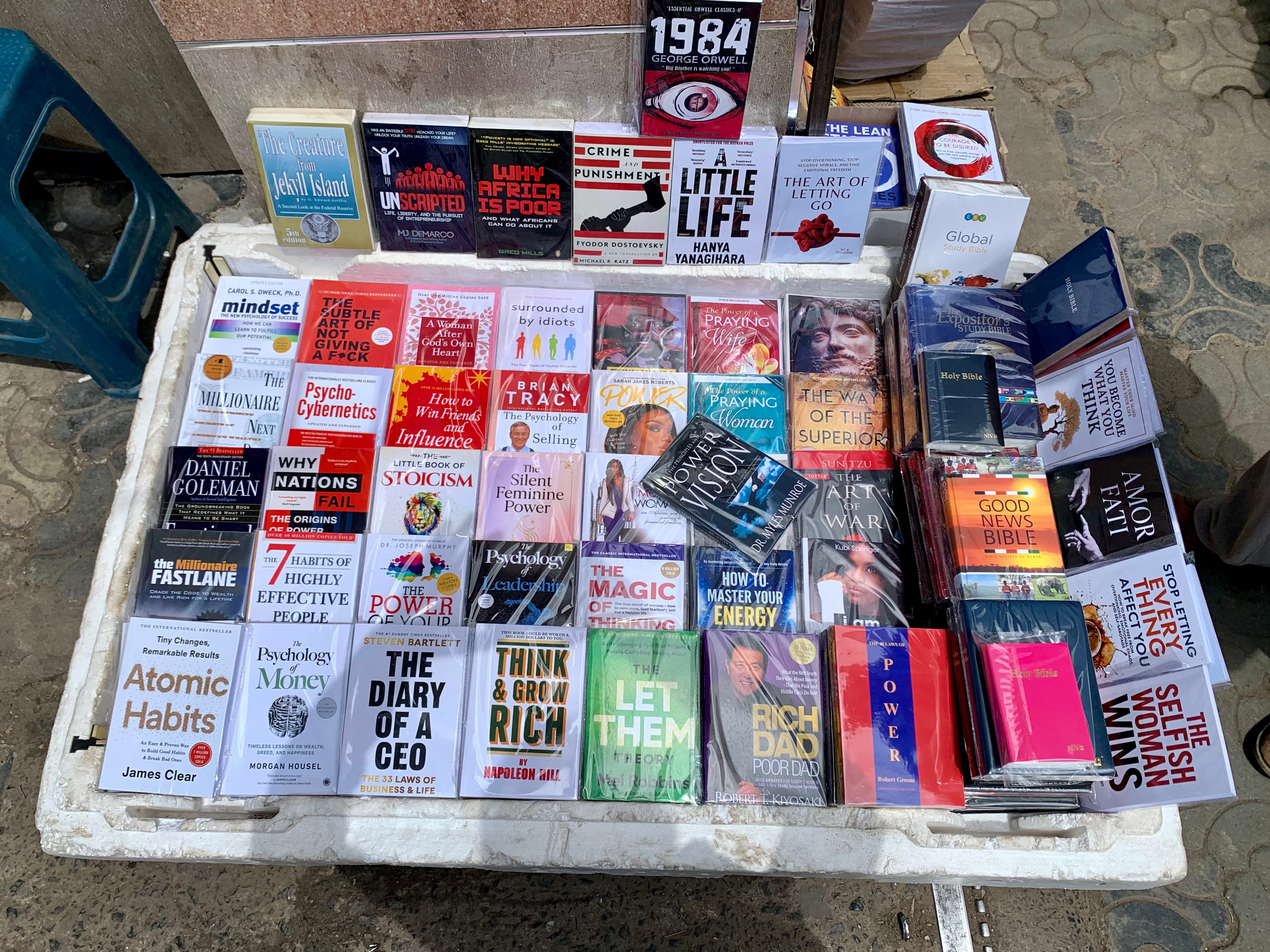
You can buy anything here cheaper than anywhere else, if you know what you’re up to: I see shoelaces, tinsel, sim cards, spectacles, sweets, soft drinks, wine, halal food, electronics, heavy-duty water pumps and much more. Most surprising is an old white polystyrene cold-storage box being used to offer pristine, cellophane-wrapped offprints of an encyclopaedic selection of self-help books. This enthusiasm is not just for people lower down the social scale. When I leave from Nairobi’s fancy airport, the bookshop there consists only and entirely of three display bookcases of similar titles like ‘The Selfish Woman Wins’ or ‘You Become What You Think’.
Does this symbolise the ‘hustler nation’ talked of by President William Rutto, trying to convince his people that he represents the ordinary people against the ‘dynastic’ rulers whom I had met in the National Archives? Fortunately, even if his electoral slogan for every Kenyan trying to get by is that ‘every hustle matters’, on the streets here there is little aggressive about it.
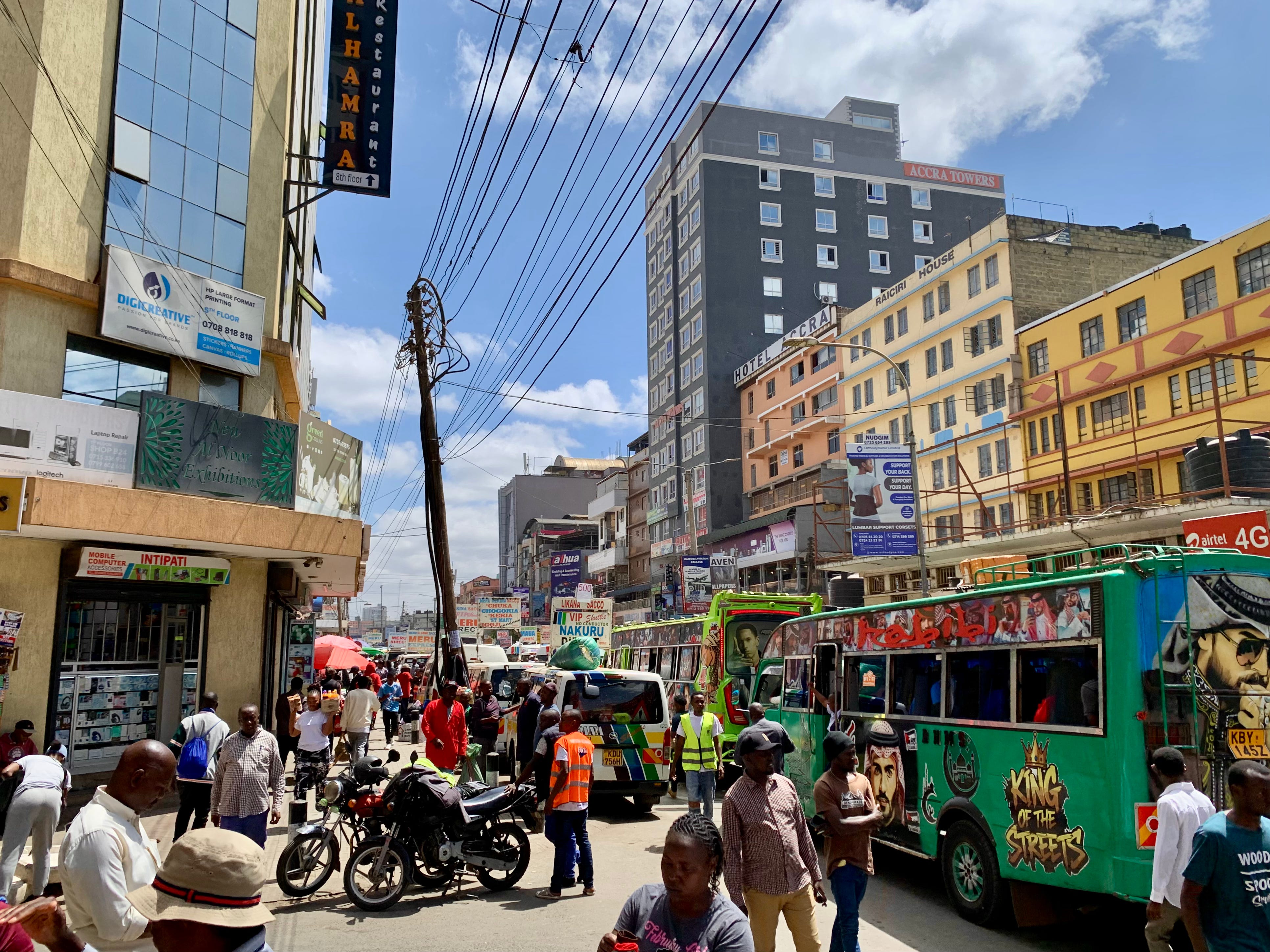
Still, there’s no unseeing the shutters of the shops, usually made of sheet iron. Then I notice that nearly every shopkeeper is sitting behind a sturdy metal grill. Many of the shopkeepers who catch my eye are descended from Kenya’s Indian community. It seems that the energy on the street can suddenly and unpredictably bubble over. If you don’t want your store looted – whether by pro- or anti-regime goons – you apparently have to be ready to take quick defensive action.
Stanley gently hustles me left onto River Road (9 km). Left to my own devices, I would have walked the two kilometres from here back to the National Museum, more than half of it via the John Michuki Memorial Park. But Stanley now wants me to experience the full matatu. He chooses a purple bus. This time we wiggle between the seats through to the back, enveloped in boisterous music and celebrity pictures plastered all round us.
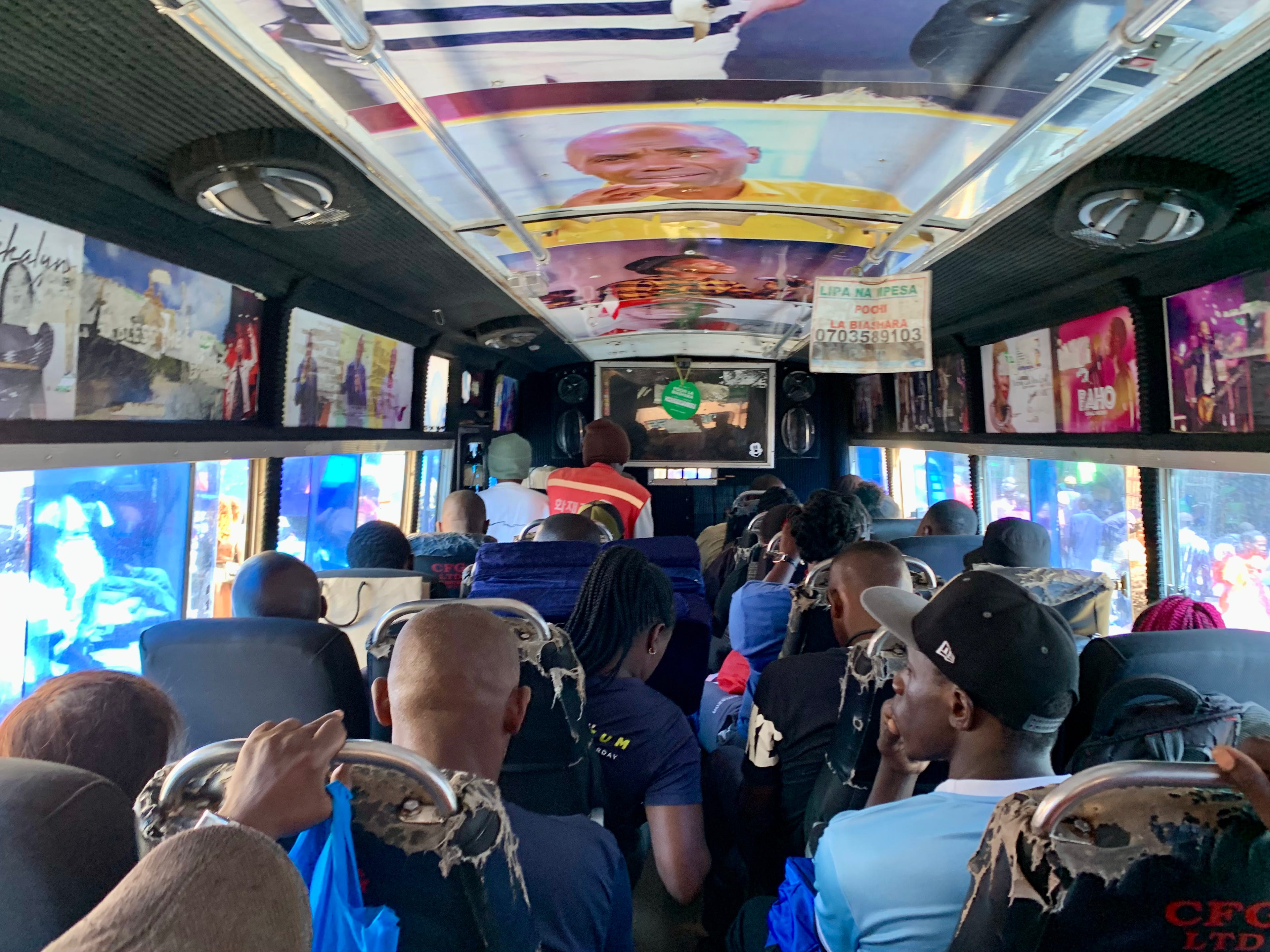
If there is a culture that bridges all of Nairobi’s differences, perhaps the matatu is it. Whether as a passenger or fellow road user, there’s no ignoring them. Some drivers, Stanley says, even jack up the suspension to give their bus a rollicking hip-hop gait. As we pay our fare, the bus conductor breaks into a brilliant smile for me as a rare white customer. A matatu is a lot calmer on the inside than it seems from the boisterous outside.
The omnipresent boda boda motorbikes are the other main way that people get from anywhere to anywhere. Stanley is particularly wary of them. They are a law unto themselves and if there’s an accident, fellow boda boda drivers automatically gang up on the other party. Taking one looks and is dangerous. When I get my hair cut later in one of Nairobi’s malls, my barber tells me he was recently in a boda boda smash-up. During his weeks in hospital, he says, he was only one of many in a whole room of motorbike crash victims with casts on their legs and feet pulled into the air.
Back at the quiet, tree-filled park of the National Museum, Stanley and I restore ourselves at the open-air restaurant with some spinach and ugali, the filling white lump of maize flour stodge that he swears is all a Kenyan needs to eat. A 15-minute-long ticket acquisition process gets us into the museum. A tour of the galleries shares memorable snippets of history: the shameful ID paper boxes on necklaces imposed on Kenyans by the British rulers, an amazingly comprehensive but terribly lit collection of stuffed birds, and a display of handmade guns used by Kenyan rebels against the empire. I even get to see that I’m indirectly part of it too: one of the displays has a colonial OHMS ‘On His Majesty’s Service’ car number plate that was made by Hills, my grandfather’s company.
It’s time to go home and end this piece: even another 5,000 words would barely scratch Nairobi’s competing realities. But the trip somehow makes me feel less isolated in the outlying rural district where I’m staying.
That reality is a socially privileged bubble. My morning runs go over bumpy lanes with wide grass verges shaded by the spreading, delicate-fingered branches of fever trees. Hedges and fences hide large houses on multiple-acre lots. I wave to languid security guards watching cars crawl over sleeping policemen, which keep the occasional passing car to a bumpy crawl. I run past gardeners chatting and walking richer peoples’ pampered pooches. There’s even a stable hand who exercises a posse of well-groomed horses.
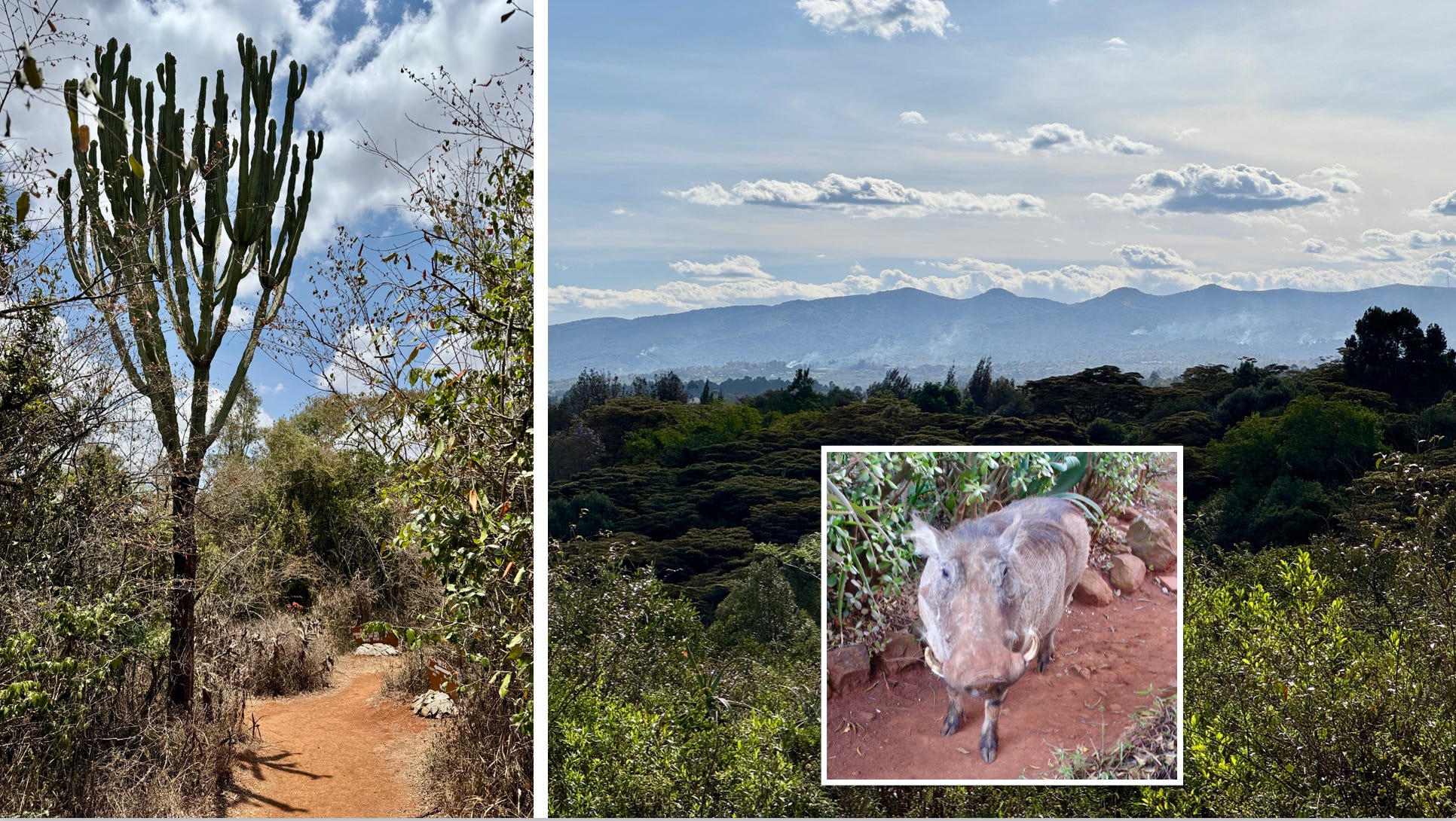
This district is near Nairobi’s huge national park, and I enjoy that side of Kenya too. On one run, I exchange a mutually appraising stare with a baboon. Families of warthogs are always trotting about on their daily rounds, or going down on their knees to get their snouts into the grass. Occasional troops of monkeys come swinging through the trees, hunting for openings into houses that might have fruit lying about or even in fridges. Some evenings, the sunlight glows with beautiful, warm depth through the fever trees and the dust floating up from the red, powdery earth.
At the same time, I am always passing by dozens of Kenyans quietly walking their long-distance trails to work. And at the busy main road at the half-way point of my run, I now pause for a while to watch the boda bodas and matatus hustling into town. Nairobi may have no great single defining feature. But my walk through the Central Business District walk makes me feel more warmly connected to all its people.
+++
Thank you for reading! Please feel free to share this and if you’d like to show some one-off appreciation, please do Buy me a coffee!


Leave a Reply