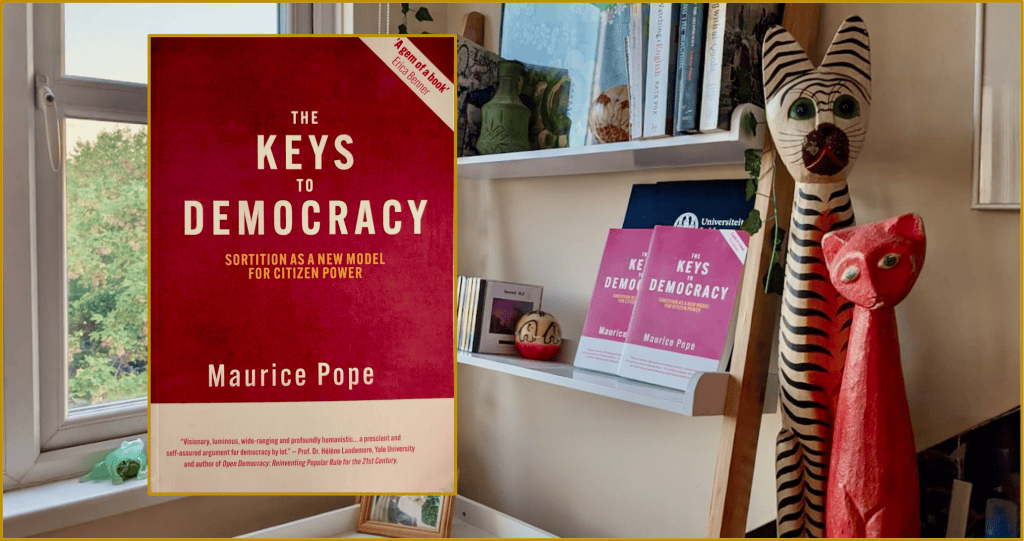
My first piece of lucky news: “The Keys to Democracy: Sortition as a Model for Citizen Power”, by my late father Maurice Pope, is now out as a £14.95 paperback!
The UK’s Imprint Academic – a rare publishing house specialising in sortition, or the random selection of people to assemblies that deliberate and take decisions – has a special deal that gives you 15% off if you sign up for their mailing list. While stocks of the hardback last, and unless you specify otherwise, you’ll actually get the hardback if you order the paperback – a 40% discount on this acclaimed work!
Martin Wolf of the Financial Times said The Keys to Democracy is a book that “I strongly recommend”. Belgian pioneer David van Reybrouck pronounced it “extraordinary”, Yale professor Hélène Landemore praised it as “visionary”, and democracy author Erica Benner said she loved “this posthumous gem of a book”.
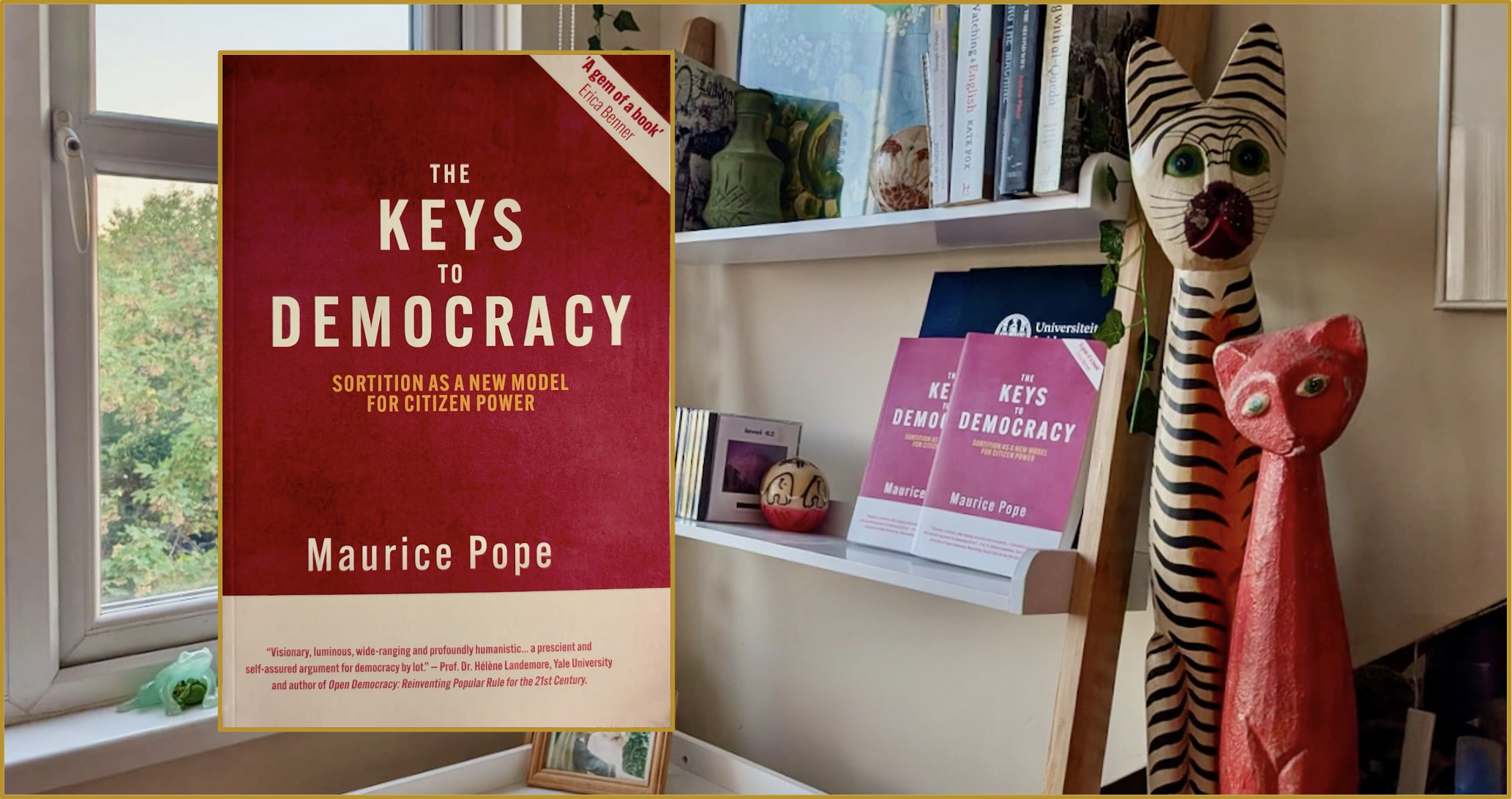
Hardback sales since first publication in 2023 have hit several hundred copies, which may be modest in the book trade but counts as a bestseller in sortition. The Keys to Democracy is just one of a growing list of books in the past decade supporting sortition’s core arguments. These are firstly that our current democratic system of voting for political parties and politicians to rule us has reached a dead end, and secondly that citizen representation and policy-making are better achieved by deliberation in assemblies randomly selected from a community.
There’s more luck to talk about in the movement for sortition-based deliberative democracy. At least 1,000 citizens’ assemblies have now been held in the past two decades, and the pace is accelerating. Organisations working with sortition are growing. Even the number of celebrities ready to endorse the idea is multiplying. Along the way, we are managing to persuade more people that randomly selected mini-publics are a broadly based, credible and legitimate way to take decisions. We don’t have to stay trapped and frustrated in a cycle of dysfunctional elections, narrow party politics and egotistical politicians.
Even though I still worry about how few people are yet familiar with the word “sortition”, I felt new hope when I checked on Google Books Ngram Viewer for the number of times various sortition-related words and phrases appeared in books between 1940 and 2022 (the last year that can be searched so far).
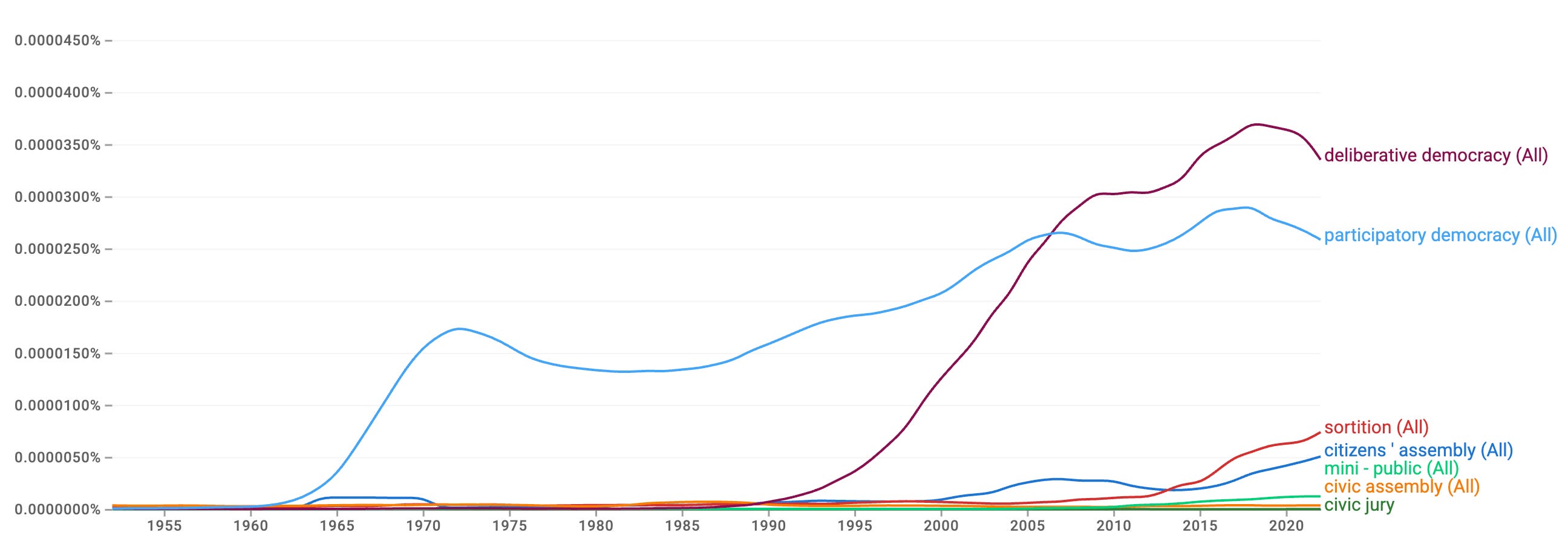
From a standing start in 1960, “participatory democracy” was first off the mark. Writing without Google’s help in the 1980s, my late father had twigged onto this already. (His encylopaedic memory was right often enough to infuriate his six children.) As he says on page 28 of The Keys to Democracy:
The phrase “participatory democracy” was invented, it seems, by American political philosopher Arnold Kaufman in 1960. An organisation called Students for a Democratic Society adopted it in 1962 and popularised it in a manifesto known as the Port Huron Statement. The decade that followed seemed bizarre enough at the time and has a dream-like quality in retrospect. There was a heady belief that all things were possible and that all barriers could come down. There need be no financial restraints: more money could always be found by expanding the economy. There need be no limits on knowledge: all that was needed was more research. There need be no chains on freedom and equality: it was only necessary to dismantle the hierarchies of the past and the habits of privilege and respect that went with them.
Around 2005, “participatory democracy” was overtaken by “deliberative democracy”. “Citizens’ assembly” was next to appear after the first of the modern era was held in Vancouver in 2004. That was in turn was overtaken by “sortition” in 2013. Other words like “mini-public”, “civic assembly” and “civic jury”, all referring to variations on the citizens’ assembly, are also beginning to rise in the rankings.
Google says it’s safe to assume that 35 billion words were indexed by 2022. The raw figures for the word “sortition” that year implies it was published more than 200,000 times that year compared to almost never before the year 2000.
This is a big rise from a low base, but it is still a tiny proportion of what the world writes and talks about. We in today’s movement to popularise sortition often wonder how we can do more to attract attention to the brilliant potential of the idea.
This feeling is particularly acute as we see populations around the world – shown by poll after poll to be fed up with elections and politicians – turning instead to authoritarian alternatives to get what they hope will be better government. That belief will surely quickly prove mistaken as power and money concentrates in a new, even smaller elite, probably after it is too late to turn back.
Another reality is just as certain. It is not credible for the pro-democracy camp to argue that the problems produced by a century of fully enfranchised election-based systems will be solved by yet another election, yet another elected politician, or yet another political party seeking votes and money.
Even worse, the rich elites that benefit most from the current system – in which they can usually own or bully most politicians – are pouring money into the rise of the authoritarian far right. Nobody on the democratic side – fighting for freedoms, public interest, and popular participation – is getting a fraction of the hundreds of millions of dollars being spent on constructing this would-be new world order.
How can we find better ways to communicate the undoubted delight of participants taking part in this new form of decision-making? How can we persuade people that they would be plain lucky to be invited and join in the intense creativity of one of these mini-publics? How can the movement for sortition and other improvements to our democracies find their own billionaire to fund a campaign to make “sortition” into a word that’s instantly recognised and understood? Or even better, could a crowd-funded campaign raise the resources needed?
We will certainly need more luck, and we’ve had it before.
Sortition was such an unknown topic in the 1980s that my father, a classicist, couldn’t get his book published at all back then. He got close – favourable readers’ reports, encouragement from friends – but in the end his publishers couldn’t believe that anyone would be interested in adapting ancient Greece’s sortition-based democracy to modern times. Decades later, when I pressed my father to take the book up again, we realised the book was physically lost.
Then fortune played its hand again. After my father’s death in 2019, my mother discovered the manuscript on a dusty lower shelf in his library. Amazingly, Yale professor Hélène Landemore gave it her indispensable support. My brother Quentin Pope, a literary translator, co-edited the book with me. Then Keith Sutherland of Imprint Academic decided that the text was worth publishing.
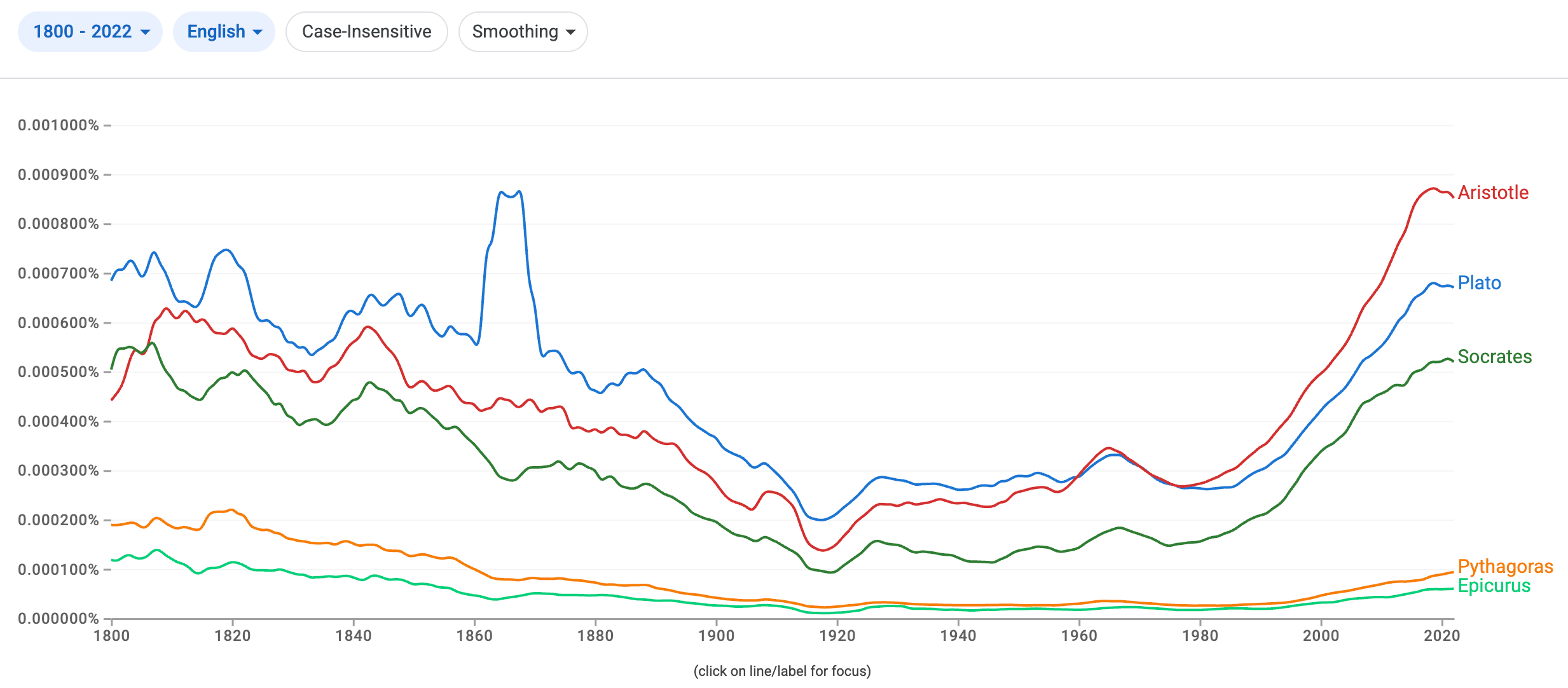
I can still hardly believe our luck. But perhaps it’s not all about chance. Societies do change. The more authoritarian Plato was cited more often before 1980, Google says, but since then he has been overtaken by the more pro-democracy Aristotle. The previous citation from Chapter Three of The Keys to Democracy, about the “Broadening Participation” of the 1960s and 70s, is a fascinating time capsule too. It shows how – eventually – new ideas do lead to positive change (pp 28-29):
By the end of the nineteen-fifties people were no longer fired by socialism as an ideal just as they had previously ceased to be fired by enfranchisement. A new rallying cry was needed. It was found in the demand for participation …
There was levelling up and levelling down … There was much exaggeration … Even the principle of appointment by merit, long held to be a bastion against nepotism and corruption, began to be abandoned in favour of the principle of positive discrimination …
[Yet] the demand for participation blossomed. Not surprisingly some of it, like the call for pupil-power or self-government for school-children, has since almost altogether blown away. But some of the blossom set. Demands were taken seriously enough by governments and some of them were actually granted. More may ripen into firm fruit. Though participation is somewhat muted as a rallying cry, it has not been replaced by any other. Who in 1860, when Britain’s Chartist movement for working-class political rights had apparently died away completely, would have prophesied that its main demand, for universal adult suffrage, would be met in full within a lifetime?
 Hugh Pope
Leave a comment