
If you like getting a feel for a new city on foot, read on. This walk through a cross-section of Frankfurt am Main is for anybody who wants to see a bit more of the city than its huge airport, the busy train station or the vast halls of its world-famous fairs.
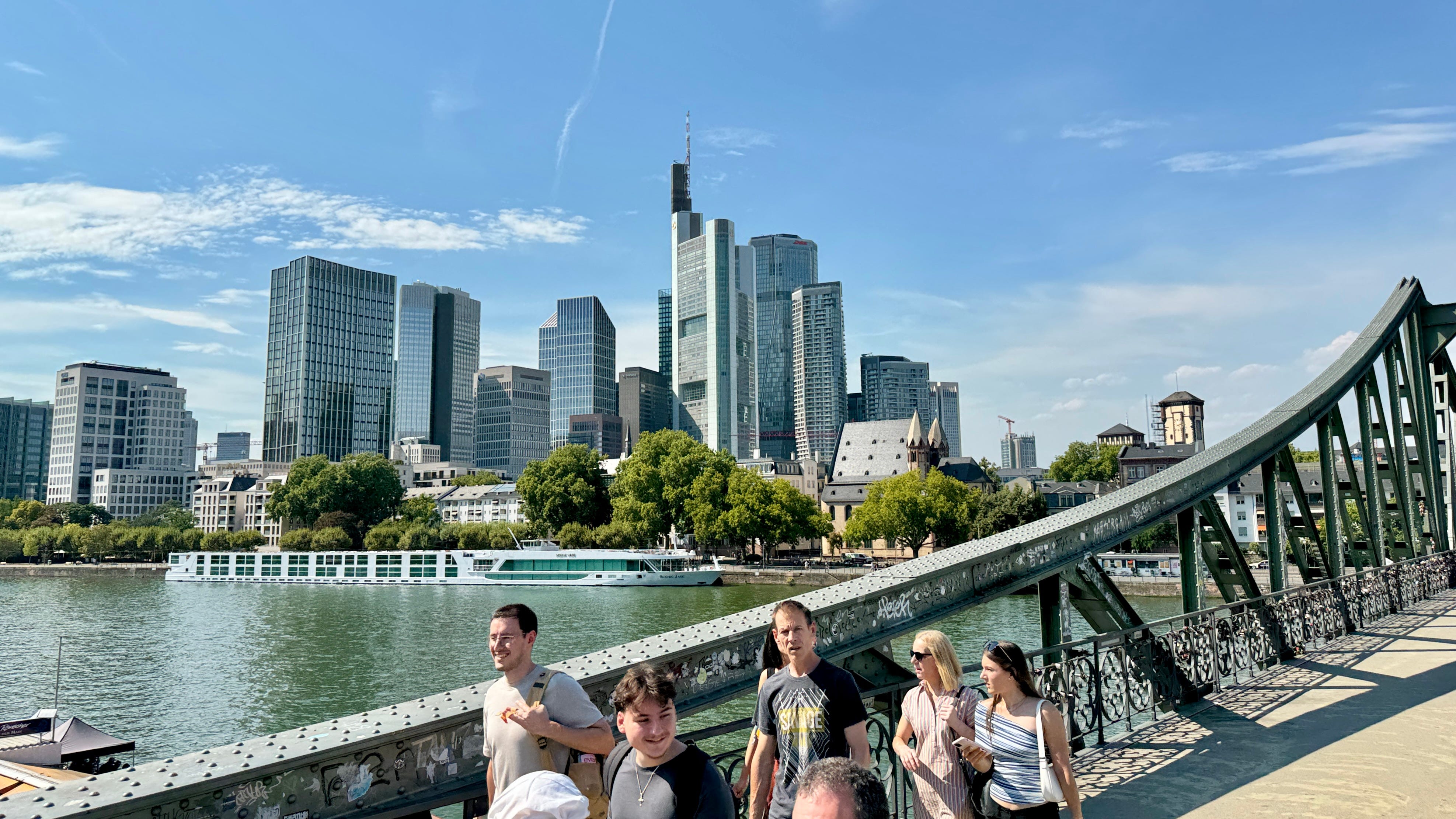
This three-hour circuit round Frankfurt fits in a lot: grungy city-centre decay, post-Second World War housing projects, shaded forest paths, rich suburban streets, a grand cemetery, heavy stone 19th century mansions, a view of the skyscrapers that house Germany’s financial heart, the restored old town square, the birthplace of Frankfurt’s book fair and the biggest euro sign I’ve ever seen.
Time from Brussels: 3 hours by train
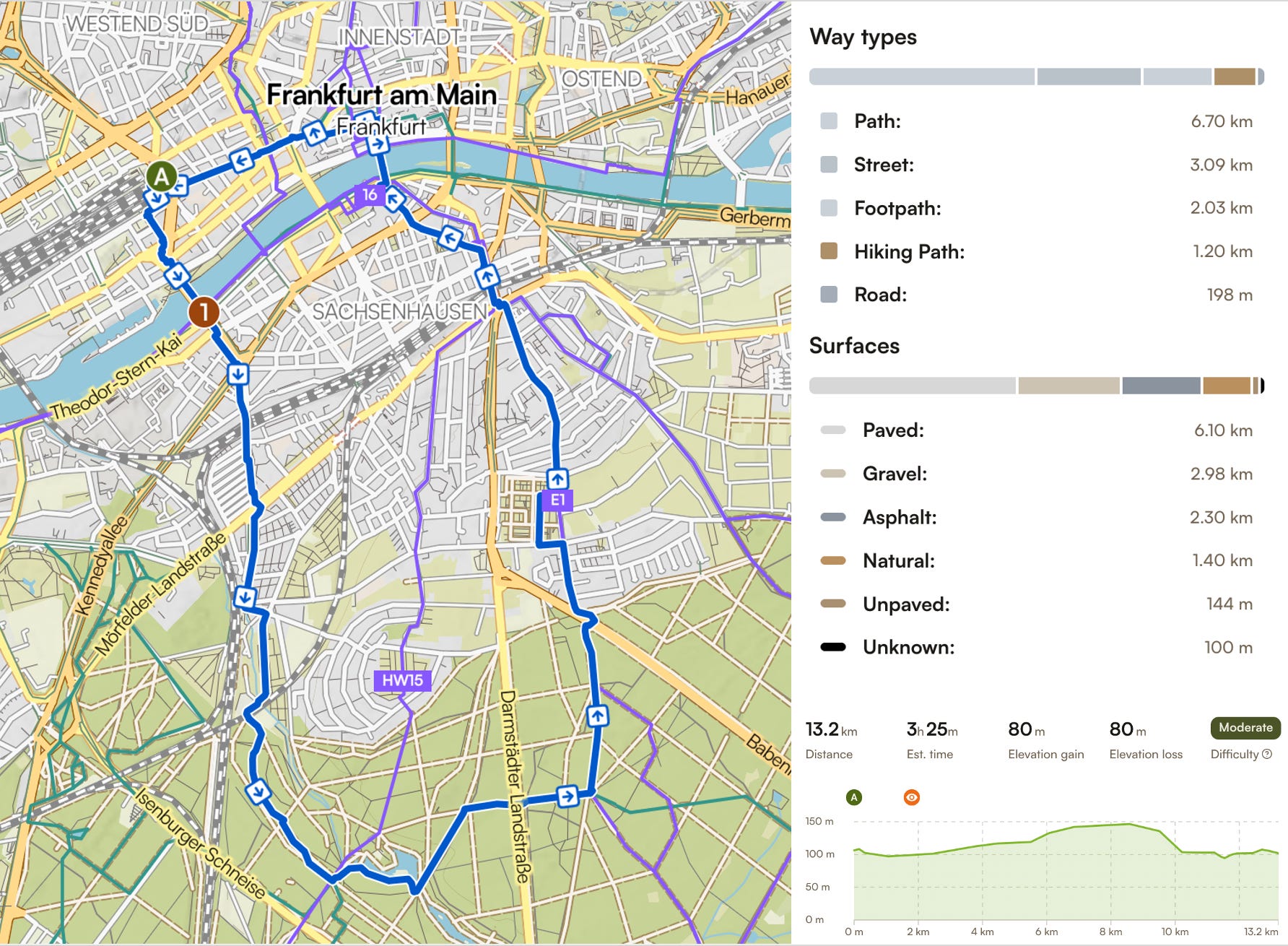
Where to where: Frankfurt main station | Frankfurt City Forest | Sachsenhausen district | Eisener Steg over the Main | old town centre | Book Alley | financial centre | Frankfurt main station
Distance to walk: 13.2 km
Time needed: 3 to 4 hours
To see: 🚅🏙️🌳🏞️🌲🏠🌉🌆⛪ 🚅
I didn’t plan to go to Frankfurt for Frankfurt’s sake, but like many people, one day I found myself there. After handing off two grandsons to my daughter at the station – the main reason for my trip – I set aside a few hours to discover a city I had never visited. Above all, I wanted to walk through some woods. The biggest patch of green I could see was south of the city, so I prepared a route and headed off.
Getting away from a European main railway station is rarely an uplifting experience, and Frankfurt is no exception. Over a couple of blocks, I passed more than a dozen distressed and likely homeless people. In one case, a man just stood on the pavement injecting himself. None of these wounded spirits even looked at me. After the bustling, over-arching grandeur of the restored railway station – per capita, this city in the central heart of Germany is one of the richest cities in the world – it was upsetting to witness such broken lives at the bottom of society’s ladder.
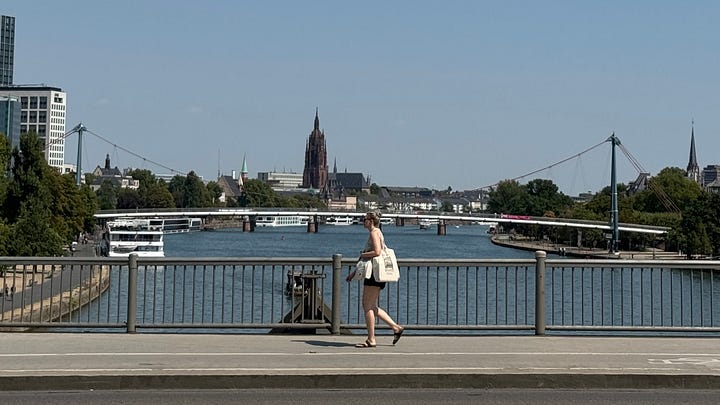
The roads opened up and after a kilometre, a big road bridge took me over the Main river. Flowing from east to west across the middle of Germany until it meets the Rhine, I was surprised to see that its waters spread 200 metres wide. Despite the recent drought, the river looked full. Great river cruise boats were tied up against the stone quays, the nearest one flying the flag of far-away France.
The streets here were wide and busy with cars, but somehow uniform. Perhaps that’s not surprising. Frankfurt suffered some of the worst aerial bombing of any German city in the Second World War. The allies were targeting an industrial powerhouse at the crossroads of Germany – even today, its airport is one of the biggest in Europe and its railway station is the country’s second-busiest.
The attacks were savage, including two deliberate allied firestorms in March 1944. Altogether more than 5,000 civilians were killed, almost all the mediaeval old town burned down and more than half of the city’s homes were destroyed. Seventeen million cubic metres of rubble lie beneath the city’s modern skin. The city looks like a place where a deep wound has healed, but where the homogenised surface patina is clearly unlike it was before.
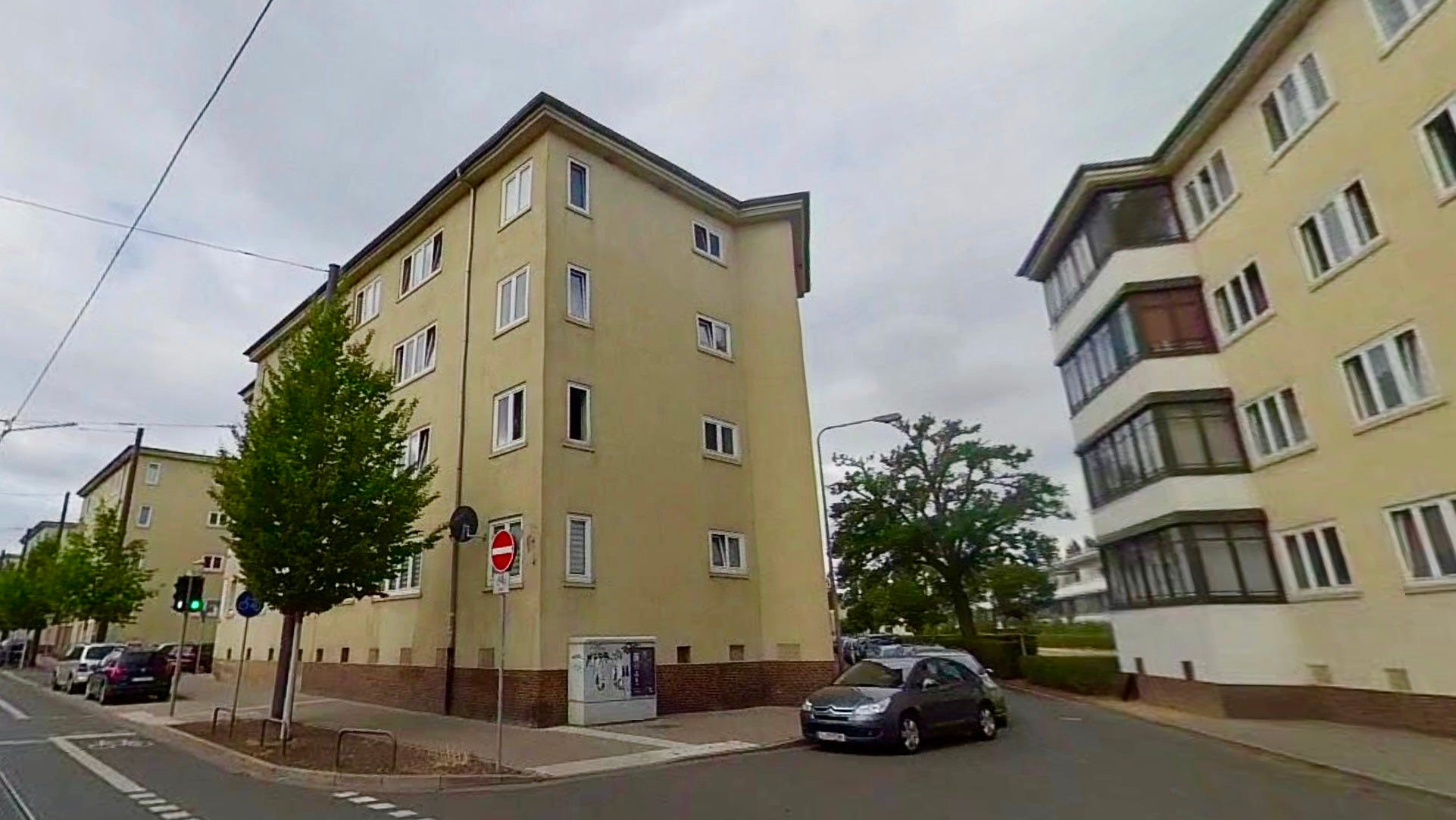
Street after street of post-war housing developments looked boxy but were holding up well. Mysteriously complex numbers marked some. Others were named for trees planted to shade their the long pavements: Unter den Linden for the Under the Limes, of course, but also Under the Oaks, Ashes, Acacias, Chestnuts, Birches and Beeches.
At the three-kilometre point I turned off the main road into a lane of green allotments. Just as German youth fashion has a grungy, black, gothic edge, some gardeners go for a re-wilded look. After a bridge over the Luderbach stream, the path then went through a short tunnel under a railway. Here was the entrance to Frankfurt City Forest.
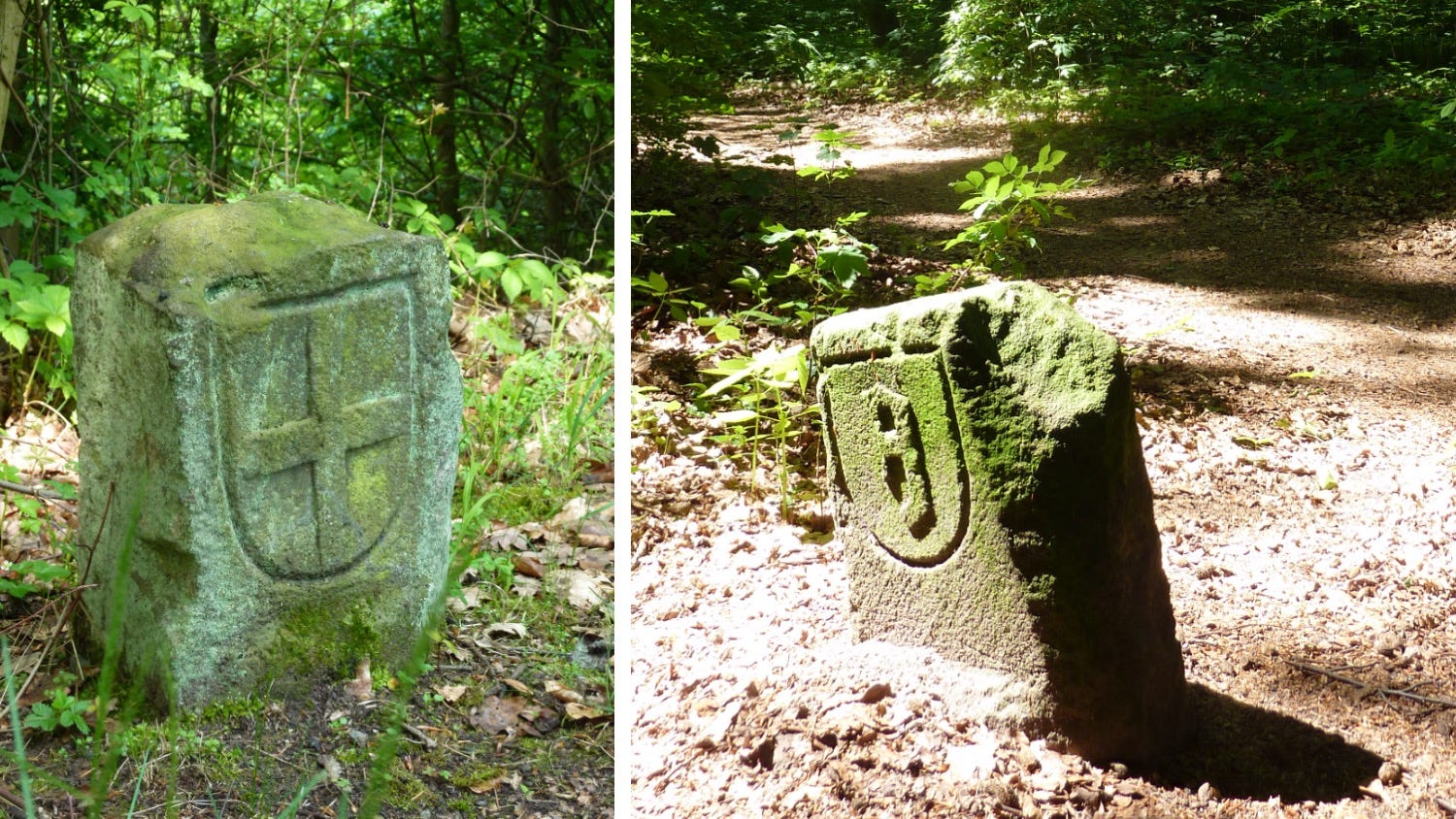
About 100 metres from the railway bridge stood quite a survival – a boundary stone set up five centuries ago so shepherds could see the dividing line between the grazing lands controlled of the city of Frankfurt and those that could be used by a religious community known as the German Order in German and as Teutonic knights elsewhere. Founded in 1190 to assist German-speakers in the crusader state formed by Christians and pilgrims who conquered Palestine , it grew over two centuries to rule over a great swathe of Prussia and north-eastern Europe, then declined during Europe’s multifarious religious wars. After bans by both France’s Napoleon and Hitler’s Nazis, the order lives on today as an Austria-based Catholic charity. A church and order house in Frankfurt’s nearby district of Sachsenhausen is one of their few active premises in Germany – 800 years after they first received it as a gift from a Holy Roman Emperor.
There is in fact a path along many of the 49 surviving boundary stones (a map board stands by the railway tunnel). If I ever get to Frankfurt again, I’d like to try the 13 km walk from here, all of it through forest. I’d probably choose to skip the first three kilometres though, taking Tram no. 17 (Neu-Isenburg Stadtgrenze) from the Hauptbahnhof and riding five stops south to start the walk at the Frankfurt Louisa tram stop.

The next 4.5 km of paths took me through the tall trees of the forest, over wooden bridges, and past the Jacobi Pond, where water levels were sagging due to the drought. It was a relief to be completely in the shade on a day that temperatures in Frankfurt’s streets reached 38 degrees. Turning left at the sculpture of a wooden “monster woodpecker”, I headed back north to the city via the Luther Trail.
After I left the forest, I headed on down pleasant, upmarket suburban streets. I jinked left to walk a few hundred metres through the South Sachsenhausen cemetery, a cool refuge of trees, greenery and quiet. It was also an opportunity to admire a truly well-maintained graveyard, where Muslim graves are integrated with all the others.
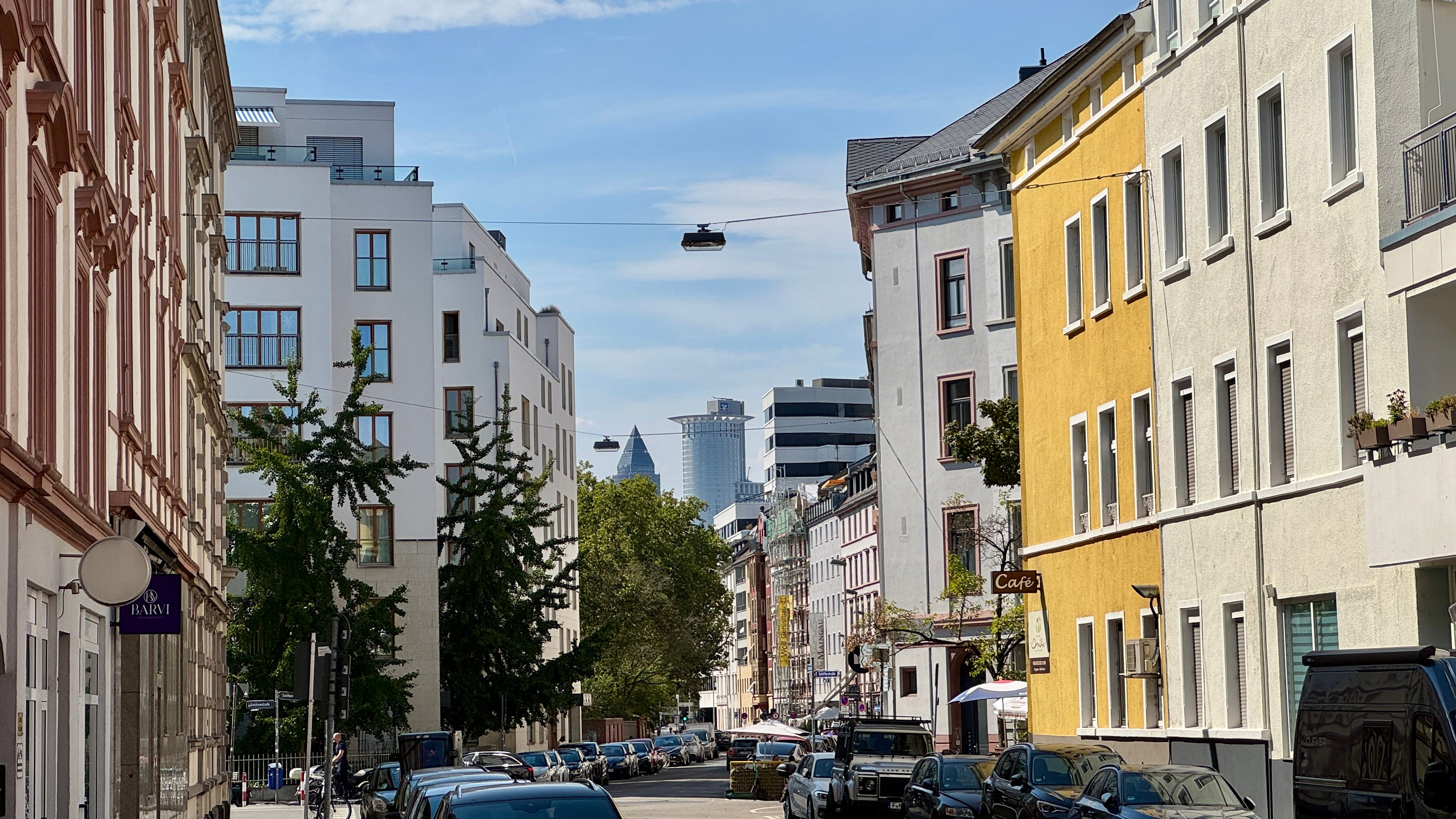
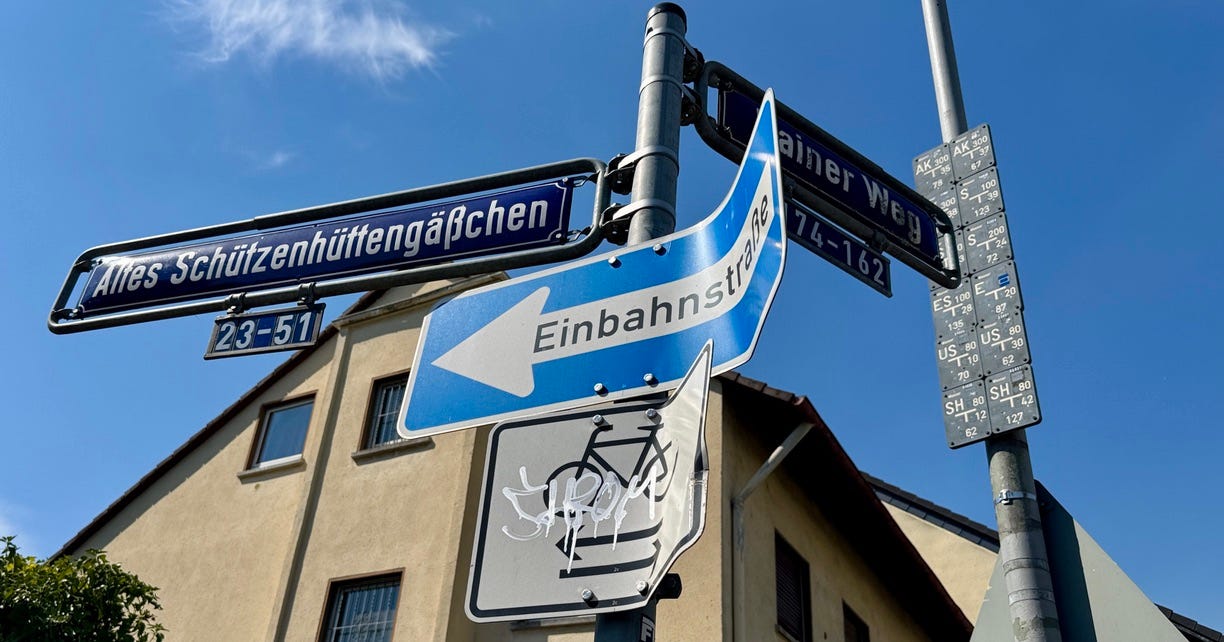
At the bottom of the gentle descent of the Hainerweg, there was another chance to re-assess stereotypes. When I studied in Germany and then worked as a Munich hotel bellboy for four months in 1978, I remember that the minority Turks with whom I lived felt very much outside the mainstream. For me as well, German society was largely invisible and living in a parallel world, partly because it seemed so much more wealthy. But now, half of Frankfurt’s 750,000 people have a non-German background. When a honking wedding cortège of cars paused beside me at the Wendelplatz lights, I was astonished at the wealth flaunted in the procession of these descendants of once-poor migrants: top-of-the-line new limousines, BMWs, Mercedes jeeps, and muscle cars that included a full-blooded Ferrari.
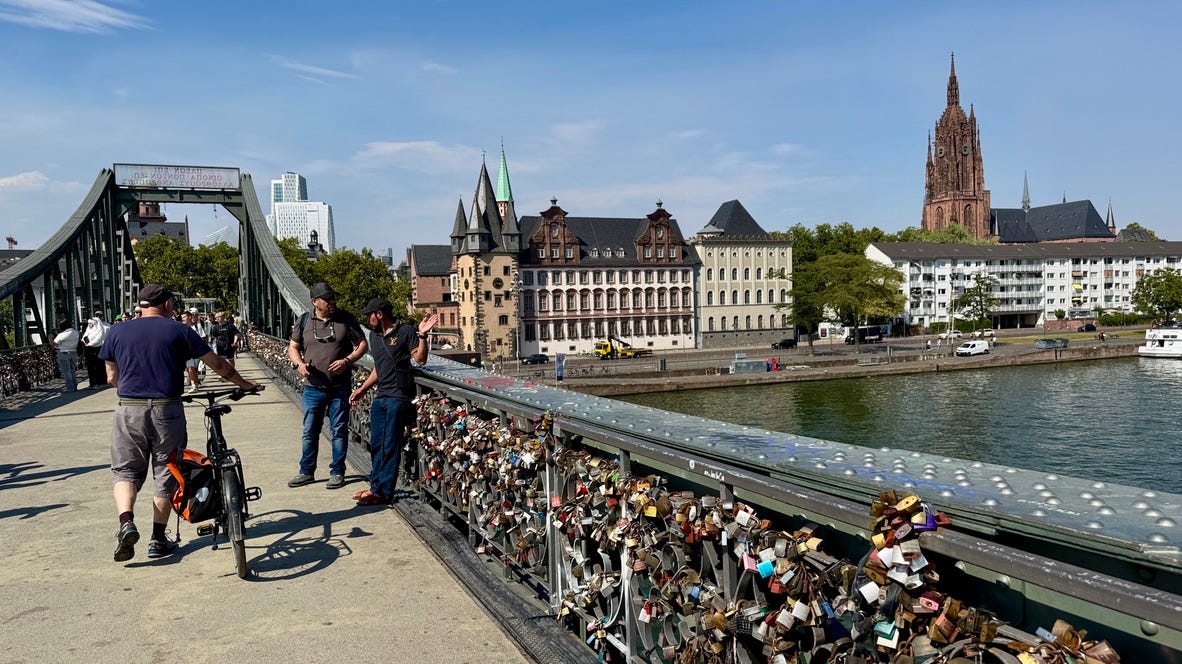
When I got back to the Main river, I found myself for the first time joining streams of tourists. They drew me over the Eiserner Steg, an iron footbridge rebuilt after the German army blew up the original as it fell back in the closing stages of the Second World War. To the left was a view of the glass towers of the financial district. The skyline was impressive, but I was surprised there weren’t more buildings, given that Frankfurt is the main intermediary between the world and Europe’s strongest economy. Frankfurt has just 20 buildings over 150 metres high, less than half the number in London, one third that of Istanbul, one seventh that of Singapore, one tenth that of Shanghai, and one fifteenth the number in New York.
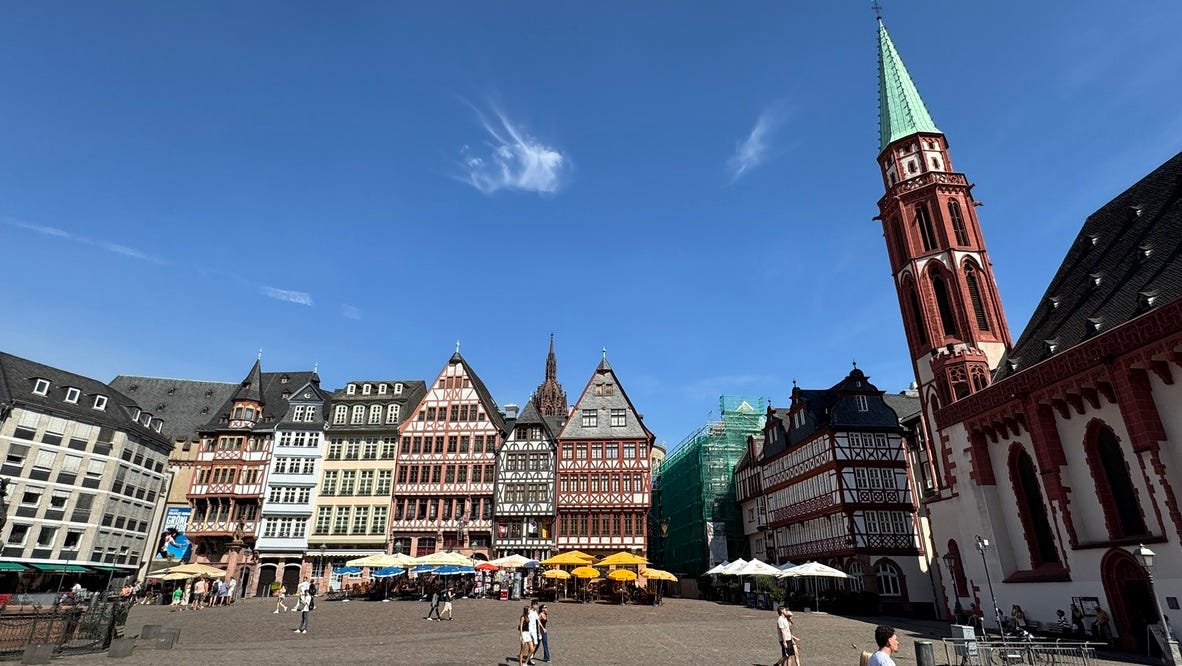
Like every big tourist city, though, thousands of metal “love” padlocks encrusted the Eiserner Steg’s railings, like barnacles on the hull of a ship. The touristic current pulled me onto the north bank of the river, where, at first glance, the main market square looked as picturesque as anything one could imagine in a historic German town. Pre-war photos, however, underline how the original had a truly fairy-tale look of overhanging eaves and winding, half-timbered alleys.
There is much tourism I could have done in the rich nearby offerings of museums, rebuilt churches and Neu Altstad (New Old City), but I had a train to catch. Limburg Street started me on my straight run west to the station, intersecting after 100 metres with Buchgasse, or Book Alley.
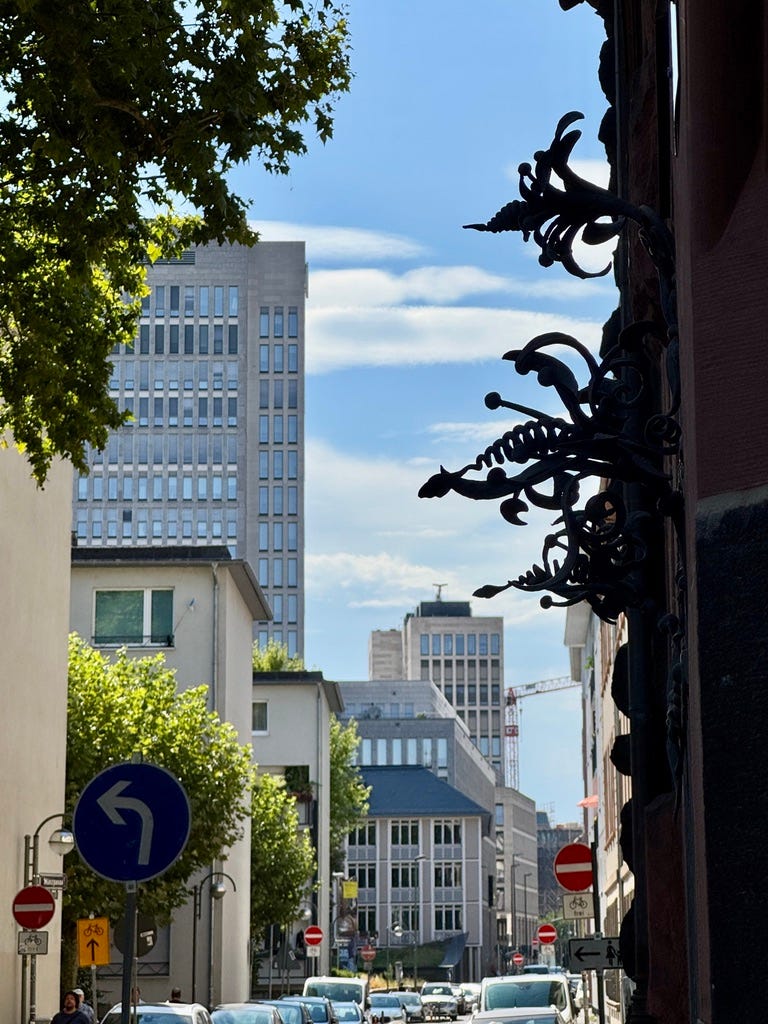
Frankfurt’s first book fair was born here more than half a millennium ago. Martin Luther had an early bestseller with his revolutionary translation into German of the New Testament, which sold more than 1,200 copies at the fair of September 1522. The event died out in Frankfurt for two centuries from the mid-18th century, thanks to oppressive censorship by the Holy Roman Empire’s Catholic authorities and competition from Leipzig, then more liberal and Protestant.
After the Second World War, however, Leipzig got stuck in dogmatic, communist east Germany. So Frankfurt, which narrowly missed out on becoming the capital of the new west Germany, partly because the choice was so plausible it might have stuck, restarted its book fair in 1949. It hasn’t looked back. The modern version attracts half a million people, half of them from the book trade: its stands and lecture spaces cover the same area as dozens of soccer pitches.
If I was doing the walk again, at this point I’d have turned north up Book Street, taken a look at the restored house museum where poet and playwright Johann Wolfgang von Goethe spent his youth, gone window-shopping along fancy Goethestrasse and then come back south through the Gallusanlage park where the old city wall once stood. But hurrying to my train, I pressed straight on.
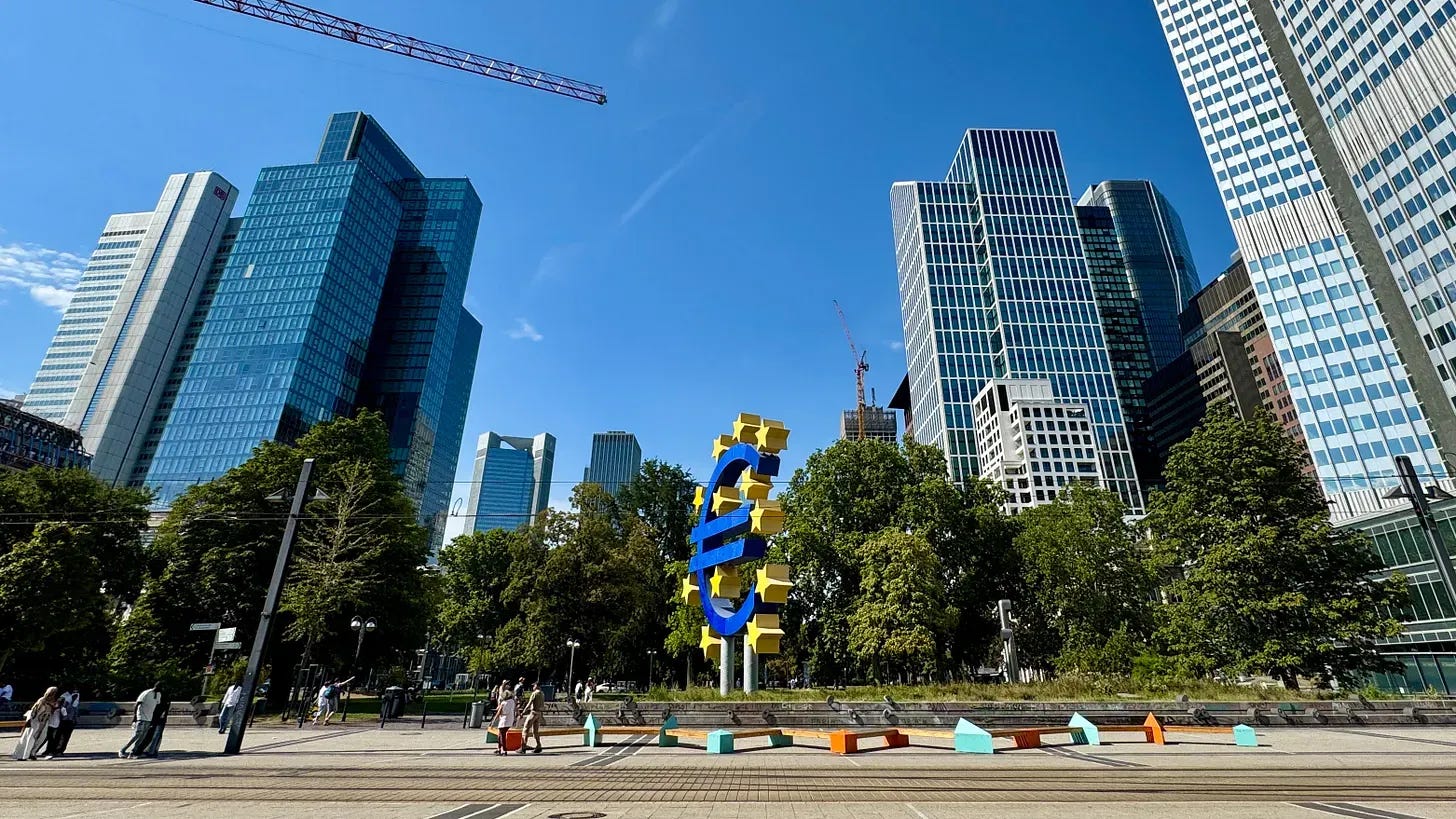
Both routes pass the Euro-Skulptur, outside the former headquarters of the European Central Bank. Since it was erected for the launch of the physical currency on 1 January, 2002, the 14 metre-high sculpture has been the backdrop for many a television correspondent reporting on the continent’s economy. The bank itself moved in 2015 to a plush new skyscraper by the river Main, two kilometres upstream.
The Euro-Skulptur’s amped-up blue and yellow bursts with the ambition of the currency. Artist Ottmar Hörl says he allowed himself “one act of artistic freedom, namely grouping the stars around the Euro symbol without any organisational principle. The participating states are individual, and they presumably scarcely be regulated in such a way that they all follow the same course.” Time will tell whether that is just Germany’s public modesty since 1945 talking – it is the most powerful economy in the Euro area – or a worrying prediction of future chaos.
After a host of Middle Eastern restaurants along the Münchenerstrasse, I reached the station and its multitude of German bakery outlets. My train was spot on time. That’s not a given for German Railways, I know from painful experience. But the Intercity Express (ICE) carriages themselves were as usual superb, more comfortable than Eurostar’s and with far better Wifi. As I settled in, I felt I’d got to know and appreciate Frankfurt much better, and to respect the river that makes it “am Main”.
For the 20 stages of my walk from Brussels to Luxembourg – easily reached by public transport for each stage – see my Substack blog The Brux-to-Lux Trail.


Leave a Reply