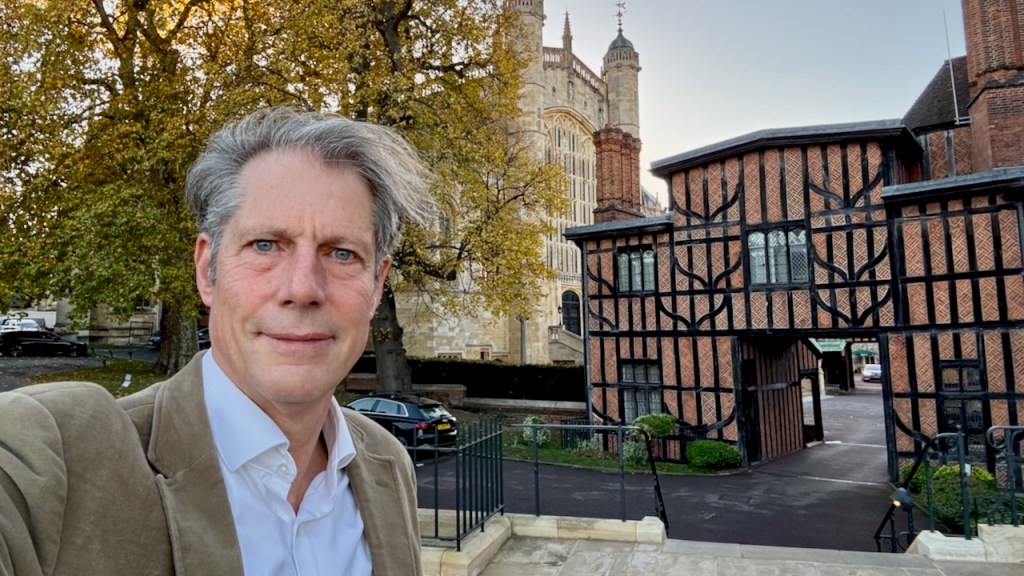
Windsor and Eton. I can think of few names closer to the pinnacle of the old-school British elite. Nor can I imagine a more puffed-out-chest place to start this description of them than my own bedroom in Windsor Castle.
My name is also on the door, and slotted into a wooden In-Out slider board at the bottom of the staircase. Perhaps that’s just in case anyone should want to know that I’ve set out on foot to discover the town, school, wide fields and river Thames below.
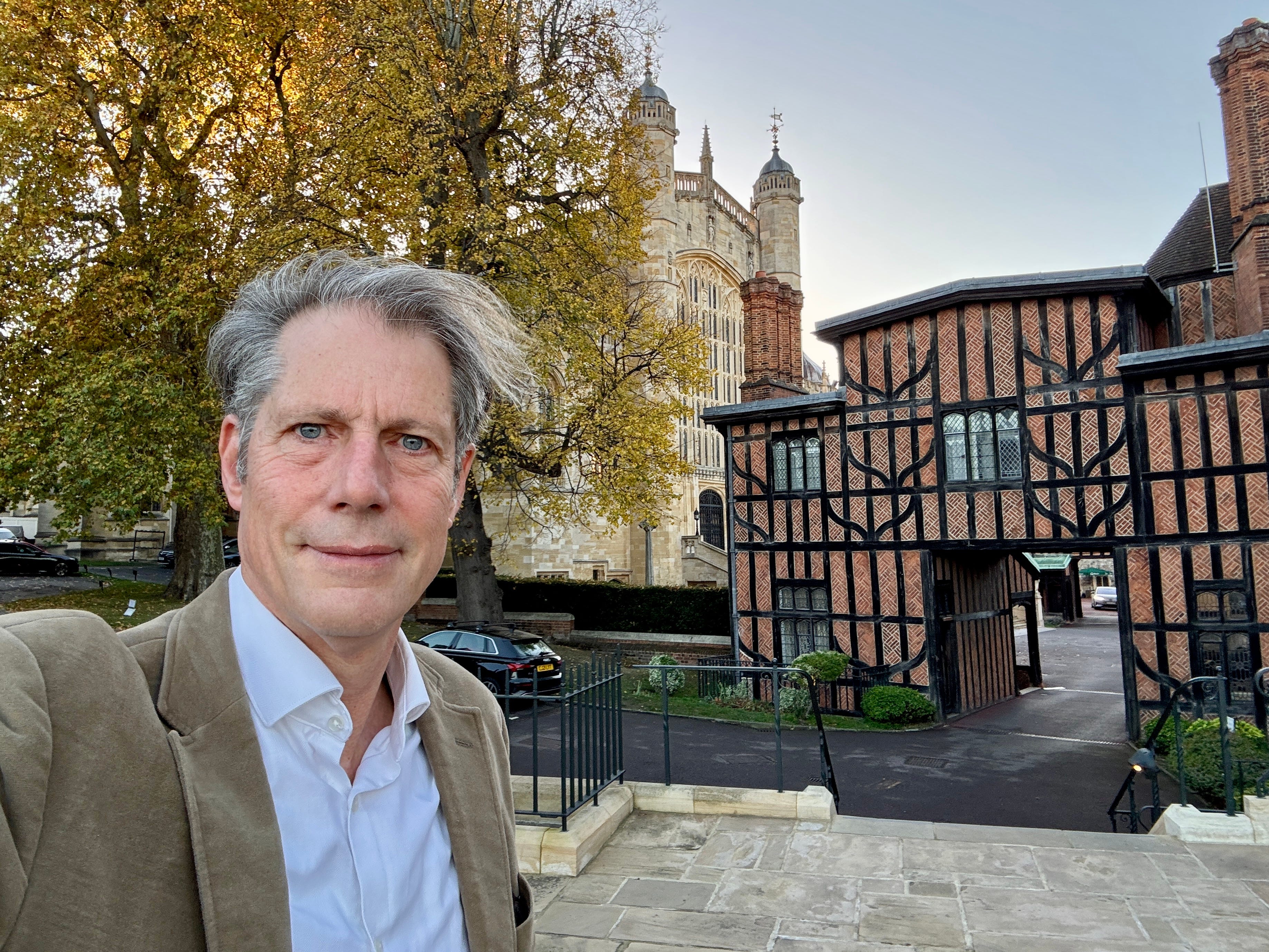
No, I haven’t been made into a Knight Companion of the Garter and I didn’t meet the King. I am briefly there as one of two dozen guests of St George’s House, a thinking chamber set up in 1966 by the late Prince Philip, Duke of Edinburgh. It organises events like our “consultation” on the future of liberal democracy. (I’ll take a look at our two days of deliberations soon on my For a New Democracy substack.)
There is no denying the glamour of this indirect brush with royalty. We’re even ushered in to see the ancient wooden choir stalls where the King and his most select circle of knights and ladies worship in the castle’s St George’s Chapel. Britain’s royals are mostly buried here. I’m impressed by the modest tomb of the late Queen Elizabeth II (1926-2022), a simple slab of polished Belgian blackstone, under which she lies with her parents and her husband, Prince Philip (1921-2021).
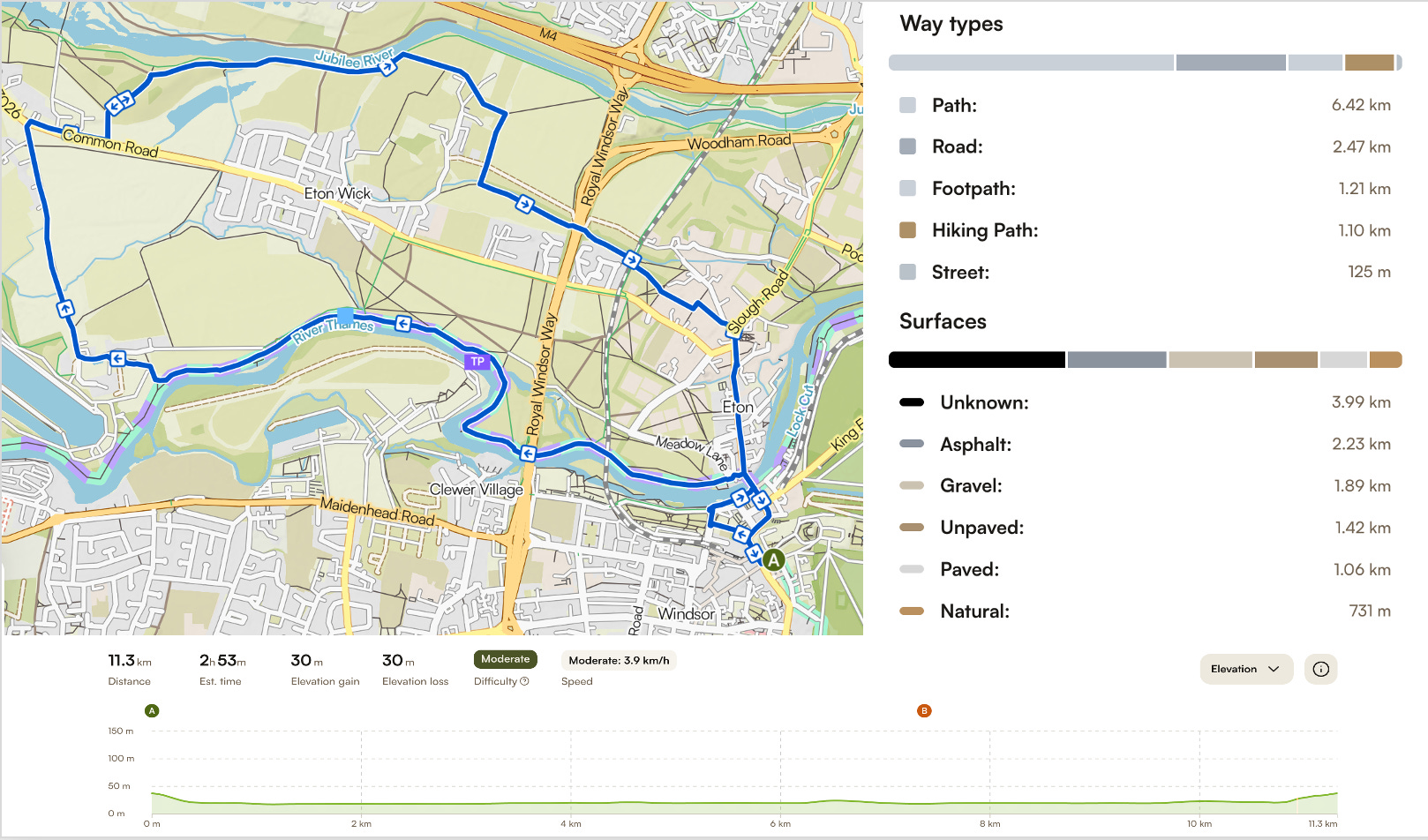
Before our democratic deliberation starts, though, I am looking forward to a eleven-kilometre walk.
Time from Brussels: 3 hours by train
Where to where: Windsor Castle Henry VIII Gate – The Goswells – River Thames – Windsor Bridge – Eton High Street – Thames River Path – Boveney Lock – St Mary Magdalene’s Church – Boveney Road – Jubilee River – Eton College – Eton High Street – Windsor Bridge – Windsor Castle Henry VIII Gate
Distance to walk: 11.3 km
Time needed: 3 hours
To see: 🏰 ♒ 🚣 🛥️ 🐄 🦢 ⛪ 🇬🇧 🫖
I slide my slider to “Out” and set off round the back of St George’s chapel past a great plane tree. Incongruously, there are cars parked here, no doubt belonging to the castle’s permanent residents like “military knights”, choirmasters, the archdeacon and other priests who live in exquisitely preserved mediaeval-looking houses along the castle wall.
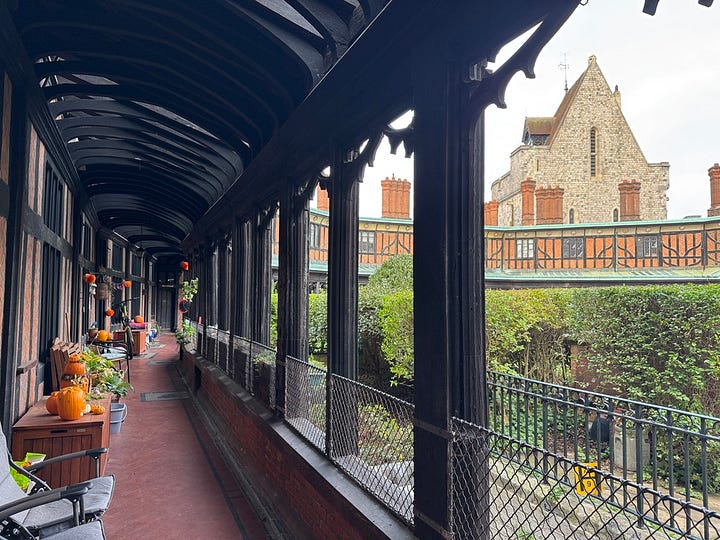
We are in the Lower Ward of the castle – the bottom, least prestigious bit – but the Horseshoe Cloister that I pass through next is remarkable for its curving, open passage of wooden arches in front of the small houses. In the main courtyard of the Lower Ward, a woman army officer is flourishing a sword up and down as she conducts the morning parade of her platoon. The soldiers are wearing everything from grey greatcoats to jungle-patch pullovers to bearskin buzzbies. I reach the Henry VIII gate, where I’m still getting used to the way the police deferentially call me “sir”. Then I’m out with the general public again.
The part of Windsor I’m now walking through is not exactly typical of Britain. There are too many Union flags, Scottish wool and tartan shops and the kind of restaurant that specialises in teas with a cake-stand full of scones, cream and jams. Facing Windsor Castle walls there is one touch of rough reality, however: a decaying 1970s shopfront by a bus stop with homeless people sleeping under cover where it’s set back from the pavement.
I take a narrow alleyway between a mass-market pub and a burger joint into a century-old public park. The houses here were “considered a slum, so the site was cleared”, a sign informs me. In their place is the Windsor & Eton bowling green. Its club house roof ridge beam is sagging a bit, but the grass looks every bit as smooth as England expects. Opposite stand three empty tennis courts. “Free to use, so no need to book”, the sign says.
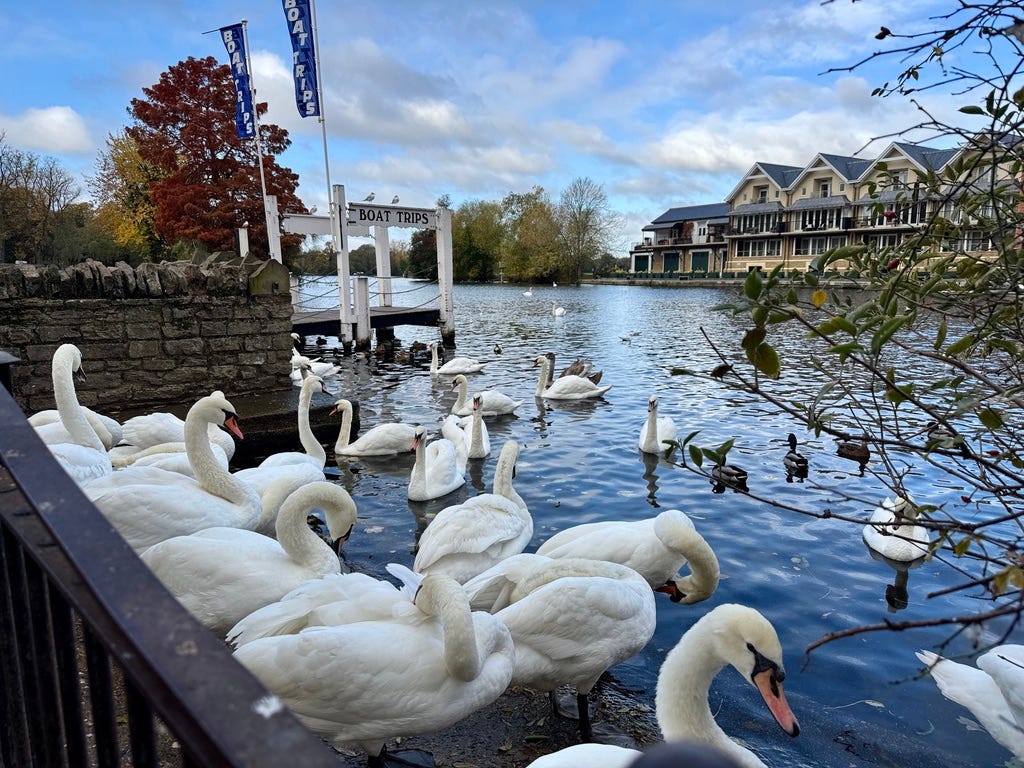
A short stretch of road leads me to the Thames river and more swans than I have ever seen in one place. In Britain these birds are the property of the sovereign, so perhaps they get special treatment around Windsor Castle, even if none of the royal family actually live here full time. I’m wary. The occasional swans on the Thames around my teenage home town of Oxford could be aggressive. But here they give me free passage.
I walk over a bridge and a sign tells me I’m in Eton. Before this visit to Windsor I hadn’t realised that Eton was actually a small town as well as the name of Britain’s most famous and biggest private boarding school, with 1,350 boys.
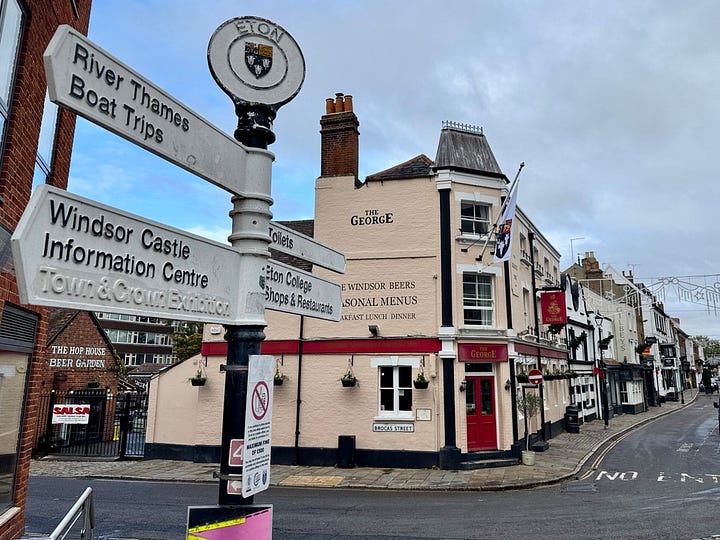
Secretly, I’ve always been in awe of Etonians, the confident, best-educated and richest denizens of Britain’s upper class. The year I went to my university, Oxford, Eton provided one of the biggest single school contingents. Even though their absolute number was small – perhaps 50 of about 3,000 students arriving – they quickly and easily dominated the high ground of university life. They would go on to do the same in the country afterwards as well. From the 1980s alone, think of politicians like Boris Johnson and David Cameron, the journalist Charles Moore and others with surnames like von Bismarck or Rothschild.
The evening before, I’d gone out with one of my fellow democracy discussants to look at the school buildings. No boys were around in their tailcoat-and-white-tie uniforms, which do much to reinforce Eton’s aura of exclusivity. But my companion and I chanced upon a kindly teacher out walking his toddlers and dogs. He loved the Eton boys, he said, and thought that their self-assurance simply came from an ability to speak to adults as equals, and the fact that electronic devices are initially forbidden and strictly controlled as the boys get older. I was even more impressed with his claim that a teenager at Eton could still communicate with him by e-mail.
I asked the master what difference it made now that Eton was actually advertising for applicants, rather than just having parents write their boy’s name down for the school in the hours after their birth. I wondered if it had anything to do with the drumbeat of private school closures all over Britain as the middle classes get poorer and a new tax on private education bites. Well, Eton’s waiting lists are actually still full, the master said. The ads, apparently, aim to get more diverse scholarship candidates.
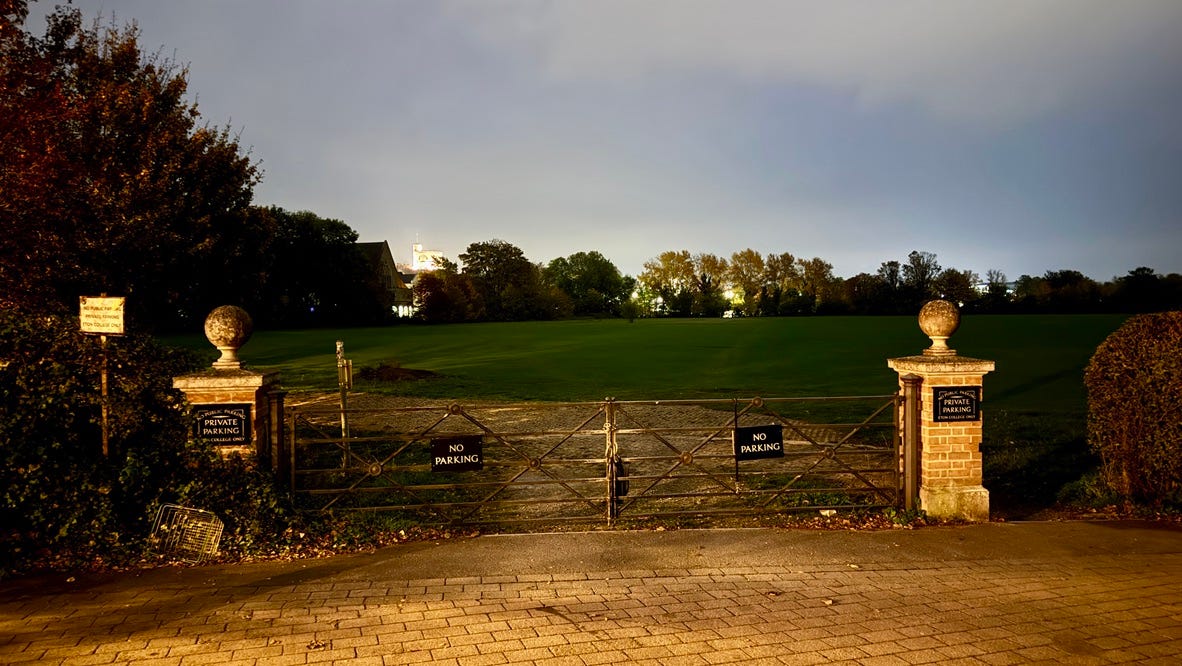
My friend and I tramped back past immaculate, well-financed school buildings and dark open meadows toward the Round Tower of Windsor Castle, turned into a bright welcoming beacon by floodlights. For this night, at least, we could feel part of this privileged bubble of British life.
On my daytime walk, I head west after the bridge from Windsor, past Eton’s riverside pubs and alongside the Thames. The footpath soon takes forms familiar from all over England, alternating unpredictably between wide and narrow, hard and muddy, or grass and asphalt. Ivy-covered trees and bushes at times make overgrown stretches of the old towpath feel like a tunnel. A beaten-up motor boat covered in mould lies moored next to some seasonal halloween skeletons. Then an iron sign marks a one-time bathing spot for Etonians. In their casual, high-minded style, they had named it Athens, and called a raised earthen diving step the Acropolis.
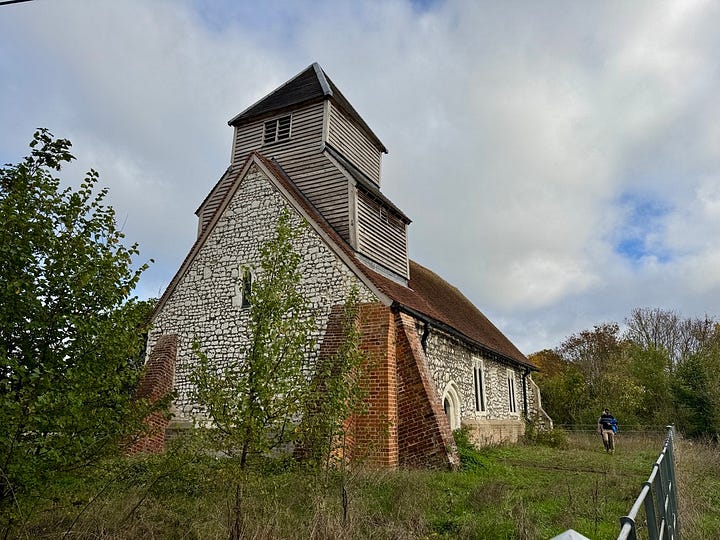
The landscape is very green and very flat – the castle mound seems to be the only elevation for miles around. There are few houses, but the high chimneys of one ancient-looking timber-and-brick mansion peep over the hedgerows. I turn north at a lonely, centuries-old stone church with a boxy spire made of planks. A sign says it is owned by the ‘friends of the friendless churches’, which strikes me as a noble cause. I don’t attend religious services, but I do like the sense of focus that a church gives both to a community and a landscape.
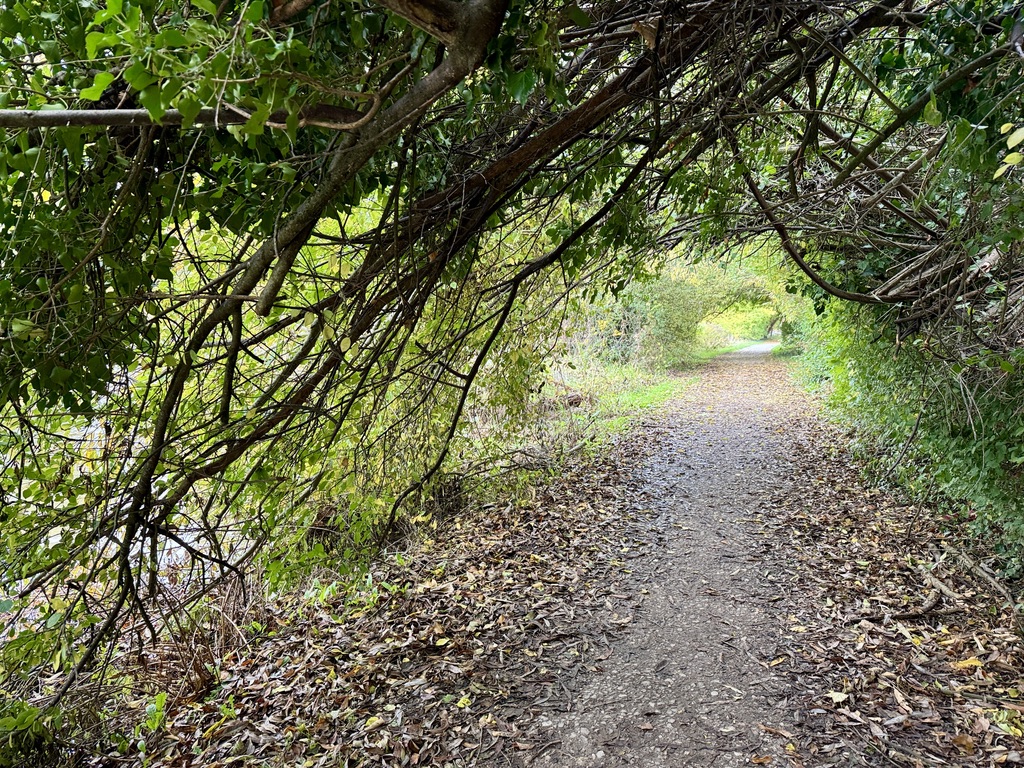
My path then passes by some English midlands family houses. It turns wilder and more open on my route back to Windsor along the Jubilee river, a man-made side-channel of the Thames dug out to control flooding. Then I realise the path is a barely visible trace taking me straight through fields with cattle. There are kissing-gate styles every hundred metres, indicating where the footpath is supposed to be, but no hedges or fences at all.
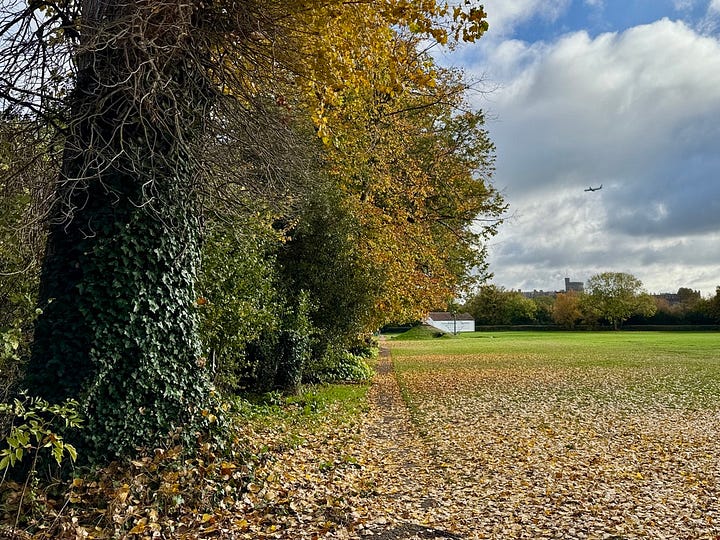
The last section of the path takes me back through Eton. I guess that something in me is trying to dislodge the ingrained chip on my shoulder I have about the school and all it represents. Some boys from my ‘preparatory’ primary school did go on to Eton, and indeed when I was thirteen years old I too was entered for a music scholarship. As I trilled my flute for the examiners that day, I certainly didn’t understand how Eton might have changed the course of my life. It made no difference. Nice though the music masters were, they judged I did not have the requisite musical talent.
Seeing Eton High Street on a cloudy afternoon does make Eton seem more approachable, however. There’s a Church of England kindergarten called “Eton Porny”, a name that seems truly mad, even if it is named after a generous Mr. Porny who used to teach French at Eton. Every street, pub and sign helps normalise the Eton cachet in my mind. One shop is run by a Mr. Eton, at one restaurant I enjoy the Eton Mess pudding of meringues, cream and fruit, and this evening I will drink the Windsor & Eton brewery’s “Knight of the Garter Golden Ale”.
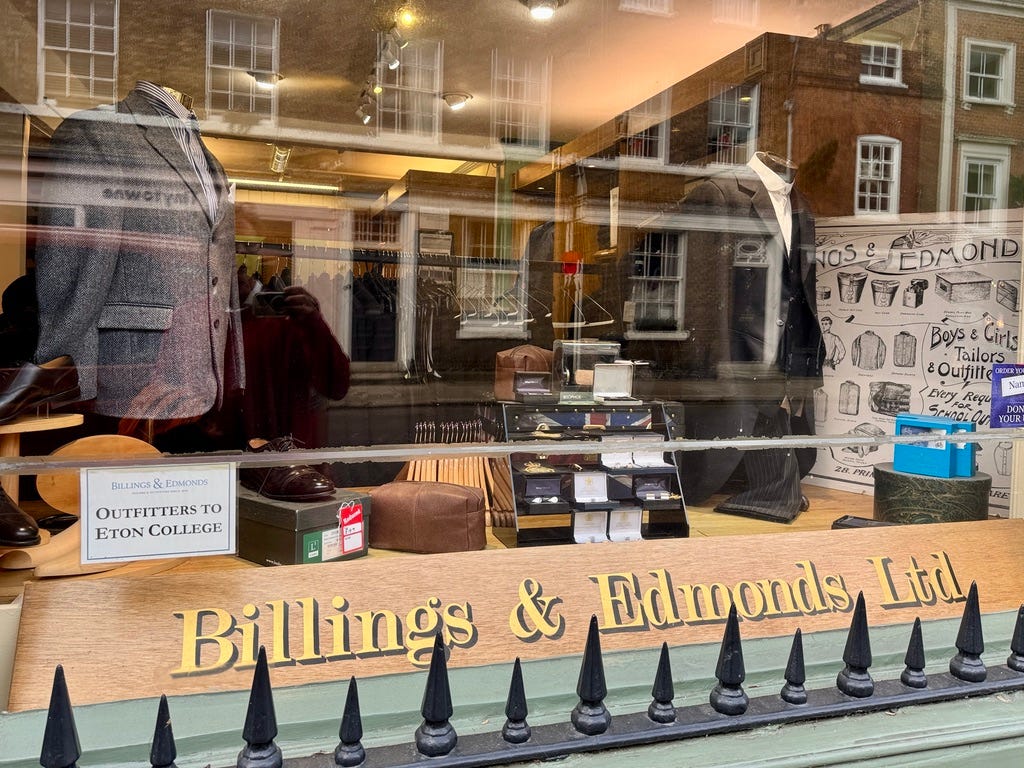
One more pin helps puncture the balloon that my upbringing has pumped so full of the idea that Etonians are a separate class of demi-gods. A shopfront looms in front of me that takes me straight back to my childhood: Billings and Edmonds, still going strong. All my over-priced prep school uniforms had that label sewn into their seams. Here is something tangible I had in common with Etonians, I now realise, and, for that matter, with the boys of dozens of other schools in southeastern England.
I head back towards the Thames past picture-perfect old small town houses. Then I climb up outside the high curving walls of Windsor Castle. They run along the same course that William the Conqueror chose nearly a millennium ago, when he built the fortress to guard the western approaches to London. As I pass through the Henry VIII gate back into the castle, the police officer acts as if he recognises me.
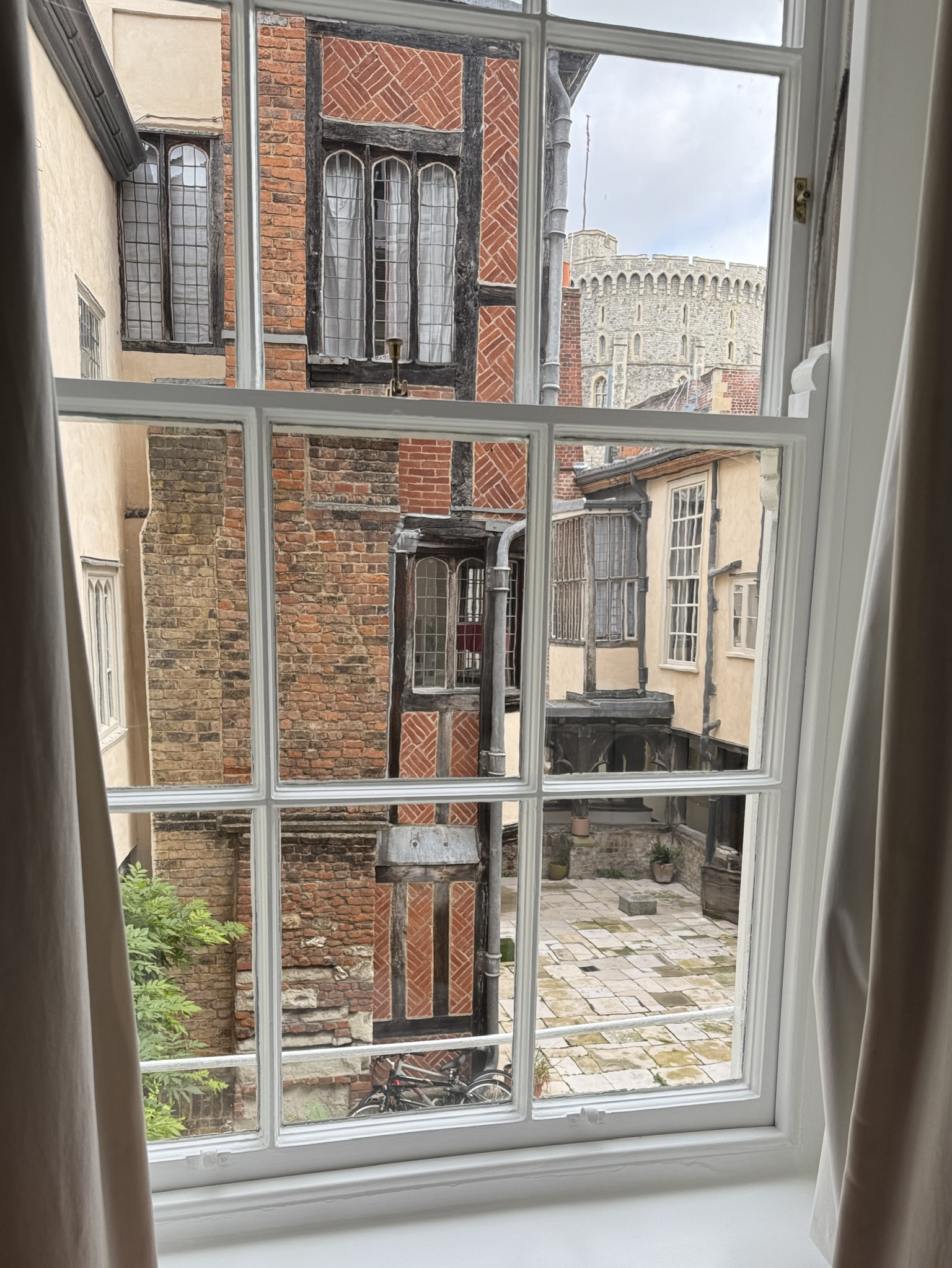
Back in St George’s House, I slide my slider to ‘In’, wind my way upstairs, and once again admire the view from my bedroom window: a courtyard of heavy flagstones, an alleyway of half-timbered houses with lead-paned windows, and behind them all, the great stone keep of Windsor Tower.
For the twenty stages of my walk from Brussels to Luxembourg – easily reached by public transport for each stage – see earlier posts on my Substack blog about The Brux-to-Lux Trail. Antwerp’s Luster publishing house are putting out The Brux-to-Lux Trail as a book in English and Dutch in April 2027.
If you’ve enjoyed this article and would like to make a one-off contribution to my work, please do buy me a coffee!


Leave a Reply