One factor above all is fuelling riots in Europe and threatening a looming fiscal crisis in the United States: a growing shortfall in funding for basic services and social security. Fragmented and polarised traditional governments – based on political parties constantly seeking re-election – are failing to come up with long-term solutions to the problem.
So it’s refreshing to see a top French institution, an influential US voice and smaller-scale European and other municipalities turning to citizens’ assemblies to try to break their budgetary logjams.
Indeed, the convening of groups of randomly selected citizens for a deeply informed, one-off deliberation may be the best democratic technique available to find ways to share all the inevitable future financial pain. A new broom is vital to establish a credible, equitable, and legitimate path: it is the old system of elected decision-makers, after all, that over the past half-century has pushed the welfare systems of these states close to bankruptcy.
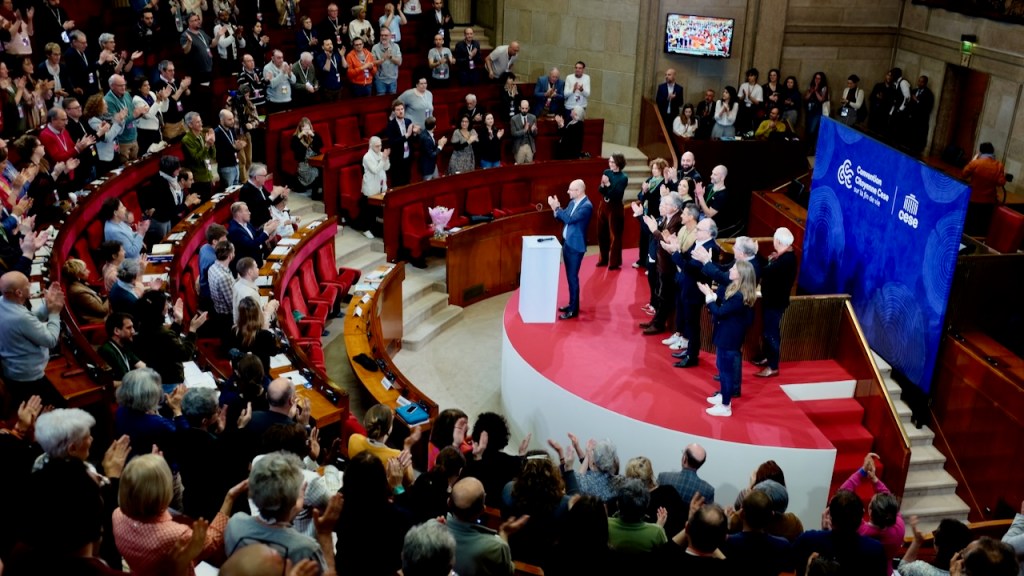
In November in France, the government’s Economic, Social and Environmental Council (CESE) – an institutional bridge between elected parliamentary bodies and citizens and civil society – is convening 150 randomly selected citizens to deliberate on all aspects of policy to fix the country’s budget. “This novel approach aims to engage citizen participation at the heart of the current debate on public finances, while simultaneously initiating a long-term reflection on the country’s future,” the CESE says.
“At CESE, we’re not frightened of the French people,” said Claire Thoury, an experienced organiser of state-backed citizens’ assemblies promoted to CESE president this year. “They know how to articulate the public interest, provided they are trusted to carry out this mission and are given the means to succeed.”
The downside is that CESE is convening the citizens only on its own authority, meaning that, as too often happens, citizens will be acting in a purely moral, advisory capacity. The light at the end of the tunnel is that in August 2026, just over three years after the CESE convened a pioneering Citizens Convention on the End of Life, France followed its lead and adopted breakthrough laws on assisted suicide.
Pitch-perfect advocacy
A second example of new interest in a citizens-based approach to fixing the budget is more hope than action, but notable nevertheless.
In October 2026, a leading Columbia University economics professor, Glenn Hubbard, proposed that a randomly selected citizens’ assembly with a strong mandate would be best suited to find a new solution to the crippling financing problem faced by the US Social Security system. Hubbard may not be a household name, but he’s a high profile public policy intellectual who was appointed to high office by Republican President George W. Bush. He used an opinion piece in The Economist to float the fully thought through idea.

Down to the last sub-heading, this 9 October 2026 Economist opinion piece was pitch perfect advocacy for sortition. Hubbard’s reasoning came straight out of the most advanced playbook of the movement that has for two decades has been improving the design of citizens assemblies, and building up the case for them to propose long-term policies.
Hubbard ticked off a strong list of arguments. Voters now want systemic change, he said. “According to the Pew Research Centre, just 17% of Americans trust the federal government to do ‘what is right’ always or most of the time, down from around 40% in the early 1980s,” he continued. Experts should be informing, not deciding: “on tap, not on top.” Randomly selected citizens are ideally placed to show what “thorny economic and political trade-offs” work for them, and to propose the truths that politicians dare not say out loud.
Critically, Hubbard also underlined the need for the government to give a strong mandate for the citizens’ assembly. “Congress should signal strongly that it will give serious consideration to proposals coming out of an assembly—and commit to an up-or-down vote on them.”
European municipalities
Mehr Demokratie, a German organisation that tracks the growing use of citizens’ assemblies, has also surveyed a growing trend to use citizens assemblies and panels at regional and city level to grapple with budgeting. These ranged from Australia in 2014 through German muncipalities more recently to a new, systematic city-level implementation that was evaluated as a success in Finland.
“The human brain is not really made for budget plans,” Mehr Demokratie quoted Mayor Georg Wyrwoll, from the south-western German town of Werbach, as saying as he thanked citizens for developing new criteria he would now use for spending and saving. “You identified key priorities that your diverse group considers important for the coming years.”


Leave a Reply