Writer of books on Turkey, the Middle East and Central Asia. Formerly Director of Communications & Outreach and Turkey/Cyprus Project Director for International Crisis Group. Ex-Turkey & Middle East staff correspondent for The Wall Street Journal.
The Istanbul launch of Dining with al-Qaeda will take place on at 4pm on Thursday, 16 September 2010, at the Istanbul Policy Center in Karakoy, the heart of the grand old Ottoman banking district. Co-hosts are the Istanbul Policy Center, Hurriyet Daily News and Homer Bookshop. The introduction will be by Joost Lagendijk, the former Euro-MP from Holland and one of Europe’s most famous faces in Turkey, now at Sabanci University. Author Hugh Pope will sign copies and give a talk about the book too. Below is a map with the formal invitation from HDN’s Michael Wyatt. All are welcome to come along, just RSVP to the address below!
For those who can’t make it and want a copy of Dining with al-Qaeda in Turkey, Homer Books (details here) nearly always has the book in stock at its shop just round the corner from Galatasaray on Istiklal Cad., and is ready to courier it to any Turkish address for little extra cost.
Dear Friends/Sevgili Dostlar,
Joost Lagendijk, Senior Adviser at Sabancı University’s Istanbul Policy Center, along with David Judson, Hürriyet Daily News & Economic Review Editor-in-Chief, and Ayşen Boylu and Tolga Ölmezses of Homer Books, cordially invite you to join Hugh Pope for the launch of his new book, Dining with al-Qaeda: three decades exploring the many worlds of the Middle East.
Joost Lagendijk, Sabancı Üniversitesi Istanbul Politikalar Merkezi’nde Kıdemli Danışman, David Judson, Hürriyet Daily News & Economic Review Genel Yayın Yönetmeni, ve Homer Kitabevi’nden Ayşen Boylu ile Tolga Ölmezses, Hugh Pope’in yeni kitabının, Dining with al-Qaeda: three decades exploring the many worlds of the Middle East, tanıtımına sizleri aramızda görmekten mutluluk duyacaklardır.
Mr Pope will greet guests and sign copies of his book on September 16th 2010 at 4:00pm at Sabancı University İletişim Merkezi, Bankalar Caddesi No:2 Minerva Han, Karaköy, Istanbul.
I always feel odd when referred to as a ‘polyglot’, since I speak no language as well as I speak English, but flattering comments like these in Denmark’s leading magazine Weekendavisen are always welcome. Danish TV news anchorman Adam Holm says in his review that Dining with al-Qaeda has an “exceptional overview” and “by example sets a noble standard: learn to communicate with ‘the other’ on the same level and eye-to-eye”. Many thanks!
(Although it’s probably short-sighted to make fun of Google Translate — which is pretty good and will doubtless be taking the jobs of all aspiring polyglots in a few short years – I can’t resist relaying its pidgin version of Weekendavisen‘s elegant Danish prose: “Pope with his insight rejects the kind vulgar nonsense. He is also noticeably disillusioned, because he has realized that three decades of attempts to sneak between bills and shades of in its reports have not shaken by large grandfather delusions…But he has not only an eye for West faux passport. Pope also takes the blade from his mouth and criticizes the ill objective tendency among many Arabs to blame for their debacle at all other than itself. Has heard the album once one knows the melody, and though it be raised with different degree of elegance and wit, it is refrænet same: it is the fault of others (read: Israel and the U.S.).”)
POLEMISK POLYGLOT
Af Adam Holm
BRITER og fremmedsprog er sædvanligvis ikke to komplementære størrelser. Shakespeares efterkommere taler jo det globale lingua franca, så why bother?
En klassisk sketch fra BBC rammer hovedet på sømmet. Et ældre ægtepar sidder på en restaurant i Paris. Manden henvender sig til tjeneren: »Garçon, je voudrais a beefsteak, please!«, hvortil hans bedre halvdel beundrende kvidrer: »Oh Harold, dear, I didn’t know you spoke Italian!«
Men hvis uformåen på kontinentale tungemål således er karakteristisk for en brite, er Hugh Pope (f. 1960), mangeårig Mellemøsten-korrespondent for avisen The Wall Street Journal og forfatter til Dining With Al-Qaeda, meget lidt britisk.
Med orientalske sprogstudier fra Oxford på sit CV og en barndom i Damaskus behersker han ikke blot arabisk, men tillige persisk og tyrkisk. Unægteligt brugbare arbejdsredskaber for en mand, der i knap tre årtier har beskæftiget sig med de arabiske lande og Iran og nu bor og arbejder i Istanbul som konsulent for The International Crisis Group.
For tidligere generationer af Orient-rejsende var polyglote egenskaber en selvfølge, men det er dyder, som flertallet af nutidens udenlandske pressefolk – mange kvaliteter ufortalt – ikke er i besiddelse af. Kun en lille håndfuld af de internationale reportere, der til daglig forsøger at gøre os andre klogere på virkelighedens Mellemøsten, er i stand til at forstå arabisk endsige hebraisk.
At Hugh Pope kan lave interviews uden tolk og læse lokale aviser og tidsskrifter (og alt det, der står mellem linjerne) giver ham et exceptionelt overblik. I 18 velfortalte kapitler skildrer Pope alt fra arabisk homoseksualitet (den i øvrigt heteroseksuelle Pope synes at have en særlig appel til irakiske bøsser) over borgerkrig i Libanon og iransk revolutionskultur til sult i Sydsudan, afghanske krigsherrer, kurdiske separatister og saudiske wahhabister.
Ind imellem dette og meget mere fra regionens trykkoger tegner Pope et billede af en korrespondents uvejsomme tilværelse. Nogle af de lande, Pope har haft som sin arbejdsmark, har budt på udfordringer og strabadser, som rummede en gedigen risiko for at komme voldsomt af dage, sådan som det er sket for en håndfuld af Popes kolleger og nære venner. Pope er fl ere gange i voldsom knibe, ikke mindst under et interview i Riyadh med en ung saudiarabisk al-Qaeda-tilhænger, som kendte terroristerne bag angrebene 11. september 2001. »Nogle vidunderlige gutter,« lyder det fra fundamentalisten, som samtidig over et stykke kylling iskoldt forklarer Pope, at han strengt taget burde have halsen skåret over som den vantro, han er. Man kan bogstaveligt talt høre Popes strubehoved snøre sig sammen, og man skynder sig frem til afsnittets sidste side for at forvisse sig om, at forfatteren rent faktisk slipper uskadt fra den makabre samtale.
DER er mange enerverende stunder i en korrespondents liv, men ind imellem sættes nervesystemet på overarbejde. I den forbindelse kan Pope ikke stå for fristelsen til at lade et par polemiske ord falde om landsmanden Robert Fisk, Mellemøstenjournalistikkens store hvide ronkedor, som angiveligt har en uvane med at dramatisere lidt for trivielle hændelser. Man aner antydningen af et karaktermord på manden, som Pope vedgår, han beundrede til hudløshed som yngre. Men i lighed med det falmede forbillede har Pope indset, hvor kompleks en størrelse Mellemøsten er, og derfor slår bogens undertitel fast, at der eksisterer flere »mellemøstlige verdener«.
Ligesom Europa ikke er ét fedt, er det ingen nyhed, at Mellemøsten dækker over en stor variation af identiteter, religioner, kulturer og etniske grupper. Men denne trivielle indsigt er desværre, hvis man skal tro Pope, ikke så selvfølgelig blandt visse amerikanske avisredaktører og bigotte kolleger. De har regnet Mellemøsten ud som et sted befolket af fundamentalt anderledes – og derfor potentielt fjendtligtsindede – mennesker.
Overflødigt at sige, at Pope med sin indsigt i kulturelle modsætninger og mangfoldigheder afviser den slags som vulgært nonsens. Han er dog også mærkbart desillusioneret, fordi han har indset, at tre årtiers forsøg på at snige mellemregninger og nuancer med i sine reportager ikke har rokket stort ved hævdvundne vrangforestillinger. Hverken blandt almindelige avislæsere eller beslutningstagere.
Irak-krigen og særligt dens forløjede optakt gav Pope et skud for boven. Invasionen af Saddam Husseins diktaturstat, hvor umenneskelig den end var, har bombet bestræbelserne på et dybtstikkende tillidsforhold mellem vores del af verden og de ofte skeptiske autoritære stater i Mellemøsten adskillige årtier tilbage, mener Pope.
Men han har ikke kun øje for Vestens faux pas. Pope tager også bladet fra munden og kritiserer den ulyksaglige tendens blandt mange arabere til at skyde skylden for deres misere på alle andre end sig selv. Har man hørt pladen én gang, kender man melodien, og selvom den bliver fremført med forskellig grad af elegance og vid, er refrænet det samme: Det er de andres skyld (læs: Israel og USA).
POPE er som antydet ingen hardliner, når det gælder den vestlige kurs over for regimerne i Mellemøsten, men dårlige undskyldninger, inerti og religiøs formørkelse fylder ham med irritation. Han gider ikke længere lægge øren til beretninger om fornemme videnskabelige bedrifter tilbage i kalifaternes storhedstid, når nutidens oplysningsniveau er så beskæmmende ringe i mange af de arabiske stater.
Selv om Popes bog ikke rummer en GPS for en mere farbar vej til fred og fremgang i Mellemøsten, har han dog med sit eget eksempel sat en fornem standard: Lær at kommunikere på lige fod og i øjenhøjde med ’de andre’. Det er de små skridts vej. Måske værd at prøve, når idealismens syvmilestøvler engang bliver kasseret.
A lovely review of Dining with al-Qaeda in The Guardian of the UK by Ian Black, who paired my book with Joris Luyendijk’s Hello Everybody!, newly published in English. I thought Luyendjik’s book was great and I found that we shared many perspectives, even if the Dutch reporter based his assessment on a quite short experience. One thing I couldn’t understand was why he often felt disadvantaged by not working for a US publication: I would have thought that it would have been liberating working for the excellent Dutch media he represented. Maybe US reporters enjoyed somewhat more privileged access, but I think that over the years all of us were given less and less time with real decision makers in the region. Original review here.
TWO JOURNALISTS PONDER THE HAZARDS OF REPORTING ON THE MIDDLE EAST
—
Hugh Pope and Joris Luyendijk describe their experiences in the Middle East in Dining with Al Qaeda and Hello Everybody
By Ian Black, Middle East Editor
18 May 2010
Foreign correspondents covering the Middle East are the first to admit that it isn’t an easy beat: partisan views, authoritarian regimes and marginalised opposition movements are routine hazards. Add in issues as divisive as the Israeli-Palestinian conflict, al-Qaida, oil, the US invasion of Iraq and theocracy in Iran – and the word “minefield” conveys just how treacherous the territory can be. Real war-zones and men with guns are part of the landscape too. And so are expectations and agendas back in the newsroom.
Two excellent new books describe some of the tricks and dilemmas of this trade. Hugh Pope left the field after nearly 30 years reporting for British and US news agencies and papers. Hello Everybody! Dutch journalist Joris Luyendijk tells the story of his five years in the region in a breezy but self-critical account of “one journalist’s search for truth”.
Pope’s book Dining with Al Qaeda is terrific on spice-scented bazaars, maddening border crossings, sinister secret policemen and sexual mores in unlikely places – as well as Islam, democracy and other staples. But he is also thought provoking on the difficulty of conveying the reality of the “dysfunctional backyard” that is the Middle East to western, especially American, audiences who are used to a diet of infotainment and familiar, easily digestible narratives.
The Guardian's caption to this photo by Morteza Nikoubazl/Reuters: "Hugh Pope tackles the difficulty of conveying the reality of the Middle East to western audiences." However, while I did once interview a Burka shopowner in Kabul in a futile attempt to discuss the situation of Afghan women with the women themselves, this photo has nothing to do with me!
In his final media job at the Wall Street Journal he battled to keep his stories “out of the ruts of traditional coverage of good ‘moderates’ versus bad ‘radicals,’ a misleading focus on an Arab-Israeli ‘peace process’ that has yet to proceed anywhere, and the way many people overemphasise the role of ‘Islam’ as an analytical tool in assessing the Middle East”. An editor at the Los Angeles Times urged him not to use the word “Kurd” if he wanted his stories published. It reminded me of the joke of hard-bitten American correspondents in Lebanon in the hostage-taking 1980s: “What’s a Druze and who gives a shit?”
This can be a frustrating and dangerous craft: not only did Pope struggle to explain Saudi Arabia to suddenly interested readers after 9/11 but had to draw on his Quranic knowledge to convince a jihadi interviewee it was not his duty to kill him as an infidel. His Jewish WSJ colleague Danny Pearl was not so lucky when he encountered al-Qaida in Pakistan.
Changing technology is part of this story: Pope is old enough to have filed copy by telex and fiddled with those crocodile clips used to attach early laptops to hotel phone lines. Luyendijk, using mobile phones and the internet from the start, recalls how Syrian censors blocked his Hotmail account and moved on to YouTube a few years later. Facebook and Twitter helped the opposition in last summer’s Iranian presidential elections.
Both fretted about how to deal with the pressure to deliver stories that filter, distort and manipulate reality. Notebooks bursting with hard-gained insights can count for little if the item has been pre-scripted according to stock assumptions and prejudices back at base in New York, London or Amsterdam.
Pope is an accomplished linguist with Arabic, Persian and Turkish under his belt: he wears his learning lightly but it shows in the quality of his writing – short on pyrotechnics but long on understanding. Luyendijk is good on bridging the gap between the modern standard Arabic most foreigners study and the different dialects spoken in every country and region. Too little ability to speak means over-dependence on local fixers and translators on the payroll of the ministry of information.
Pope bravely tackles the reputation of his onetime Independent colleague Robert Fisk, for many a cult figure who “manages to step around the cautious conventions of Middle Eastern reporting and drive home at an emotional level the injustices of the dictators and the cruel side of US policies”. But he is not the first journalist to wonder with envy and irritation how Fisk “managed to get an amazing sounding story from a dull day we all spent staking out Israeli anti-insurgency troop movements in south Lebanon”. Drama and colour may be easier to deliver than accuracy, analysis and insight: “Our readers were too far away, physically and mentally, to grasp the emotional context of careful reporting,” he gloomily concludes.
Reporting on the run-up to war in Iraq for the WSJ, he says, was a depressing time: a carefully researched article warning of “unintended consequences” for foreign conquerors had no effect on the pro-war juggernaut: it was published a few days before the tanks began to roll. Shortly afterwards Pope got his first call from the paper’s baffled opinion page editor who wanted the correspondent to explain why Iraqis were resisting their American liberators. It was a short conversation.
Pope’s book, acclaimed in the US, has yet to be published in Britain. Luyendijk’s, now out in English (Profile Books), sold an extraordinary 250,000 copies in the Netherlands. It’s just as well neither heeded the advice one old hack offered the young Dutchman. “If you want to write a book about the Middle East, you’d better do it in your first week,” he counselled. “The longer you hang around here, the less you understand.”
I didn’t realize that I was perceived as having a ‘swashbuckling style’, but reviews don’t get much more flattering than this Adam Chamy take on my April presentation of Dining with al-Qaeda at the New America Foundation. It was published in the Music and Arts section of the July edition of the Washington Report on Middle East Affairs, pages 52-53.
Music & Arts: Hugh Pope Discusses Mideast Politics, New Memoir
LONGTIME foreign correspondent Hugh Pope, currently director of the Turkey/Cyprus Project at the International Crisis Group, discussed his new memoir, Dining with al-Qaeda, at an April 23 event hosted by the New America Foundation, International Crisis Group, and Foreign Policy Magazine. Pope, who has spent more than three decades in the Middle East as a traveler, journalist and student of Arabic, Persian and Turkish languages, said one of the most important things he has learned is that the Middle East is not a monolithic “Islamic World.” With intelligence and wit, the British journalist fielded difficult questions concerning ongoing political changes in the region.
Clearly, war correspondence in the Middle East is not for the faint of heart. Pope’s perilous assignments included reporting on the Lebanese civil war and the U.S. occupation of Iraq. Even as a polyglot, he encountered difficulty in finding reliable and safe sources in a region dominated by autocratic, media-sensitive regimes and a sometimes hostile Arab street.
The author of Dining with al-Qaeda really did dine with a member of al-Qaeda soon after the 9/11 attacks on the United States. At the time a foreign correspondent for The Wall Street Journal, Pope met in Riyadh with a young militant who’d worked in Afghanistan and had helped prepare many of the hijackers for their deadly mission.
In addition to dangerous assignments, Pope said he’s faced editorial room intrigues as a result of pressure by powerful pro-Israel lobbying groups and a media-sensitive Bush administration.
“Most journalists are honest,” Pope said, “and what you read in the newspaper is mostly right, but it is not the whole story. You do have to search for other sources of information to compare and think about what you are hearing and take a variety of points of view.”
Expressing optimism about the changing narrative surrounding Israel and Palestine, Pope noted that several mainstream media outlets have reported issues that would have been wholly taboo during his tenure as a Wall Street Journal foreign correspondent. Likewise—citing the example of Turkey and the power of the Internet on young people in the Middle East—he seemed cautiously hopeful about the gradual prospects for media, social, and political freedoms in Ba’athist Syria, and with the prospect of elections in a post-Mubarak Egypt.
As for his swashbuckling style of foreign journalism, Pope—with his characteristic smile—joked that a life like his would probably be unrealistic in the future, given the dangers, costs, and demise of traditional reporting, but praised the potential of Twitter and bloggers as tools for future journalists.
Pope’s memoir is available from the AET Book Club for only $19. To order, call (202) 939-6050 ext. 2 or visit <www.middleeastbooks.com>.
The fortunes of my books among British readers has always felt complicated by my ambivalent relationship with the United Kingdom. I love the high English liberal culture of my parents and my education, but I never fully connected to England itself. Perhaps this was because I spent the first decade of my life in South Africa, and the three decades since leaving Oxford University in the Middle East and Turkey. On top of that, my former wife was Swiss, my present wife is Dutch, my daughters went to French and German schools, and I have almost always preferred the rigour and vigour of working for Americans. My lack of a true anchor in Britain may be why my first two books seemed to do better in U.S. and international markets than in England.
So it may prove for Dining with al-Qaeda as well. High-octane UK publications like the Economist and Prospect Magazine have reviewed it (here) and excerpted it (here), but the book is not yet formally published in Britain. Independent stores like Daunt Books and the London Review Book Shop display and stock the US edition published in March, as does amazon.co.uk, but if asked about it, mainstream bookstores scratch their heads or announce that it has been ‘sold out’.
Nevertheless, I couldn’t resist when invitations arrived to give public talks about the book in May in three English venues: the first a presentation of the themes of the book to a dozen friends of International Crisis Group over dinner in London, and then talks in Cambridge and Oxford.
I was met at Cambridge station by Ata Akiner, president of the university’s Turkish Society and the prime mover in inviting me to speak. We first headed to Magdalene College, where I was greatly looking forward to staying. If my life had taken a different turn, I would have become the fourth generation in my family to be a student there; but, bruised by high 1970s drop-out rates in Oriental Studies, and probably wary of my rebellious school record, the college had dismissed my application to study Persian.
Talk at Department of International Studies
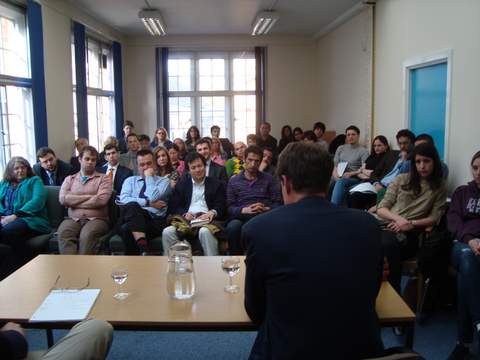
Akiner and the Turkish Society proved the perfect hosts, setting me up in a delightful senior fellow’s room overlooking a leafy courtyard on a sunny afternoon that was flattering every corner of Cambridge’s lawns, gardens and lilac-garlanded stone walls. We then gathered followers to my talk in the Department of Politics and International Studies, and it became clear that Cambridge now helps prove a paradox: its collection of ethnically Turkish students from Belgium, Germany and England were another example of how the Turks of Europe can sometimes appear more cosmopolitan and borderlessly ‘European’ than Europeans themselves. They were also efficient in broadcasting news of the talk and directing people to the lecture hall through a departmental labyrinth. Even at this time of finals exams and gorgeous weather, they also defeated elite institutional ennui and filled every seat in the room.
Euroturks dining at Pembroke College, Cambridge
Dr. Geoffrey Edwards, the Reader in European Studies who introduced my talk, then spoiled me and the Turkish Society with a formal dinner in the hall of Pembroke College, replete with gongs, academics in flowing gowns, Latin graces, long silver-decked tables and a gorgeous light flowing in from windows opening out onto the honey-coloured quadrangles all around.
Geoffrey Edwards, Hugh Pope, Ata Akiner
Edwards turned out to be following the same lonely path as I do in trying to draw attention to the benefits of EU integration, and Turkey’s role in that, and gave me new strength in my conviction that Europe needs more unity rather than less.
Two days later I headed over to Oxford, where my invitation was of a different nature. On being called up several months before to be asked if I would contribute cash to my old college, Wadham, I had said I had little money to spare but would be happy to give something in kind – a talk to the new generation of Oriental Studies students, perhaps. Within an hour my offer had been accepted. Wadham Arabic student and lead organizer Jessica Kelly filled a fine new room on the front quadrangle with an impressive number of students, and wrote up a pre-talk interview published in the student newspaper Cherwell (here). A lively barrage of questions ranged from my views on the film the Hurt Locker (more here) to a discussion of why, after I described International Crisis Group’s efforts to mobilize information behind policy recommendations, academics did not make the same effort to be currently relevant and accessible.
Oxford was looking so beautiful that I happily lingered for two days more, punting on the river, lunching on a lawn near the Oriental Institute to chat with students about what post-Orientalists like us can expect from the world. I also took in a Balliol college lecture by Rory Stewart, an Etonian, Balliol man, army officer and diplomat, who, after writing successful books on his experiences in Afghanistan (The Places in Between) and Iraq (The Prince of the Marshes), has now stormed into the British parliament. By chance I sat exactly in front of him as he spoke, which doubled the impact of his words. He sports a well-trained memory, a clear rhetorical style, a confident strutting around and leaning on the lectern, a well-cut suit with a dashing extra waist pocket, and a political ambition that is only highlighted by his quotations from T.S. Eliot about the need for humility. I was soon convinced me that he has his sights firmly on Britain highest political office.
Good for Rory Stewart. I found myself agreeing with all his arguments about the need for a far lighter footprint for troops in Afghanistan, and his account of the hypocrisy and irresponsibility that led to the build-up of troops there in the first place. Above all, I appreciated his attack on the great theoretical and academic infrastructure that continues to justify these self-defeating Western deployments, a mesmerising mixture, as he pointed out, of paranoia and megalomania.
His comments about the UK’s predicament, and the misrepresentations of Middle Eastern reality that make it so hard to change policies, mirrored he arguments I make in Dining with al-Qaeda about U.S. policy and American media. I hope that in our different ways, people like us pushing together will in the end result in some better understanding of how to let the Middle East become a more constructive place.
A lovely review from Crisis Group media director Andrew Stroehlein, posted on Reuters AlertNet (original here). As for Stroehlein’s concern in the last paragraph, let me state that I had never thought that anyone would be uncomfortable at my occasional mentions of girlfriends in the Middle East! I reckoned that eyebrows would more likely be raised at the book’s opening, in which I escape the attention of lustful Iraqi truck drivers in an Aleppo brothel — an episode chosen, as ever, as much for its comical as its dramatic content.
Dining with al-Qaeda
By Andrew Stroehlein
—————————-
Let’s start with full disclosure: I work with the author of this book. So, yes, I’m likely to say good things about it.
But, to be honest, I would anyway, because what my colleague Hugh Pope has done in Dining with al-Qaeda: Three Decades Exploring the Many Worlds of the Middle East, is at once revealing, convincing and, um, sort of fun.
The first two adjectives won’t surprise anyone who knows Hugh or who is familiar with the reputation he earned for serious reporting from the Middle East over decades. The third, well, let’s save that for now…
What I find most interesting in these memoirs of a newspaper foreign correspondent — from the good old days before newspaper foreign correspondents joined the endangered species list — are the parts of the book where Hugh describes the challenges of presenting ground-level truth in the Middle East to American audiences via US editors.
Examining both the editors’ own biases and their perceptions of their readers’ biases, Hugh demonstrates in case after case how stories got watered down, had their emphasis altered, were scarred by a cliched headline, or otherwise ended up conveying meanings at odds with his original field reporting. It was frustrating, sometimes embarrassing, and it occasionally made his job more difficult by damaging important relationships in the countries concerned.
Of course, this kind of thing happens between correspondents and editors, and reporting from the Middle East probably falls victim to it more often than that from most other regions. But the detail Hugh gives about the individual stories he was working on — what he saw on the ground, how his original text was framed, what the editors’ input was, where the problems crept in, and how the final copy read — is illuminating. For a news and media junkie like me, this sort of thing is fascinating.
What Hugh also does is is show the diversity of people in the region, breaking down the all-to-common stereotypes. These are real people, not ideologies or symbols, and they have their individual interests and concerns. They laugh, cry, hope and express outrage for reasons Hugh makes clear.
This is, of course, exactly why Hugh wrote the book: to break down some of the misconceptions the outside world, particularly the US, has of the Middle East due to one-dimensional media coverage — which, of course, he feels somewhat guilty for having played a small part in, however unwilling and unintentional. Dissecting the distortions step-by-step, Hugh exposes the problem. Day after day, much of the US mass media dehumanises people in the Middle East, deepening divides between cultures. Hugh’s book is one small push in the opposite direction.
And many parts of the book are just fun. Well, they would be for most readers. Humour changes to discomfort for me somewhat at certain passages, and I must confess I rather wish I didn’t know the author. It would be much easier to read about Hugh Pope’s sexual misadventures around the region if I had never met him. Hugh, you dark horse…
Oxford University’s student newspaper Cherwell published this interview (here) ahead of my 20 May talk in Wadham College. My dinner with interviewer and Oxford Oriental Studies scholar Jessica Kelly and two of her fellow Oxonians was fun and memorable. While we discussed Hollywood’s portrayal of Iraq and America’s mission in the Middle East, it became clear that one of the party, recently awarded a first class degree in Arabic, was able to take a heated part in the debate without even having seen the film. Now that’s an Oxford education …
The Real Hurt Locker
by Jessica Kelly | 20:22 GMT, Thu 20 May 2010
I meet Hugh Pope for the first time when I am stuck in the lift leading to his sixth floor flat on Istanbul’s main drag, Istiklal Caddesi. I couldn’t read the sign that read in Turkish, ‘Danger: lift faulty’, and the lift stopped between the third and fourth floor. Through the chink of light between the floors I hear Pope say, ‘Ah yes. The lift doesn’t work. There is a sign…’
This isn’t an ideal start to an interview with a man for whom the ability to speak Turkish is an occupational prerequisite. Finally easing the lift doors open, we retreat to Pope’s local restaurant. First topic of conversation is the film ‘The Hurt Locker’. He wants to be clear that every scene in the film conveys a mesage that is entirely anti-Arab and neo-conservative.
Later Pope explains that if a degree in Arabic taught him anything, it was that he must never become an ‘Orientalist’. He was determined to discover ‘the real Middle East’ and so a month after leaving Wadham he set off to Damascus to become a writer.
He worked his way up from fixer to stringer to correspondent for the Independent, the BBC and the Los Angeles Times before settling at the Wall Street Journal. But Pope soon realised that not much of what he wrote about ‘the real Middle East’ would make the final edit; “About 20% of the story would normally be missing, because it was considered too discomforting for the American reader”. When referring to the 3 million Palestinians living outside of pre-1948 Palestine as “refugees, barred from return” he would be told to change this to “original refugees and their descendants”.
With each of these omissions or white lies, he writes in his new book, Dining with al Qaeda, “we laid another brick in the great wall of misconception that now separates America and the Middle East.” He characterizes this misconception as the tendency to view the Islamic world as a monolithic bloc. All this, he says, is one of the reasons that the US stumbled into the war in Iraq and is finding it so difficult to get out of Afghanistan. Pope belives that if the media had not given such a sanitized version of what America was doing in the Middle East, their foreign policy might have turned out differently.
I ask about the title of his book, an effort to compete with ‘Tea with Hezbollah’ or ‘Recipes from the Axis of Evil’ (both recently published titles), perhaps? Pope tells me that it’s meant to grab people’s attention, “but it does also specifically refer to the time I went for a Chinese meal in Riyadh with a missionary from one of al-Qaeda’s Afghanistan camps.” The missionary began by asking Pope why he shouldn’t kill him. “I persuaded him that my invitation into the country was legitimate and that it would be ‘un-Islamic’ to harm a guest, especially an innocent journalist just trying to present al-Qaeda’s side of the story.” The missionary calmed down and then began to tell Pope all sorts of secrets about the system of recruitment in al-Qaeda’s training camps.
But secrets they remained; Pope explains that “back at the office of the Wall Street Journal the story was tossed aside. Much too provocative.” He’s certainly tetchy about this issue and quickly moves back to our first topic, ‘The Hurt Locker’.
“Have you ever seen such an absurd load of militarist nonsense? It clashes with almost every aspect of my experiences of Iraq, war zones and American soldiers…Although it’s shot with no overt politics there is a clear agenda behind all those brilliantly filmed slow-mo pressure waves, sinister improvised explosive devices and the cocky gait of Sgt. James as he lopes into action in his bomb suit.”
He points out that one by one Iraqis are portrayed as cowardly, poor, inadequate, base, stupid, treacherous, and threatening. “The only half-positive character is a cheeky DVD-selling boy who pretty soon is killed off by a booby-trap planted in his stomach by his fellow Iraqis.”
In 2007 Pope decided to leave journalism behind; the situation in Iraq and the realisation that what he wrote wasn’t having any impact on American public opinion forced him to seek other outlets. He became director of the Turkish branch of the International Crisis Group. This position, he says, has given him more freedom to ‘bridge gaps’ than journalism ever could have done.
Pope is optimistic about the future; he believes that an upside of the Middle Eastern ‘brain-drain’ is that more and more Middle Easteners are now writing for American papers. This means that the grossly misinformed Western public are now increasingly exposed to hitherto hidden truths.
Hugh Pope’s new book ‘Dining with al-Qaeda’ (Published by Thomas Dunne Books) is now available. RRP: £18.99.
I meet Hugh Pope for the first time when I am stuck in the lift leading to his sixth floor flat on Istanbul’s main drag, Istiklal Caddesi. I couldn’t read the sign that read in Turkish, ‘Danger: lift faulty’, and the lift stopped between the third and fourth floor. Through the chink of light between the floors I hear Pope say, ‘Ah yes. The lift doesn’t work. There is a sign…’
This isn’t an ideal start to an interview with a man for whom the ability to speak Turkish is an occupational prerequisite. Finally easing the lift doors open, we retreat to Pope’s local restaurant. First topic of conversation is the film ‘The Hurt Locker’. He wants to be clear that every scene in the film conveys a mesage that is entirely anti-Arab and neo-conservative.
Later Pope explains that if a degree in Arabic taught him anything, it was that he must never become an ‘Orientalist’. He was determined to discover ‘the real Middle East’ and so a month after leaving Wadham he set off to Damascus to become a writer.
He worked his way up from fixer to stringer to correspondent for the Independent, the BBC and the Los Angeles Times before settling at the Wall Street Journal. But Pope soon realised that not much of what he wrote about ‘the real Middle East’ would make the final edit; “About 20% of the story would normally be missing, because it was considered too discomforting for the American reader”. When referring to the 3 million Palestinians living outside of pre-1948 Palestine as “refugees, barred from return” he would be told to change this to “original refugees and their descendants”.
With each of these omissions or white lies, he writes in his new book, Dining with al Qaeda, “we laid another brick in the great wall of misconception that now separates America and the Middle East.” He characterizes this misconception as the tendency to view the Islamic world as a monolithic bloc. All this, he says, is one of the reasons that the US stumbled into the war in Iraq and is finding it so difficult to get out of Afghanistan. Pope belives that if the media had not given such a sanitized version of what America was doing in the Middle East, their foreign policy might have turned out differently.
I ask about the title of his book, an effort to compete with ‘Tea with Hezbollah’ or ‘Recipes from the Axis of Evil’ (both recently published titles), perhaps? Pope tells me that it’s meant to grab people’s attention, “but it does also specifically refer to the time I went for a Chinese meal in Riyadh with a missionary from one of al-Qaeda’s Afghanistan camps.” The missionary began by asking Pope why he shouldn’t kill him. “I persuaded him that my invitation into the country was legitimate and that it would be ‘un-Islamic’ to harm a guest, especially an innocent journalist just trying to present al-Qaeda’s side of the story.” The missionary calmed down and then began to tell Pope all sorts of secrets about the system of recruitment in al-Qaeda’s training camps.
But secrets they remained; Pope explains that “back at the office of the Wall Street Journal the story was tossed aside. Much too provocative.” He’s certainly tetchy about this issue and quickly moves back to our first topic, ‘The Hurt Locker’.
“Have you ever seen such an absurd load of militarist nonsense? It clashes with almost every aspect of my experiences of Iraq, war zones and American soldiers…Although it’s shot with no overt politics there is a clear agenda behind all those brilliantly filmed slow-mo pressure waves, sinister improvised explosive devices and the cocky gait of Sgt. James as he lopes into action in his bomb suit.”
He points out that one by one Iraqis are portrayed as cowardly, poor, inadequate, base, stupid, treacherous, and threatening. “The only half-positive character is a cheeky DVD-selling boy who pretty soon is killed off by a booby-trap planted in his stomach by his fellow Iraqis.”
In 2007 Pope decided to leave journalism behind; the situation in Iraq and the realisation that what he wrote wasn’t having any impact on American public opinion forced him to seek other outlets. He became director of the Turkish branch of the International Crisis Group. This position, he says, has given him more freedom to ‘bridge gaps’ than journalism ever could have done.
Pope is optimistic about the future; he believes that an upside of the Middle Eastern ‘brain-drain’ is that more and more Middle Easteners are now writing for American papers. This means that the grossly misinformed Western public are now increasingly exposed to hitherto hidden truths.
Hugh Pope’s new book ‘Dining with al-Qaeda’ (Published by Thomas Dunne Books) is now available. RRP: £18.99.
Working in America is completely different from trying to get anything done in the Middle East. In five hyperactive days, only once did something go wrong. Spring rains flooded the rail tracks on Rhode Island, and when I arrived at New York’s Penn Station, my train to Washington DC was running at least 90 minutes late. That would have made me miss two interviews and delayed a key presentation too. So I stirred up some reporting tradecraft and dodged my way at the last minute onto another late but different category of train heading to Washington DC. Phew. It wasn’t as scary as the time in 1993 that I fought my way onto a clapped-out Tupolev plane as Georgia’s control of Sukhumi collapsed, ending up with two armed men on my lap with bullets spilling out of their pockets. But as the train accelerated out of the tunnel, I felt the same sense of relief and of a need for gaze-out-of-the-window reflection on recent encounters.
Next to me at one stage of my Penn Station adventure I found myself chatting to a lady who was in television cosmetics marketing. Apparently, unless one is booking 10,000 dollars of sales of lipstick and highlighters per minute, it’s not worth doing. This was impressive of course – if I’m lucky, it will take me a year or more to earn that from all my hours of blogging, interviewing and standing up and telling people about Dining with al-Qaeda. Clearly I had much to learn.
“What’s the secret?” I asked.
“The best is when you use celebrities,” she said.
“But that must cost a lot to get them onto the show with you.”
“Oh no! People don’t want to see a real celebrity. What you have to do is associate the product with a celebrity. Then you get a real spike in sales.”
As I sat watching the waterlogged wastelands of the New Jersey shore I wondered how I could use this golden nugget of wisdom. What would work for me? Then I remembered. I had once had a slight acquaintance with a certain famous actor. Now I knew what to answer the question that interviewers often asked:
The British Hugh who isn't an actor in romantic comedy films but once knew an actor of the same first name (Photo: Mohamed Elshinnawi)
‘Why did you go to the Middle East to become a correspondent?’
I would now answer: ‘Well, I couldn’t get another job. And it seemed obvious to that I wasn’t going to become an actor like someone in my year at university, Hugh Grant, have you heard of him?’
‘What? No way! You were at college with Hugh Grant?! ‘
‘Oh yes, when we met in the street we’d both say at the same time ‘Hello, Hugh, Hello Hugh.’
‘Wow.’
The television cosmetics lady was right. Revealing this fragile link to a celebrity always had a far greater impact on the average American acquaintance than the fact that I spoke Middle Eastern languages, wrote books, or had been in tight corners in wars. And not just Americans. I was once in the back of a Turkish taxi whose driver became convinced that I was actually Hugh Grant himself. The more passionately I denied it, the more he became convinced that I was the famous actor. “But Hugh Grant doesn’t speak Turkish!” I remonstrated. “Ah, yes, but you would say that. You don’t want to be recognized!” he replied, his admiring eye still fixed on me in the mirror. “Your secret is safe with me.”
I suppose that Dining with al-Qaeda would surely fly out of the bookshops if I could pull off this classy act of celebrity association as effortlessly as Hugh Grant himself would be able to. Unfortunately, no subsequent interviewer asked me the right leading question again. The route to best-sellerdom is surely hard to find. The tough reality after arrival in Washington DC was a stressful taxi ride and a late arrival at the studios of Voice of America for a discussion of the state of EU-Turkey relations, for which my Turkish grammar was all stressed and back to front from the rush of events.
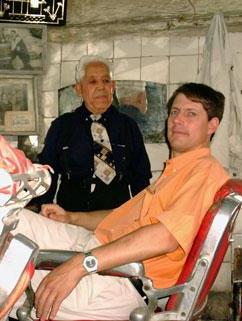
VOA's website chose this image (by Stephen Glain) after I sacrificed my hair to interview a barber who said he'd trimmed the last King of Iraq and once had the young Saddam Hussein in his shop
Luckily VOA interviewer Hülya Polat then let me talk about Dining with al-Qaeda, which was more fun (here),before handing me on to VOA’s veteran Egyptian broadcaster Mohamed Elshinnawi to talk about it for VOA’s English-language outlets. Elshinnawi is one of those soft-spoken, gentle interviewers that makes a guest feel like a million dollars — and that they’re talking sense too. (The interview is here, although the voice-over is not Elshinnawi’s). But I realized he was drilling down on something not many people notice: there’s not much about Egypt in the book, even though I lived and worked in Cairo for nearly a year as a student, English teacher, reporter and guide for French tourist groups up and down the Nile. I explained that Egypt was obviously a big Middle East country, but that I felt that the limitations of authoritarian military dictators since 1952 had deprived the country of much socio-political meaning beyond its own borders. Aha, Elshinnawi replied, and brought me up to date on the rise of the digitally-empowered opposition of Mohamed ElBaradei.And I have to admit that it is a fascinating new turn of the Middle Eastern kaleidescope.
As a good Middle Easterner, Elshinnawi gallantly drove me to my next destination, the New America Foundation. Here Amjad Atallah of the think-tank’s Middle East Task Force introduced me before I was interviewed by Foreign Policy magazine editor Susan Glasser (Middle East Channel’s transmission of the event can be watched here or here; Foreign Policy also ran an excerpt of Dining with al-Qaeda, in which I seek out a Yezidi fortune teller during the Iraq war,here). The genuine enthusiasm for the book expressed by both Atallah and Glasser – the latter a former war reporter for the Washington Post, who tramped up to the Afghan heights of Tora Bora during the 2001 war – was thrilling. It certainly communicated itself directly to the relatively large audience, resulting in the only time on the book tour where all available copies of the book sold out. Adam Cheny of the Washington Report on Middle East Affairs reckoned it was done with ‘intelligence and wit’ in his review of the event here.
A really good crowd turned out in the evening for a talk at Washington DC’s Politics & Prose bookshop, including many old friends. I realized how lucky I had been to get this fixture – the venerable owner said she turned away three out of four applicants. C-Span filmed our proceedings. Afterwards retired Brooklyn congressman and early Crisis Group fund-raiser Stephen Solarz and his wife Nina took me out to dinner — Solarz having just finished his own book full of insights into his 18-year career as an activist member of the Congressional Foreign Affairs Committee, where he used his position to travel the world and do remarkable work in seeking ends to conflicts.
I then went over to have drinks with another friend who’d come to the book launch, and who was just off to Afghanistan to join USAID. Opposite me was a U.S. Navy officer, a Navy Seal decorated so often in seven years’ service in Afghanistan and Iraq that his dark uniform jacket seemed to be weighed down to one side (it still seems strange to me that the navy would send its best men to the deserts of Iraq’s al-Anbar province and to Afghanistan, which barely has any water let alone access to the sea). It turned out to be one of the most remarkable conversations I had in the U.S. He had fully understood how the U.S. must now take responsiblity for Muslim symbols since it is in charge of Muslim countries, saw the price the U.S. pays for Israeli actions against Palestinians, and had an articulate and clear-eyed view of the dead end that Israel’s own policies are in. If he is as high up in the Pentagon as he looked as though he must be, things are really changing. For sure, in the future, American Middle East experts are also going to be very thick on the ground.
The next morning I headed straight after breakfast to MSNBC’s TV studio to appear on the Joe Scarborough Show. I’d forgotten it would be one of those TV link-ups. This wasn’t quite the tiny cupboard of some TV studios, but still it was disorienting. Luckily a bright intern from Crisis Group, Melissa Haw, was there to keep me on track. The biggest trouble I find in these dehumanized studios is not looking at myself on the monitor, which shows the interviewee making his panicked hand-wavings after a distracting second-long delay. So I got Haw to stand right beyind that deep, dark, all-swallowing eye of the TV camera, so that I had a pair of real eyes to lock onto as I told my story and keep my mind focused on the questions coming through a tinny earpiece. It was the usual high-pressure business and I remember nothing of it – save that in the corner of my eye I was happy to see the television station making intelligent insertions of pictures from the book.
My next engagement was to do a formal speech on Turkey’s relations with the EU and Cyprus at the Brookings Institution. Professor Ömer Taşpınar introduced me and then set me loose (the 1h17min audio can be heard here or a transcript skimmed through here). Since I was due to talk about Turkey’s relations with the Middle East the next day at the Middle East Institute, here I was able to do full justice to Turkey’s westward-facing side. It’s always difficult to explain how a country can be two things at once, but I guess that’s easier than Iran, which I sometimes think is trying to be half a dozen countries at the same time.
Kojo Nnamdi
I then headed out to do a live discussion with one of Washington’s best-known intellectual radio hosts, Kojo Nnamdi. His gentle, off-beat Guyanan accent framed quietly probing questions, slowed me down and the recording is one of my favorites from the trip (on line, on CD, or in transcript here). “Now a lot of us are listening,” Kojo said of the new American readiness to consider alternative perspectives in the Middle East, “and a lot of us might be reading Dining with al-Qaeda.”
Juliette Tolay, Joshua Walker, Kemal Kirişçi, Nathalie Tocci & Hugh Pope in a 2002 Baghdad necktie (photo courtesy Anna Murphy)
My next stop was one I’d been looking forward to most, in fact it had been the first place to offer to host an event. In the Fall of 2009 I briefly enjoyed the longest title in my career – Bosch Public Policy Fellow of the Transatlantic Academy of the German Marshall Fund of the United States – and was looking forward to seeing my fellow Fellows again at the Academy for a book presentation and celebratory drinks. I was not disappointed. In the longest, warmest and most strikingly empathetic introduction of the whole tour, my presenter and fellow Academician, Kemal Kirişçi, showed he had clearly read and completely understood the principal aims of my book – to humanize the Middle East for American readers, to take people alongside me into all the places I’d been and to show what exactly life as a foreign correspondent is like. I was especially touched that Kirişçi should have found new perspectives in it, since is of Turkish heritage and is an expert who has devoted an important part of his career to studying the Middle East and its influences on Turkey.
Afterwards I rode the Metro out to Rosslyn for an interview on News Channel 8, the Washington DC affiliate of ABC where I was to appear on a local show called Federal News Tonight. The shiny building had a giant screen outside, silently transmitting to the traffic what transpired within. I was early and was asked to settle down in the pleasantly laid-out lobby by Frank, the African-American doorman, tall as a basket-ball player and half as broad as a bus. He had taken along the role of enaging in jocular repartee with nervous guests waiting to go on. Intentionally or not, this certainly broke the ice. We were soon joking about the headline in the Washington Post that morning about a ‘political-military offensive’ in Afghanistan. I joked: “What are they going to say when the F-16s come over? ‘It’s okay, don’t take cover, that’s just a political-military warplane!’” Frank gave as good as he got in an extraordinary, coherent mix of tight jive language and intelligent college education. “That’s right, don’t you worry, it’s of them po-litical bombs. Oh my.” I had some of the best fun I had all week until he guided me onto the set. Federal News first told its audience about the ‘gunslinger,’ a new weapon for America’s Middle East wars. When the clever, sympathetic newscaster brought me on (here), I referred back to the ‘gunslinger’, making the point that fancy weapons that could wipe out an Afghan village without having to put one’s head out of one’s tank were all very well, but a bit of thought and empathetic understanding of the human dimension of the place would probably be a better long-term plan. All went well, but my book tour was beginning to feel a bit of a blur. Looking forward to a cheery fairwell from Frank, I left all my speaking notes for the rest of the week at a sidetable at TV8.
The next morning was a double bill with Gönül Tol’s Turkey programme at the Middle East Institute. First up was a talk about Turkey in the Middle East, in which I suggested that the West might consider adopting elements of Ankara’s new approach to build stability, interdependence and free trade first, and leaving magical flips to democracy until later. Then came another chance to talk about Dining with al-Qaeda,and enjoying the agreeable sense that most of the MEI audience, well versed in the reality of the region, were sympathetic to my point of view. The talks are posted on MEI’s site on YouTube, directly visible here in most countries, but not in Turkey, which chooses to show its Eastern side by banning the film-sharing platform.
Lunch was in a private room in Johnny’s Half Shell, a restaurant just over a lawn from the grand white dome on Capitol Hill. Maia Comeau of the German Marshall Fund had invited me to present the book to some 20 staffers for congressmen and senators who came to hear me speak over some unusually excellent roast chicken. Among many of those who came, however, I found that the real hunger was for fresh approaches to the Middle East. I noticed especially focused note-writing when I tried to set out why I thought sanctions and America’s 30-year-old blood feud with Iran were so counter-productive – and showed how much there was to say for Turkey’s policy of engagement, including visits by an annual 1.3 million Iranians to see a prosperous Muslim democracy (mostly) at peace with the world.
Three more television shows wound up the tour. The first with America Abroad Media, which supplies in-depth programming to a wide range of television stations around the world. It was a bit hard to be truly wise since I felt so bad for one of the cameramen awkwardly nursing his arm — he was in great pain after falling off a table as he tried to block a noisy air-conditioning duct. Cameraman Javier Barrera later wrote in to post a comment (below) to say he had “broken my elbow and wrist on my left arm and thumb on my right hand, but I didn’t want a few broken bones to disrupt our interview with you for our program”, injuries that are far more severe than I ever managed to clock up in the Middle East. That seems pretty heroic commitment to our trade, and Barrera kindly also forwarded the AAM interview here.
Hugh Pope and Chris Isham
Then I joined CBS Washington Bureau Chief Christopher Isham for an interview about Dining with al-Qaeda for the ‘Washington Unplugged’ webcast (here) that he introduced to the network. The show proved how the Internet allows a traditional broadcaster can now spend quality time (14 mintes in this case) presenting a non-mainstream point of view. Isham – the man who organized the first major network interview with Osama bin Laden in 1998 – called my book “very intriguing”. He then let me sink or swim, allowing me to say things about Israel, Iran and U.S. policy that would have had me shooed off screen not so long ago. Too bad I fluffed my line about the cat and mouse games of dictatorship in the Middle East! For the record, the old Arabic proverb is ‘The tyranny of the cat is better than the justice of the mouse.’
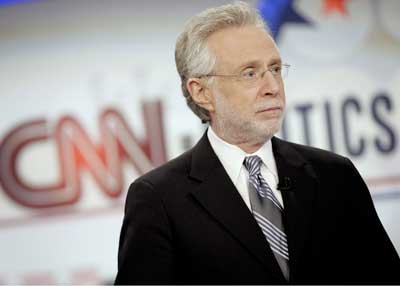
The book tour’s last media stop was Wolf Blitzer’s show on CNN called the ‘Situation Room’. I got there half an hour early and spent it waiting in what several TV stations seem to call the ‘Green Room’, where guests anxiously cool their heels and rehearse their lines. I watched the ‘Situation’ as portrayed from a studio set that gives the impression that one is in a spaceship hovering over Washington. First up was a scare-story on how Iran was supplying weapons blowing up Americans in Afghanistan – a Pentagon-sourced bill of fare full of pictures of mines and weaponry, and, of course, a subtext of how justified it was to see Iran as the mortal enemy of the U.S. Then banners under the screen announced my later appearance as a Middle East explainer. But how could I counter the cumulative impact of the on-screen accompaniment? The show kept up a rolling loop of that unfocused, tired old film of that al-Qaeda training camp in Afghanistan, with all those misguided young men doing their paces around a 19th century obstacle course. For the folks in the ‘Situation Room’, the whole world beyond Washington seemed to be an al-Qaeda training camp.
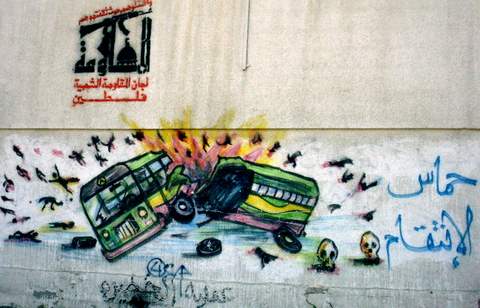
Amid the many high-powered cameras, bright lights and tall handsome stage hands exchanging coded hand-signals, Blitzer was kind enough to put me at my ease. Indeed, he was to prove tolerant and honestly permissive, if not quite encouraging, about my point of view that the West was also part of the Middle East problem. He began by telling viewers it was a ‘good book’, and then asked me to look a picture on the light-box wall to the left. Oh no! I thought. But yes, Blitzer’s first question was about that recent Moscow metro bomber again. All I could do was slide to the question of what originally motivates such people to get involved with terrorist groups. As the picture I put in the book of pro-Hamas graffiti in Gaza depicting an exploding Israeli bus showed, I tried to explain, the motivation was not usually global jihad or 72 virgins in paradise, but what was written next to the blasted bus: Revenge!
Hamas graffiti in Gaza – 'Revenge' (Photo: Hugh Pope)
Blitzer bid me a gentlemanly farewell – modestly spelling out his famous name for me while I signed his copy of the book – and the tour was over. Time for a celebratory party at my hosts Christina Balis and Stephen Glain — my remarkable predecessor as Middle East correspondent of the Wall Street Journal, and soon to publish a new book called The Sixty-Year War on the scourge of militarism in U.S. foreign policy. Writing these lines four weeks later, I realize I still have not really recovered from the concentrated intensity of those five days of talking all the time. But many thanks once again to everyone who helped me to put the word out so energetically and to make it so much fun!
This interview about Dining with al-Qaeda with Hülya Polat of VOA’s Turkish service features a photograph in 2002, taken as I sacrificed my hair to win insights from a whip-saw handed barber in central Baghdad. He claimed to have trimmed the locks of the pre-1958 King of Iraq, to have had the young Saddam Hussein in his shop in al-Rashid Street, and to have done the hair of British officers from the days of the monarchy … unfortunately my sartorial sacrifice was pretty much in vain since reasons for his survival clearly included his eccentric vagueness.
Hugh Pope’dan Yeni Kitap: “Dining with Al-Qaeda”
Hülya Polat | Washington
06 Nisan 2010
Hülya Polat | Washington 06 Nisan 2010
Foto: Stephen Glain
Uluslararası Kriz Grubu Türkiye/Kıbrıs Direktörü olan ve 25 yıldır İstanbul’da yaşayan Hugh Pope, uzun yıllar Wall Street Journal, New York Times gibi büyük Amerikan gazeteleri için muhabirlik yapmış. Pope karşılaştığı en büyük zorluğun Batı’ya Türkiye’yi ve Ortadoğu’yu anlatmak olduğunu söylüyor. Amerika’da piyasaya çıkan “Dining with Al-Qaeda/El-Kaide’yle Yemek Yemek” adlı yeni kitabını tanıtmak amacıyla geçtiğimiz günlerde New York ve Washington’da konuşmalar yapan Pope, Hülya Polat’ın sorularını yanıtladı.
Gazeteci-yazar Hugh Pope’un yeni kitabı “Dining with Al Qaeda” “El Kaide’yle Akşam Yemeği” (El Kaide’yle Yemek Yemek) piyasaya çıktı. Ortadoğu’da Arapça, Farsça ve Türkçe öğrencisi ve araştırmacı-gazeteci olarak 30 yıldan fazla süre geçiren Pope, yıllardır İstanbul’da yaşıyor.
Hugh Pope’un son kitabına “El Kaide’yle Akşam Yemeği” adını vermesi, reklam ve pazarlama hilesi değil. Pope, gerçekten de 11 Eylül 2001 terör saldırılarından kısa süre sonra El Kaide üyelerinden biriyle yemek yemişti. O zaman Wall Street Journal gazetesi için muhabirlik yapan Pope, uçakları kaçıran Suudi vatandaşları hakkında daha fazla bilgi edinmek için Riyad’a gitmiş ve intihar saldırısı düzenleyenleri ölüm misyonuna hazırlamakla sorumlu genç bir militanla görüşmüştü. Pope bu olayı şöyle anlatıyor:
“Afganistan’daki kamptan gelen militanlardan biriydi. Bana Amerika’daki misyona hazırlanmadan önce Afganistan’daki kampta eğitim alan militanları anlattı. Yarısından çoğunu tanıyordu ve yaptıkları saldırı için onları takdir ediyor, ‘harika çocuklar’ olarak tanımlıyordu.”
Courtesy: Hugh Pope
Hugh Pope, militanın kendisini öldürmemesi için Kuran’dan ayetler okumak zorunda kaldığını, oldukça gergin bir ortamda başlayan söyleşinin sürpriz bir şekilde samimi bir akşam yemeğiyle son bulduğunu söylüyor. Pope, bu yemekten sonra Ortadoğu’daki farklı dünyaları Amerikan halkına tanıtmak için duyduğu isteğin yeniden alevlendiğini belirtiyor:
“Amerikan halkına gazetecilerin büyük çoğunluğunun dürüst olduğunu, gazetelerde okudukları haberlerin çoğunun doğru olduğunu, ancak hikayenin burada bitmediğini anlatmak istiyorum. Başka bilgi kaynaklarını da araştırmalı, elinizdeki verileri başkalarıyla karşılaştırmalı, duyduklarınız hakkında düşünmeli ve konulara farklı bakış açılarından bakmayı öğrenmelisiniz.”
Hugh Pope, “Bölgede geçirdiğim 30 yıl boyunca öğrendiğim en önemli şeylerden biri, Ortadoğu’nun sadece İslam dünyasından ibaret olmadığını anlamaktı,” diyor.
“Dünyanın neresi olursa olsun insanları tek bir etiket altında toplamanın zararlı olduğunu düşünüyorum. Örneğin kitabımda kullandığım tekniklerden biri, İslam kelimesini kullanmaktan mümkün olabildiğince kaçınmak oldu. İslam kelimesini kullandığınızda herkes farklı bir anlam çıkarıyor. Bir ülkeyi, hatta İslam dünyasını sadece tek bir özellikle tanımlayamayacağımızı göstermeye çalıştım.”
Gazeteci-yazar Hugh Pope, hukuk sistemi şeriat olan ülkelerin şeriat kanunlarını çok farklı şekillerde uyguladığına dikkati çekiyor. Yazar, Amerika karşıtı İslam rejimi tarafından yönetilen İran’da tanıştığı birçok İranlı’nın Amerika’yla çok daha yakın ilişkiler kurmak istediğini gördüğünü belirtiyor.Pope kitabında ayrıca nüfusunun çoğunluğu Müslüman olan Mısır ve Türkiye’deki laik hükümetlerin geldikleri farklı noktaları da değerlendiriyor.
“Türkiye’nin Avrupa’ya açılan bir penceresinin olması ve İsrail’le komşu olmaması büyük şans. İsrail’in Mısır’daki gelişmeye sekte vurduğu çok açık. Albay Nasır 1952’de Mısır’da niçin başa geldi? 1948 İsrail Savaşı sırasındaki yenilgi ve İsrail’le olanlar nedeniyle ulusal çapta bölünme duyguları hakim olduğu için. Ne yazık ki Mısır’daki baskıcı yönetim, Mısır halkının neler başarabileceğini göstermesine engel oldu.”
Hugh Pope, Ortadoğu araştırmalarına hakim olan tipik akademik yaklaşımın ve gazetecilerin bölgeden geçtiği haberlerin Amerikan halkına Ortadoğulular hakkında olumsuz ve gerçekdışı bir tablo sunduğunu söylüyor.
“Herkes artık Ortadoğu’yu sanki bir hayvanat bahçesi, karmakarışık yabani hayvanların toplantığı bir yer gibi görmekten vazgeçmeli. Hepimiz insanız, hepimiz aynı şeyleri paylaşıyoruz. Örneğin her yerde erkek çocukları arabaları sever, kızların da benzer zevkleri vardır. Ortadoğu’ya olan bakışımızda eksik olan, insan unsurunun görünmemesi. Medya hep en garip, en korkunç haberleri, hikayeleri aktarıyor.”
Hugh Pope, Amerikan kamuoyuna bölge hakkında daha doğru ve eksiksiz bilgi vermek için medyayı kullanan eğitimli Ortadoğulular’ın sayısının artması nedeniyle iyimser. Yazar ayrıca Başkan Obama’nın İslam dünyasıyla diyalog kapısını açarak Amerikan halkının Ortadoğu’nun birçok yönünü görmesini sağladığı için de memnun. Başkan Obama, bir yıl önce Türkiye’de yaptığı konuşmada Amerika’nın İslamiyet’le savaşmadığını, İslam dünyasıyla ortaklık kurmak istediğini söylemişti. Türkiye ziyaretinden iki ay sonra Mısır’a giden Başkan Obama, Kahire’de yaptığı konuşmada da, Amerika ve Müslümanlar arasında yeni bir başlangış arayışı içine girme sözü vermişti. Hugh Pope Başkan Obama’nın İran’a da açıkça el uzattığını söylüyor.
Deneyimli gazeteci, yeni kitabını okuyacak Batılılar’ın Ortadoğu ülkelerini yeni bir bakış açısından görecekleri, Ortadoğu halklarının sesini daha yakından duymaya başlayacakları konusunda umutlu.
“Kitabımın Ortadoğu’nun ne anlama gelebileceği konusunda fikir ve bakış açıları sunan bir kaynak olmasını istiyorum.”
Hugh Pope’un “Dining with Al Qaeda: Three Decades of Exploring the Many Worlds of the Middle East” “El Kaide’yle Akşam Yemeği: Ortadoğu’daki Birçok Dünyayı Keşifle Geçen 30 Yıl” adlı kitabı, St. Martin Yayınevi tarafından piyasaya sürüldü. Hugh Pope da Amerika’da Washington ve New York’ta imza günleri yaparak kitabını tanıttı.
An interview about Dining with al-Qaeda with Christopher Isham of CBS news for the network’s ‘Washington Unplugged’ webcast (here) shows how the Internet allows a traditional broadcaster can now spend quality time showcasing a non-mainstream point of view (14 minutes in this case). Isham – Washington bureau chief for CBS and the man who organized the first major network interview with Osama bin Laden in 1998 – called my book “very intriguing”. He then let me sink or swim, allowing me to say things about Israel, Iran and U.S. policy that would have had me shooed off screen not so long ago. Too bad I fluffed my line about the cat and mouse games of dictatorship in the Middle East. For the record, the old Arabic proverb under the title of Chapter 12 (‘The Central Bank Governor Has no Socks’, about Afghanistan and Pakistan) is ‘The tyranny of the cat is better than the justice of the mouse.’
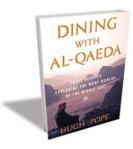 The Istanbul launch of Dining with al-Qaeda will take place on at 4pm on Thursday, 16 September 2010, at the Istanbul Policy Center in Karakoy, the heart of the grand old Ottoman banking district. Co-hosts are the Istanbul Policy Center, Hurriyet Daily News and Homer Bookshop. The introduction will be by Joost Lagendijk, the former Euro-MP from Holland and one of Europe’s most famous faces in Turkey, now at Sabanci University. Author Hugh Pope will sign copies and give a talk about the book too. Below is a map with the formal invitation from HDN’s Michael Wyatt. All are welcome to come along, just RSVP to the address below!