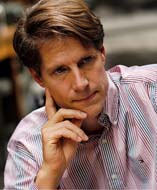
Writer of books on Turkey, the Middle East and Central Asia. Formerly Director of Communications & Outreach and Turkey/Cyprus Project Director for International Crisis Group. Ex-Turkey & Middle East staff correspondent for The Wall Street Journal.
If there’s one subject that’s tough to get right concerning Turkey these days, it’s Ergenekon. Yet Sophie Roell went straight for it when she interviewed me about my five favorite books on Turkish politics for The Browser (read all about them here).
Ergenekon is the catch-all name for alleged deep state bureaucratic-military plots against the government, including the complex of court cases marshaled up in the past two years to punish the supposed conspirators. For me, though, it is more like a blood feud between Turkey’s old and new rulers. On one side are the secularists of the Turkish Armed Forces and their companions in old elite who founded the Republic of Turkey, and on the other the popular conservative/religious Justice and Development Party, often newly urbanized folk who have been in power since 2002.
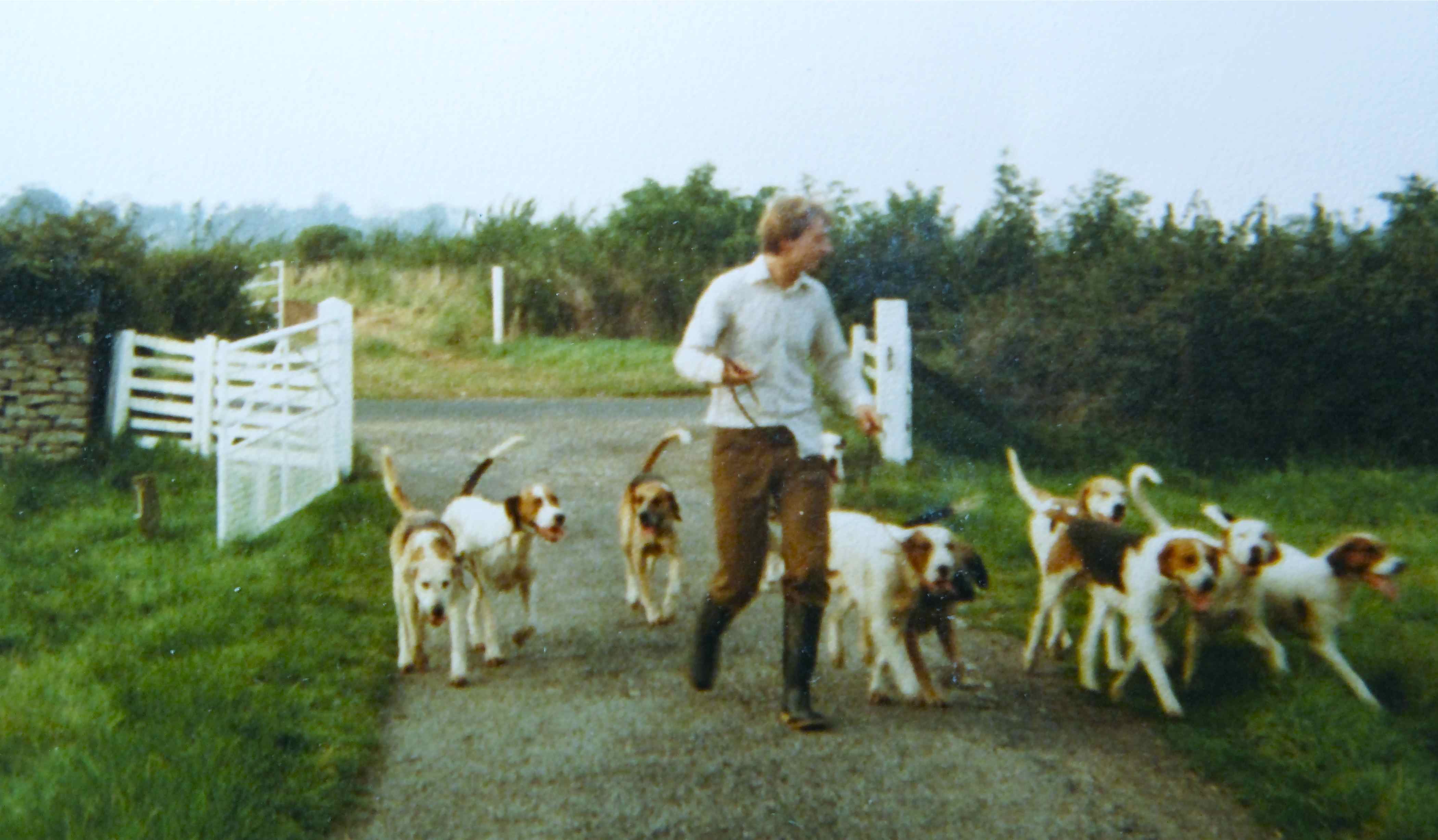
Another way of looking at Ergenekon is class war. Broaching the Ergenekon issue at a Turkish social gathering is like trying to have a rational discussion about fox hunting at a London dinner party – soon everyone is shouting angrily at each other and nobody knows quite why. One difference with London fox hunting debates, in which the participants have usually been nowhere near a 6 a.m. meet on a frosty English morning, is that Ergenekon discussants often feel they have either been in the position of the fox or the hounds.
John Sunnucks and his hounds, too long ago to admit
This is actually no joke to experience, as I learned when my university friend John Sunnucks asked me innocently many years ago if I’d like to be the fox for his pack of beagles. I thought it meant a bracing cross-country run through pleasant English fields. In fact I had to drag a sack of smelly urea up brambly hill and down muddy dale, soon realizing that the head start I’d been given was nominal and that baying pack was catching up. I was truly scared when the dogs came in sight behind me.
This experience is not enough, of course, to make me understand how the partisans of the current prime minister Recep Tayyip Erdoğan felt in 1997 and 2007 when the armed forces and whole system ganged up on them, throwing or trying to throw them out of jobs, out of politics and sometimes into jail. The current Ergenekon investigations are also putting officers, well-known journalists and people well past retirement age behind bars. In both cases, the judiciary has shown its unfortunate tendency to side with the powers that be, to confuse smoke for fire and to count intent as action. The consequences have often been personally devastating.
Most of Sophie Roell’s questions related to the particular case of retired general Çetin Doğan, accused of being ringleader of a plot known as “Sledgehammer”, a subset of the supposed Ergenekon conspiracies. Her attention had been caught by the high-profile campaign of Çetin Doğan’s son-in-law, Harvard professor Dani Rodrik, which exposes apparently flimsy evidence and inconsistencies in the case .
I remember Gen. Doğan as Turkey’s gentlemanly number three military chief. It was February 1997 and I was his guest at General Staff headquarters, a place where immaculately groomed, heel-clicking conscripts swept in and out with trays of fine Turkish tea, dried fruits and nuts. I was part of a group of mostly American correspondents who spent a week being briefed by several officers at the pinnacle of the service, a moment of openness that was astonishing at the time. “Traditionally, we have been a bit reserved, like a Turkish man,” Gen. Doğan told us.
In retrospect, the briefings about supposed Iranian and Islamist threats – some by officers now on the suspect list in the Ergenekon case — were likely preparing us for what was happening. Some weeks before, the army had run a column of tanks through a township near Ankara, an implicit threat that had put everyone on edge. A few days later, on 28 February 1997, the military read out a list of demands in a marathon National Security Council meeting. Within a few months, the government of the pro-Islamic Necmettin Erbakan had collapsed. Public accountability for this and other actions of the army of which Gen. Doğan was a part is only in its infancy. In the 1980s, especially the coup years of 1980-83, torture was routine in army-run jails. In the 1990s, hundreds of Kurdish nationalists were killed by shadowy death squads that probably operated under armed services cover.
Which all makes Ergenekon hard to judge, especially if one has no direct experience of being a fox or the hounds. When I turned to face John Sunnucks’ hunting pack, as they caught up with me half way across that lumpy English field, all they did was mill around me in a happy, panting tumult. They then made me feel ridiculous by licking my legs.
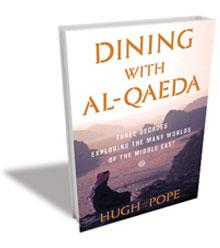
This English version of Dining with al-Qaeda‘s review by Francis Ghilès – a leading authority on Algeria and the Magreb – was printed in the winter 2010/2011 edition of Afkar/Ideas, a bilingual Spanish/French publication of Madrid’s Estudios de Política Exterior and Barcelona’s European Institute of the Mediterranean (IEMed).
A fascinating exploration of the many worlds of the Middle East
By Francis Ghilès
This is the story of Hugh Pope’s wanderings from Afghanistan to Sudan through the Middle East and Turkey where he is currently based with the International Crisis Group: it is a self deprecating voyage which starts when a young student in Persian and Arabic has been turned down for a job in the Middle East by a bank in the City of London and the UK Foreign Office and decides to become a journalist a very challenging region indeed. He starts in Syria in 1982 after accepting the invitation of a French academic, Jean Paul Thieck who is conducting research in Damascus. The first few weeks offer the budding journalist a crash course in Middle Eastern mores and politics which no western university could provide. His host’s boundless curiosity, dare devil behaviour, enthusiastic homosexuality quickly teach the naïve student “how to use a magic cloak of unprejudicial openness” as he tries to understand a country which is simply incomprehensible when seen through western stereotypes.
An early encounter with the famous reporter Robert Fisk teaches him how well known reporters can embellish quotes, fills in facts that never existed to “make the story fly, preferably onto the front page.” This art was not however practised by serious journalists. Pope also explains very well “the extraordinary power of Arab rhetoric to make facts redundant, conjure up meaning out of nothing, and camouflage intolerance with rampant grandiloquence.” The author’s prose is elegant and self deprecating throughout.
He raises essential questions about the practise of modern journalism and how we in the West understand our world. From discussions with young Iranian soldiers on the war front with Iraq to Kabul and Kurdish freedom fighters he illuminates the multilayered conflict of the region in a way many scholarly books fail to do. Why do so many senior decision makers in the West fail to understand the Middle East? Because they see it through the eyes of Israeli experts or Arab exiles. “The many wars and revolutions of the past century (have) destroyed existing societies” instilling an endemic sense of instability which Turkey alone has escaped.” The youth of the region “if they had wings, would fly out.” A weariness born of countless deceitful foreign interventions” weighs heavily on everything in the Middle East.
The author explains how he often failed to get analytical pieces published in the Wall Street Journal for whom he worked later because they simply did not fit the prejudices and narrow news focus back at head office. He is candid about the contradictions of the trade, the difficulty of describing events in countries where verifiable facts are few and far between. Knowledge of the inner sinews of society, boundless curiosity and speaking the language are thus essential prerequisites for any serious analysis. Hugh Pope also highlights features which make life so trying for ordinary people such those waiting to cross borders: “their faces locked in expressionless submission to the God of Border Crossings.
The piece de resistance is a quote from a Saudi intellectual who tells the author over a private dinner in Jeddah: “The Wahabis say, “’al-Qaeda is not us’ and it’s believable. But for me the difference it is the difference between Marlboro and Marlboro Light.”
Here’s an interview about Dining with al-Qaeda that I liked well – and hope that it wins the book many readers in central Europe! It’s from Slovakia’s magazine “Zahraničná politika“, or Foreign Policy.
Hugh Pope:
—
Západ by mal prejaviť viac zodpovednosti
—
Lucia Najšlová
20.10.2010
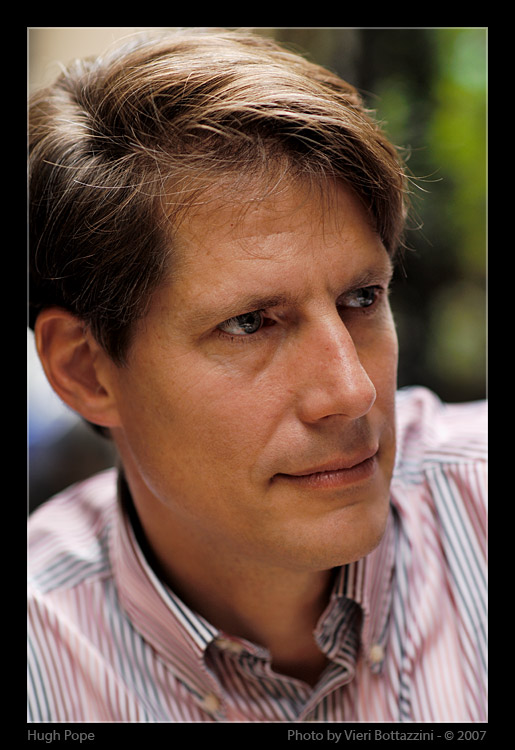
Photo by Vieri Bottazini
V knihe spomínate články, ktoré bolo treba prerobiť, aby boli prijateľnejšie pre americké publikum. Ako editor určí, čo je prijateľné, a čo už nie? Najmä ak je článok o téme, o ktorej čitateľ nič nevie?
Nuž, zjavne je to umenie, nie veda. Popularitu článkov dnes môžeme posúdiť podľa toho, koľkokrát si ich niekto stiahne. Ale stále je tu funkcia informovania verejnosti – veci, ktoré by ľudia mali vedieť, aj keď nie sú populárne. Aj editori môžu byť veľmi nezávislí ľudia. Čo považujem za najzvláštnejšie, je to, že kým som nezačal písať knihu, neuvedomoval som si všetky sily, ktoré na mňa pôsobili. Pretože keď ste novinár, ide vám hlavne o to, aby Vás publikovali. A aby ste sa dostali na titulku, ste pripravení akceptovať, že niektoré veci redaktor škrtne. Za normálnych okolností rátate s tým, že z rozličných dôvodov pôjde von asi 20 % článku, ale zvyšných 80 % za to úsilie stojí. O čom som začal rozmýšľať neskôr, najmä pokiaľ ide o Irak a Stredný východ, je, že v rámci tých 20 % boli veci, ktoré sme vynechávali systematicky. A vždy, keď sme vynechali jeden z týchto nepríjemných faktov, len sme pridávali ďalšiu tehlu do múru nevedomosti, ktorý stál medzi americkým publikom a realitou Stredného východu. [Full text here]
Hugh Pope: The West should show more responsibility
By Lucia Najšlová
Reading your book is also a bit of a journey through technologies available to journalists in the span of the last 30 years. What was the impact of the technological advance on the quality of reporting?
Buy from Amazon.com
The quality of the reporting depends on the person doing it. I don’t think that there is less or more of it. Certainly the consumers have now vastly more access to information. At the time I started out, you could be in the Middle East, and even be the person in the middle of something, but you did not understand anything, because there was no information about what was going on. Now you can really know a lot and be much more sure about the background information. Wikipedia for instance is something that is astonishing. I think the challenge comes in – and it’s always been there – in challenging preconceptions. All newspaper articles are based on the idea that you are giving fresh information to the reader. Often I used to treat that as an opportunity to change the prejudices of the reader – and there you face the same problems as you ever did. If you challenge it too much, the reader stops reading.
So how do you know when it is too much?
Normally, when the editor shouts at you. (laughs)
In the book you frequently refer to some texts that had to be remade so that they would be more acceptable for the American audience. How does the editor know what is acceptable for the audience and what is not? Especially if the article is about things which the audience does not know anything about.
Well, it’s an art, not a science, obviously. What is popular in the press nowadays can be judged by the number of times an article is downloaded. But there is still a public information function – that people should know this, even if it’s not popular. Editors can be very independent people as well. Mostly, what I find strange is that all the forces acting on me were not apparent to me until I started writing the book. Because when you are a journalist, you are mainly concerned with getting published. And in order to get on the front page of a newspaper, which was my job, you were ready to accept that certain things would be edited out. Normally you accept that maybe 20 percent of your original article would be lost for all kinds of reasons, but that the 80 percent that goes in would be worth the effort. What I later came to think about, especially as it has to do with Iraq and the Middle East, was that within these 20 percent were certain things that we kept leaving out. And each time we left out one of these uncomfortable facts, we were adding another brick to a wall of ignorance between the American reader and the Middle East reality.
You came to Middle East after studying Persian and Arabic, one of your goals was a bit idealistic – to help to bridge the communication gap. Yet, many would consider you to be an agent.
Portraying me as an idealist is going a bit far – I was seeking a role in life, I was seeking adventure, as well as believing there was a gap that needed to be filled and that I would like to fill it. But I had no clue about what it was all really like. The Middle East is not really well known today but 30 years ago it was even more difficult to get to grips with it. I have described in the book how I resented being considered an agent of the governments that, I began to see, have done a lot of damage to the Middle East and how I had to resist offers from governments to work with them. And then I gradually realized that many of the people I knew were actually spies. And therefore I believe that the Middle Easterners had a reason to believe that people are spying on them.
So, how were you coping with it?
First of all, I was always very insistent that I was not a spy. I thought it was very important, because it gave me the right to ask. If I knew I was innocent, I had the right to ask questions from a broad range of people. I could look them in the eye and say I have no government agenda, I’m just writing about the situation. And I think this protected me a great deal, especially when I got into a situation when I was actually dealing with someone who thought that I should be killed, because he thought I was out there to kill him. To persuade somebody like that, you have to be able to radiate innocence.
That does not seem to help in every situation.
It lasted pretty well until I reached the Iraq story, which was 25 years after I started. There I began to realize that it was really dangerous. Danny Pearl, who worked with me in the newspaper, was never a spy. He was only trying to plug the information gap. But because he was Jewish, they did not believe him and cut his head off. That was one strike against my sense of invulnerability. The other strike was seeing the US and Britain going into war with Iraq, a war which appeared to have only a cotton thread of legitimacy, and which would do a great deal of damage to Iraq. Seeing how traumatized the Iraqis were, and realizing that working for an American newspaper that supported the war, carrying a British passport, I had no protection anymore, I felt I had run out of innocence. And why was I doing it anyway? I was the only reporter for the WSJ going to Iraq before the war, they published all my stories, but I could never get through, I could never break through and explain, in my relatively short stories from Bagdad, why it was mad to invade Iraq. And yet at the same time big stories were going every few days on the op-ed side, explaining, why it was a wonderful idea.
Let’s get back to the Middle Easterners’ fears – you say it is understandable that Middle Easterners are mistrustful of foreigners, because some of them are agents, and Western governments did a lot of damage to the region. But is it not the same stereotyping, as when the Westerners think of all Muslims as terrorists?
You are right, I hadn’t thought of it like this, it is a mutual prejudice, and, how prevalent is either prejudice is a good question too. I’m not sure if I was aware of it in the early years, but certainly I came to the position that I would almost refuse to use the word Islam in a report, because I felt that anyone reading the report would understand the use of the word Islam differently. It’s not a good analytical tool. There are all kinds of different ideas about it. I would get calls from my editors saying ‘what does the Islamic world think of this or that’ and you are kind of forced to construct an artificial Islamic world that is thinking about 9/11 or some other attack. And the other thing is the way the Western world tries to view the world as blocks. They are always trying to fit Turkey into bloc – is it in Europe, is it in in the Middle East? Eurasia?
Is that only Western thinking? Do not people here view the West as a unified bloc?
Yes, the bloc perception is also here, but I do think, that the richer, more powerful, better educated countries have the responsibility to set an example.
You mentioned Danny Pearl. In the book, you write about his funeral, where the speakers would be mentioning how nicely he played violin, but no one mentioned the part of his struggle for East-West understanding that might be critical of the West. In popular imagination, the job of a foreign correspondent is a one of adventure. In reality though, there is as well a lot of danger and inconvenience and often the work goes under-appreciated. How were you digesting this?
I was not aware of it. You know, as a working person, you always try to do your best, if it does not work out this time, you try again and … as I said the Journal was a great newspaper. You could get most of the stories in. The frustration is when you realize is that there is a pattern of things you are leaving out and, you are able to change peoples’ ideas a bit, but it’s frustrating to always have to be dressing up the information, as if it’s entertainment. And then, the turning point was the Iraq war.
I was very depressed and very unhappy during that period. Mainly because I felt that there was no trust left between me and the people I was going to report on.
If you compare working for the Journal and now working for ICG, a newspaper and think-tank. Do you feel you have more influence now?
Absolutely. But firstly, I could not do the work that I do now for the ICG if I hadn’t spend 25 years as a journalist learning about information processing, learning about writing, learning about what makes people think. Because I knew nothing when I graduated from university, I was hopeless, I really didn’t understand anything. I learned it all from other people. The most depressing thing for me, and illustrating my complete naïveté, was, that when I left journalism and became a think-tanker, some diplomats started inviting me for lunch saying ‘Oh, Hugh, at last I can talk to you, you are not a journalist anymore’. I was was shocked. Thoughts ran through my head like ‘I never realized that. I didn’tt know you were “not talking to me” when I used to come and see you!’ And then, we’d have lunch, and they would tell me the same thing that they would tell me as a journalist, but now with a very different approach, because they would listen to me, what I was saying. That’s also new.
So you see the direct impact of your work now?
Yes. Our reports for the Crisis Group can take 3 to 6 months to produce, and we talk to 50 or 100 people for each one. They are field-based. You really are empowered by the number of people who you have talked to – you can see the direction where the trend is going. When you communicate it to a government official, who is usually dealing with lots of stuff, you can say very convincingly ‘Look, A, B, C means D, here. Look how it works’. I have seen government policy change. And I have seen when governments do things because we were pushing it. And it is something I don’t think I ever saw with journalism. I mean, you could expose torture by Israelis in South Lebanese prison camps, I remember doing that, thanks to some friends who leaked information to me. As far as I know, it made no difference whatsoever.
Once when they expelled you from Iran they literally accused you of ‘reporting that glass is half empty when in fact it was half full’. You suggest that many of the actions of Middle Eastern governments are a reaction to feeling being bossed around by the West, feeling as a loser. Humiliation is a powerful emotion, widely present in the Middle East. At the same time there are a lot of irresponsible people ruling countries in this region, abusing this feeling of humiliation. How can one solve this puzzle?
Middle Eastern governments get away with that, because they are all little islands, not interacting with the others. And within those autarchic universes, people continue to emigrate, you have coups and revolutions as your only method of real changes of power, and each time you have a revolution, the country goes 20 years back. But Turkey is coming along and saying hang on, this is not doing any of us any good. Let us try and integrate more. And let’s travel between each other more. This is completely new, this never happened. The Arab league was a joke, it never addressed fundamental issues, and it was always dealing with high political issues, like confronting Israel.
On the other hand we see where the Turkish-Israeli relations are at the moment
But let’s not give all the blame to Turkey for that. Turkey didn’t kill anybody – Israeli commandos boarded the ship and killed nine people.
Even before the Mavi Marmara affair the relations were not at their best.
Sure. But Turkey’s main interest is to have working relations with Israel and I believe that most Turks understand that. The main dynamic of change has been the current Israeli government. And the one just before has authorized extraordinary measures against the Palestinians. Operation ‘Cast Lead’ against Gaza killed 1400 people. Against 13 Israelis. This is not a balanced policy that will make nearby states like Turkey feel comfortable with Israel.
Of course, Israel can be considered its own worst enemy sometimes.
Well, yes, but there are consequences to that. Everyone presents Turkish-Israeli relations as if they were natural allies, which the AKP is now undoing. That is a wrong analysis. Turkish-Israeli relations were strategic during the Cold war years, because Turkey faced a big threat, from Syria especially and sometimes Iraq, and it was its obligation under NATO to be with the strategic ally Israel. It didn’t matter that Israel was Jewish, or Buddhist, it was just on the team, right? After that ended, in the 90s it seemed as though Israel was making a genuine attempt to make peace with the Palestinians. That is when Turkey sent its first ambassador, in 1992. In 2002, when Israel occupied the West bank, we had the ultra-secularist leader Ecevit in charge in Turkey, and he accused Israel of genocide. It is not AKP – the driver of what is happening is Israeli policy. And I am certain that the moment there is a genuine Israeli-Palestinian accommodation, everything will become easy with Turkey again. And one has to say that the onus is on Israel now.
I agree that what we see now in the Western media – “Turkey is moving towards the East, and away from the West” is a simplification. At the same time, Turkey wants to be a regional power and a mediator. But distancing Israel is not helping this ambition.
It’s clear that his has been a setback for Turkey. The Turkish decisions that led up to the sailing of the Mavi Marmara are quite questionable. They thought they had a deal with the Israelis, they thought they had a deal with IHH (organizer of the flotilla, ZP note), the Israelis thought they had a deal with Turkey, and then something went very wrong. The main responsibility has to be with the Israelis. They are the ones who started shooting at apparently unarmed – in terms of guns – people. But if Turkey wants to have the image of a neutral player in the Middle East, it should have thought through the consequences of allowing that flotilla to sail. And the way in which they have talked about Israel went outside of the international consensus of what is proper to say and that has cost them enormous leverage in Washington. And America is still a very important country. I think Turkey is trying to find a way back to where it was but they have a new mountain to climb.
North Korea is also a large open air prison but you rarely hear about efforts to send a ship and save the people. So if the Gaza issue is not something that has to do with being a Muslim and forging some type of Muslim solidarity, to channel out the frustrations, then what it is about? Because if it is about humanity, why don’t we go to the larger open air prison?
Yes, and Sudan, and Syrian human rights violations as well. There has to be a more globally integrated vision of what they are doing, at least certainly in presentation terms. Turkey can no longer act as if its idealist agenda is separate from its pragmatic agenda. Turkey used to be a very cautious foreign policy player, because it lives in a very difficult region. And I think that the AKP leadership is perhaps over-idealist in what they hope to achieve in the Middle East, because there are some pretty unpleasant governments. Turkey should be a bit more honest with itself about the nature of the countries it is dealing with, but still I think that the way they are going about the job is better than how the West has been approaching these countries, that is, a mixture of force and very high-minded lectures, which kind of ignore the West’s history in the region.
One of the the biggest challenges for Turkey today is the Cyprus question. The whole international community is trying to foster reunification. The field research however shows that for Cypriots themselves that might not be the most preferred option.
I think when it comes to negotiations, this is the last chance. Time does not stand still. You can’t turn the clock back for instance on the property question in North Cyprus. I mean, you can’t suddenly say that all these people have to suddenly uproot and leave. Turkey will never agree to it. Just like you can’t say to Greek Cypriots ‘you’ll never get your money’. Turkey will never get in the EU unless it compensates them or does something that the Greek Cypriots are satisfied with. Things should have been sorted out in 2004. It was a huge mistake for the EU to take in Cyprus after the Greek Cypriots refused the Annan Plan. Even if it is perhaps understandable because then Greece might have vetoed the East European countries getting in.
It showed the EU is not able to implement its own strategic interest.
There are a lot of people hiding behind Cyprus. Germany and France especially. Europe and the international community have to find ways to deal with it but they should find ways of removing it from the EU-Turkey relationship. Of course Turkey must eventually withdraw its troops, and both sides must sort out compensation for properties that Greek Cypriots and Turkish Cypriots have lost, but Ankara is supporting the UN process at least as much as the Greek Cypriots are, if not more, so there is no overwhelming moral argument about a need to punish Ankara any more. Because Turkey is being punished, half of its chapters are being closed down by the Cyprus question. And if Germany and France have a problem with EU membership for Turkey, well, let them say it through other channels than hiding behind Cyprus.
Some time ago, Turkish Newsweek asked psychiatrists to analyze Turkey’s soul, and one of them arrived to the conclusion that Turkey wants to be liked, especially by those who don’t like her. So it does not focus so much on, let’s say, Swedes, or Czechs, who are supportive of its EU process, but is obsessed by Sarkozy and Merkel, who oppose it.
The European leaders have to be more responsible and not seek cheap votes by presenting their policy as, for example, ‘I am opposing Turkey’s membership in the EU, therefore I am going to solve your fears about immigration, jobs and Islam’, whatever Islam is supposed to be. And if tomorrow Sarkozy was to come to Turkey and say, ‘Oh My God, this is Turkey? I didn’t understand. I’m sorry, I’m going back and I’m going to tell my government that from now on we’re going to lift those blocks on those chapters and we’re going to be back behind your EU accession process. It’s great that I came, I now see the light.’ within two weeks you would see the pro-EU ratings in Turkey changing. I think the public opinion is quite emotional about it.
What about Turkey? Does it still want to join?
I do not believe that Turkish leaders have taken that decision. I make a hobby of it, I ask: ‘Imagine you get the treaty, everything is done, you just have to sign. Would you?’ I still have not met a Turkish leader that would say he’d sign. Most say ‘then I’d see’. Even Turkish president Abdullah Gul said it the other day – ‘Maybe we wouldn’t, maybe we would like to be like Norway’ – NATO member, close to the EU, but not a member.
So Turkey itself might want to opt for a sort of privileged partnership?
Turkey already has a privileged partnership. TUSIAD (industrialists and business chamber, ZP note) has pointed out that 50 percent of business decisions in Turkey are made on the basis of what has to be done in order to be in line with EU standards. And already, ¾ of the foreign investment, more than half of the trade, more than half of tourists are from the EU. Turkey cannot ignore the EU. Europe has to find a way to include Turkey. Turkey has also been slow to prove to the Europeans that it is really fundamentally serious about its negotiations. It has been slow to persuade the Europeans ‘C’mon, we’re trying our best’. It was more of ‘Oh, Sarkozy said something rude, therefore I’m not going to do any work on my harmonization process’. Anyway, I remember the times when Italy and Spain were viewed as fundamentally un-European by my parents’ generation. And now no one questions their Europeanness.
Bio: Born in South Africa, a UK citizen, and having spent almost 30 years as a reporter covering the Middle East and Central Asia, the last ten as a WSJ correspondent, Hugh Pope’s perspective on the countries and conflicts he writes about is unique in Western media and policy circles. That is a pity, since the engagement of people who know the region would save the EU and the US many resources, not to mention the negative emotions. In his last book, Dining with Al-Qaeda, Pope recounts his journalistic beginnings, joys and ultimately, the disillusionments of working for a newspaper, which, although having one of the highest standards of reporting, helped to build consensus for a war he considers illegitimate – the operation “Iraqi Freedom”. Since quitting the WSJ, he has worked for the International Crisis Group, world’s leading independent think-tank. Starting our conversation with media, progressing through “Eastern” and “Western” biases, we ended up talking about the region’s frontrunner and one of biggest enigmas– Turkey.
I’d never been to an authors’ book fair before, and it was sobering to appear alongside 90 writers at the National Press Club’s annual jamboree in Washington DC in November. As we gathered for the opening reception, we sized each other up. I have to say we didn’t look particularly diverse, notable, or even interesting as a group, except for one of our number who was determined to make the most of the occasion. His book had a picture of a gorilla on the front cover, and he made us notice this by holding it out in front of him as he swept through the cocktail crowd with a full-size dummy ape in evening dress piggy-backed onto his hips. Plenty of people’s drinks got spilled as he lurched about.
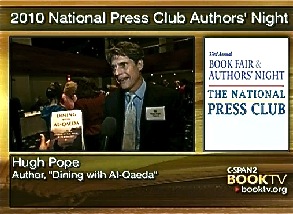
Otherwise most of us, I reckon, had a pretty furtive look. Conceiving a book, finding an agent, landing a publisher, writing the text, rewriting it, getting the book accepted for publication, managing the editing process, planning the promotion, and now, finally, selling the book, is, in the end, a pretty harrowing experience. We were the survivors, I agreed with a cheerfully agitated fellow-author, Steve Light, a New York kindergarten teacher and artist with a picture book called “The Christmas Giant”. But we all felt we had to keep an eye on the others for ideas on how to make our pitches more attractive, and waited for our turn with media out to cover the event (C-SPAN Book TV’s three-minute interview with me about Dining with al-Qaeda is here).
As we practiced potted accounts of the best possible interpretation of our publishing success, one group of authors seemed set above the rest of us. This was clear right from the nametag get-go. Writers who might be ambassadors, doctors, professors, priests, lords or ladies got no titles in front of their names. But if you were a cookbook writer, you got to be “Chef”. One or two even wore a white coat and chef’s hat, so that everybody could spot them from a distance. As we moved into the ballroom where tables were set out with piles of our books, their other advantages became clear. Spotlights illuminated the long line of authors touting books like SOS! The Six O’Clock Scramble to the Rescue: Earth-Friendly, Kid-Pleasing Dinners for Busy Families. This meta-kitchen was where the energy was, where everyone clustered. Several even had big bowls of pre-cooked offerings to tempt the passing crowds to linger, chat and feel more like buying the book.
I had a good spot in the center of the room, but felt in the shadow of the glamorous cooks, towards whom the eyes of people walking past were naturally attracted. There wasn’t much I could do except wait until someone approached me. I wished that, like the chefs, I’d put on some professional gear, the flak jacket that still lies unused under my bed at home, for instance. Perhaps I could also have found a battered helmet and put a plaster strip over its rim and scrawled “PRESS” on it in Arabic. After a while I realized that since I couldn’t beat the chefs, I should join them. “Dining with al-Qaeda” is of course in the mealtime category, and when the eyes of a passing soul paused on the title, that was my chance: “No, it’s not a cookbook, but it does have a really interesting account of what it’s like to eat a Chinese meal with someone who knew the September 11 hijackers …”
My pile of books gradually and gratifyingly diminished. I suppose that at least half the people in the world are not likely to find your book to be just right – I know that only a few books in an average bookshop appeal to me. Indeed, the National Press Club had chosen very few other books on foreign affairs, let alone the Middle East (full list here) — the closest to that category I found was a book about the CIA and a novel about Little Egypt, Illinois.
On the other hand, it was fun chatting with the kind of people who did want to buy my book. A lady told me she was writing about the fate of journalists who could no longer support themselves by working in the media. An elderly man related how he’d set up the Peace Corps program in Turkey, becoming godfather of a galaxy of Americans who grew to be prominent in introducing the country to the world, from historian Heath Lowry to guidebook pioneer Tom Brosnahan. Best of all, I met several younger readers for whom I really wrote the book, students starting out in their discovery of the Middle East.
With a series of people stopping by my table for anything for one to ten minutes, I honed my message about what the book was about (and learned that if someone hasn’t bought your book after five minutes, they are probably not going to). Perhaps this is what the publishing world should do before anyone starts to write: organize a book fair in which publishers wander from table to table and hear writers making their pitch. Or perhaps that’s what the publishers’ rejection system is actually trying to imitate – if only they’d just say “no” straight away, instead of leaving us nervously waiting months for their message telling us “this is a fascinating and important book, but we’re going to pass”. Anyway, when C-SPAN’s Book TV reporter and cameraman suddenly turned up at my table, I was in full flow, and about as clear as I can verbally get (the result is here). And perhaps even better, an agent appeared in front of me and said she was interested in my work, flattering my vain authors’ idea that one day I might be able to earn a living from all this books business.
The reality is, of course, that most of us have to have day jobs. I had to leave the book fair early to rush off to the airport (and board the second of Turkish Airlines’ superb new Boeing 777 flights direct from DC to Istanbul). So I don’t know what the final score was for the evening. At least as successful as the chefs was my neighbor to the right, a former senator had been in constant demand for his colourful tome about What Washington Could Learn from the World of Sports. On they other hand, my neighbor to the left, New York Times reporter Kate Zernike, shifted only a few copies of her ‘Boiling Mad’ book on the Tea Party movement. But then she hadn’t turned up.
In the end it seemed that, with my pile of books about halved, I’d roughly equaled the performance of nearby James Zogby, a pollster and long-standing Arab voice in the American wilderness. Throughout the evening he had looked predisposed to be disappointed with the world as he stood behind his new volume telling Americans about what Arabs really think. Still, who knows what makes what happen in publishing? Perhaps it was something at the Press Club book fair that helped him hit a vital jackpot two weeks later, a sweet review in the New York Times…
When I was wondering what to call my new book on the broader Middle East, I went to Homer’s bookshop in Istanbul to check out the many shelves full of competition. I soon decided I didn’t want my title to be heavy with dry theorification about Islam, democracy, politics, or terrorism. It also seemed a bit soft to join the romantic set, beckoning readers with images of Persian nights, caravans, deserts, marshes and mountains. But I didn’t want to go to the other extreme with gory high drama. In just recent years, the sanguinary sub-class alone has included dozens of titles like Holy Blood; the Blood of Lambs; the Blood of the Moon; Blood, Sweat and Steel; Blood and Oil in the Orient; and my favorite, The Land of Blood and Honey.
Middle East book titles have to struggle for attention: about 300 come out every year in the U.S. alone. I wanted something that conjured up multiple dimensions, like Stephen Glain’s Dreaming of Damascus (actually about the economics of the front-line Arab states), or Jonathan Randal’s After Such Knowledge, What Forgiveness? (about the Kurds). When I gave up on my first title idea — Mr. Q., I Love You — and settled on Dining with al-Qaeda, I was pleased that I’d featured the Q-word, but in an unexpected way that might draw in a reader seeking the back story. What better way to symbolize the human side of things than breaking bread together? Little did I realize that there’s nothing new under the sun, and that there were already volumes called Dining with Terrorists, The Cuisines of the Axis of Evil and Tea with Hezbollah. They have now been joined by Tea with the Taliban: war reporting for beginners.
Actually it’s Thee met de Taliban, since it’s written in Dutch (De Geus, 2010) by Deedee Derksen. It’s fresh and topical, the fruit of Derksen’s past four years living and working in Afghanistan, mostly reporting for the Dutch left-leaning newspaper De Volkskrant. I was particularly interested to see that in some ways she shared my own confusion about the country, especially about the Taliban and women.
Derksen meets women who tell her that life was actually o.k. under the Taliban, and that things had gone downhill since they were driven from power. The bigger problem in women’s lives was violence and chaos. Schools for girls were all very well, but rights were not much use without honest courts to enforce them. As Derksen says: “I would hear from rural women that there was no change in their lives before or after the Taliban” and that, compared to deeper problems like unemployment and power cuts, “Western concerns with cultural matters just poured oil on the flames.”
Derksen’s mission to Afghanistan took flight when her new posting was announced at a public event, at which her Volkskrant editor was challenged about the lack of coverage of the ‘other side’ by Joris Luyendijk, an ex-journalist Dutch commentator known for his iconoclasm about Dutch coverage of Middle East news in his book Het Zijn Net Mensen, recently published in English as Hello Everybody. But she soon finds herself wrapped up in the expatriate whirl of Kabul.
“The crazy thing is that as a war correspondent in Afghanistan it’s not at all easy to get to the war,” she says, despite the fact, as she details, the Pentagon spends an annual $4.7 billion on public relations and employs 27,000 people to supply upbeat pictures and stories for the press corps. One of the Pentagons front-line media handlers digs up Derksen’s file in their computer, along with her picture and an evaluation of her reports. If a reporter is judged to be “negative”, this handler says, the Pentagon will cut him or her off.
She’s judged to be neutral and gets to see a terrifying part of the American side of the war in a distant mountain valley: “that’s it, people: bombs, grenades, and fear so pure that you begin believing in God on the spot”. But she’s frustrated that she can’t hear at first hand what Afghan villages think of what is being done in their name, and worries that maybe she’s giving a one-dimensional, Hollywood rewrite of what people already think the war is. She gets hooked on the idea of getting to the bottom of it all, and of not being like the Westerners in their “luxury jail” in Kabul, who speak about what Afghans think without ever speaking to Afghans. “The more often I went [to Kabul], the more often I wanted to go. It was a sort of gold rush fever.”
Panning for this gold was tough. Travel proved dangerous and the risk of kidnapping great. Afghan militants targeted Westerners, be they journalists, aid workers or diplomats. Reporting was a juggling act of managing fixers, telephone calls to Taliban commanders, swapping information with local journalists, opportunistic interviews in Kabul with provincial visitors, and occasional sorties into the countryside. Western soldiers appear as almost accidental actors. One Dutch lieutenant studied to be a hotelier and tells Derksen “and then I went and did this.” An American “Major B”, who only “lives in the world of Major B”, gives her bibles to study admits that he is busy trying to proselytize the Afghan population – and then advises her to read Tolkien, “an author at home in the Christian tradition”. She attends a painstakingly arranged town-hall meeting between the American troops and Afghans, at which the Americans rush away before listening to anybody. And, of course, editors all want it summed up in 700 words, with villain and victim clearly identified.
She admits that sometimes, the more she hears about the real Afghanistan war, the less she understands. Reporting one story, “every Mohammad says the other Mohammad is a murderer, which the said Mohammad admits, while pointing the finger straight back. At Mohammad.” There are tales of head-hacking cruelty by the Taliban, for sure, but she attacks the myth of any ideological divide between Taliban and non-Taliban, says non-Pashtuns do not necessarily rule out cooperating with the group and that the Karzai government is in a semi-permanent negotiation with them about its own survival. Above all, she notes that no Afghan faction is necessarily more ‘Islamic’ than another, all having shared in an upsurge in religious extremism and violence during the past decades of war.
Among ordinary Afghans, she finds farmers have little incentive to cultivate more than poppies for opium, since there are no refrigerated stores or roads to transport vegetables or other normal crops. During an attempt to track down the financing of an aid project, she finds that everyone believes a different sum of money is involved. Afghans feel Koran schools are preferable to no schools at all; yet ignorance means that young, poor, illiterate Afghans are susceptible to anything, from acting as suicide bombers to believing that American soldiers’ sunglasses mean they can see straight through you. She reaches one Afghan village to find its conservatism a façade, with everything for sale in secret, from whisky to opium to prostitutes, be they young or old, women or men. “All very hypocritical,” the phlegmatic local Afghan governor tells her.
She shows again and again how the chief ingredient of the Afghanistan war is village feuds, sometimes magnified by Western arms and support into province-wide conflicts that are mistakenly interpreted as being struggles about the fate of the Kabul regime. She finds that storied gunfights between American troops and the “Taliban” can also be described more simply as clashes between the Americans and “armed men who hate the Americans”, fueled in part by a high rate of civilian Afghan casualties rarely admitted to by the Pentagon press machine. Between Afghans, the role of victim and killer has switched so often that everyone is performing in both roles, all waiting for their chance of a sign of weakness to “hold the other’s head under the water.”
Derksen’s strongest criticism is of the Western governments, who ignored Afghanistan for too long and still give it far less support for reconstruction than other post-conflict situations. (In East Timor, she says there was one international peacekeeper for every 65 people; the figure is one for every 5,380 in Afghanistan). The US is blamed for storming in like cowboys in 2001, shooting for al-Qaeda and hiring anyone who would help, however corrupt. “The US and other NATO countries pretend that there is a properly functioning government, but there isn’t”, she quotes a disillusioned American aid worker as saying. “It’s a band of criminals who are raping the country. We pretend that we’re not responsible, but we are.”
Looking at the four-year Dutch misadventure trying and failing to bring peace and development to the province of Uruzgan, she asks whether The Hague had ever thought through what it meant to take their mission into a place where the US was arming and supporting a regional faction that was clearly oppressing many local people – and on whose support the Dutch also relied for their lifeline of convoy-borne supplies. Or was The Hague in fact fully aware of the situation, sending in its troops simply to be a good U.S. ally, and never mind about the fate of the Afghans? The whole disaster, she reckons, was a bad piece of theater that could only be called “War For the Wrong People Against the Wrong People.”
I read much of Tea with the Taliban on a transatlantic flight, and on arrival in the U.S. I did some occasional testing of its findings. Indeed, judging by my straw poll of experiences and conversations over a week, America still seemed to be both aware of and disconnected from the Afghan reality. Shawn, my driver from the airport to a lecture at Amherst College in Massachusetts, knew a thing or two. His best friend was serving on the Afghan side of the Pakistan border, and had just been back home to tell of his experiences. The poor friend was apparently strung out as taut as the trip-wire of an IED, drinking heavily as he told of his ‘seven confirmed kills’, of being administered military drugs to stay awake on night duties, and, in a telling irony, of being unable to see as much from his base watchtower with state of the art night-sight equipment as his Afghan army companion could see with his bare eyes. On top of that, as Derksen often points out, he was utterly sealed off from the Afghan civilian population.
Photo: Scott Olson/Getty Images
On the first morning of my visit, the hotel’s complimentary copy of USA Today had just one page of foreign news. Half of it was a story called “Afghan villagers stronger against Taliban” (here). The US general in charge of a province, perhaps in charge of Shawn’s friend, was claiming that a new strategy aimed at making Afghan villages defend themselves was working. This was an interesting claim, given that Derksen shows in her book that it is precisely in the villages that the Afghan war starts and Western influence ends. And, illustrating another of Derksen’s complaints, there wasn’t a single Afghan voice in the piece, let alone a quote from the Taliban, or any sign that the reporter had been able to go to an Afghan village to check out if indeed its inhabitants felt stronger. Instead the report was just assertions by the military, accompanied by a few vague ‘to be sure’ paragraphs, which, if taken seriously, would actually contradict the military claims, and, indeed, the whole point of writing the story. As International Crisis Group says in its new report on Afghanistan: “An alluring narrative of a successful counter-insurgency campaign has begun to take shape, but the storyline does not match facts on the ground.” Or, as a recent call by some of the best writers on and aid workers in Afghanistan put it, “the military campaign is suppressing, locally and temporarily, the symptoms of the disease, but fails to offer a cure.” The only verified new fact in that USA Today report appeared to be the obituary notice naming two more young American soldiers in their early 20s killed by an IED in Kandahar.
Photo: David Gilkey/NPR
(The coverage is not all like this, of course. Much more to the point was another piece done around the same time for National Public Radio’s intrepid Quil Lawrence (here). Jumping from helicopters perilously perched on cliff-edges, Quil laconically reveals the mindlessness of the war and how little communication there is even within the various U.S. groups trying to get a grip on the Afghanistan-Pakistan border – let alone between the Americans and the Afghans themselves.)
My other conversations in America did not encourage me to believe that much was about to change. Amherst, I was told by the generous professorial hosts of my visit for an evening lecture about Turkey’s new strategic choices, is one of the top liberal arts colleges in the United States, with 8000 candidates for 400 places every year. Yet not a single student showed up for a brown-bag lunch organized to discuss journalism and the Middle East. In Washington DC, a highly placed former US official informed me that there was no chance of the US leaving Afghanistan in 2014, as is being publicly suggested. Yet the wars in Iraq and Afghanistan did not even feature in the recent mid-term election campaign.
If anger about these expensive and damaging conflicts was being expressed anywhere, it was in worsening sentiment blaming all Muslims for the trouble. The Moroccan immigrant who drove me away from Amherst was sanguine about his personal safety, but said that the real enemy was ignorance, the problem that writers like Derksen and I are trying to combat with books about Middle Eastern realities on the ground. “I came to the U.S. to be a guide to the Moroccan pavilion at Disney world, and that’s the kind of place where you really find out how little people know about what goes on outside America,” he said. “One person looked at me and asked if in Morocco we lived in the trees.”
A review in the Gulf News by Francis Matthew, one of the first people I met in the Middle East 30 years ago (original here). I can still sense the relief and gratitude I felt when he invited me to share his apartment in Cairo, which was a blessed sanctuary from the cacophonous confusion of the streets of Egypt’s capital.
Insight into a region
A journalistic memoir portrays the reality of the Middle East from new angles
Reviewed by Francis Matthew, Editor at Large
Published: 00:00 October 22, 2010
The uphill struggle to tell the story of what is really happening in the Middle East is at the heart of Hugh Pope’s personal tale of three decades of working as a reporter in the Arab world. For much of this time, he was the Wall Street Journal’s Middle East correspondent and he recounts how he often tried, and sometimes succeeded, in bridging the gap between Middle Eastern reality and American perceptions.
It is fascinating to read how many times the author saw important themes and news angles in what was happening in many hotspots around the Middle East region and how he then struggled to get his editors in the United States to understand something which was outside their American preconceptions.
For example, in the run-up to the invasion of Iraq, Pope wanted to write a long story challenging the US assumption that “there would be a delirious welcome awaiting US troops as liberators in Iraq”.
He summed up the defiant Iraqi attitude before the US-led invasion with a quote from a driver telling Pope that his relatives died because of lack of medicines due to American sanctions and that he (the driver) would fight the Americans.
But Pope was told by Bill Spindle, his editor, that “no reader in America would be able to stomach that kind of talk, would not believe it and would stop reading”.
But Dining with Al Qaeda offers more than the depressing struggle to get the real Middle East on to American pages. What makes the book a very attractive read for anyone who lives in the Middle East, or wants to understand it better, is Pope’s deep respect and affection for the people of the Middle East.
Universal problems
As he points out, the idiosyncracies of the region are not some unique Middle Eastern effects due to religion or ideology but far more the product of universal problems of inequality, circumstance and international politics.
This in turn makes them much more able to be tackled and solved. What Pope makes clear is that the lives of Middle Easterners, the majority of them only a generation away from an illiterate peasant background, differ greatly from those of Europeans and Americans — not because of some insoluble “clash of civilisation but because of bridgeable disparities in education, security, prosperity and expectations”.
It is also rare for a journalist to take on senior members of the profession and deconstruct their work.
Pope takes some pages of his book to show how the iconic Middle East reporter, Robert Fisk, committed the cardinal error of inventing facts and exaggerating others.
It was to do with Fisk’s report of British soldiers in 1991 operating in Iraq after the liberation of Kuwait when 500,000 Kurdish refugees from Saddam’s forces moved up to the Turkish border in camps controlled by the US and British forces.
The story Fisk ran in The Independent was that the Turkish army “went on a rampage of looting” and that the allied forces had “cocked their weapons in a confrontation with the Turkish troops”.
At the time, Pope felt the incident had been greatly exaggerated by Fisk but years later he had the chance to meet the British Royal Marine captain who said “Fisk’s story has no basis in fact” and a British doctor involved in the relief effort apparently quoted by Fisk tells Pope that “there was certainly not any difficulty that I can recall”.
Pope’s point is that “Fiskery” is when a few dazzling reporters know what they want in the essential thrust of the story and its political message but the details, quotes, witnesses and even whole battles may be made up to embellish the story on to the front page. He takes the space in the book to make clear the inventing of facts cannot be excused, despite Pope’s respect for Fisk’s trademark scorn of the over simplification of the Middle Eastern news by the networks and Fisk’s ability to avoid the clichés and drive home at an emotional level what people felt in the Middle East.
Very early in his career, Pope writes about himself after a visit to Ain Al Helweh, a Palestinian camp in Lebanon which supported active Palestinian fighters, but this needed to be proved. He went into the houses of the beaten down refugees but did not feel able to go for the jugular in his questioning.
“Confronted with the unfortunate people themselves, however, I never quite got the steel-clad sense of the journalist’s right to probe.”
Pope does himself an injustice with this view, since he is clearly a journalist who bothered to move behind the obvious headlines, and over the years has reported with understanding on the lives of the people he dealt with.
Dining al-Qaeda may not yet be out in Portuguese, but Portugal’s leading newspaper Publico gave the book an eye-catching outing in this review/interview published on 15 October.
“Dining with Al-Qaeda”
não é um livro de culinária
—
Margarida Santos Lopes
—
O Médio Oriente são “muitos mundos”. Hugh Pope percorreu-os durante 30 anos e agora revela, numa obra notável, as suas várias histórias, incluindo as que o “Wall Street Journal” omitiu e as que Robert Fisk “inventou”. A viagem começa num bordel na Síria, onde o antigo aluno de Oxford percebeu que não bastava ser fluente em árabe, farsi e turco para compreender uma região tão complexa ou sobreviver a um jantar com a Al-Qaeda.
Depois de três décadas como correspondenteno Médio Oriente de vários média internacionais e, em particular, do “Wall Street Journal” (WSJ), Hugh Pope desistiu de ser repórter. As dificuldades que tantas vezes encontrou para contar o que viu e ouviu deixaram-no frustrado. Os seus artigos foram frequentemente reescritos – e até não publicados – para poderem agradar a uma audiência muito singular. “Quando, por exemplo, escrevi que os palestinianos foram ‘forçados a deixar’ as suas casas e a exilar-se, os vigias do ‘lobby’ pró-Israel (…) activaram uma campanha para exigir o uso da palavra ‘fugiram’”, conta Pope, actualmente director do Projecto Turquia/Chipre do “think tank” International Crisis Group (ICG), em Istambul. “Quando escrevi que três milhões de palestinianos fora da Palestina pré-1948 são ‘refugiados’, forçados ao exílio pela expansão de Israel, e estão impedidos de regressar, os ‘lobbyistas’ quiseram que [o WSJ] os dividisse em refugiados originais e seus descendentes. (…) Com todas estas omissões e subterfúgios, fomos acrescentando mais um tijolo à grande muralha de incompreensão que agora separa a América do Médio Oriente”, aponta.
Ao longo de mais de 300 páginas, sem seguir uma ordem cronológica, Hugh Pope ajuda-nos a descodificar a complexidade dos “muitos mundos” do Médio Oriente. Um Médio Oriente que inclui Wao, no Sul do Sudão, onde se encontrou “pela primeira vez facea- face com a fome”, mas também o Irão, onde, depois de uma visita ao túmulo de Mohammad Hafez, cujos poemas são mais vendidos do que o livro sagrado dos muçulmanos, percebeu que “Morte à América” pode querer dizer apenas “América, por favor, mostra que gostas de mim”; o Afeganistão, onde o governador Taliban do Banco Central o recebeu de olhos no chão, descalço e sem nunca lhe apertar a mão – mas confiante de que iria atrair muitos investidores estrangeiros; e a Arábia Saudita, onde o dissidente Sami Angawi tentou provar-lhe que pouco distingue a Al-Qaeda dos wahhabitas no poder: “É a diferença entre Marlboro e Marlboro Light”.
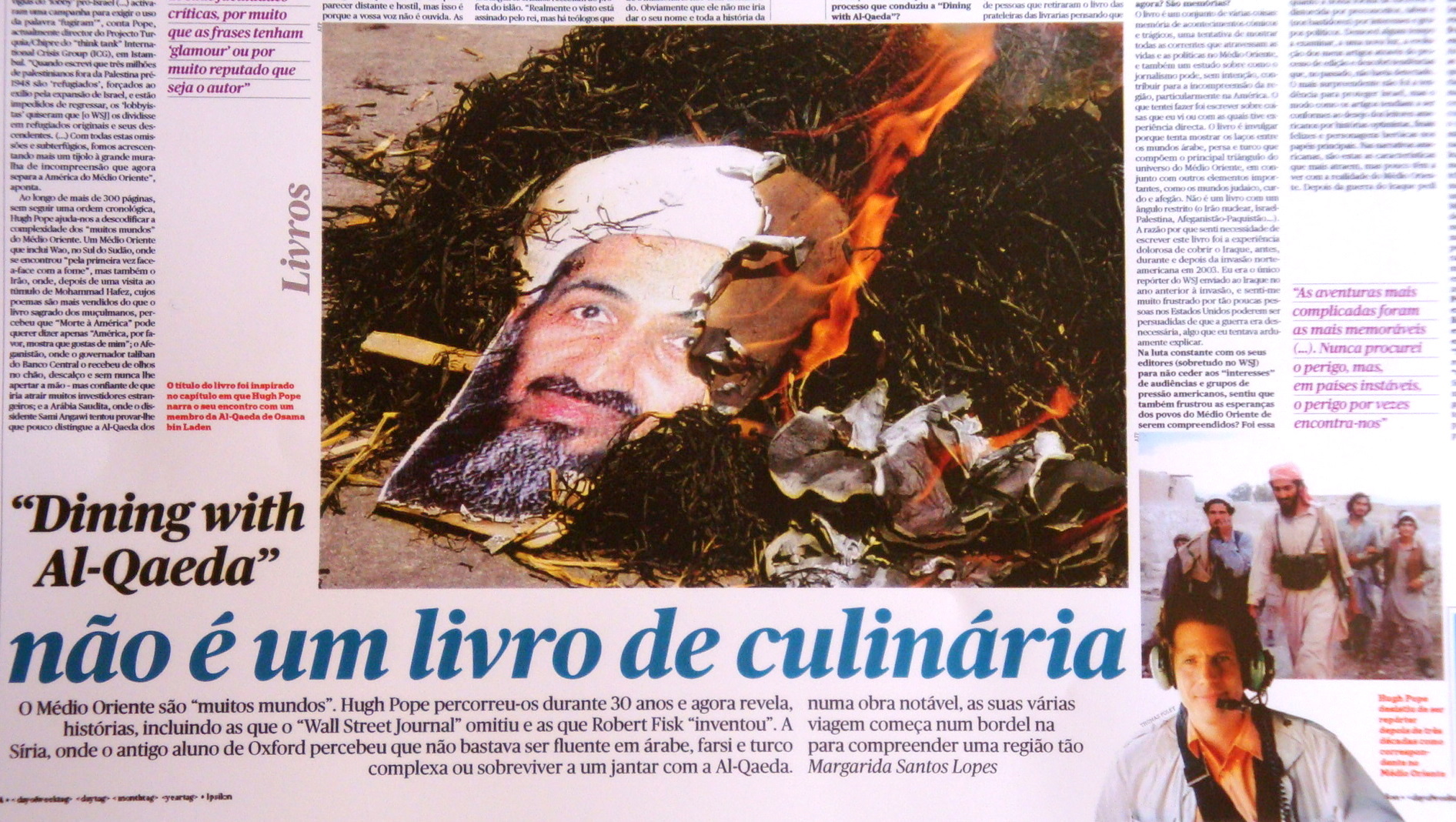
Foi a esse reino onde os suicidas dos atentados terroristas do 11 de Setembro são admirados (por alguns) como “rapazes maravilhosos” que Pope foi buscar a ideia para o título do seu livro. “Dining with Al-Qaeda” é o capítulo em que narra o encontro com um “da’i”, ou missionário, da rede de Osama bin Laden. Intimidado com a hostilidade do jovem de 24 anos, Hugh iniciou assim a conversa: “Sei que a imprensa ocidental pode parecer distante e hostil, mas isso é porque a vossa voz não é ouvida. As pessoas não estão familiarizadas com a vossa perspectiva. Se aceitar falar comigo, posso dar a conhecer o vosso ponto de vista”. Depois de uns minutos de silêncio, o interlocutor perguntou: “Devo matá-lo?” Pope escapou ao destino do seu colega Daniel Pearl (decapitado no Paquistão) porque conhecia bem as escrituras e as “hadith” (tradições) de Maomé. Argumentou que o seu visto de entrada na Arábia Saudita seria equivalente ao salvo-conduto que os estrangeiros cristãos recebiam do profeta do islão. “Realmente o visto está assinado pelo rei, mas há teólogos que consideram o rei ilegítimo”, contrapôs o discípulo de Bin Laden. “Mas as orações de sexta-feira são rezadas em nome dele”, contestou Pope. “É verdade. Tudo bem. Aceito que tem autorização para estar aqui”, condescendeu o “da’i”, que a partir daí ofereceu a Pope “uma nova perspectiva” sobre a Al-Qaeda. “Para meu espanto”, confessa o repórter várias vezes confundido com o actor Hugh Grant, o ‘Journal’ não estava interessado neste relato. A principal razão era o facto de o missionário não estar identificado.
Obviamente que ele não me iria dar o seu nome e toda a história da sua vida, tendo sido preso quatro vezes pela polícia saudita desde o 11 de Setembro.”Esta é uma entrevista por “e-mail” com Hugh Pope, que já anteriormente publicara duas obras de referência sobre a região: “Turkey Unveiled” (com a sua ex-mulher, Nicole Pope) e “Sons of the Conquerors: The Rise of the Turkic World”:
Reconheceu que o título do seu livro, por alguns considerado enganador, “iria sempre chamar a atenção”. Pode explicar o processo que conduziu a “Dining with Al-Qaeda”?
De início, pretendia realçar a natureza pessoal do livro e dar-lhe o título de “Mr. Q, I Love You” [o do primeiro capítulo]. Mas o meu editor e outros não gostaram e sugeriram “Eating Chinese with Al-Qaeda” (título de outro capítulo). Um velho colega do “Wall Street Journal” notou que soava a canibalismo, e então decidi brincar com a ideia “Dining Out with Al-Qaeda”. A minha filha Vanessa achou, no entanto, que bastava “Dining with Al- Qaeda”. Sim, o título chama a atenção, e até tenho recebido mensagens de pessoas que retiraram o livro das prateleiras das livrarias pensando que se tratava de culinária! Outros pensaram que era um estudo sobre a própria organização, mas creio que o livro consegue transmitir a mensagem de que é um olhar sobre o Médio Oriente a partir de perspectivas inusitadas. Também creio que contém muitas mensagens sobre como o Ocidente pode aproximar-se da região com mais empatia e compreensão, o que pode contribuir para reduzir o apoio à Al-Qaeda.
Porque sentiu a necessidade de escrever este livro – e porquê agora? São memórias?
O livro é um conjunto de várias coisas: memória de acontecimentos cómicos e trágicos, uma tentativa de mostrar todas as correntes que atravessam as vidas e as políticas no Médio Oriente, e também um estudo sobre como o jornalismo pode, sem intenção, contribuir para a incompreensão da região, particularmente na América. O que tentei fazer foi escrever sobre coisas que eu vi ou com as quais tive experiência directa. O livro é invulgar porque tenta mostrar os laços entre os mundos árabe, persa e turco que compõem o principal triângulo do universo do Médio Oriente, em conjunto com outros elementos importantes, como os mundos judaico, curdo e afegão. Não é um livro com um ângulo restrito (o Irão nuclear, Israel-Palestina, Afeganistão-Paquistão…). A razão por que senti necessidade de escrever este livro foi a experiência dolorosa de cobrir o Iraque, antes, durante e depois da invasão norteamericana em 2003. Eu era o único repórter do WSJ enviado ao Iraque no ano anterior à invasão, e senti-me muito frustrado por tão poucas pessoas nos Estados Unidos poderem ser persuadidas de que a guerra era desnecessária, algo que eu tentava arduamente explicar.
Na luta constante com os seus editores (sobretudo no WSJ) para não ceder aos “interesses” de audiências e grupos de pressão americanos, sentiu que também frustrou as esperanças dos povos do Médio Oriente de serem compreendidos? Foi essa frustração que o levou a desistir de ser jornalista e a dedicar-se ao International Crisis Group?
Sim, senti algumas frustrações quando trabalhava para editores americanos. Como faço notar no meu livro, os meus editores no WSJ eram honestos, rigorosos, exigentes, representado o pináculo da nossa profissão [Pope exemplifica em “Dining with Al-Qaeda” a extrema dificuldade em conseguir ter uma notícia publicada na primeira página do WSJ]. Só quando comecei este livro me dei conta de quanto a nossa forma de escrever é distorcida por preconceitos, tabus e (nos bastidores) por interesses e grupos políticos. Demorei algum tempo a examinar, a uma nova luz, a evolução dos meus artigos através do processo de edição e descobri tendências que, no passado, não havia detectado. O mais surpreendente não foi a tendência para proteger Israel, mas o modo como os artigos tendiam a ser conformes ao desejo dos leitores americanos por histórias optimistas, finais felizes e personagens heróicas nos papéis principais. Nas narrativas americanas, são estas as características que mais atraem, mas pouco têm a ver com a realidade do Médio Oriente. Depois da guerra do Iraque pedi uma licença ao “Journal” para construir uma casa e, talvez, escrever um livro. Quando deixei o jornal, tive muita sorte. Ofereceram-me um emprego no ICG. Não sabia naquela altura, mas descobri que escrever para o ICG é o
que eu sempre quis que o jornalismo fosse – reportagem intensa e factual de acontecimentos importantes, sem embelezamentos para agradar à audiência.
De um bordel na Síria até à guerra no Iraque, que aventuras e acontecimentos foram os mais marcantes desta sua “viagem” [que inclui guerras mas também romances fugazes e tentativas fracassadas de o recrutar como espião]?
As aventuras mais complicadas foram as mais memoráveis. Foram aquelas que senti que poucas pessoas poderiam suportar: estar dez semanas numa pequena terrinha do Sul do Sudão cercada por guerrilheiros rebeldes como um dos poucos estrangeiros e o único repórter; ver em primeira mão o medo e a bravura dos homens nas linhas da frente da guerra Irão-Iraque; o dia em que testemunhei, por mero acaso, o início da revolta tchetchena contra a Rússia; ou descobrirme fechado num bordel enquanto uma grande revolta [da Irmandade Muçulmana contra o anterior Presidente, Hafez al-Assad] era suprimida numa cidade síria. Para algo ser memorável, creio que é preciso ter sido perigoso ou inesperado – o que é mais raro do que se pensa, até no jornalismo. Nunca procurei o perigo, mas, em países instáveis, o perigo por vezes encontra-nos.
Porque sentiu necessidade de expor as “fiskeries” do veterano Robert Fisk? Será que podemos estabelecer um paralelo entre histórias alegadamente “inventadas” por Fisk e as realidades supostamente “omitidas” pelo WSJ?
Sim: não há uma realidade única. Jornalistas e jornais são falíveis, e toda a gente deveria pensar cuidadosamentesobre o que está a ler, nunca suspender as suas faculdades críticas, por muito que as frases tenham “glamour” ou por muito reputado que seja o autor. Robert Fisk não é o único jornalista que extrapolou a exactidão do seu jornalismo, mas porque informações e alegações de Fisk tiveram impacto no decurso da minha vida e da minha carreira [Pope recebeu ordem de expulsão da Turquia, em 1991, por causa de um artigo “sem qualquer fundamento” sobre rebeldes curdos que Fisk publicou no diário britânico “The Independent”, para o qual ambos trabalhavam] senti que a sua escrita, por muito brilhante e influente que seja, merece um exame crítico.
Agora que está dedicado ao Projecto Turquia/Chipre do ICG, ajude-nos a avaliar os vários focos de tensão na região.
Eu escrevo sobretudo sobre o triângulo Turquia-Chipre-União Europeia, mas tem havido grande procura de informação sobre as relações da Turquia com o Irão e sobre se elas demonstram que a Turquia se “está a afastar do Ocidente”. No Crisis Group não temos prova disso. A Turquia partilha genuinamente o objectivo do Ocidente de que o Irão não deve possuir armas nucleares. Quanto ao Afeganistão, tem apenas um interesse indirecto para o nosso projecto, uma vez que a Turquia só desempenha ali um papel [militar] não combatente, estando a tentar desenvolver melhores relações entre Cabul e Islamabad.
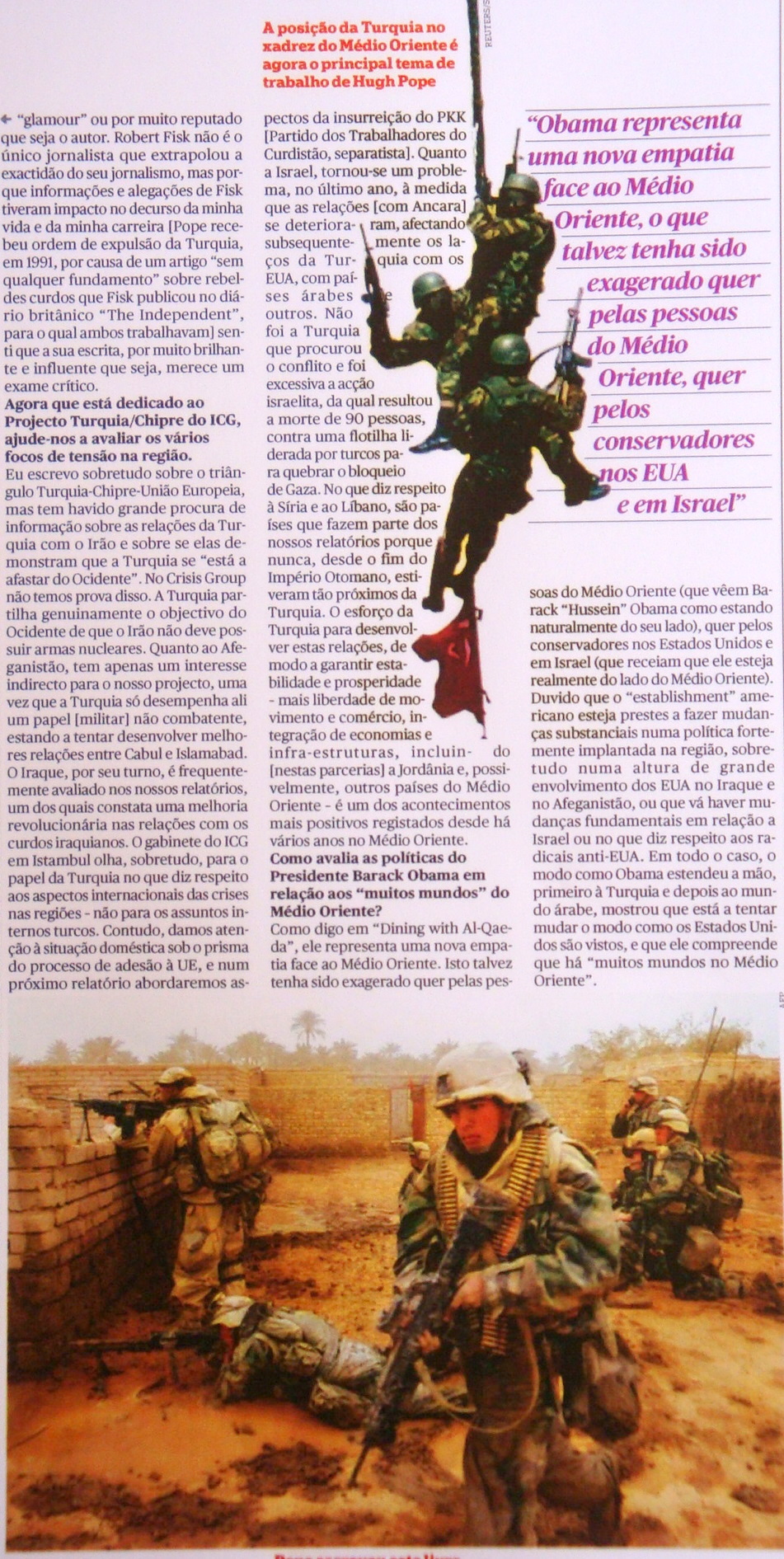
O Iraque, por seu turno, é frequentemente avaliado nos nossos relatórios, um dos quais constata uma melhoria revolucionária nas relações com os curdos iraquianos. O gabinete do ICG em Istambul olha, sobretudo, para o papel da Turquia no que diz respeito aos aspectos internacionais das crises nas regiões – não para os assuntos internos turcos. Contudo, damos atenção à situação doméstica sob o prisma do processo de adesão à UE, e num próximo relatório abordaremos aspectos da insurreição do PKK [Partido dos Trabalhadores do Curdistão, separatista]. Quanto a Israel, tornou-se um problema, no último ano, à medida que as relações [com Ancara] se deteriora- ram, afectando subsequente- mente os laços da Tur- quia com os EUA, com países árabes e outros. Não foi a Turquia que procurou o conflito e foi excessiva a acção israelita, da qual resultou a morte de 90 [means 9, I think] pessoas, contra uma flotilha liderada por turcos para quebrar o bloqueio de Gaza. No que diz respeito à Síria e ao Líbano, são países que fazem parte dos nossos relatórios porque nunca, desde o fim do Império Otomano, estiveram tão próximos da Turquia. O esforço da Turquia para desenvolver estas relações, de modo a garantir estabilidade e prosperidade – mais liberdade de movimento e comércio, integração de economias e infra-estruturas, incluin- do [nestas parcerias] a Jordânia e, possivelmente, outros países do Médio Oriente – é um dos acontecimentos mais positivos registados desde há vários anos no Médio Oriente.
Como avalia as políticas do Presidente Barack Obama em relação aos “muitos mundos” do Médio Oriente?
Como digo em “Dining with Al-Qaeda” ele representa uma nova empatia face ao Médio Oriente. Isto talvez tenha sido exagerado quer pelas pessoas do Médio Oriente (que vêem Barack “Hussein” Obama como estando naturalmente do seu lado), quer pelos conservadores nos Estados Unidos e em Israel (que receiam que ele esteja realmente do lado do Médio Oriente). Duvido que o “establishment” americano esteja prestes a fazer mudanças substanciais numa política fortemente implantada na região, sobretudo numa altura de grande envolvimento dos EUA no Iraque e no Afeganistão, ou que vá haver mudanças fundamentais em relação a Israel ou no que diz respeito aos radicais anti-EUA. Em todo o caso, o modo como Obama estendeu a mão, primeiro à Turquia e depois ao mundo árabe, mostrou que está a tentar mudar o modo como os Estados Unidos são vistos, e que ele compreende que há “muitos mundos no Médio Oriente”.
I didn’t write much about the women’s headscarf debate as a journalist — it always seemed too complicated — but I had a go in a chapter on Middle Eastern women in Dining with al-Qaeda. Barçin Yinanç of Hurriyet Daily News in Turkey picked up the story (original here).
An outsider’s look at Turkey’s headscarf issue
BARÇIN YİNANÇ
Friday, October 8, 2010
The issue of the headscarf is back on Turkey’s agenda. The heated debate coincided with my reading of Hugh Pope’s recent book, “Dining with al-Qaeda.” As the subtitle, “Three Decades Exploring the Many Worlds of the Middle East,” suggests, the former journalist explains to his readers the many and rather complex faces of the Middle East, emphasizing that the region is much more than a monolithic “Islamic World.”
One of the 18 chapters is dedicated to women in the Middle East. Some of the passages of “Subversion in the Harem: Women on the rise from Cairo to Istanbul” pertain to issues that are directly related to the current debates in Turkey.
One may recall the war of words between the ruling Justice and Development Party, or AKP, and the opposition Republican People’s Party, or CHP, on the different way the headscarf is worn in Turkey, Iran and Pakistan.
Pope also compares Turkey with Iran in his book. Changes to the traditional moral and household duties of women are recent in the Middle East, following the lead of the West, says Pope. Family honor and submissiveness are still usually considered to be essential and symbolized by the appearance of women, yet women also use their appearance to make political points, according to Pope. “The Turks consciously unveiled in their 1920s secular revolution to show how they were turning toward the West. Iranian women covered up during the 1979 Islamic Revolution to turn their back on the West and its support for the shah’s dictatorship. In the 2000s these two countries swapped places, with Iranian women pushing back their head scarves to register opposition to the regime and Turkish women wrapping themselves up,” he says. “Each nation had its own struggle with modernity rushing in, and paradoxes abounded.”
He says Turkey is almost schizophrenic in its attitude toward women. The country’s republican secularists and its religious conservatives use women as their favorite political playground. But, argues Pope, this conflict is not only about the place of Islam in society, it is also a “new front in a long-running conflict about communities and social class. The religious-minded two-thirds of the population that is rooted in the villages of Anatolia tend to be pragmatic and open-minded about headscarves, whereas the more secular third is urban and often descended from refugees who built the Turkish Republic up from the wreckage of the Ottoman Empire after the 1920s and views headscarves as the nemesis of their ideological goal to create a modern state.
For those who know Turkey and the headscarf issue, Pope’s analysis might not be so new. But in the following passages he touches on one dimension that rarely comes up:
“The problem for me lies more in the Islamists’ other main justification for headscarves; that they are part of women’s duty to stop men lusting after them. Innocently enough, many young women therefore wear a chic headscarf that signals not that they are fundamentalists, but that they are morally upright and marriageable or are dutiful wives. But for exactly the same reason, the secularists are quite right, as in France, to insist that no headscarves be allowed in schools. A schoolgirl wearing a headscarf implies that I, as a man, might be lusting after her. I find the insinuation repugnant – if people really think there is such a general problem, they should first start educating the men.”
Let me put it in different words. The headscarf also symbolizes in conservative Turkey that the woman wearing it is not an easy woman; implying in reverse that those who are not wearing it have the potential of being easy.
One of the drivers of the daily I was working at 10 years ago once told me how his daughter, living in Southeast Turkey, decided to cover her head, as her husband, a soldier in the Turkish army, used to go away for long periods of time. That way, she thought, she would not be harassed by men.
That’s the point when I, as a woman not wearing a headscarf, perceive this attitude as insulting. Just because I am not wearing a headscarf does not make me “less Muslim” or less “dignified.”
Dining with al-Qaeda has been selected as one of the books on show at the National’s Press Club’s annual Book Fair & Authors’ Night on 9 November 2010! This year the jamboree showcases 90 journalist-authors who sign their books that have appeared in the preceding year. NPR’s Diane Rehm is the honorary chairperson of the event, which runs from 5.30pm and ends “promptly” at 8.30pm. I will be joining the authors gathered at the 13th floor ballroom of the National Press Building near Metro Center at 529 14th St NW, at the corner of F & 15th Sreets NW in downtown Washington. Hope to see you there!
This interview and concise summary of the themes of Dining with al-Qaeda appeared in one of Turkey’s own English-language newspapers, Hürriyet Daily News, on the day that HDN co-sponsored the Istanbul launch of the book. (Original here). Thanks again to editor David Judson, executive Michael Wyatt and associate editor Barçin Yınanç for all this unexpected rallying round your fellow Istanbullu!
Note for readers in Turkey: Homer Bookshop in Galatasaray (tel: +90 212 249 59 02) almost always has copies of Dining with al-Qaeda and can cheaply courier them anywhere in the country.
Veteran journalist Pope explores Mideast in new book
—
BARÇIN YİNANÇ
ISTANBUL – Hürriyet Daily News Wednesday, September 15, 2010
—
Simplistic reporting that skirts deep-seated conflicts and cultural complexity has made it difficult for the West to come to terms with the Middle East, according to one journalist with long experience in the region.
The Israeli-Palestinian conflict has been just one of the crucial issues Western reporters have failed to explain, said journalist-turned-analyst Hugh Pope, the author of the new book “Dining with al-Qaeda: Three Decades Exploring the Many Worlds of the Middle East.”
“As a reporter [for the Wall Street Journal], I tried to explain to Americans why it is that Palestinians feel they are so unjustly treated, but I could not get the story across,” Pope told the Hürriyet Daily News & Economic Review in an interview Monday. “There is such a gap between what Americans think is the case and what the case is on the ground.”
The author illustrates this phenomenon in “Dining with al-Qaeda” with a story he wrote about the plight of Palestinians. According to Pope, the published version portrayed a situation in which Palestinians and Israelis had lived happily for a long time until the Palestinians started shooting – failing to give the full picture of why they felt the need to fight. Such small, but critical, omissions made to cater to the assumed tastes of an American audience become bricks in a wall of incomprehension, he said.
“In order to reach readers, you need to communicate. In order to communicate, you need to find common ground. That forces you to compromise,” said Pope, who has spent more than 30 years in the Middle East, much of it based in Istanbul. “But while searching for that compromise on what the American reader can take, often you end up confusing the situation even further.”
Concerned about keeping readers on board, editors often avoid subjects seen as difficult for them to digest. To keep readers’ attention, journalists likewise feel obliged to appeal to expectations by focusing on Americans in the region, the spread of American values such as progress or democracy, themes of disaster and redemption and uplifting or happy endings – all things that are thin on the ground in the Middle East, Pope said. The lack of understanding of how every country in the Middle East has been to hell and back compounds the problem.
In a previous book, “Sons of Conquerors: The Rise of the Turkic World,” Pope took readers on a journey through a geography that spreads from China to Europe and even to America, introducing largely unknown figures such as the Turkish mufti in Sofia, Bulgaria, and the leaders of Uighur Turks in China. His latest book is equally vast. In it, he seeks to break down the broader Middle East, ranging from Sudan to Afghanistan – and better known to Western readers, whose deep-seated convictions based on simplistic ideological labels such as “Arabs,” “Islam” or “terrorism.”
“There is an overemphasis on Islam in understanding the Middle East,” Pope said. “There are ideologues who want you to believe that Islam is a monolith. They can be neo-conservatives in Washington, right-wing Israelis or Islamic fundamentalists. But look at the religious practice of core Muslim countries like Turkey, Egypt and Saudi Arabia, and you see very different religious cultures, almost different religions.”
He added: “It is wrong to use Islam as a major analytical tool. You can’t explain everything with it.”
In his 329-page book, which devotes significant space to journalism in the Middle East, Pope gives examples of how some reporters distort news, or even make things up, to make their stories fly. He also reflects his frustration with those who try to give a genuine, full picture but often fail.
“As President Obama’s new American administration took office explicitly promising to listen and reassess its approach to the Middle East, I hope my observations can be a source of new ideas, empathy and change,” Pope wrote in the prologue.
U.S. and European understanding of Iran could be served by the book as they seek to engage Tehran.
“What you see in Iran is not what you get,” Pope said.