
The crisis between the transatlantic powers used to sound like a distant thunder. Now that the storm has broken, it feels like it’s tearing apart something inside myself. That’s because even though I identify mostly as an Englishman, as a Belgian citizen and in general as a would-be European, like many others on the old continent, I’ve long also felt partly American.
I’ve worked half my life with Americans. I admire the energy, high standards and efficiency Americans often bring to the workplace. I’ve grown up with American culture, music and humour all around me. As a child in 1964, I crossed the larger-than-life continent with my parents in a car that felt as wide as a room. Since then, I’ve visited more times than I can count, sometimes for months at a time.

The US decision to publicly eject Europe from the construct that both have shared for 80 years or longer feels like being kicked out of the house.
It’s not just that I know how many Americans are funny, hospitable and generous (and several have reached out to share their shock and pain at recent developments). It’s also as if the supplier of my favoured brand of mental software just told me that support will be discontinued.
The junction ahead
This parting of the ways didn’t start with President Trump. I first realized that irreconcilable differences had arisen between Europe and the US when President George W. Bush bamboozled the transatlantic alliance into joining him on his foolish campaign into Iraq (a principal theme in my book Dining with al-Qaeda).
Whatever Donald Trump’s personal ability to manipulate his audience, the US change of heart now is clearly about more than than just him. Enough Americans voted for Trump and his America First message to win two elections, the last one after he tried to maintain power by force on 6 January 2020. They thus endorse Trumpian greed, all-out competition and selfishness – perhaps exactly because the time has come when many Americans cannot fully live the old American dream.
Such ideas are contagious – the UK in the 2010s is a case in point, culminating in the tragedy of Brexit – but I think most Europeans still want to live under a regime that stands for values that are more sharing, caring, fair and collaborative. EU countries like Belgium where I live may higher taxes, but in terms of income they are some of the world’s most egalitarian countries. The US is in the top tier of unequal countries.
Striking out more independently as Europeans will be hard and time-consuming. It’s not just because of that soft power the US has in all of our heads. The current EU architecture is built round the assumption of dependence on the US. Whether this is the result of Europe’s idealistic pacifism or lazy dependency, asking the current set of leaders to create a credible, autonomous, defensible system is like asking an invertebrate animal to grow a backbone.
Still, evolution can happen. America was a British colony for a century and a half before it decided (with initial difficulty) to fight to go its own way. Ukrainians discovered a unifying ethos even though – prior to Moscow’s intervention and then invasion – many had felt much in common with the Russian-speaking world that they knew so well.
Consciousness is growing in Europe that stronger internal solidarity will be needed survive and flourish in a multipolar world dominated by the US, China, to some extent Russia and perhaps soon India. To get anywhere, we are all going to have to upload new, primarily European mental software.
Perhaps the change will be helped by remembering that Europe’s lack of unity is as much the result of American preference as by European choice. Already twenty years ago, I remember chatting with a senior diplomat in the US embassy in Ankara who off-handedly commented that “of course we never really want the EU to add up to anything.”
Readers of of this blog will not be surprised to hear me say that that to achieve all this, we will also have to upgrade our European democracy. Perhaps a similar change in America would have avoided the transatlantic bust-up in the first place. That means broader-based ways of taking public decisions about what we want to achieve. We need to be less vulnerable to capture by special interests, fake news merchants and financial titans.
Europe and its citizens
What political system can give Europeans the required sense of active agency in their own affairs? Polls say people in most richer countries are fed up with the current way we organize our politics. At the same time, surprising numbers of people believe the best way forward is to choose strong leaders with Trump-style charismatic personalities or bold visions to sort things out with more authoritarian rule.
It might strike democrats as unwise to switch horses at a time of threats and potential crisis. But that would be to underestimate the problem. Right-wing populists have got where they are by exploiting popular dissatisfaction with the electoral system. Unlike most advocates of democracy based solely on elections, authoritarians have already evolved to make themselves more attractive. Leaving things as they are will only augment the authoritarian advantage.
From a different perspective: if democrats are to outflank the authoritarians, it also won’t work to just elect someone new. It is the whole system of elections that has got us into this mess.
To be sure, elections have been a crucial democratising force as suffrage widened over the past 250 years. But they no longer work well. The system is lost in polarised party politics, elite capture and subservience to financial powers. Shiny campaign promises are rarely possible to implement. Short-term politics usually crowd out long-term interests. Today’s elected charismatic leaders too often turn into tomorrow’s dictators.
To rebuild people’s trust in their rulers will mean going beyond the tired model of government by elected representatives. Instead, we will have to come up with a robust new system for people to rally around that offers transparency, justice and solid defences against corruption.
One promising idea to re-engage citizens that is gaining popularity is the citizens’ assembly. Here’s how it works: a randomly selected group of people from a community or country are brought together for several days to solve a tough problem by listening to experts, deliberating among themselves and finding super-majority support for their chosen course of action.
Several hundred have now been held around the world, with numbers rising sharply in recent years, especially in Europe. Just this weekend, the EU started a new round in its series of randomly selected citizens’ panels. This group of 150 citizens chosen by lot have the satisfyingly large remit of looking at the new EU budget. It’s a fundamentally new approach to building a credible, legitimate policy input representing the informed popular view.
The EU’s experienced translators are still vital for the smooth operation of these democratic innovations. But the technological breakthroughs of the last decade mean that Europe language differences may become less of an obstacle to mutual understanding than they once might have been. The spread of English as a second language among European youth may also help, even if that is a paradox, since this is another result of American soft power.

People are hungry for a new way forward, as I experienced once again this weekend in my hometown of Brussels. Within 24 hours of sending just one email, one hundred people from all over the country had signed up to discuss ideas for democracy with the Belgian non-profit G1000 – one of Europe’s first to advocate for deliberative democracy and to organise citizens’ assemblies. French- and Flemish-speaking participants worked side by side, equally alarmed by the situation.
Importantly, citizens’ assemblies are not designed to be a vehicle for any subset of a population, from language groups to liberals and left wingers. Random selection brings everyone into the room. And face-to-face deliberative democracy techniques have a track record of side-lining polarisation. The policies that they propose almost always depend on attracting the votes of at least two thirds of their participants.
Beyond rearmament
While random selection has the potential to represent European citizens one day, joint European action will never happen in the absence of a critical mass of people who feel primarily European. Re-arming, keeping up with technology and disentangling all our command-and-control systems from our American other half will be pointless unless we can forge a sense of European common identity, purpose and solidarity.
We can begin by finding European principles, values and intellectual outputs, and consciously supporting them. To be serious about this ultimately means creating ideals that we Europeans will be ready to die for. God forbid that this would ever be Europeans fighting Americans, which I neither expect nor want. It’s more about a Europe that has found a true new centre of gravity – unfortunately, without America as a full partner.
Creating a trans-national European consciousness will mean learning new European names to follow, tuning into neighbours in a language we both understand, and sharing emotions in new ways. For instance, there must be many more European personalities like Arjen Lubach in the Netherlands, someone who is quite as funny as Jon Stewart of New York’s Comedy Central. I happen to understand Dutch, but I wouldn’t be able to follow a Spanish or German equivalent. Reducing our dependency on America won’t work until we find a critical cultural mass that is as relatable and satisfying to fill its place.
Elites must also push themselves to go further than a dependence on US policy writing, however good they are. A strong lead is being given in the UK by Alastair Campbell of the The Rest is Politics podcast, in which he deliberately makes time to read and talk about European media. Such sharing and legitimizing the work of fellow-Europeans will be essential.
The tactical supremacy of the void
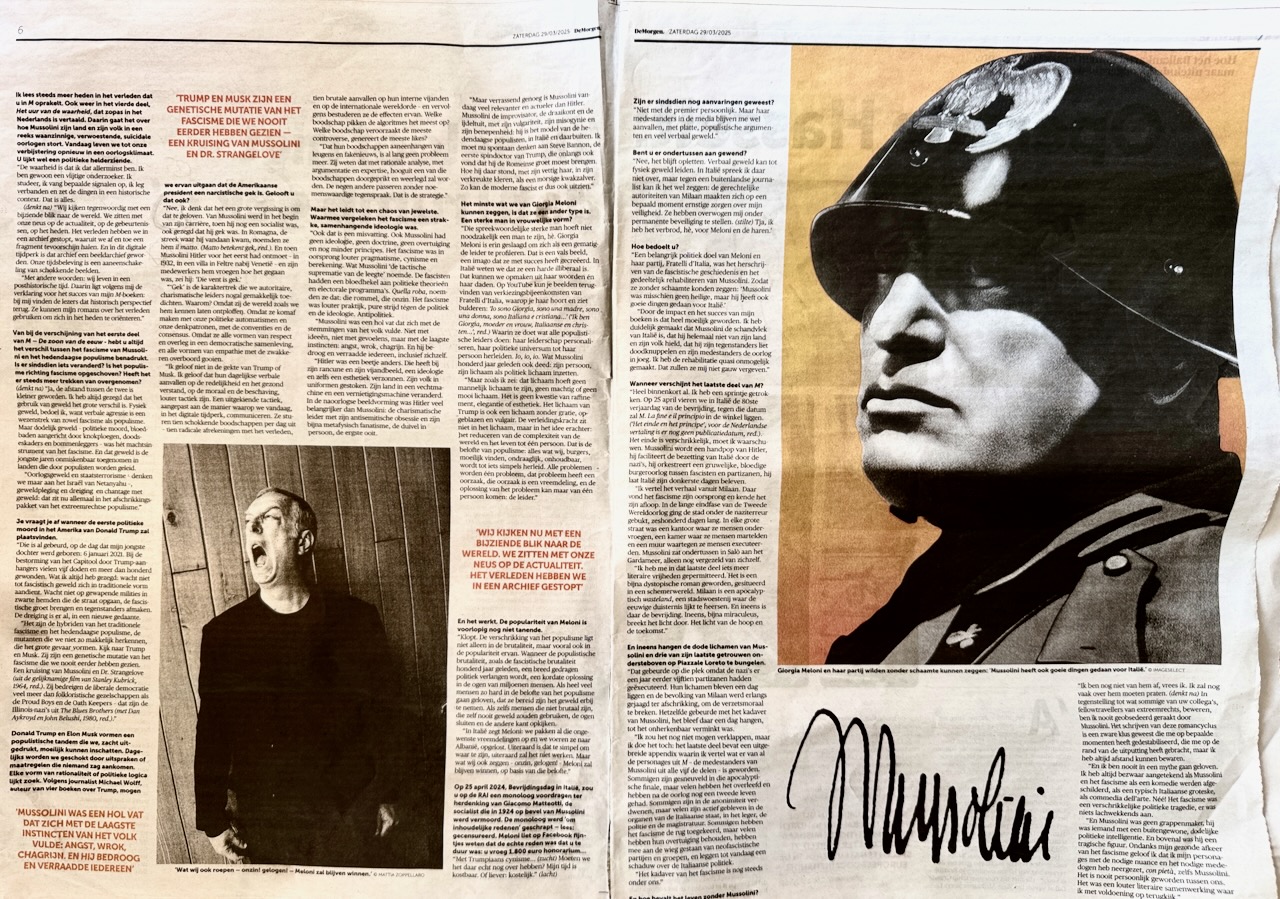
A nearby example of European perspectives worth spreading is an interview with Italy’s Antonio Scurat by reporter Danny Ilegems in this weekend’s Belgian daily newspaper De Morgen. Scurati makes trans-continental sense, is authentic and relevant to European experience and challenges.
A professor in Milan, Scurati is just publishing the last of five volumes of his fictionalized life of Benito Mussolini, the 20th century Italian dictator. Here are some points he makes that seem significant to me:
- We call populo-fascists mad because they aim to blow up the world as we know it.
- Even Germany’s Adolf Hitler called Mussolini “crazy”, but he wasn’t. Unlike Hitler, Mussolini had no ideology, feelings or principles, beyond what he called “the tactical supremacy of the void”. He cynically filled this empty vessel with lies and anger. The ultimate pragmatist, he is a more relevant fore-runner of today’s opportunistic populist right than the highly focused Hitler.
- Populism crosses the line to fascism when it starts using violence, whether in reality or as a threat. This is now happening more and more. Scutari gives as examples Israel’s Benjamin Netanyahu killing Palestinians and Trump’s actions on 6 January 2020, which led to the killing of five people during the assault on the US Capitol.
- Don’t expect to recognise fascism by a return of blackshirts and militias; rather, expect hybrid descendants of populism and traditional fascism. Scutari sees Elon Musk as a hybrid of Mussolini and Dr Strangelove, and militias like the US Proud Boys or Oath Keepers as “folkloric” rather than true fascists bent on the violent seizure of power.
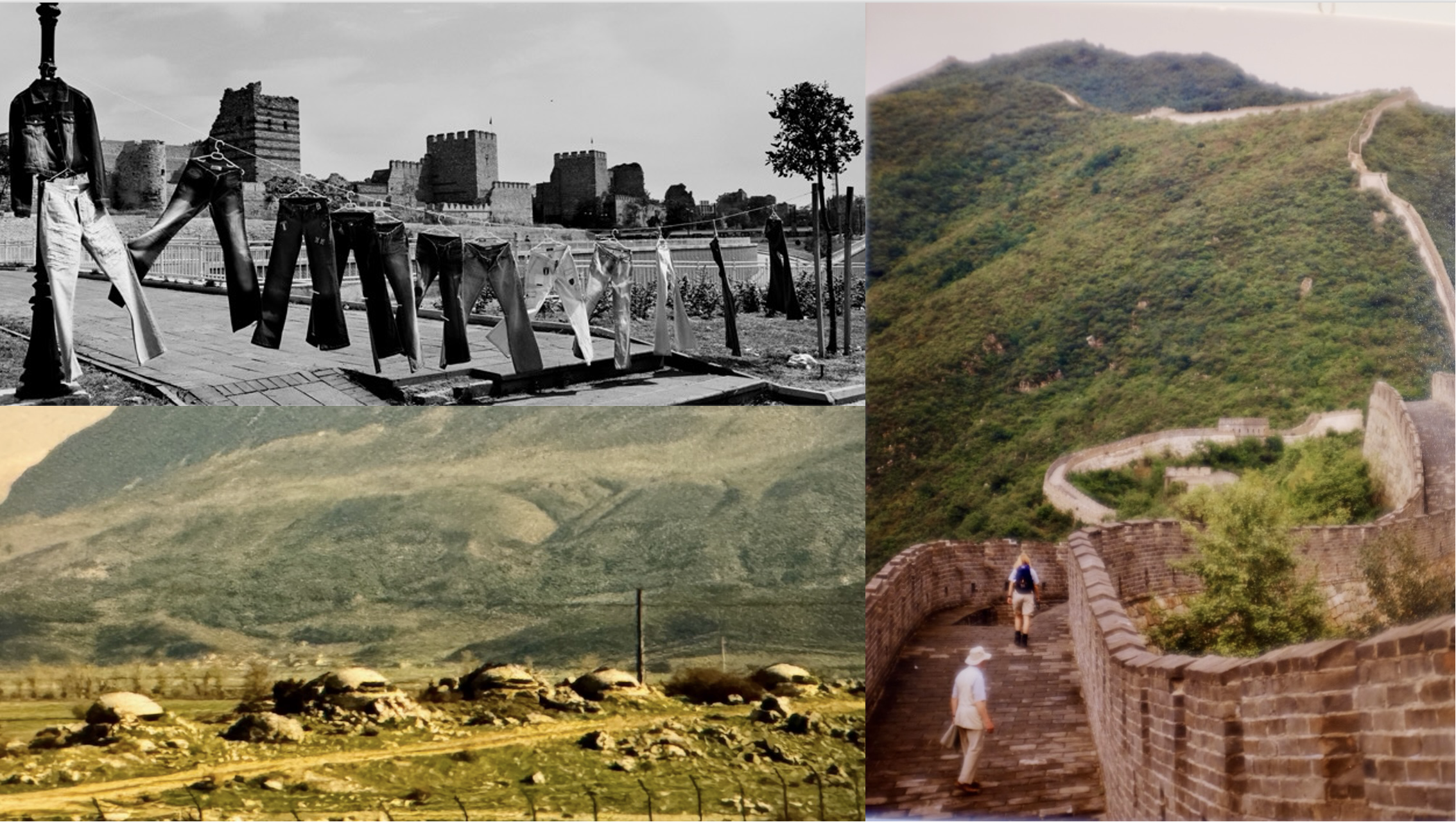
- Europe needs strong army, one that is specifically designed to defend rather than attack. (I agree about the need for strong defence but couldn’t help wondering what a defensive army looks like – Albania’s old bunkers? The Maginot Line? The Great Wall of China? The Byzantine walls protecting Constantinople? Switzerland and its cupboard in every home with food reserves and a gun?).
- Europeans are mentally unready for any kind of existential war in which they would have to be ready to die for their beliefs, country or alliance.
Divorce is a painful new beginning
We still don’t know where the unravelling of the transatlantic alliance will end, but it’s not the only shocking separation we’ve experienced in recent times. The UK’s split with the EU was a terrible wrench. It supplied yet more proof about how much the current system of political parties and elected representatives is vulnerable to manipulation and unfit for the defence of common interests.
At first, I was surprised at the public tears at the breakdown of the transatlantic relationship shed by former top German diplomat Christoph Heusgen at the Munich Security Conference this year. I remember him as a calm and efficient foreign policy aide to Chancellor Angela Merkel, when I used to visit the chancellor’s offices in Berlin in my days as an International Crisis Group project director working on Turkey and Europe.
I’m now beginning to understand Heusgen’s reaction. This transatlantic divorce – just like the real thing in our personal lives – might be a “Liberation Day” for some, but it is going to tear apart much more in us than we initially realized. The US has started a revolution, and revolutions don’t just mean a new beginning. They usually sweep aside the old way of doing things too.


Leave a comment