Writer of books on Turkey, the Middle East and Central Asia. Formerly Director of Communications & Outreach and Turkey/Cyprus Project Director for International Crisis Group. Ex-Turkey & Middle East staff correspondent for The Wall Street Journal.
First sparks can be hard to fan into bright lights. Especially when they’re needed to banish dark demons lurking in the violent history of Iraqi Kurdistan’s six million people.
Five years ago, a few Iraqi Kurdish health professionals and friends of Iraqi Kurdistan, mostly in Britain, had an idea. They wanted to introduce the first psycho-therapeutical help for such deeply buried traumas. They knew that few Kurds even consider having such treatment. The little relief available is mostly tranquillisers or heavy-duty psychiatric medicine.
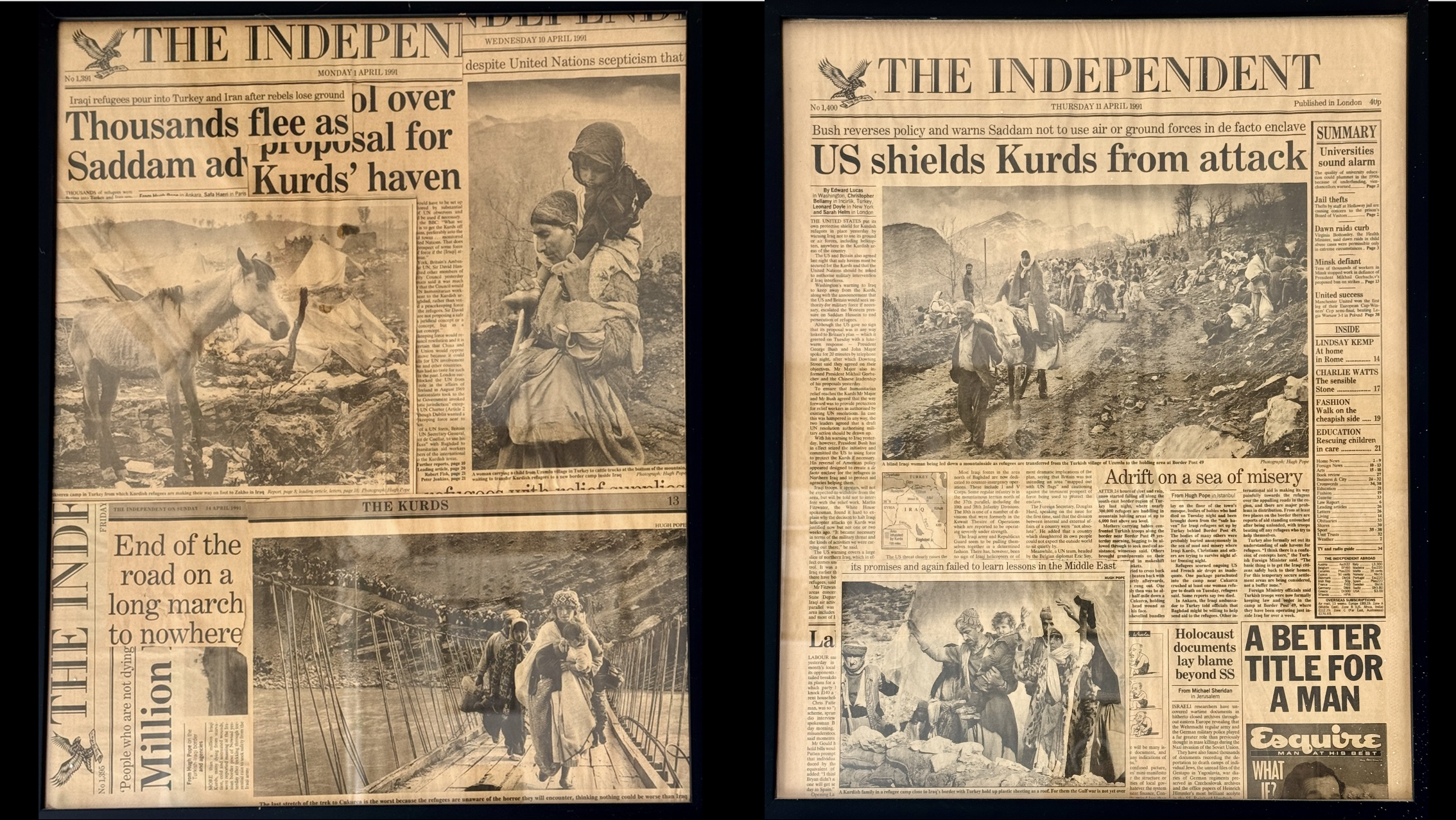
Traumatic scenes from Iraqi Kurdistan in the UK’s Independent newspaper, April 1991.
The Iraqi Kurdish expatriate group faced an uphill battle to introduce this “talking cure”, which consciously shapes behaviour to leave trauma behind. Western partners hesitated to deliver a program in a remote place where their governments advise against travelling. Hopeful leads for funding came to nothing, even after apparently unbreakable promises. Kurdish politicians voiced support, but were overwhelmed by other priorities.
Bringing the plan together
Yet the original core group – collected under the umbrella of a charity, KR-UK-Impakt – kept the idea alive with stubborn persistence. And gradually the pieces of their plan began to come together.
An anonymous donor stepped forward in the name of foreign reporters who travelled to witness the doomed Iraqi Kurdish uprising in March 1991, when U.S.-led forces reversed the Iraqi occupation of Kuwait.
An Iraqi Kurdish host offered to host the program. The European Technology and Training Centre (ETTC) in the regional capital of Erbil brought immaculate organisation, facilities and the ability to choose qualified candidates.
To actually teach the new method, the Oxford Cognitive Therapy Centre (OCTC) put up its hand. Its coaches found ways to train therapists online, in English and with no personal meetings. Teachers even had to judge their students’ clinical abilities from videos of them with patients. For these leading UK experts, the work was a rare chance to experience how Cognitive Behavioural Therapy would fare in a non-Western context.
An emotional launch
Despite all the difficulties, 30 candidates were found who had the right knowledge of English and psychological training. They gathered for the launch of the Kurdistan Mental Health Program in January 2024 with emotional speeches from all involved. Just the night before, a dozen Iranian missiles had struck what Tehran called “Israeli targets” in northern Iraq, killing four Kurds not far away from the conference room in Erbil.
“Sometimes, as the Kurdish people, we see these tragedies as normal,” Zakia Saeed Salih, minister of social and labour affairs in Iraq’s Kurdistan Regional Government, told the opening ceremony. “But they have left a long-lasting impact.”
To illustrate her region’s legacy of more than a century of conflicts, Salih told the candidates a story she had heard from Jonathan Randal, a veteran Washington Post reporter. Randal had challenged one of Iraqi Kurdistan’s leaders, Jalal Talabani, to take some care of a rare survivor in a village hit by the Anfal, or late Iraqi President Saddam Hussein’s brutal massacres of Iraqi Kurds in the 1980s. “Why?” Talabani replied. “We have all been through that. We have all survived it. We all need therapy.”
Even after the therapy training started, the problems weren’t over. Language obstacles proved insuperable for some. Family obligations intervened. Electricity supplies and the internet broke down. Despite the lifting of sanctions, Western banks remained suspicious of Iraq and financial transfers were delayed up to one year. Lack of new funding meant that a planned second cohort of candidates was never recruited. Instead, attention was focused on giving a second year to the original students, to make sure all reached the required proficiency.
Graduation
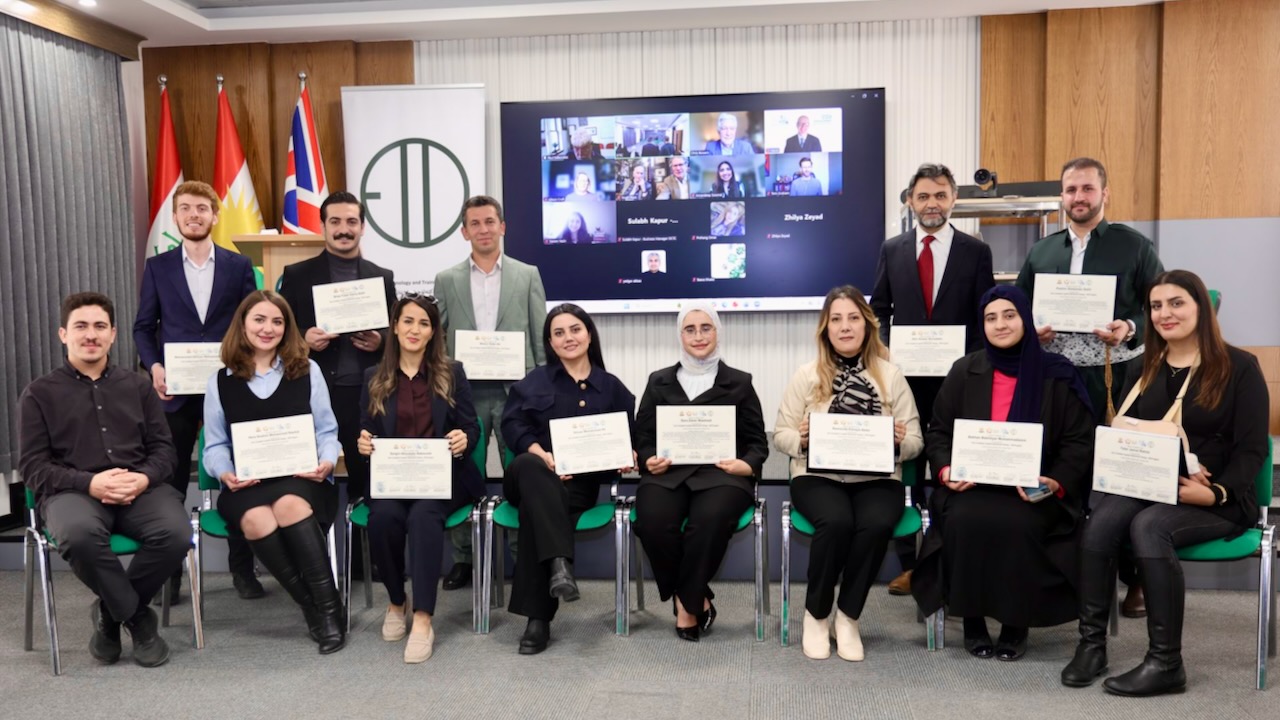
It all seemed worth it on 15 December 2025, when a first cohort of proud Iraqi Kurds received their certifications from the Kurdistan regional government minister who had greeted them at the start. There 30 therapists and clinicians who completed either one or two years of training and then supervision. 12 made it to Erbil to receive their final certificates.
Photo: European Technology and Training Centre (ETTC), Erbil.
During the previous five years, the idea born in 2020 had brought together at least 50 people, absorbed a mountain of volunteer hours, and had cost half a million dollars. With matters like official accreditation of program graduates by the Iraqi authorities still a work in progress, it may be decades before anyone can plausibly guess how much therapy alleviates Kurdish trauma.
But it is a start. The graduates spoke movingly of their determination to make the most of their new insights, whether in public health or their private practices. Media coverage alerted the population to the new approach. Salih, the Iraqi Kurdish minister, promised continued interest and support.
A candle of hope
Jonathan Randal, speaking to the ceremony as one of the outside reporters who had witnessed the 1991 turmoil, told the trainees how the money was donated to thank the Kurds and their leaders for smuggling them alive over the border into Turkey. The journalists escaped not far ahead of the Iraqi army that brutally crushed the rebellion and killed one of those reporters, German photojournalist Gad Gross, and his Kurdish fixer, Bakhtiar Abdulrahman. A three-person BBC reporting team also died on the Iraqi-Turkish border around the same time, apparently murdered by smugglers.
Veteran reporter Jonathan Randal speaks from France to the twelve new Cognitive Behavioural Therapy graduates in Iraqi Kurdistan. Photo by Hugh Pope
“I hope what you have learned will be a candle of hope in these dark times, and that the knowledge you have obtained will light many more candles in the future,” Randal told the newly qualified therapists..
December’s graduates will be the last cohort for now. Hopes for new funding had centred on an Iraqi Kurdish institution that has now been crippled by the big 2025 cuts in U.S. foreign aid. But KR-UK-Impakt is still seeking money for a Phase II of the Kurdistan Mental Health Project.
A new London play
Outside moments of catastrophe, it’s hard to raise awareness of the region’s long term struggle. The co-founder of KR-UK-Impakt, Chris Bowers, a former UK consul-general in Erbil and BBC journalist, has done so by writing a new play about Iraqi Kurdistan, Safe Haven. The play runs from 14 January to 7 February 2025 at the Arcola Theatre in London. Set in the corridors of British officialdom, the play shows how the UK helped create a protected area for the Iraqi Kurds after 1.5 million of them fled their homes in terror.
Arcola Theatre publicity for Chris Bowers’ play Safe Haven, 14 January-7 February 2025 in London. B&W photos by Hugh Pope, 1991.
I was one of the reporters who watched the Iraqi Kurdish refugees pour over the Turkish border. So it’s moving to see Arcola Theatre putting my photos from those freezing mountain passes to good use on stage, in the posters and in a small exhibition at the theatre during the run. Kurdistan24 television did a nice report on the play that you won’t need Kurdish to understand.
The Iraqi Kurdish emergency was not the first and is far from the last wrenching displacement of people in the world. The UN says a total 36.4 million people now count as refugees who have fled over international borders, and 73.5 million count as internally displaced. That’s 117.3 million people forced out of their homes, five times as many people as in 1991.
The people involved will not be the only ones who suffer. If these traumas remain untreated, the chances are that their communities will be trapped in yet more cycles of violence.
Correction: The number of students in the first cohort of the Kurdistan Mental Health Program was corrected on 11 January: 12 students received their certificates in Erbil, as originally stated, but altogether 30 were trained for either one or two years.
To hammer home the universal relevance of deliberative democracy, I treat every speaking opportunity as a possible nail. Hitting this one cleanly, though, was a challenge: my comments were to be made from the front bench of an Oxford Union debate about the Ottoman Empire.
Oxford University’s famed debating club invites speakers for and against a topic, and the audience then votes for one side or the other. The motion set for us was “this House regrets the demise of the Ottoman Empire.” The topic was familiar: I lived, reported, and wrote books about Turkey for more than three decades. When I stood up in the chamber on 20 November, the essence of my argument was that:
Regretting the past is futile and blocks thinking about ways to progress
Histories show it’s a myth that the Ottoman Empire brought centuries of peace, justice and equality
All empires are sustained by oppressive force.
None of the Ottomans’ dozens of subject peoples regret the demise of this top-down political construct, including the Turks
The Oxford Union, like the British political system of which it is a part, should move on from old-style duelling debates to deliberation on topics of real relevance to its members and the public interest
Voting against regret and imperial nostalgia would be a vote for new, improved democratic practices, like decision-making by randomly selected citizens’ assemblies.
The full text of my speech is at the end of this article. You can see photos from the evening here. The full debate will be shared here in a couple of weeks.
The arguments
On our big night in Oxford, I shared the opposition bench with four others. An Australian student, Oliver Douglas, went first, rejecting all forms of empire. Historian Attila Pók then talked of how his native Hungary still viewed Ottoman occupation as a national tragedy. Constantinos Filis said the same for Greece. The Ottomans had earned their demise, he added, as they fell deep into debt and lost control of their sovereignty. Turkish author Kaya Genç quietly and persuasively showed how Turks today have no wish to resurrect the past.
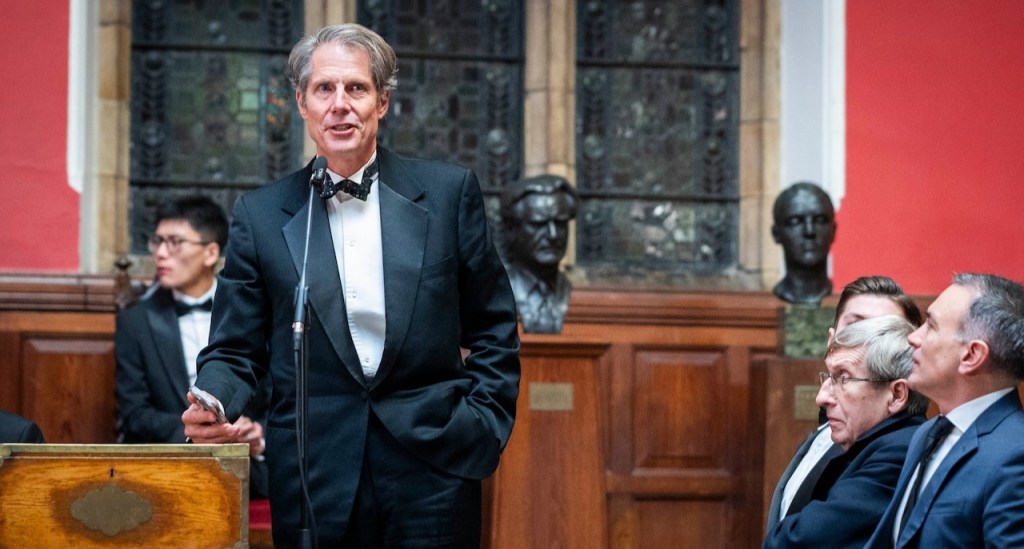
Ayşe Osmanoğlu wearing the Order of the House of Osman. (Photo: Oxford Union)
The star on the bench for the proposition was Ayşe Osmanoğlu, a writer and descendant of the defunct Ottoman dynasty. Her ancestors may not have been perfect, she said, but gently asserted that they ruled over a wide geography for centuries, brought peace, gave rights to minorities and avoided forced integration. American academic Carter Findley then talked about his books on the long-running themes of Turkish history. The bravest speech of the evening came from Turkish film director Atıl İnaç, who, tragically, had heard a few hours before that his mother had unexpectedly died. Clearly in shock and unable to get back to Turkey that evening, he courageously went on with the show.
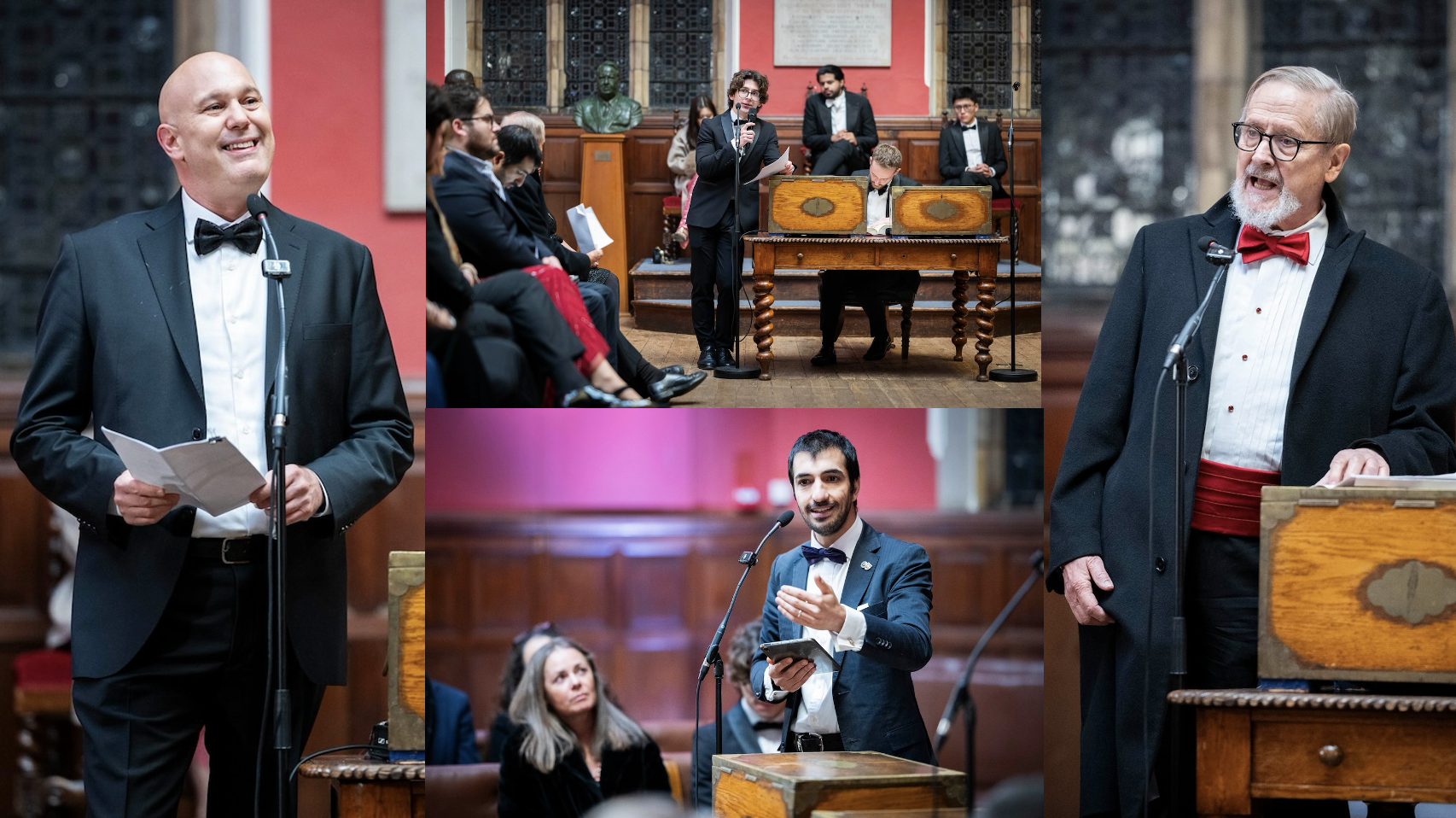
The proposition bench: Atıl İnaç (L), Ege Havlucu (top), Carter Findley (R), Ayşe Osmanoğlu and Kubilay Ahmet Küçük (bottom). (Photos: Oxford Union)
Their comments were bracketed by two Turkish students, Ege Havlucu and Kubilay Ahmet Küçük. Havlucu asked the House to regret not the Ottoman regime, but the traumatic bloodshed as the Ottoman Empire collapsed and as the republic was born. Küçük rehearsed with passion the assertion that the Ottomans were much better and more tolerant than their historical peers.
My fellow speakers on the opposition bench: Oliver Douglas (L), Constantinos Filis (top), Kaya Genç (R) and Attila Pók (below) (Photos: Oxford Union, except for Kaya Genç by Hugh Pope)
Our side won the debate. 196 people rejected the motion to regret the Ottoman Empire’s collapse, walking through the left side of the great gothic door to the chamber labeled “Noes”. 111 people chose the right hand side to vote with the “Ayes” in favour.
Debate vs deliberation
The evening was intense and lots of fun. We heard several clever people making points I hadn’t considered before. Three of the students made short, clear, powerful interventions, luckily supporting our side opposing the motion. But ever since co-editing and finding a publisher in 2023 for my father’s posthumous book The Keys to Democracy,my eyes have been opened to the benefits of deliberation. I was ultimately frustrated by the process of a “debate”focused on such an I’m-right-you’re-wrong outcome.
I didn’t go much to the Oxford Union much as a student. Perhaps wiser now about why debates frustrated me, I found it more fun four decades later. (Photo: Oxford Union)
The main speakers were not expected to respond to each other. There was little sign of coordination between them to streamline the information flow. The occasional rhetorical flourish made the chamber come alive, but these seemed more entertaining than persuasive. A significant amount of what was said consisted of broad assertions mixed with too few facts, or too many obscure facts drowning out a structured assertion. The couple of hundred people in the audience had little chance of distinguishing between the two. Distractingly, between speeches, a good portion of those attending churned in and out of the chamber.
Oddly, Ayşe Osmanoğlu was the only woman among the ten speakers. Although women were well-represented among the Union officials and the audience, no women were among the half dozen students who made comments from the floor.
If faced with a real-life decision made in this old-style parliamentary manner, I wouldn’t have wanted to obey it. The yes-or-no debate only strengthened my faith in citizens’ assemblies, the epitome of deliberative democracy. These consist of a group of ordinary citizens randomly selected and mandated to solve a big, knotty problem for their organisation, community or country. Guided by impartial facilitators, they are briefed by accredited experts from all sides of the question, deliberate in small groups and then vote on a new policy. Only what achieves a two-thirds majority counts and the assembly’s final report takes minority opinions into account.
Forging a new Oxonian elite
There was more for a deliberative democrat to learn from observing the Oxford Union, perhaps the most famous training ground for the UK’s political elite. Some surprises were refreshing. If earlier on in its 200-year history the club’s members were stalwart champions of imperial expansion, the former British Empire has certainly now struck back.
The union’s president, Moosa Harraj, scion of a political family in Punjab, is the fourth Pakistani to hold the post. Incoming treasurer Matthew Chiu is from Hong Kong. Student speakers came from Australia and North America. And these are only the ones from Britain’s former dominions. Looking back later, I realised that of all the Oxford Union officers I personally met or speakers I heard, I was probably one of only two who were “mainly” British. But I was born in South Africa, am also a Belgian, and have lived in all kinds of places but Britain for more than four decades. So the most born-and-bred British person of this group was arguably Ayşe Osmanoğlu, the princess wearing a necklace of Ottoman stars and crescents and the Order of the House of Osman. Her perfectly pitched speech would have been the one most at home on a highbrow BBC radio program.
This multi-ethnic, international mix will in the coming years doubtless transfer to London to enrich the diversity of Britain’s rulers. The elite of Oxford’s student groups did just the same move after my time at the university. Now as then all had seamlessly assimilated the breezy Oxonian corporate culture.
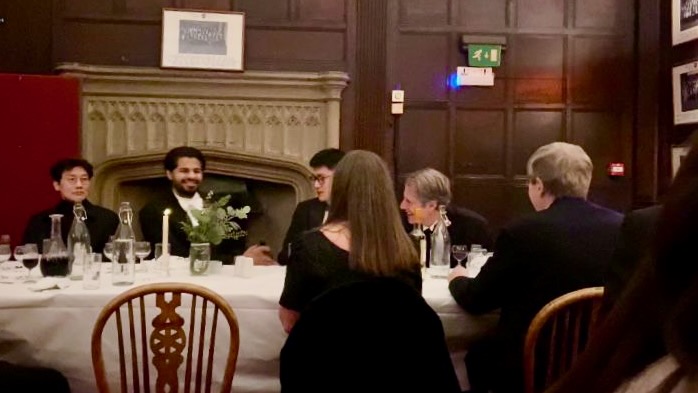
Oxford Union President Moosa Harraj (seated centre next to Korea’s Hwang Dong-hyuk) with speakers proposing the motion (seated right) and those opposing (seated left). Committee members and guests stand behind.
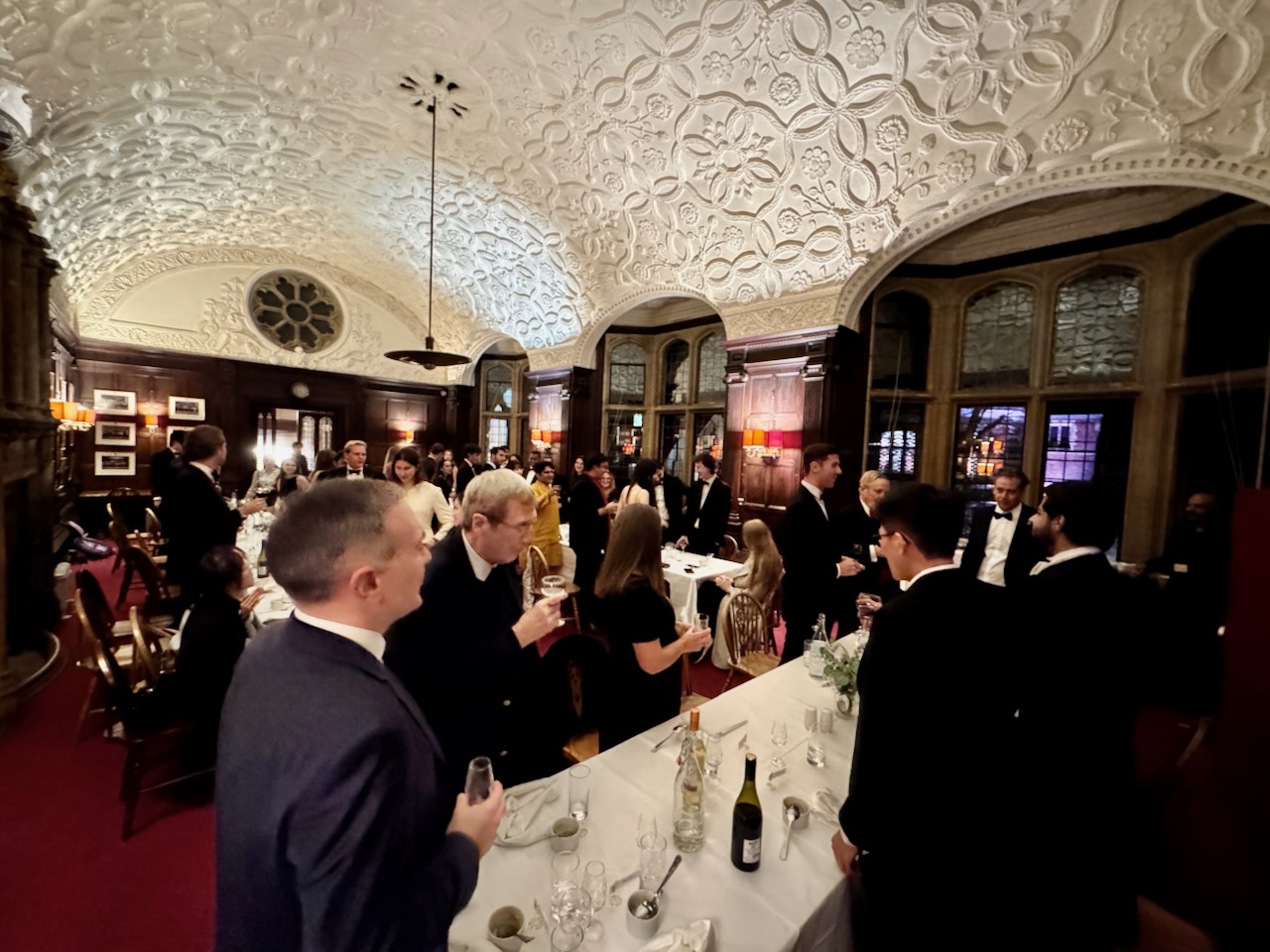
Confidence amid chaos was at the heart of it. Union committee members showed their officer calibre, shuttling their confused guests through a fast-moving succession of drinks parties, a three-course dinner, formal photographs and processions. Something cut the power supply to the debating chamber a couple of hours before the debate. But a generator was found and the lights went back on. The 150-year-old building was still brain-crampingly cold, forcing people to pull on coats over their formal wear. One speaker donned his safari hat too. “I thought I’d left power cuts behind in Pakistan,” Harraj muttered into his microphone.
The club juggles its guests with insouciance. Flattered by our speaker invitations, at least two guests had flown all the way from the US for the evening. But we were just bobbing sticks in a stream of celebrity showboats that Oxford students see all the time. Former US Vice-President Mike Pence had dropped by a couple of days before. And the real guest of honour at our debate dinner was Korea’s Hwang Dong-hyuk, creator of the Squid Game. Even though his world-conquering Netflix series is all about winner-takes-all survival, he sometimes seemed as bewildered as us by these high-powered students and their laser-sharp focus on network and careers.
Hwang Dong-hyuk (L), creator of Korea’s hit Netflix series the Squid Game, observing the Oxford Union’s real-life game of the survival of the most ambitious. (Photo: Hazel Pope)
Back in my day, I had little idea that such contacts might open great doors in the future. As I tried and failed to catch the eyes of students to talk to in the Union bar, I realised how blasé my attitude must have seemed to visiting grandees. Indeed, nothing holds a student’s attention like a fellow student, who might prove useful right now.“Even to get elected to the committee, you end up spending your whole life trying to win support on Instagram messenger,” Union official Boldizsar Paladi-Kovacs confided as he guided us round the premises. “That’s why I gave up thinking of going for Union president.”
My pro-sortition convictions deepened as we passed the photo portraits on the walls of past Union officers whose victories in student elections had paved their paths to national power. “Ah, there’s Boris Johnson when he was president of the union,” one union official said, pointing out the former prime minister’s infamous mop of pale hair. “Of course, you all know the story about how votes for his opponent [when he failed to win election the first time round] were found in a chimney here.”
A school for power
The photos present more proof of the Union’s intimate role in the British establishment. During the Cold War, the British secret service insisted that the faces of Union officers be rubbed out, in case Soviet spies spotted them. Every face in some frames is wiped out with a white blotch. Weirdly, the names were all left in. It reminded me of the grassy bank of the Cherwell river running through Oxford that was known as Parsons’ Pleasure. Here we used to punt past often elderly, naked male sunbathers. The clever ones, my late father enjoyed pointing out, would bury their faces in their newspapers, but leave everything else hanging out. “After all, your face is how you are normally recognised,” he’d explain.
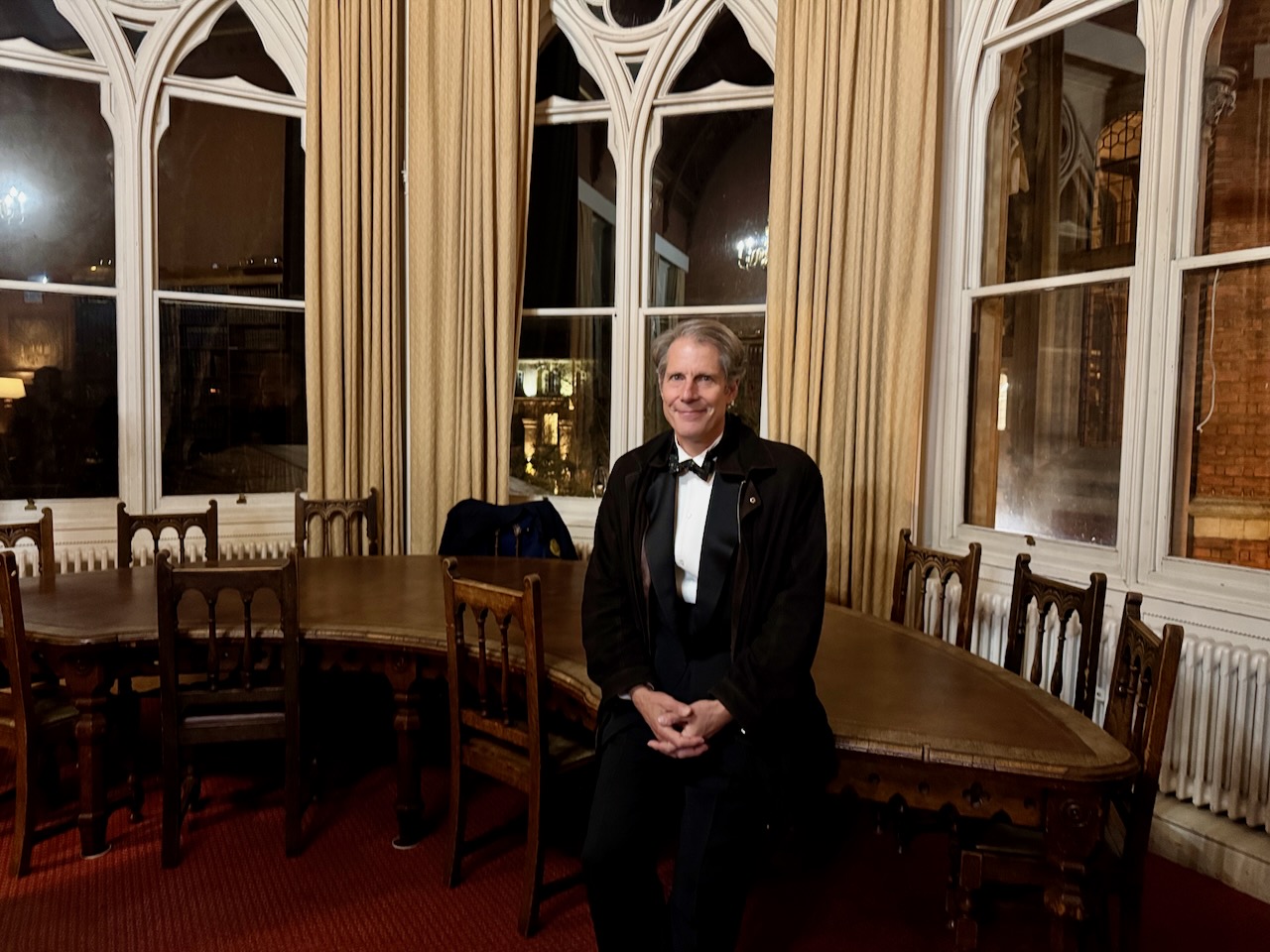
It’s hard for a visitor not to be in awe of the Union’s Victorian grandeur and its ingrained pomp and circumstance. Unshakeable traditions feature white-tie-and-tails costumes for top officials and a great crescent-shaped table that Prime Minister William Gladstone designed for Cabinet meetings a century and a half ago. Its curves were clearly designed to allow one person to dominate and epitomised the top-down culture of British imperial power. “Gladstone wanted to look into all his ministers’ eyes to see if they were lying,” our guide Paladi-Kovacs suggested.
Posing with the desk used by Prime Minister William Gladstone to keep a close eye on members of his government. (Photo: Hazel Pope)
This sense of being suddenly in the power of the Oxford Union was reinforced by the just-in-time experience of visitors. It wasn’t just us outside speakers who weren’t sure what was going to happen next, one student explained. The president is elected for just one term, and committee members have to stand for re-election every term. “Unsurprisingly, there’s little continuity,” they said.
There were reasons too that our hosts might be distracted. The Union is in the grip of a very British scandal. Harraj’s would-be successor next term, George Abaraonye, was voted out of office after he gloated on social media over the September shooting of US right-wing activist Charlie Kirk. Even Harraj has had to fight to keep his presidency. Top speakers cancelled Union appearances, new memberships dropped by a quarter and revenues were badly hit. Overspending on our debate dinners, apparently, was part of the problem. This high drama will doubtless further prepare everyone involved for future UK political life.
Oxford Union President Moosa Harraj proposes toasts to his guests and Rosalie Chapman (seated centre). (Photo: Hugh Pope)
The recent scandal brought another rite of passage. Raising a glass of port, Union President Harraj reserved his last toast after dinner for “my girlfriend, Rosalie”. That was apparently a reference to misogynistic, dismissive tabloid coverage of his partner. In fact, Rosalie Chapman’s robust social media posts celebrate the fact she’s the first in her family to go to university, recently got one of the top degrees in her subject, can give a fine speech and has been elected multiple times to committee positions in the Oxford Union.
Something to believe in
Watching the construction of this new elite as a visitor was certainly less stressful than actually being one of the students. Back then, I did join the Oxford Union in my first term, but I rarely went. I was put off by the febrile politicking of ambitious students and never saw much difference between power-hungry political parties.
I now felt glad that fate had led me to something I could believe in, namely deliberative democracy and random selection. I enjoyed planting the seeds of these ideas in my speech, even if I don’t know how these landed with the union officers or the bulk of the chamber.
But I did learn a new word after my final appeal for “this House” to stop regretting the end of oppressive empires. My guest for the evening, my teenage niece Hazel Pope, overheard two students in the audience react to my final proposal to embrace new citizens’ assemblies, not regret old imperial rulers. “Based” was the word they whispered. This expression has moved from describing a cocaine user, Google says, to becoming “a compliment to show approval of someone’s confident, courageous, and authentic behaviour.”
Our side’s victory in defeating the pro-empire proposition of the debate felt good. But hearing of this openness to new ways of doing things tasted sweet too.
My speech
Here’s what I wrote for my speech, more or less as delivered:
Good evening ladies and gentlemen. It’s a great honour to be here.
Before we get into what to think about the Ottoman Empire, I want to draw your attention to a paradox.
Most of us in this room are or have been members of Oxford University. I daresay those of you still studying here are quite enjoying the experience.
But here’s the thing. To “regret the demise of the Ottoman Empire” is to choose a world that is run as some kind of eternal groundhog day.
If you are an undergraduate, say, the question before you tonight is like asking you whether or not you want to live in student digs forever. I am sure you would all agree that the novelty would soon pall.
In short, a vote for this motion means a vote never to change, never to develop, never to progress.
I put this choice in stark terms to underline this point: when we talk about the demise of the Ottoman Empire, we are talking only about the collapse of a political construct. A construct that, like all empires, was based on conquest, force, elite rule and extortion.
We are not being asked if we like the style of this or that palace, the cadences of a ghazal poem, or the beauties of an Iznik tile. The question begins and ends with, do we wish that this constitutional arrangement had persisted until today?
Our argument is that it could not have survived, and should not have survived.
The gallant proponents of the motion on the other side of the aisle have painted charming pictures of various aspects of life in Ottoman times. Some of them genuinely believe that the Ottoman Empire brought peace, integration and justice. The reality for its subject peoples was different.
Most evidence-based surveys of the Ottoman Empire – present company included – show that there was no pax ottomana. Fighting was a constant on the Ottoman frontiers and internally too. As Ayşe Osmanoğlu’s fine books point out, her own ancestors were locked up for decades in a palace by the Bosporus.
Full justice was impossible because non-Muslim minorities were, by law, second-class citizens. The empire also often lashed out at Muslims who did not adhere to the orthodox Sunni version of the faith. In short, Ottoman pluralism didn’t offer equality, it was a strategy for imperial control.
Similarly, there was no single Ottoman realm or Ottoman citizenry. It was a patchwork of peoples, faiths, provinces and autonomous satrapies that masked all kinds of inequalities.
Foreign visitors to the Ottoman capital, Constantinople, now Istanbul, often wrote of their thrill at its cosmopolitan vibrancy. But I would like to share with this House the published view of Edhem Eldem, a wise academic and another descendant of the Ottoman dynasty. Because of domestic inequalities and oppressive rule, he says, the city may always have been wonderful for foreigners to visit, but it was so difficult for its native people to live in that they often just wanted to leave.
I am sorry that we won’t be hearing from Zülfü Livaneli on the proposing team this evening. I feel that, like many of Turkey’s intellectual elite, he could only have helped our opposition to the motion.
This famous writer and singer made a fine film in praise of the man who deposed the sultans, Kemal Ataturk. He is an outspoken member of Ataturk’s Republican People’s Party. He is a free spirit who sings songs with titles like “Oh Liberty!”. He is not known for laments called “Oh my lord sultan of all the horizons, how I miss you!”
Sympathy in Turkey for the republic is strong indeed. While researching my own book on the country, Turkey Unveiled, I met the late Hümeyra Özbaş, a grand-daughter of the last sultan. She ended her days holding court in the Kismet hotel on Turkey’s Aegean coast. Hümeyra told me that many members of her family were secretly proud of the way Kemal Ataturk beat off the invading forces of Britain, France, and Greece to create a truly independent state of Turkey.
Now, there has been a recent fad for films in Turkey that portray early Ottoman sultans as all-conquering heros. This neo-Ottomanism is often not historically accurate. But to some extent it succeeds in its main aim. This is to add a veneer of glamour and legitimacy to the current Turkish government and its strongman leader.
That’s why the phenomenon of neo-Ottomanism should not be taken as evidence of Turkish regret for the past. The only regret I feel is the way the Turkish authorities have made some historic parts of Istanbul, like Eyüp, look like a kind of Ottoman Disneyland. They have stripped centuries-old mosques of their patina and scrubbed them as clean as shopping malls. This is just another way to manufacture an Ottoman-themed endorsement for strong, central rule. It’s why the current government of Turkey, not all of its people, would be with the ayes tonight.
Don’t just take it from me. In the 100 top-grossing films of all time in Turkey, there’s only one with such an Ottoman theme. It’s called “Conquest 1453.” Despite having one of the biggest budgets in Turkish film history, it comes in only at number 48.
There is also one minor Turkish film, the Ottoman Republic, that imagines what the country might have looked like had Ottoman rule survived. It is a farcical comedy, the sultan is presented as a bumbling incompetent and the country as a small, unimportant stretch of Anatolia under US mandate and European control. Again, no regrets here.
As you listen to the other side, please remember that dozens of countries and peoples emerged from the Ottoman collapse. And in none of them – Arabs, Serbs, Greeks, Bulgars, Yezidis or Alevis – is there any sign of significant nostalgia for its demise.
Of course, there is admiration of today’s Turkey in the region. Turkish Airlines flies to more places than any other airline. Turkey’s diplomatic outposts around the world rival those of the US and China. Turkish companies build metros, shopping malls and kitchen appliances for half the neighbourhood. But these are achievements of the Turkish Republic after it freed itself from the shackles of the past.
Even the Turks do not regret the Ottomans’ passing. For sure, invasions by Britain, France, Russia and Greece a century ago made the transition to a republic bloody and deeply traumatic. But the overall improvements since then are so clear that I could find no polls on the question we are discussing tonight. I could find a proxy, however. A 2024 Pew Research poll shows that 56% of adult Turks want, if they could, to join the European Union. Sounds to me like they’ve moved on.
Let’s probe a little deeper. Who is doing the regretting that we are so earnestly debating? I suppose we imagine ourselves as “the right-minded people of the world”. But we speak of “this House”.
“This House” is in many ways a descendant of another empire, the British one. Many politicians who ran that Empire sharpened their rhetorical skills in this same chamber. The British forces under their command played a critical role in bringing down the Ottoman Empire. And the last sultan slipped out of Istanbul in 1922 aboard a British warship.
“This house” must therefore be honest with itself. Yes, there may have been brief tactical alliances between Britain and the Ottoman Empire, as during the Crimean War.
These British policies had little to do with the inhabitants of the Ottoman Empire itself. They were about domestic politics (busts of Gladstone and Disraeli), commercial interests and the goals of superpower diplomacy like building British maritime power and limiting the reach of Russia.
An institution like this House, so entwined with the British establishment, cannot airily undo the past and easily regret the demise of an Empire it did so much to destroy.
Tonight you may hear counter-factual imaginings about how the Middle East might have remained more peaceful if only the Ottoman Empire had remained in control. Please put these fanciful ideas to one side. Wars and uprisings were endemic.
Indeed, the Ottoman Empire had already shown it could not resist early pressure from the two biggest drivers of Middle East conflict in the 20th century: the creation of the state of Israel, and the lust for control over Middle East oil.
So the real point to focus on is that the world needs to move on from all empires, which have always relied on force to maintain control. We should not be regretting the passing of authoritarian despotisms.
What this House should be channeling is the naturally egalitarian, collaborative instincts of our fellow humans.
Seeing the yes-or-no format of the debate in this House tonight makes me feel even more strongly that we should all be moving on from this binary, polarised duelling about policies.
We should be trying to create new structures for decision making around the world, like randomly selected citizens’s assemblies.
We should hurry forward with humanity’s journey from point-scoring debates to deliberation in the public interest, from inherited hierarchies to full equality, and from empire to self-government,
So I appeal to this House to reject this motion. Let the past be what was, frankly, a not-so-attractive past. Please vote for all of us to be free to embrace a more equal, democratic future.
The Oxford Union in full flow. The opposition is on the right, with Oliver Douglas speaking. (Photo: Oxford Union)
Rulers in many countries are struggling to meet public expectations. Elections fail to produce stable governments. Disinformation spreads alienation. Selfish hierarchies hollow out law and tradition. Trust in elected politicians plumbs new lows. Authoritarian ideas and leaders fill the void.
Surprisingly few people, however, question the electoral systems that are a central part of the mess. What can the partisans of citizens’ assemblies – and other deliberative, participatory, broad-based ways of public decision-making – do to persuade other people that their form of democracy offers a better way to run our lives?
The scale and urgency of the challenge was a defining theme when, for a week in Brussels this October, I joined 270 fellow members of the international movement to develop such a new constitutional architecture. It was the biggest meeting yet of the Democracy R&D network, which has grown by leaps and bounds since 30 people founded it in Madrid just seven years ago.
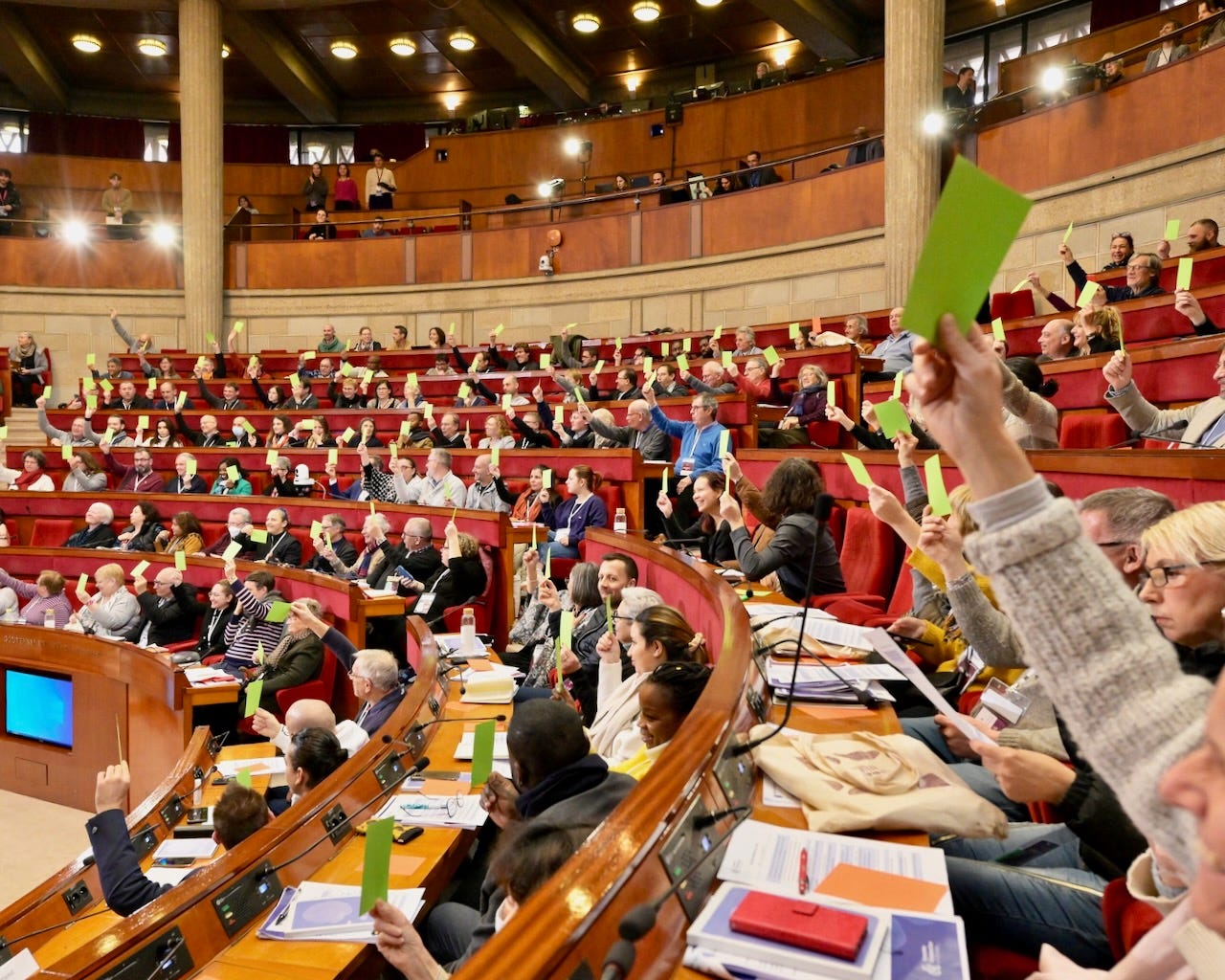
Compared to most conferences and talking-shops I’ve attended, deliberative democracy get-togethers have definitely been the most meaningful and fun. Democracy R&D 2025 in Brussels was no exception (Photo: Hugh Pope)
These activists mostly seek to develop and popularise the use in public decision-making of citizens’ assemblies. Like juries in courts of law, these assemblies are groups of everyday citizens – from a dozen to 200 people – who are chosen by lot to find a solution to tough local or national problems. They meet for several days over weeks or months, are briefed by experts, deliberate on what they hear and take votes on the best way forward. None are exactly the same, but most follow the same principles. A typical template is this one by DemocracyNext, a non-profit on the cutting edge of international thinking on the topic.
Exponential growth
Citizens’ assemblies have grown fast since the first of the modern era was held in Vancouver, Canada, in 2004. The movement lost count of the total after the number reached 713 in 2023, but for sure their spread around the world has continued exponentially. For instance, 51 new citizens’ assemblies were held in 2024 in Germany alone.
Citizens’ assemblies show a way out of the deepening paradox in countries ruled by elected governments. An average 63% of adults in 12 high-income countries are dissatisfied with the way democratic governments are working, a figure that has steadily risen from 49% in 2017, according to a Pew Research poll from June 2025. The paradox is that 77% of adults told a separate 2024 Pew poll of 24 countries that they are convinced that elected governments is basically a good system.
The movement for deliberative democracy, by contrast, maintains that squabbling political parties, polarised societies and self-centred leaders are not bugs that can be fixed, but fundamental flaws of the electoral system. This idea is gaining ground, despite people’s paradoxical faith in voting for representatives. An average 70% of people, the 2024 Pew poll showed, now also think of direct democracy as good (defined broadly as when “citizens, not elected officials, vote directly on major national issues to decide what becomes law”).
In the UK, more than half of respondents from all four major political tendencies told an April 2025 YouGov poll that they would trust members of a citizens’ assembly more than members of parliament to take a policy decision in their own interest.
“Connect, get out there, make more people understand what we’re trying to do. Give people the tools to make participation happen where they are.” Anthony Zacharzewski opens the second day of the Democracy R&D conference in Brussels (Photo: Hugh Pope)
Looking back with pride, Anthony Zacharzewski of the Brussels-based non-profit Democratic Society told the Democracy R&D conference of the change since he started out more than a decade ago. Back then, in “every conversation I had about participatory democracy, the question was: ‘What is participatory democracy?’ …. We really had to knock on every door. Now the phone is ringing and people come to us.”
But the new democrats have by no means won the argument. The 2024 Pew poll showed there is also clear support for top-down, non-citizen-based alternatives. 58% of people favoured rule by experts, 26% rule by a strong leader and 15% rule by the military. And to judge by myriad speeches, workshops and dinners at the Democracy R&D conference in Brussels, the deliberative movement still needs to find more internal cohesion, popular traction and funding.
Barbed wire can’t protect a house from rotting within
Since last year’s Democracy R&D conference in Vancouver, the electoral success of Donald Trump in the United States has fanned fears that autocratic rule is running away with the race. Alarm has grown over the rise of the authoritarian right in Europe, and the multiple failures of several traditionally strong north European powers to form stable governments after elections.
Zacharzewski pointed out that President Trump’s elimination of USAID and all its funding programmes meant that in a developing country like Kosovo, two thirds of the people working on democracy lost their jobs overnight. “This is repeated right away across the world, even in Europe, where national governments are making similar cuts,” he said.
Recently, too, European states have prioritised defence, not governance, throwing new resources into drone technology, cybersecurity and military spending. For instance, the European Union is proposing to quintuple security spending in its next seven-year budget starting in 2028. Several speakers at this year’s conference worried this neglected improvements to democracy – a domain that, in theory at least, gave Europe its competitive edge in the first place.
“A strong defense on the outside of Europe, protecting a weak democracy on the inside, is asking for problems,” David Van Reybrouck, the Belgian writer, poet and political philosopher told the conference-goers. “We’d be repeating on a continental scale what has happened in Israel on a national scale. A dilapidated house [won’t repair itself just because] you put some barbed wire around it.”
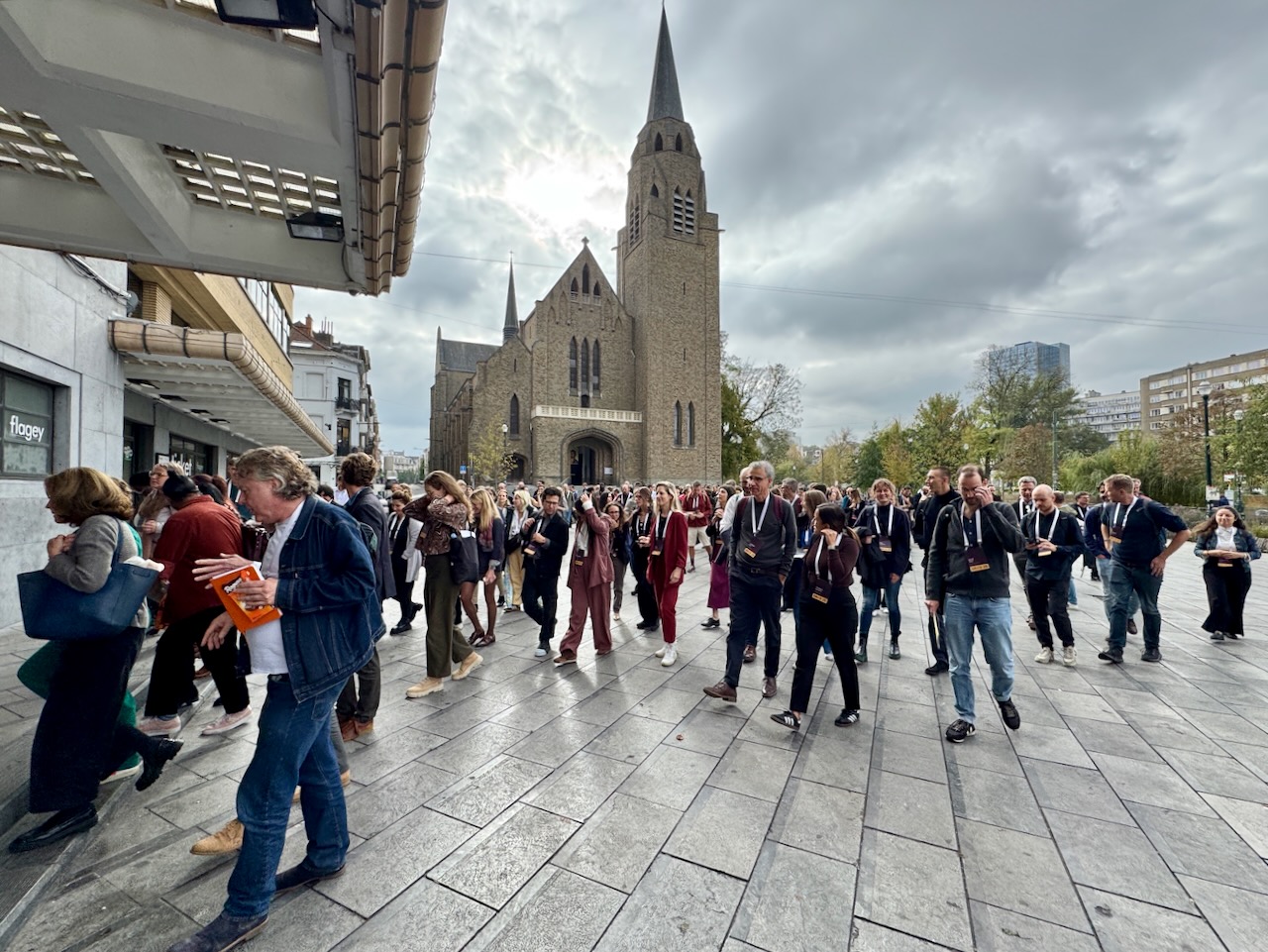
The deliberative wave: conference goers in front of the Flagey building in Brussels (Photo: Hugh Pope)
Just €3.6 billion in the EU’s next €2 trillion budget is earmarked for democracy-adjacent activities. Conference speakers urged activists to work harder on getting more funds directed towards democratic innovation. This includes not just citizens’ assemblies but developing ideas like participatory budgeting (allowing groups of citizens a say over part of a government budget), using artificial intelligence to reduce the cost and increase the efficiency of assemblies, and multiple choice “preferendums” on new policy instead of simplistic and easily politicised yes-or-no referendums.
As it happens, the EU has just held a randomly selected citizens’ panel (its name for a citizens’ assembly) on what priorities should guide the budget. Ironically, the 150 citizens did not explicitly recommend the funding of more citizens’ panels.
Still, the first of the seven EU citizens’ panels organized since 2021 did recommend that citizens’ assemblies should be encouraged. The citizens allotted to the latest panel also said the format represented the EU well and that they were satisfied by the experience of democracy by lot. As for stronger defence, the panel ranked it only seventh of their 23 priority recommendations (healthcare, youth jobs and infrastructure spending came out on top). “Very quickly, we realised these discussions are incredible,” an EU budget official who attended the panels told our group. “You can ask more from citizens and trust them more than most people think.”
An EU official praises the contribution of a recent European Citizens’ Panel to policy making on tackling hatred. (Photo: Hugh Pope)
The European Commission wants to hold more more citizens’ panels. It invited democracy conference attendees to meet members of its panel held in 2023 on tackling hatred in society, some of whom are still involved in briefing EU officials on their findings. As one EU official from the directorate general involved said to the deliberative democrats: “We found common ground. We were amazed by the [panel’s] recommendations. We are advancing on those.”
Breaking through
The growing number of citizens’ assemblies being organised by powerful entities like the European Commission, Germany’s parliament and France’s President Emmanuel Macron is not the only good news. More and more thoughtful celebrities are also ready to endorse them. From the English-speaking world, these include author and comedian Stephen Fry, political podcaster Rory Stewart, the late UN Secretary General Kofi Annan, British actor Riz Ahmed and cookery author Delia Smith.
Even India’s Mahatma Ghandi would count as a supporter, according to a conference speech by Yves Mathieu, head of French citizens’ assembly organiser Missions Publiques. He pointed out that Ghandi defended a democracy of directly participating citizens when he said: “If you do something for me without me, it’s against me.”
Many at the conference said the deliberative democratic movement, having devoted its early attention to conceiving and building a new model of doing democracy, must now focus more on mobilising this model to catch up with autocrats and oligarchs. “The sector of deliberative democracy is obsessed with design,” Van Reybrouck warned. “Design matters, but we cannot afford to stay and to remain nerds only. We have to become campaigners as well.”
One sign of new activism is the Sortition Foundation‘s new campaign in the UK for a randomly selected citizens assembly to take the place of Britain’s antiquated House of Lords. But public advocacy on this scale is still a rare initiative, given the cash-strapped nature of most democracy non-profits.
At one conference workshop – on citizens’ assemblies organised without an official mandate – we dove deep in search of new ideas. One of the organisers was Sofie Furu, of Norway’s SoCentral non-profit, which this year joined several Norwegian civil society groups to organise a major citizens’ assembly on the country’s oil fund.
“We know that [the citizens’ assembly model] works, we have seen the magic. But autocrats are way ahead in the communications game and we need to stop being a nerdy little club,” Furu warned.
Ideas to do better voiced during our workshop included these suggestions:
Streamlining terminology, since the meaning of words like sortition are obscure to many
Bringing more coherence to the mosaic of organisations working for more deliberative democracy
Writing into national laws and constitutions the role of and resources needed by citizens’ assemblies
Spending more time and effort convincing politicians that citizens’ assemblies can help achieve politicians’ own public policy goals
Outreach to ordinary people along the lines of the Camarados and their “public living rooms”
My personal favourite, suggested by another participant at my table, was to add the simple tagline “Get lucky!” when using the phrase “citizens’ assemblies”. It captures the inspiring sense of empowerment and joy that develops among randomly selected people when they attend and engage in well-organised assembly.
Dutch citizens’ assembly organiser Charley Fiedeldij Dop collects ideas at her workshop to popularise the cause (Photo: Hugh Pope)
Champions, terminology, taglines will likely just be part of the time, familiarity and personal advocacy it will take to bring deliberative democracy into the mainstream. There’s still far to go to match classical Athens, democracy by lot’s first and last great success: the ancient Greeks believed their extraordinary civilizational breakthroughs were due to their democracy of randomly selected decision-makers. Here and now, on average just 5% of people reached by post or phone to be told they have won the civic lottery to be part of a citizens’ assembly actually say they will join in.
The quest for an ideal
Several deliberative democrat speakers in Brussels are now more comfortable calling themselves part of a movement. Activists share a faith in the ideals of greater participation, the representative power of random selection and the benefits of greater public engagement. But it’s not clear precisely what the movement’s most favoured new constitutional arrangement is.
A draft paper circulated to conference-goers suggested a “system goal” for future discussion and development: “People from all walks of life benefit from more inclusive, fair and informed decision-making on tough, politically-gridlocked issues because lottery-selected deliberations are a go-to decision-making method (institutionalised or not).”
Such dense language reflects the evolutionary approach that most deliberative democracy activists prefer, despite the fact that a system change to democracy by lot would actually be revolutionary. This careful approach is not surprising in a movement that has minimal ideological convictions and is still trying to find its feet. But what did strike me more this year in Brussels than last year in Vancouver – and perhaps it was only because I kept asking people provocative questions – was that younger participants seemed keener to hone a more radical approach to rally round. At the same time, others are convinced a hybrid mix of elected politicians and randomly selected bodies goes far enough as a goal. One reason is that established activists are often concerned about threats to credibility and government funding.
To build participatory democracy into a default attitude in government bureaucracies, argued Democratic Society’s Anthony Zacharzewski, activists need to shift from being “people who are doing experiments around the edge, and thinking about these big new ways of reforming the state, into people who are able to work with the state and work with politics as well … [that means] never quite getting what you want … We may need to grow up.”
Another formulation for a harmonious transition came from Gaetan Ricard-Nihoul, a senior official at the European Commission’s directorate for citizens’ engagement. She said: “We have to show the virtuous circle between voting and the participatory stuff.”
Not every participatory democrat agrees. One UK non-profit, Humanity Project, opposes elections, seeks to create an “assembly culture” from the ground up, and radiates radical urgency. Its website uses a headline font of cutout printed letters more often associated with ransom demands. It recruits citizens for “popular assemblies” that are not chosen through expensive random selection, but from whomever local organizers can mobilise. There is “no need to wait for permission from anyone … Neighbourhood by neighbourhood, we’re building something big enough to change things at every level,” the non-profit says.
At the Brussels workshop on assemblies with no local or national government mandate, University of Westminster academic and author Graham Smith noted that: “Some of us will work with such groups publicly. Others will offer help in private. Others might want to blackball them … We will have different positions on whether to give them support, ignore them or try to kill them off.”
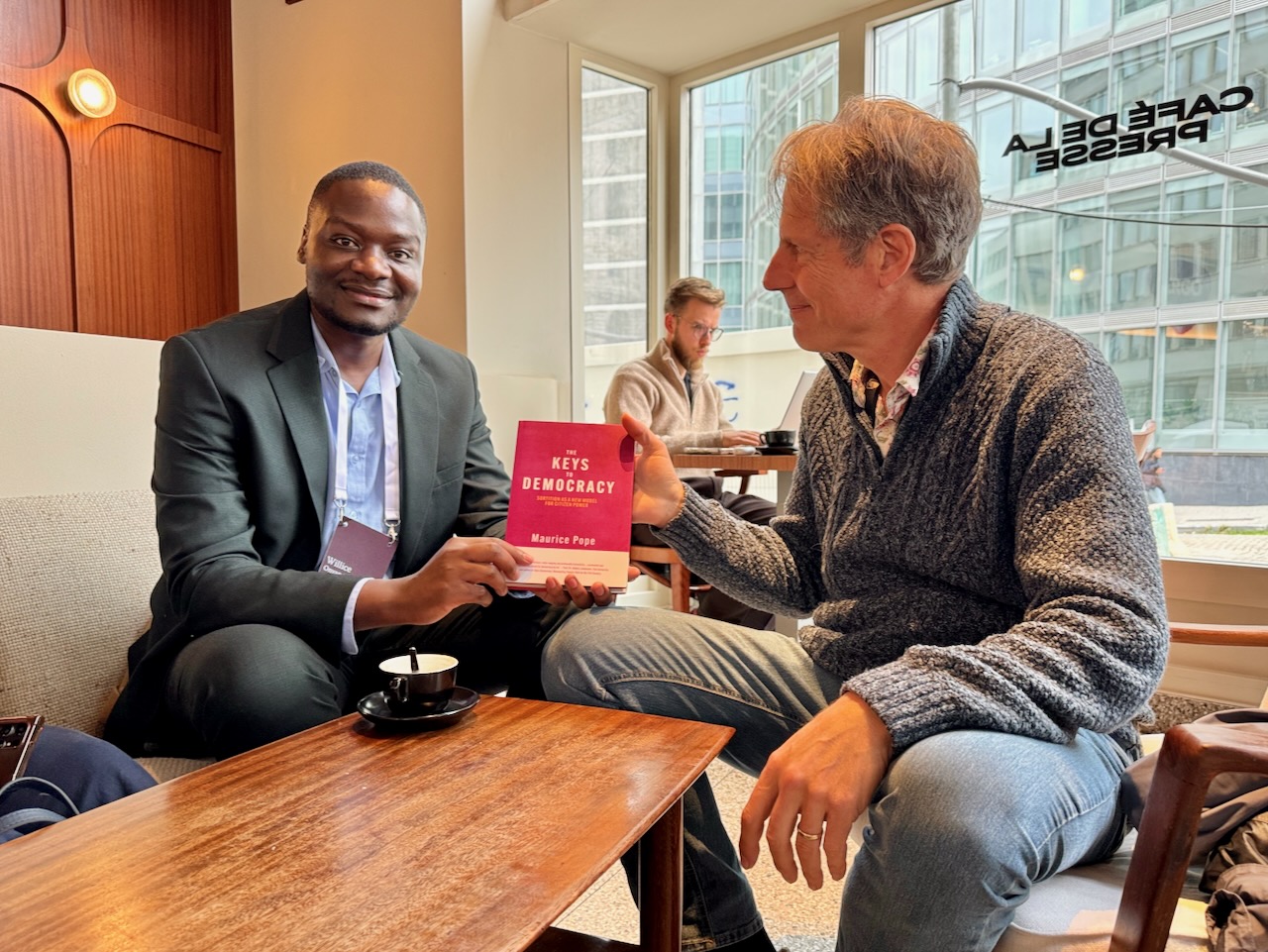
Willice Onyango – a deliberative democrat from Kenya – takes delivery of a copy of my late father Maurice Pope’s posthumous book, The Keys to Democracy (Photo: Hugh Pope)
The movement’s lack of clarity over its ambition is no small issue, even for a newcomer to the field like me. I would be disappointed to abandon an eventual goal of a society ruled by a system of pure sortition – even while recognising that this might take another century or so. I became a follower of the movement as I edited The Keys to Democracy, a posthumous book by my late father Maurice Pope, a classicist and admirer of ancient Athens. What convinced me were his arguments about the forgotten power of full, mandatory popular civic engagement and the scientific beauty of randomness.
Brussels: the shining city on the hill?
The more I think of a world without elections, the more conscious I am of a gap in the ideological dimension. It’s not that I would want democracy conferences to resemble a meeting singing hymns to the same religious or ideological belief. That would be impossible anyway: the new democrats’ diversity of approaches and lack of specific ideology is too great. But many deliberative democrats do feel that their cause will make the world a better place, and that a more decisive spirit might get there quicker.
Sortitionists are not oppressed heretics and are unlikely to emulate the 17th century English religious dissidents who boarded the ship Mayflower and headed to the US to build a new world. But I can’t help thinking it would help define what is possible if an organisation, a community, or even a town chose to join an experiment to see what happens if its key public decisions were entirely taken through randomly selected panels or assemblies.
One chapter of my father’s book lays out what a sortition-based utopia might look like. He imagines a scientific community on Antarctica being the only survivors of a nuclear apocalypse that wipes out the rest of the world. The group goes on to repopulate New Zealand with an entirely new political structure. In reality, a more likely candidate to be sortition’s shining city on a hill might actually be Belgium, or more specifically, my own home town of Brussels.
The time seems ripe. Belgium’s national politics are near-paralysed by squabbling parties and multiple governments based on regions and language groups. The electoral gridlock is worst in Brussels, which is both a city and one of Belgium’s three federal regions. It has been unable to form a government for more than 500 days since the last elections in June 2024. Popular confidence in politicians is plummeting.
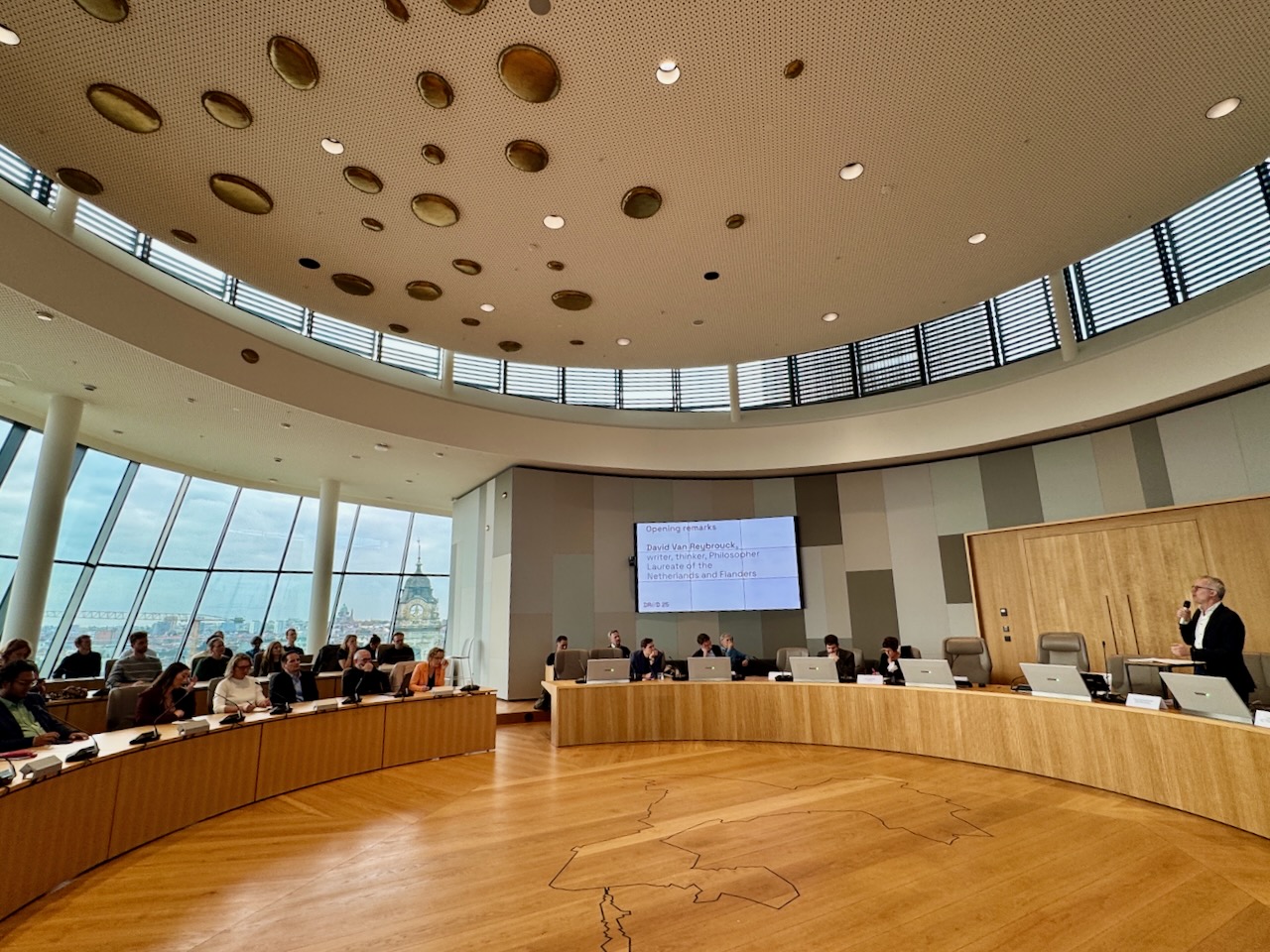
David Van Reybrouck speaks to democracy conference-goers in a Brussels municipal hall overlooking the city (Photo: Hugh Pope)
“Every year we lose between one and 2% of people [in Belgium] still believing in democracy,” David Van Reybrouck said in his speech. “It doesn’t seem a lot, but after 10 years, it’s going very fast.”
Already in 2011, Belgium was left without a national government for more than 500 days after an election. This had inspired Van Reybrouck to lead the organisation of one of the world’s first citizens’ assemblies, the G1000, to try to plot an alternative path forward for the country. Since then Belgium has played a pioneering role in the world of deliberative democracy.
In 2019, Belgium inaugurated the world’s first permanent citizens’ assembly as part of the parliament of the East Belgian German-speaking community. It is made up of two parts: one is permanent in the sense that it chooses the topics for the second part, which are one-off citizens assemblies; the first part’s membership is regularly refreshed with new members. The assembly is now onto its seventh policy topic. In 2023, the Brussels region also created a permanent climate assembly, again the first permanent one of this type in the world, in which a subgroup of the group of 100 randomly selected citizens chooses the topic for the next one. Two other regional Belgian parliaments have refreshed their chamber’s policy committees by mixing in three randomly selected citizens for each parliamentarian. The national parliament has now also agreed that future assemblies that have a government mandate can use the national electoral register for their random selection procedure, considerably reducing the cost of any such exercise.
Random selection is putting down local roots in the city. By chance – of course – my wife Jessica Lutz was chosen by lot to join a panel of citizens from our own sub-district, which meets every three months to adjudicate on projects and priorities for the commune. “Being part of a decision-making structure, with people that I would never otherwise meet, makes me realise how important it is to take everyone’s perspective into account. I also see how when you bring things down to practical decision-making, differences between people aren’t so big. And even though our panel is very small, I see how empowered everyone is by having a say in where our tax money goes,” she told me.
The idea of sortition is becoming mainstream. Alexandre Helson, seventh-generation head of one of Belgium’s fine ginger biscuit makers Maison Dandoy, wrote in the Belgian newspaper Le Soir in October: “What if we [citizens] pick up the baton, after the elected ones have tried for months to find common ground? What if we dared to do a big, participatory citizens’ assembly? [It would] restore confidence and remake democracy into what it should be: the slow construction of a common language.”
In an opening speech to the democracy conference, Fatima Zibouh, a Brussels veteran of the original G1000 citizens’ assembly in 2011, described a city ripe for a new form of governance. She pointed out how different the city is from Belgium’s two main federal states, Dutch-speaking Flanders and mostly Francophone Wallonia. With 40% of Brussels’ population not having Belgian nationality, and 74% having one parent born outside Belgium, it is actually the most diverse city in Europe, she said.
“Radical inclusion is not just being invited to the party or being asked to dance, but helping to design the party, to shape the space itself,” Zibouh said. She has now also called (in an open letter in Le Soir newspaper) for a randomly selected “B1000” assembly for Brussels to think up a citizens-based alternative while politicians bicker on about their next coalition government.
The instinct to cooperate
Whether in Brussels or far beyond, it’s still hard to imagine decision-making citizens’ assemblies being written into constitutions without a major breakthrough in public opinion by the movement for deliberative democracy, a change of heart among political leaders or a much greater availability of resources. Getting approval for advisory ones remains uphill work.
“We are both desperate for money and coming across as a luxury item … how do we communicate the value of what we do better?” Zacharzewski said. “If we are doing this as a collective of fragile organizations, always trying to close the next budget … we will never be able to let our thinking and our work rise to the scale that needs to be at.”
Direct democracy activist Cynthia Mbamalu makes a point in Brussels. Her group Yiago Africa organises people’s assemblies in Nigeria at the local government level because “democracy is beyond votes and elections.” (Photo: FIDE)
But the movement is growing. New democrats working on new, deliberative ways to channel the human instinct to work for the common good came to Brussels from all over the world. It’s a mostly “northern” movement so far – indeed, richer countries have got a lot to fix with governance at home before preaching to others – but a record tenth of participants came from the global “south” this year.
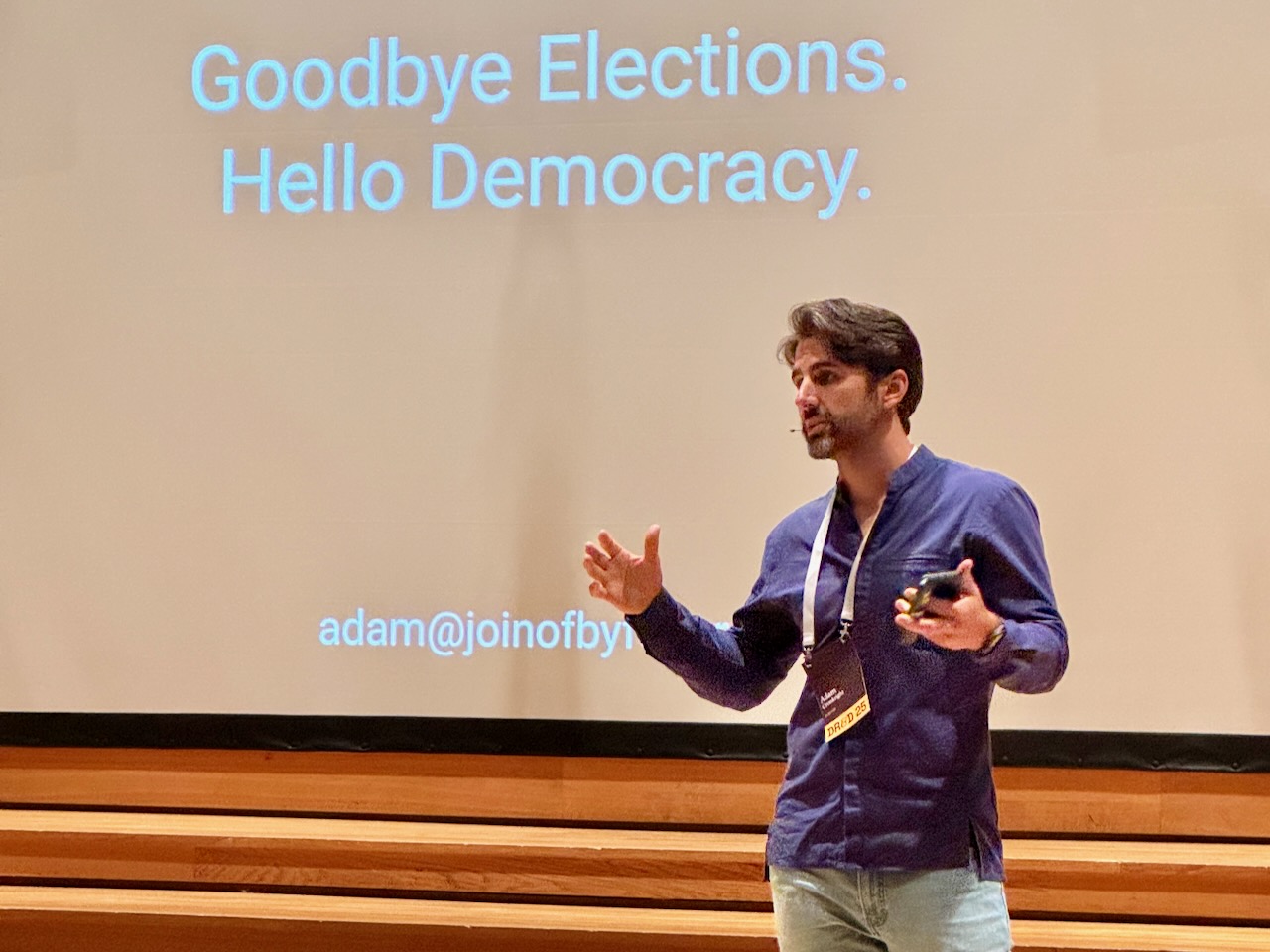
And despite the high-level reasons for angst, the conference bubbled with presentations about the uptake of citizens’ assemblies in the Balkans, in Africa and in eastern Europe. Adam Cronkright gave a pre-screening of his documentary “Goodbye Elections. Hello Democracy,” a superb fly-on-the-wall account of a US citizens assembly about Covid-19 held online during the pandemic and due for release in 2026. One inspiring participant told of an assembly in Ukraine where the allotted group insisted on going ahead with the meetings in a bomb shelter despite ongoing Russian attacks.
Adam Cronkright’s documentary is based on footage taken during a US citizens’ assembly on the fraught topic of Covid-19 (Photo Hugh Pope)
Cooperation has always been a default feature of humankind. Arguably, it’s what made us what my late father would have called the Top Species (so far). Societies have always found ways to channel this instinct through religions, ideologies, or moral codes, as in the Victorian era. Even criminal gangs create rules to collaborate. Authoritarians exploit this tendency too, prioritising themselves and imposing collaboration through force and oppression.
Our democracy conference in Brussels refreshed my conviction that most people actually want to work together in the positive public interest, and long for an agreed, decent way to do so. And that a great group of people is working hard to harness this cooperative instinct as a force for good.
It makes a welcome change to step aside and look back. Such a chance arose last week when I joined a few ex-colleagues for dinner with our old boss Gareth Evans, the long-serving former Australian foreign minister. Evans took over a small outfit called The International Crisis Group in 2000 and over the next decade turned it into a powerhouse of global conflict analysis. In various ways – in my case, a lucky two-year overlap at the end – we had been part of that adventure.
What struck me most was our debate over Gareth’s formula for policy impact and why it worked so well. At its best, we agreed, it worked like this: bestow trust and responsibility on far-flung country directors; give them time to write long, ground-breaking reports on how to avoid or end conflict; put their reports through an editing regime to bring out the best in what they were trying to say; mobilise resources for weeks-long advocacy tours; and harness the work to board members who accessed the top level of governments around the world.
With such support, I loved the fifteen years I spent at Crisis Group after Gareth, Nicholas Whyte and others not at our dinner took me on as the director of the Turkey & Cyprus Project. There was also the joy of working for a non-partisan organisation. For sure, I had been given resources and rigour at my previous employer, The Wall Street Journal. But I had crashed out. I felt exhausted by reporting the folly of the 2003 US invasion of Iraq for a newspaper whose opinion pages so wantonly fanned the flames of war.
Gareth reminded us of the terrible fight he had had with Crisis Group’s US board members who blocked the organisation’s attempts to oppose the Iraq invasion. He remained proud that Crisis Group managed to publish at least some of the basic facts about what lay ahead. But it was too little, too late to blunt the George W. Bush administration’s war-mongering intent.
There were high points, too. Gareth now laughed about the day in 2006 when rumours swirled that Crisis Group was in the running for the Nobel Peace Prize. Television teams were even ready down in the lobby. But the award went to Muhammad Yunus for his micro-finance bank in Bangladesh. Suddenly the television crew wanted to interview not Gareth, but one of the humblest members of our IT staff who happened to hail from Yunus’s homeland.
Still, being a Nobel runner-up was quite an achievement. Gareth, now 81, says he has written all the books he wants to write (more than ten of them) and has long cut back his once legendary sixteen-hour-plus workdays. But he keeps his fiery style. His Australian expletives remain richly undeleted, as does his swashbuckling chorus line of “it seemed like a good idea at the time.”
I remembered how those of a gentler disposition were physically scared to offer up work for his appraisal, which could indeed be terrifyingly scathing. He was unrepentant about the demands of his style, arguing that rigour was vital in his quest to win respect for his organisation in chanceries around the world as “professional, professional, professional.” Another key to any success, he believed, was the high performance he got from “high maintenance” staff that others found demanding or difficult to manage.
Building up Crisis Group, he said, was one of his proudest achievements, a close second to his decade “inside the tent” as Australian foreign minister. He reminisced about creating the organisation’s stylebook with, under the letter G, the “Gareth Rule”: namely, that he could override any of the other rules. He still almost always rejects any editing of his own outputs, he said. “I spent half my life editing other people, why should I let anyone touch my own writing?”.
We raked over the coals of why today’s non-profits are losing their fire. They now struggle to find stable funding, to choose good boards, to manage themselves openly, to maintain first-hand experience of countries in conflict and to make work on thematic topics genuinely unique. One of our former colleagues, Neil Campbell, noted that in the corridors of European power in Brussels, the word “advocacy” itself has become a taboo. Another ex-Crisis Grouper with us, Andebrhan Giorgis, lamented the apparently unstoppable rise of authoritarian governments round the world.
In short, many rules have changed. The all-male profile of our dinner speaks for itself (even if accidental). Few non-profits likely implement one of his old impact-seeking diktats, namely that even in their own offices, staff should act the part of suited-up diplomats. And the old ruler himself reckoned that, compared with his heyday of the post-Cold War, Western-led order, the era has passed when then youthful, plucky non-profits like Crisis Group could achieve such an extraordinary and outsize role.
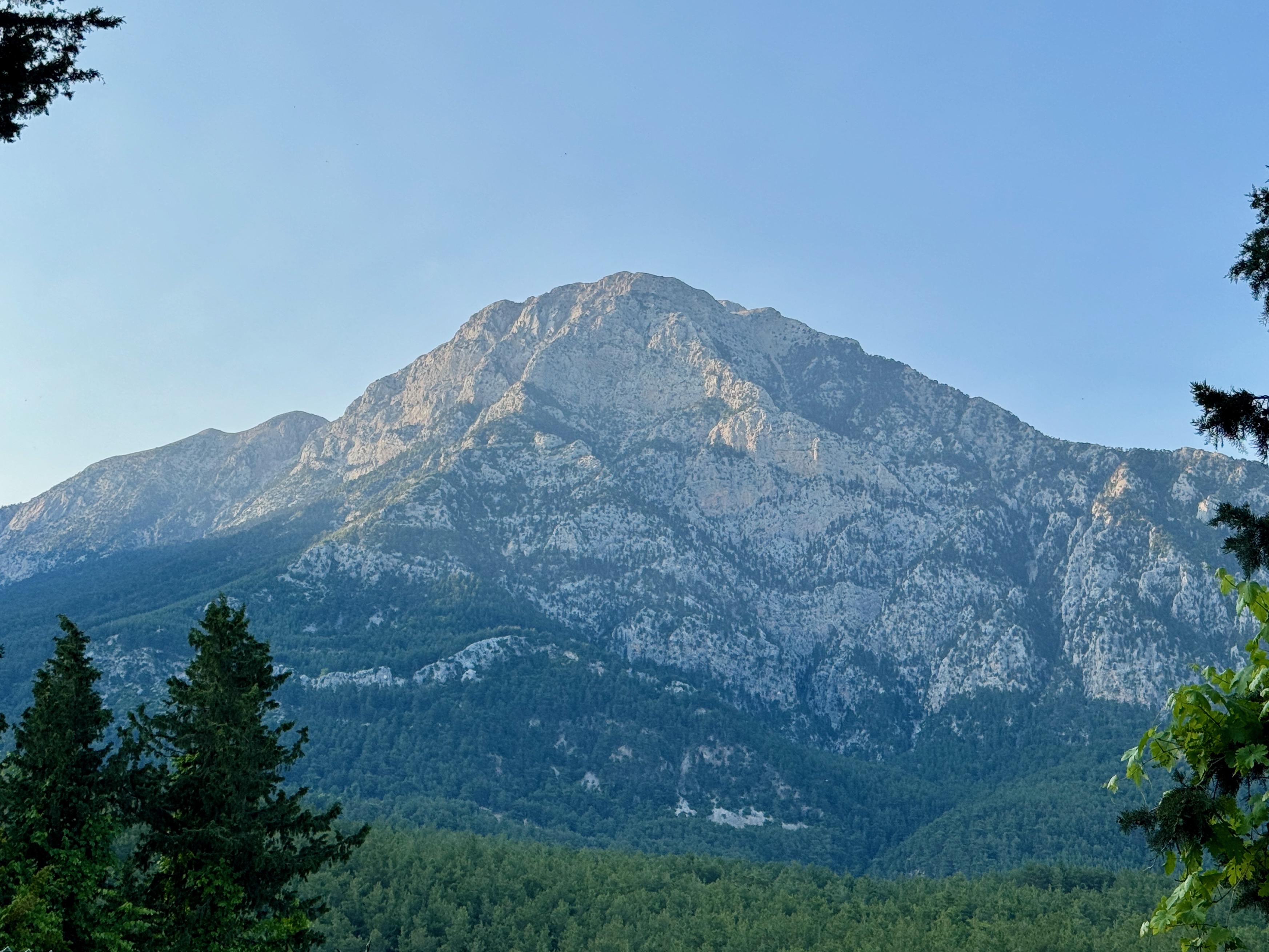
Twenty years ago, my wife Jessica and I fell in love with a remote, mountainous corner of Turkey. Deeply forested and rooted in antiquity, its steep valleys are overseen by a majestic peak soaring 2,365 metres (7,760 feet) above the nearby Mediterranean Sea.
We took on a two-acre plot of land on the flanks of the mountain range, hard to reach and initially bereft of road, electricity or water. Living in a campsite for five months, we built a house, The Lazy Olive. But over the years that followed, we were so busy struggling to cope with small details that, without wanting to, we lost touch with the big picture of our surroundings.
The Lazy Olive with Mount Olympos in the background
From the outset, I had wanted to scale the summit of the great peak of Mount Olympos, also known as Tahtalı in Turkish. (A number of high mountains in Turkey have inherited the name Olympos from antiquity, but are separate from the more famous Mt Olympus in neighbouring Greece). But, after a first eight-hour trek over a nearby mountain twenty years ago, I never made time for more.
This April, however, I was determined to get back to what had initially attracted us to Olympos and the raw beauty and unspoiled, 70 km-long coastline of the Beydağları National Park.
Once a week, I set out to discover what had lain at our doorstep for so many years: the Lycian Way, a 760-km, 35-day trail along the coast of the Lycian peninsula pieced together from ancient village paths by British pioneer Kate Clow in the 1990s. Turkey’s first long-distance trail has since become famous in the hiking world.
I soon worked out that there were a dozen good sections of the Lycian Way that would work well as day trips from The Lazy Olive. I wanted to start with a reprise of that first walk in 2005. Jessica joined me. From our front door we went up and over Musa Dağ, or Mount Moses, which spreads across our horizon when we sit on the terrace of our house. 18 km and 10 hours later, exhausted, we reached the beach at Adrasan.
Jessica ascends through a strawberry tree forest on Mount Musa/Musa Dağ
One 3 km stretch climbed a steep 620 m in elevation through a close-packed forest of smooth red-trunked strawberry trees. Stony escarpments, earthen forest tracks and silent paths carpeted in pine needles led us to another world. We marveled at how the inhabitants of the two millennia-old port city of Olympos below had built a second stone city near the peak, perhaps to avoid the scourge of pirates.
The experience made me feel a little foolish. We had spent too many of our vacations scouring building supplies shops as big as cathedrals, shuttling between government offices on mind-numbing bureaucratic errands, and enduring long, sweltering drives to distant towns. We always needed something: parts for broken water pumps, esoteric natural pool essentials or yet more makeovers for The Empress, our 1987 ex-Turkish army Land Rover.
Now we were finally walking those walks. We reconnected with the amazing fact that all this natural beauty was just a footpath away from our house.
Thistles on the canal road
For the next stage, Jessica and I hiked 11 km along the contour track that runs alongside our village’s small agricultural canal to the water springs in Ulupınar. Every grassy bank was thick with offerings to spring, like daisies, red poppies, vibrant white-and-yellow camomile, purple thistles, salsify heads of seed like giant dandelions, and a flower with a delicate display that truly earns its name of white lace.
Then I did a round trip of 18 km from Ulupınar that passed through Beycik, the high mountain village which would be my jumping off point for the route up Mount Olympos. I wanted to build up confidence: the 700 m climb in height up to Beycik was just half the 1,400 m I’d have to manage to reach the top of the mountain (and the same on the way down). It wasn’t the only thing that made me anxious. Hiking apps are all very well, but the Lycian Way can be elusive to follow. From a couple of trips up Mount Olympos by a cable car installed in 2007, I also knew that up at 2,365 m (7,760 ft) the sun cuts like a knife, the air is thin and cold, and the last 3 km to the summit climbs through trackless-looking screes of bare, uneven stones.
A welcome break with Hanife at Göl Yaylası, last stop on theLycian Way path up Mount Olympos
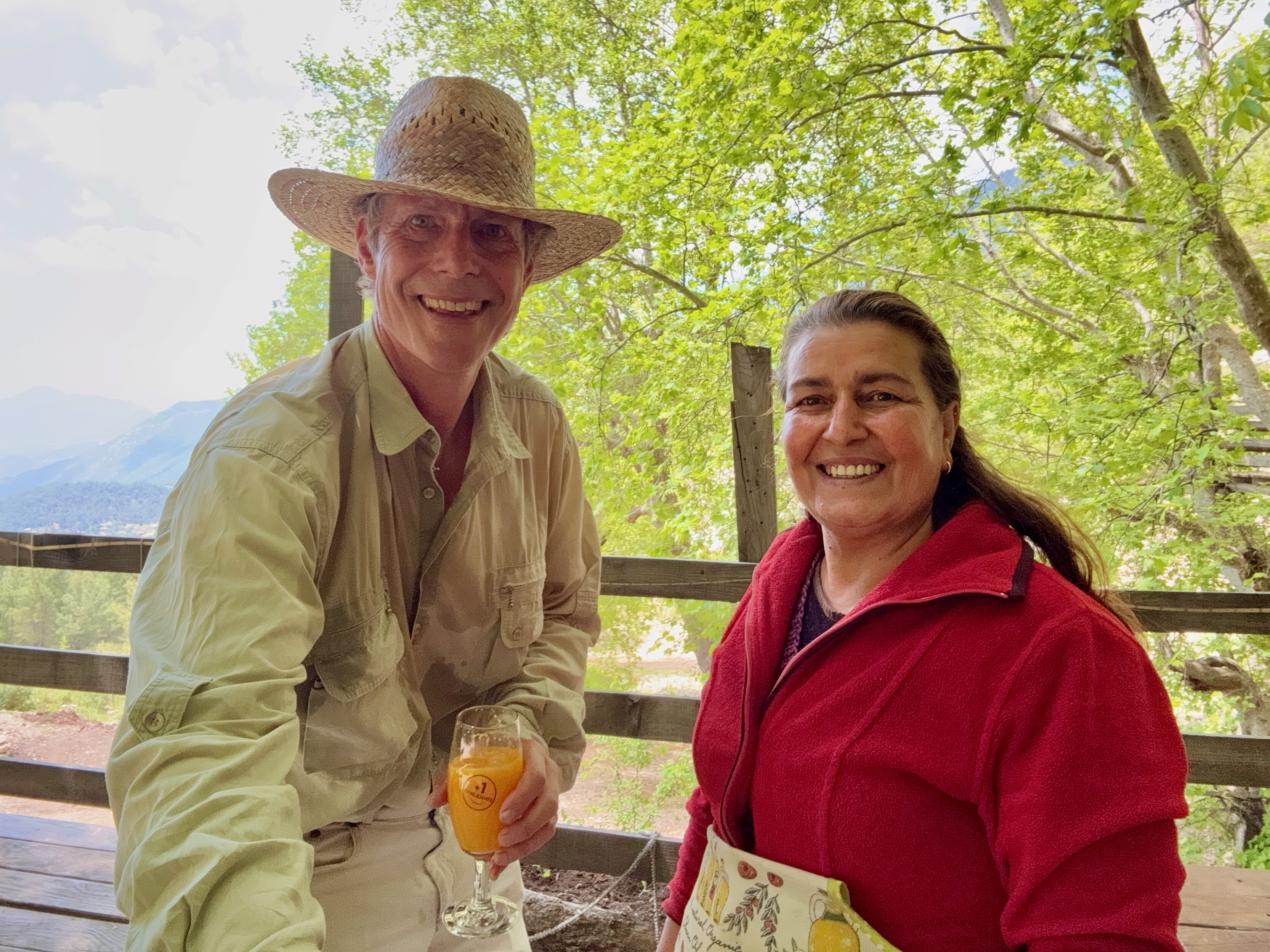
All started well on the day. After an hour, the path literally wound through a delightful, informal cafe built out of wood from the forest. A pint of fresh-pressed orange juice from the proprietor, Hanife, further raised my morale. Continuing uphill, I briefly overlapped with a Turkish hiking group. They had driven four hours to the starting point, and, after the eight-hour climb and descent, they would be driving four hours home the same night. Their commitment added to my sense of occasion.
The path was steep but not vertiginous, with many rocky outcrops from which to admire the Mediterranean coastline far below. The resinous pine trees common on the lower slopes gave way to high-altitude cedars with their feathery layers of branches spreading out like cirrus clouds. Great ancient trunks lay in clearings, bleached as white as bones, while the forest floor was bushy with bright green cedar saplings to take their place.
A glimpse of Çiralı beach and Genoese bay through the cedars of Mount Olympos
My training walks had shown me how the Lycian Way can split into confusing parallel or side trails, but up here walking was more straightforward. Cairns, wooden signposts and the occasional crossed branches – not to mention my favourite Belgian walking app – kept me on track.
At the treeline, I paused, intimidated by the bare, steep slope of broken stones ahead, all between the size of a brick and a bollard. I detected the path that snaked upward, nearly invisibly. A young Australian caught up with me and we kept each other company for the last hour of gruelling climb. She’d chosen to come to Turkey by chance after an artificial intelligence search told her that the Lycian Way was one of Europe’s top 10 long-distance trails. We took our minds off the ascent by talking about the rest of her 25-day walk and her work on indigenous Australians’ adaptation to climate change. We soon reckoned that remote rural family cultures in Turkey and Australia had a surprising amount in common.
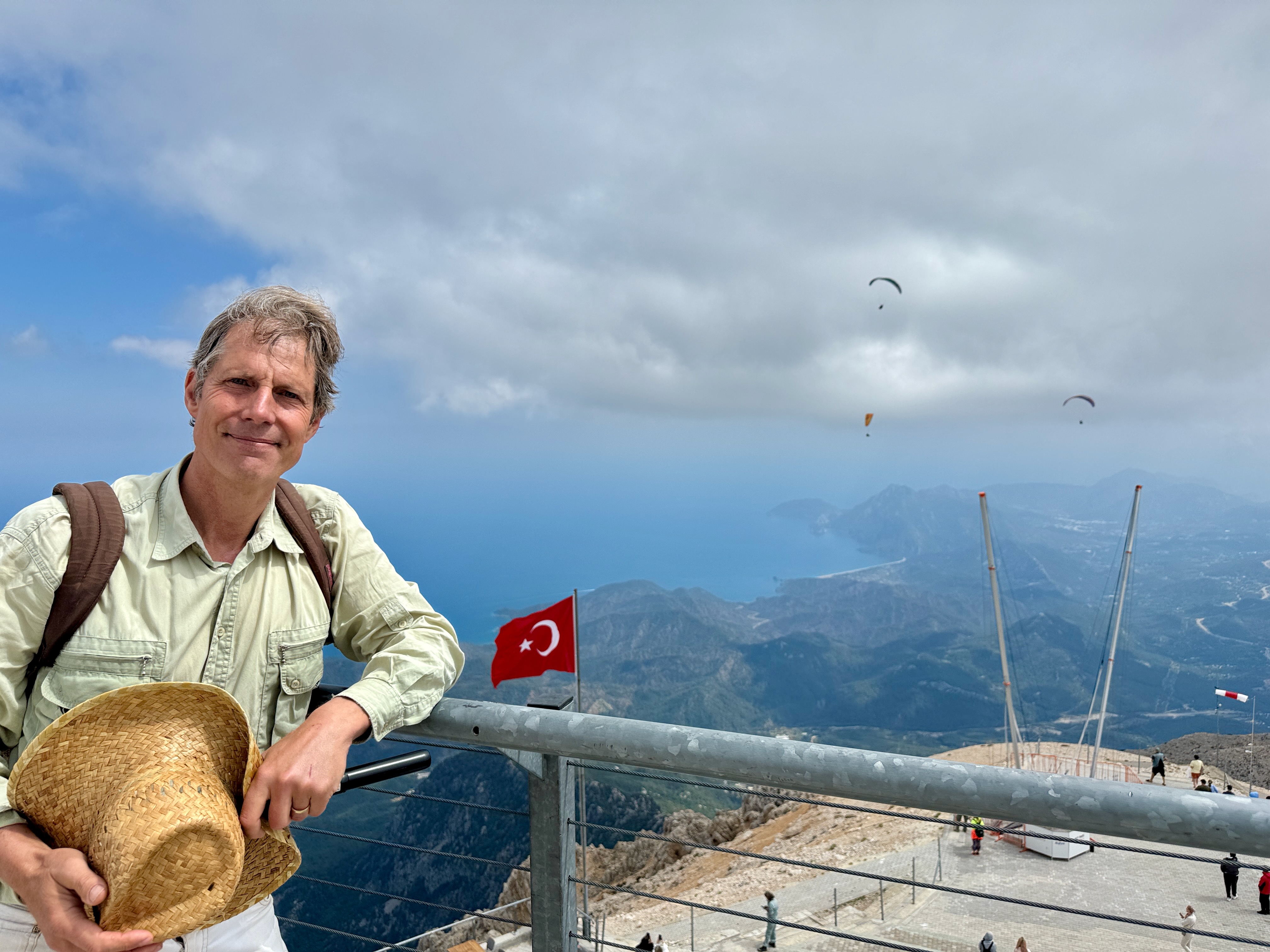
Together we closed on the summit. I marveled at the ugly concrete angularity of the Swiss-built cable car station, a blockhouse that one day could be chosen for the denouement of a James Bond film. I hadn’t expected how it took my breath away to reach and look over the last crest before the station’s perimeter fence. The other side of the mountain plunged steeply away to reveal the whole western coast of the Lycian peninsula at our feet, from the resort town of Kemer to a white line by the sea that marked the port city of Antalya, 45 km distant.
Ducking through the wire into the cable station’s realm brought a jarring change from the beauties of the ascent. We found a seat on the restaurant terrace amid an east-meets-west mix of people in flip-flops and t-shirts. Cartoon Olympian god statues served as mute selfie buddies, squeals rang out as a bungee trampoline heaved people high over the escarpments and pilots of two-seater paragliders stood ready to transport the bravest on a soaring shortcut back down to the sea 8 km away.
After a bracing Turkish coffee, my Australian companion and I were ready to stage our own flight from the tourist bubble and back into nature. At the treeline, she turned north to her next village host. I headed back south, down the way I had ascended. I wished that like her I had metal-tipped alpine walking sticks to give me purchase on the stonier surfaces. I scavenged fallen branches to serve as rough wooden staffs, but had to plant them down so hard they kept breaking.
For the rest of the afternoon I felt privileged to have the great mountain back mostly to myself. In fact, apart from the Turkish hiking group and the Australian, I only saw three other people on the Lycian Way during that whole late April day. When I got back down to the café, and gratefully accepted more orange juice and some succulent stuffed cabbage leaves, Hanife told me it was rarely busy. The peak seasons from February to mid-April and from October to November, she said, bring at most 50-60 hikers a day.
Nine hours after I’d left the Empress in Beycik, we were reunited and I started the drive back to The Lazy Olive. There have been many rewards for the past 20 years we’ve spent on the building, maintaining and managing the occasional renting out of our second house in a hard-to-reach place. But my exhilarating four April walks from Adrasan beach to Mount Olympos – in all, 54 km along and 3 km up and down – made me remember why we fell in love with this part of Turkey and started this adventure in the first place.
Mount Olympos at sunset
When we’re not there, we rent out The Lazy Olive through AirBNB or VRBO. To see more walks from the house there’s a YouTube video playlist too.
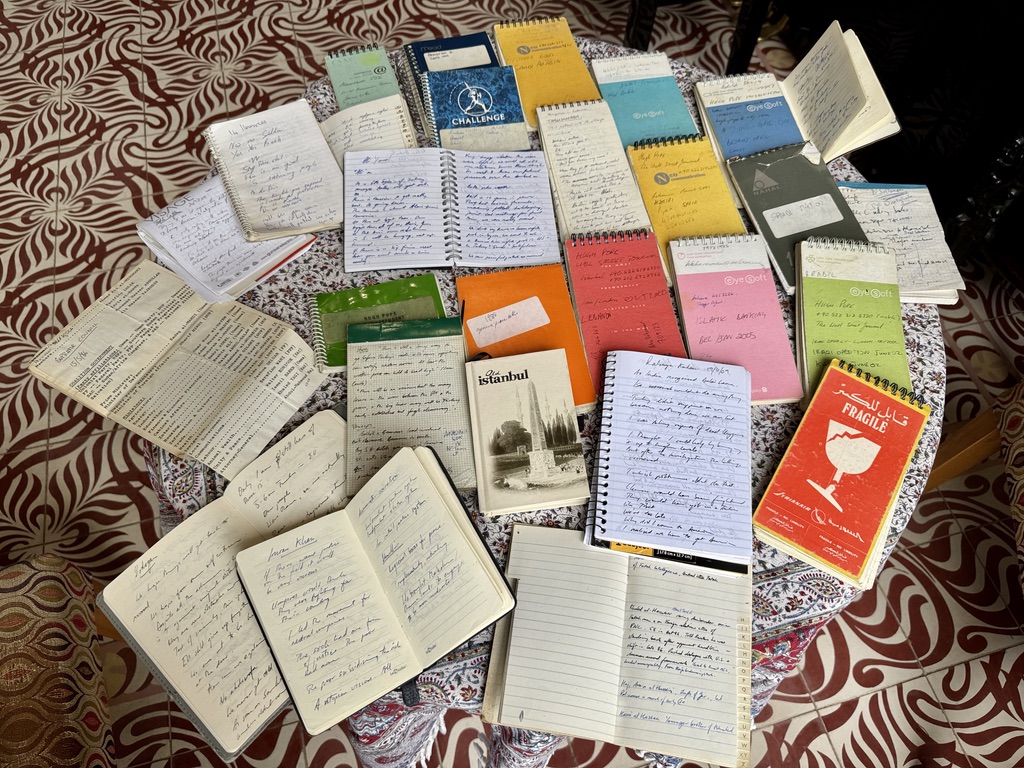
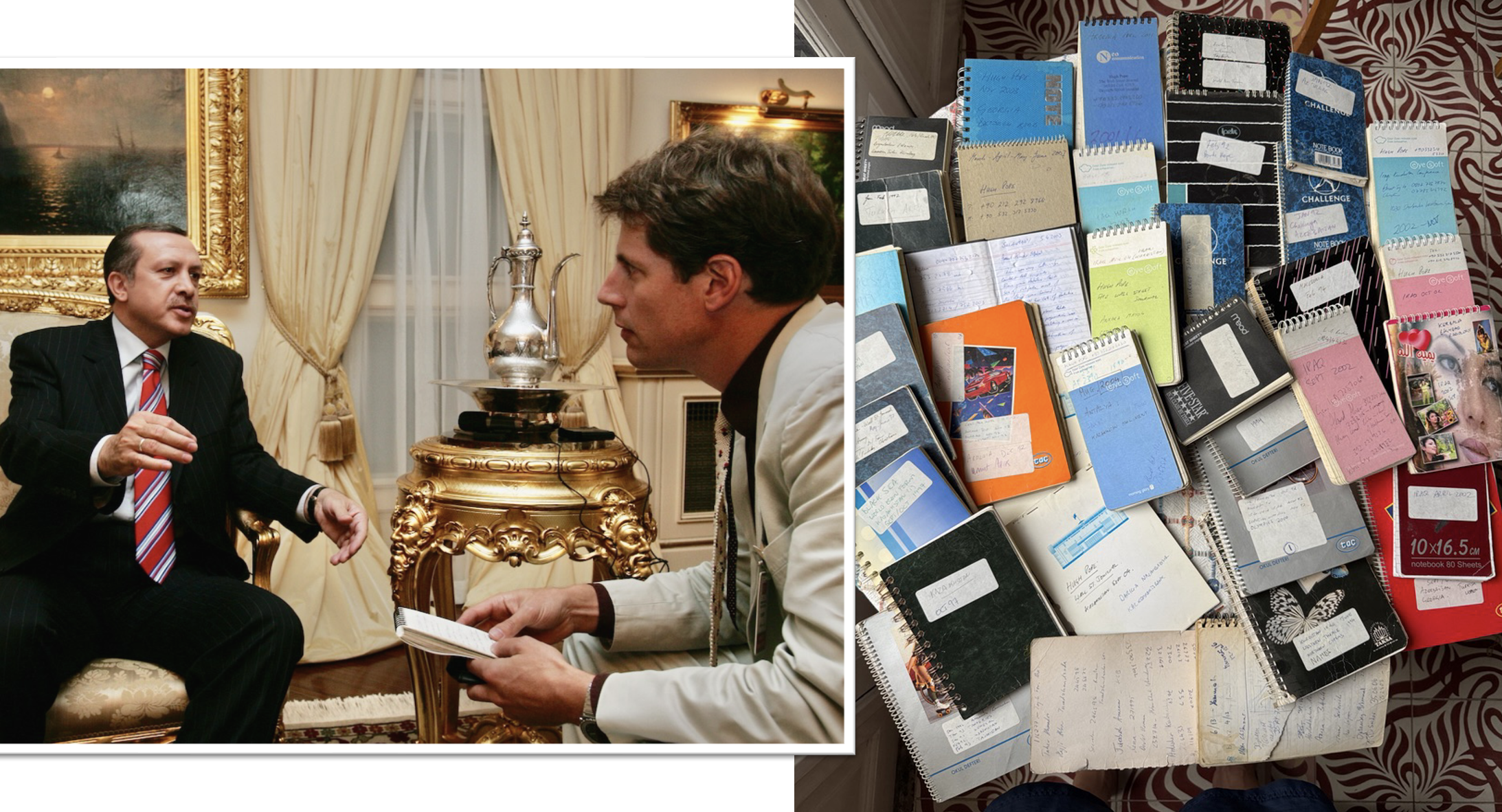
My notebooks long seemed to me to be priceless. For 43 years, they helped me pin down the chaotic rush of war zones, wise words from unexpected people and the gist of long discussions that might stretch deep into the early hours.
By the end, their number grew to some 200 notepads and booklets, spanning all shapes, colours, sizes and qualities of paper. They had ranged over more than 30 countries, crossing and recrossing borders hundreds of times. They had moved with me from homes in Damascus to Beirut, Manama, Tehran, Nicosia, Istanbul, and, finally, to five boxes in my attic in Brussels.
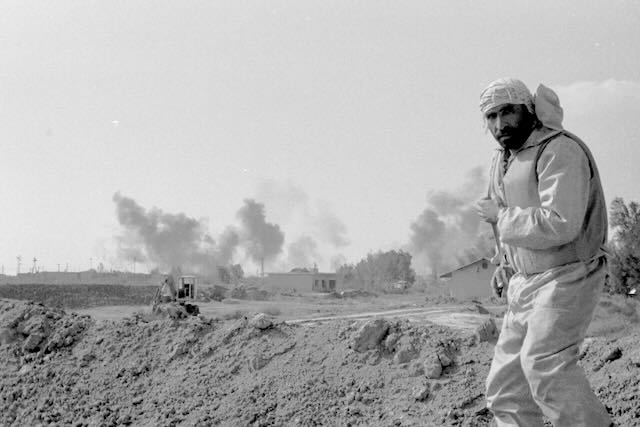
Some of the least intelligible notes were from the most dramatic days of my work, visits to warfronts. On the left, some of my notebooks from a year in Tehran in 1985-86. On the right, wearing a perfunctory chemical warfare suit, I felt green with shock after a terrifying day with the Iranian forces who briefly conquered Faw, the southernmost point of Iraq.
I never thought I’d take my leave from these core ingredients of my working life. The notebooks were survivors. Even briefly misplacing one on a reporting trip would trigger a traumatic panic, as if the whole journey risked being in vain. Yet when I needed to make space in my attic this summer, most of them did not pass the final edit. To my great surprise, I was able to bid farewell to all but a shoebox-full of them.
Home-made shorthand
A lot has changed to make me ready to let them go. For a start, many were probably only fully understandable by me. Sometimes I scribbled stuff down without dates, without full names, without places. My handwriting is not always that legible, and reading my home-made shorthand, which omits the vowels, takes some practice. I can still work most of it out.
But as I leafed through each notebook, considering its fate, I realised the contents were highly fragmented. I never focused for long on one topic or one country. Many notebooks bounced between several countries, like one that jumped from Saudi Arabia, to Lebanon, to Washington DC, then to the Turkish Republic of North Cyprus.
My dependence on them in pre-digital days was augmented by the back page or two that tracked my treasure hunt for contacts in each new location. Names, telephone numbers and addresses were culled from chance meetings, trips off the beaten track, friendly colleagues, local journalists, stringers and diplomats. Stuck into one notebook from Sudan, I found a mimeographed list of the entire government. (I only managed to reach one of them, the prime minister, in his lounge at Khartoum airport late one night. Then, before we’d exchanged a full greeting, the power cut out and all went black – and silent. No notes needed.)
It dawned on me too that the forces propelling me on those journalistic journeys were usually random. There were few sustained trails of enquiry that would be useful to me or any future researcher. My magnets were the zig-zagging pinball of the news, which country had finally surrendered to my faxes begging for a visa, or the determination of my editors that I serve up new topics and places that I had never written about before.
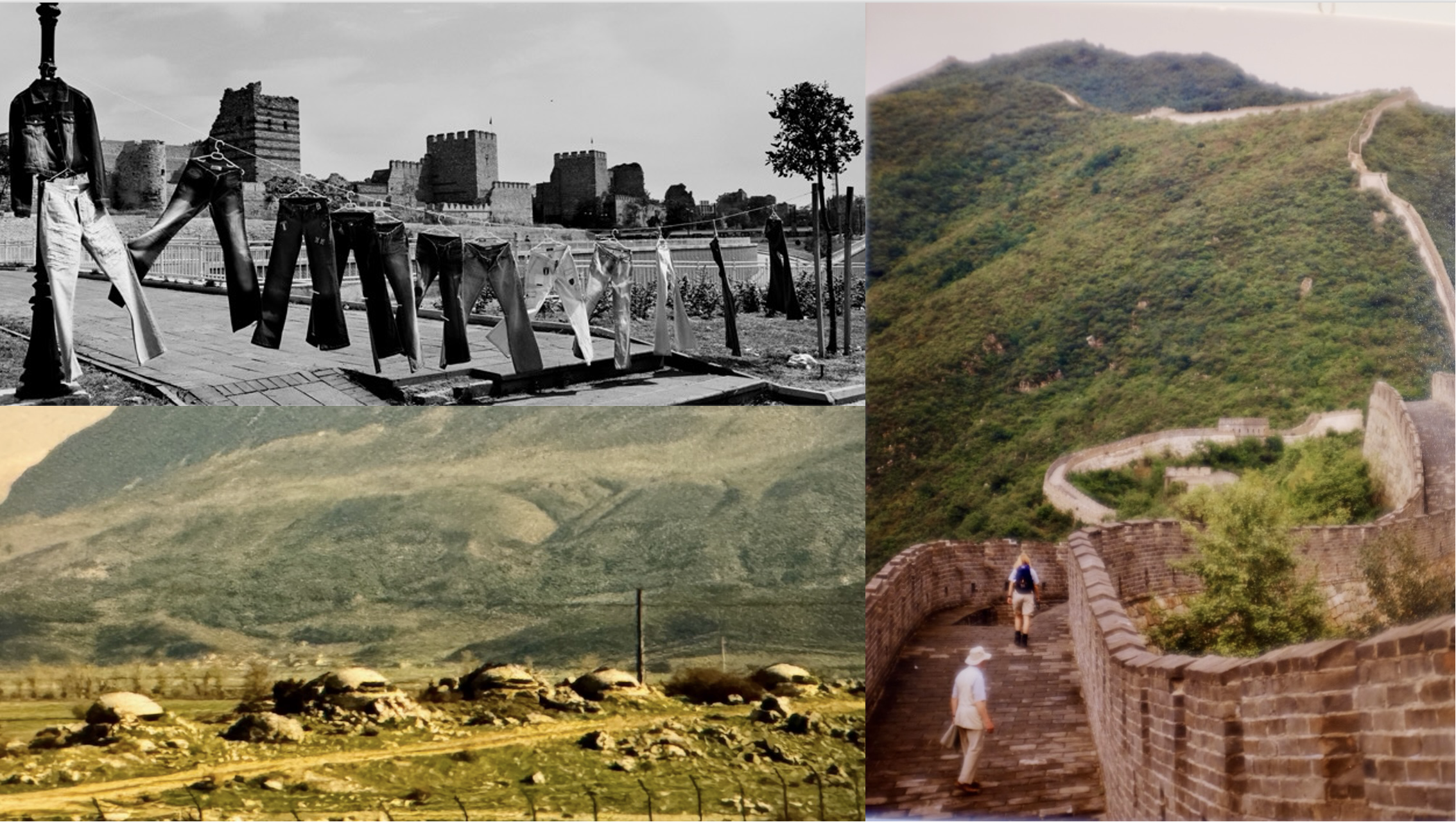
That’s why I often reported on idiosyncratic subjects. A Soviet aluminium smelter in Tajikistan that history had forgotten. How Albanians dealt with their leader’s obsession with concrete bunkers. What happened when reconstruction experts, wanting an authentic floor for a new version of Shakespeare’s Globe Theatre in London, went to Turkey looking for hazelnut shells. I greatly enjoyed tracking down such stories, but my reporting notebooks added little to what was published.
Notebooks everywhere, especially when you don’t need them (left). It looks like wobbly A4 paper was in action in 1983 (right) as I tried to get a straight answer from Lebanon’s mercurial Druze leader Walid Jumblatt. (Photo on right courtesy of Jack Dabaghian).
Notebooks, too, were mostly just a starting point for me. The closest I usually got to long-form writing in them were a few drafts of lead paragraphs while sitting in a taxi on my way to my office or hotel, a pointless record at the best of times. Blinking green computer terminals had just arrived when I started in the trade, and when I couldn’t use one I chose either normal paper or, rarely, my typewriter.
Only once do I remember writing anything in a notebook that was intended to last. That was when I found myself in an Iranian helicopter streaking low over a southern desert war front into banks of smoke and exploding Iraqi bombs. I began scribbling a goodbye note to my first wife. I was too terrified to make any literary or even emotional sense, and stopped half-way through. As I sifted through the stacks, I found the right notebook. But the fond farewell had disappeared. In some previous editing, I had already torn it out.
Just once or twice, I found a page where I couldn’t resist writing in real time. Here I am on board the Azerbaijani ship Ghassan Aliev after it docked in Baku, ending my three-day struggle in 1993 to get out of the Turkmen port of Krasnovodsk (now Türkmenbaşy) and across the Caspian Sea.
“Huge crush of sweating Azeris trying to find places to get off. Enterprising lads and one old man leap over to a flying pontoon at deck level. “Hey,” shouted one man. “You’re not in Turkmenistan now.” It was a premature call to order as we heaved through. Material-wrapped baggage bombarded the quayside, causing the crewmen lowering a stairway to join in the frequent swearing of “what animals.” After that, crew abdicate responsibility for order completely. In the bar/restaurant/purser’s lobby, one man shouts “What a stupid nation we are.” Last remnants of Soviet order are commands that snap through the intercom at all times of day and night: “No smoking except in the restaurant.”
That page seems born of a rare situation where I had extra time on my hands. I soon gave up any idea that there might be literary passages worthy of a hero writer. They are different. For instance, take Ernest Hemingway.
In 1956, Hemingway unexpectedly recovered his notebooks about life in 1920s Paris from a trunk he’d forgotten that he’d left in the Ritz Hotel. Later published as A Moveable Feast, he talks of watching a beautiful woman with hair “black as a crow’s wing” from his seat in a café. Then he jots down: “You belong to me and all Paris belongs to me and I belong to this notebook and pencil.”
Perhaps my relationship with my notebooks would have been deeper if, like Hemingway, my work had involved haunting Paris cafés drinking Rhum Saint James and downing Portuguese oysters. I can only console myself in the knowledge that Hemingway used school notebooks too.
Living in the moment
The lack of grand asides, emotional depth or narrative context in the notebooks was also because the notes were meant to feed stories written up within a few hours or days. I felt little motivation to jot down any sights, sounds, smells, or my side of any conversation, especially since I was often busy taking photographs too. Even the date did not feel necessary. I’m observant and have a fair memory. I was living in the moment, everything seemed obvious. I knew I would remember it all while writing my piece.
The variety of subjects I was juggling with meant that I often felt I was skating on the surface of stories.In parts of just seven of the pads above are an interview in Pakistan with Imran Khan, my homemade Palestine Liberation Organistation handbook, a mimeographed Sudanese government list, my Arabic political vocabulary book, notes from the Iran-Iraq peace talks in Geneva in 1988, a London energy conference …
The passage of time hasn’t wiped out such memories, some of which returned as I handled my old companions on the road. But each of the many stories has moved far, far on. The notebooks seemed to have gone past their expiry date. They added little intriguing or new.
Another big reason for my sense of the notebooks’ disposability is doubtless that most of them have already had an afterlife. If there was a logic to where I went and what I did beyond the news, it was my quest to fill in gaps in more personal, longer-form narratives. The notebooks had already refreshed my memory as I wrote books in the 1990s and 2000s on Turkey, Central Asia and the wider Turkic World, and the Middle East. The scene in Baku port, for instance, features in Sons of the Conquerors. But even back then, I noticed that my on-the-job jottings were less inspirational or complete than I expected.
Also, I religiously kept the published versions of my articles, even though I know that they too are only part of the overall story. I once had a lot of my first drafts as well. Especially when writing about the Middle East, I found these of more long-lasting value than the long, highly edited, front-page stories that appeared in a publication like The Wall Street Journal. In fact, the way the editing process produced a pattern of omissions became an unexpected but critical part of the narrative of my Middle East memoir Dining with al-Qaeda.
In either case, notes taken for ephemeral daily news stories or longer-form books were now unable to tell a compelling story on their own. Reading the notebooks again sometimes felt like coming back to an untidy kitchen counter after making a meal that I have already eaten.
The changed mechanics of reporting
What I found on the pages before consigning them to yellow garbage sacks also made me realise how much has changed in the way we work.
A traveller or reporter now would find it hard to imagine how difficult the mechanics and context of foreign reporting could be in the 1980s and early 1990s. Landing somewhere for the first time before cell phones and the internet would mean becoming almost completely detached from your previous bubble and total absorption in a new one. Even if available, communicating in real time with the office or home could be ruinously expensive.
It wasn’t always easy to get proper notebooks in poorer countries. A misty eyed lady celebrity accompanied me on an emotionally rough trip to Iraq in 2002(left) and in 1992-93 some racy teenagers saw me through another freezing winter on the collapsing former ex-Soviet periphery. In the middle, a list of contacts grows on the back page.
My 1990s notebooks prominently featured obscure international telephone numbers and log-on codes. Reporters of my generation had to spend many, many futile hours trying to make technology work. To get a better line to our newspaper’s computers to file our stories, many of us learned to dismantle the wall sockets behind our hotel beds and then attach crocodile clips from our computer modems to the bare telephone wires.
Indeed, the stories written from these notebooks went back to newsdesks in a great variety of ways. Early on, I handed letters to people in queues in airports, sent telegrams, endlessly typed telex tapes, wore out my thumb on an amateur radio transmit button, hunted for Kurdish militias with satellite faxes and dictated to the legendary blind transcriber at the old Los Angeles Times (overall, one of the fastest and most accurate methods). I once even bought a half-barrel of diesel to power a generator so that two Sudanese Army radio operators could send my story by morse code (it was diligently transmitted, but never arrived).
Before the vast pool of knowledge in personal computers, Google maps and the internet, one also had to keep track of basic facts for oneself. For a trip to the northern front line of the 1980-88 Iran-Iraq war, I had stapled a smudged and incomprehensible photocopy that supposedly showed where the border was. Alongside the notebooks were hundreds of neatly filled cards in boxes to collect, say, tidbits about Iran and Islamic revolutionaries. There were also slim green hardback notebooks with pages sorted by the letters of the alphabet. One of these tracked the rival factions of the Palestine Liberation Organisation. Another kept my mind sharp on Arabic political terminology.
Early notebooks logged many long-dead conversations with foreign diplomats. We used to look in awe at Western embassies as critical sources of not just international perspectives but also guidance and wisdom about a country. That gradually wore off, and disappeared after the invasions of Afghanistan and Iraq. Even so, many of the Middle Easterners we interviewed still thought we were, at best, just another representative of their old colonial oppressors or, at worst, another kind of spy.
Quality not quantity
As I went from news agency reporter to newspaper correspondent to an analyst for the International Crisis Group, my taste in types of notebooks seems to have improved. I started off in Syria, Lebanon and Iran with notebooks that differed wildly in quality, from some that were little better than kitchen paper to others that were as good as parchment.
When I joined the hallowed Wall Street Journal and was given one of their bottomless American Express credit cards, I moved on to high quality reporting pads. Later, as I transitioned to analysing ideas for peace-making at Crisis Group, a European consul general invited me to lunch in his country’s Istanbul palace and told me how he felt free to speak since I was no longer a journalist. I felt self-conscious about my ever-present spiral notepad. I decided to go upmarket to the Moleskine-style writing books that I saw some diplomats using, now that they were actually visiting me in my own office.
From index cards (top left) to Moleskine’s smooth writers’ notebooks (the black ones), I’ve taken notes on every conceivable kind of folded piece of paper, pad and machine. But in the end, notes are just one part of the process of producing an article or book.
Looks and experience made no difference to how many of those notebooks I kept. Diplomats might now be talking to me more freely, but, as far as I could tell, the substance of what they said was mostly the same. In fact, the lack of on-the-ground reporting made the contents less interesting. However clever it sounded at the time, second-hand geopolitical analysis does not age well.
Selecting samples
My decision to let my notebooks go was also informed by my experience of a far more daunting task over the past two years: trying to put some order into 50 boxes of letters, diaries, loose photographs, albums and commonplace books accumulated on both sides of my family over more than 200 years.
These included the papers of my late father, Maurice Pope, a classics professor and author with wide interests. I had to prepare these for Cambridge University’s Department of Classics archives. Before taking them there in April, I asked archivist Rebecca Naylor what she wanted.
“You should put in all varieties of record. But remember, no archivist keeps everything,” she said. “To control the sheer volume of material, our final and essential step is to make sample selections.”
A lot might not be kept, in other words. “Archives are never used as the depositor expects them to be exploited,” Rebecca explained. “The hope is that interesting, intelligent, observant people embody a repository of experiences of an era that is no more.”
“Even about small things?” I asked. “My great-grandmother May’s account of her honeymoon is just a few lines a day, and she gives away almost nothing about herself. She just lists things like boarding the boat across the English Channel, catching the horse-drawn ‘diligence’ where the railway line ends, and attending Anglican church services in German hotel drawing rooms.”
“Well, people do discard stuff because there is Just So Much of It,” she replied. “So as centuries roll on, the exasperated winnowing means eventually very little is left of what ultimately becomes the deep past. Imagine if you now had the account of a Tudor honeymoon, if honeymoons were even invented by then! The burden is not on us to ‘get it right’ for all perpetuity, just to fashion our own chapter of recollection and reflection, then pass on the baton to the next generation.”
Notebook in hand (left) as Turkey’s then prime minister Recep Tayyip Erdoğan makes a point, although the notes are actually being taken by the tape recorder on the table.
I kept the sample of my notebooks only partly in hope of saving the geopolitical equivalent of a Tudor shopping list. I mostly wanted reassurance that I was right to break with my hoarding habit. As I took farewell photographs of them all on a table, I also realised that what I wanted most was not to read them, just to see them again.
Letters and diaries
I was also guided by more of archivist Rebecca Naylor’s advice: “The genre most people cull before they donate to an archive is letters. But these are often the most valuable records, in terms of information.”
The same applied to my reporting notebooks, I realized. My letters, diaries and photographs from the same time are much better at bringing the past back to life. That’s not all. Going through all those family papers quickly taught that if diary entries are too functional, if a photo doesn’t have the names or place on the back, if a letter isn’t clearly dated and properly signed, if an album has no captions, their content loses most of its meaning.
Indeed, by far and away the best notebooks from my four decades on the reporting road were the rare ones I kept in diary form. Once was while trying to avoid trouble in Iraqi Kurdistan while I waited for the 2003 US-led invasion to start. Even better were the ones from surrepetitiously reporting in 1999 on Xinjiang in western China, where foreign journalists weren’t supposed to work. While talking to the deeply oppressed Uighur community, my then travelling companion (and future wife) Jessica Lutz and I would hurry back to our hotel to write down everything while our memories were absolutely fresh.
In these diaries, we both found that we gave a better account of what was said to us and noted details absent from other reporting books: the clapping wings of startled doves, the angry eyes of a horse being shod while suspended in the air from a mediaeval wooden frame, our Uighur interlocutors’ shockingly deep fear of the Chinese, the explosive tang of Chinese flash-fried chunks of snakes and snails at a roadside stall, and the thick, soft satisfaction of Uighur noodles. Perhaps most importantly, I had something missing from my other notebooks: what I actually said or thought to myself.
I kept these diaries and letters, of course. I decided that the rest of my much-loved notebooks had now served their purpose. The cutting room floor could be swept. As I move on, I’m already writing more letters and being much more diligent about keeping a diary.
The US bombing of Iranian targets today got me thinking about how US actions in the Middle East have often propelled it into places that it had no apparent inkling about beforehand.
I studied Persian at university, lived for year as a journalist in Iran and made several trips to the country during three decades of reporting all over the Middle East. I’d say that it’s worth bearing in mind that few people are good at predicting the future anywhere, and that we can expect plenty of unintended consequences:
Iranians are in my experience one of the more secular and pro-American peoples in the Middle East, and many people there are indeed sick of the oppressive Islamic Republican regime. But that will likely evaporate when under direct attack. I remember how even some ordinary Iraqis warmed to the idea of Americans taking down Saddam Hussein in 2002. But when the US actually attacked in 2003, bitter enmity ensued.
The US bombing is no bolt from the blue. In fact, the action feels like the long-awaited Phase II of the 2003 US invasion of Iraq. A subsequent attack on Iran was often on the agenda of the right-wing Israeli, pro-Israeli and neo-con columnists who so compellingly urged President George Bush to attack Iraq after 9/11. We can debate why it is that Israel has so dearly wanted the US to do this (to distract from actions in Gaza and the West Bank, to tie the US to Israel, or now to prolong the political life of Prime Minister Benjamin Netanyahu against corruption allegations, etc). But it is clear that Netanyahu and right-wingers like him have been trying to embroil the US in wider Middle East for decades, and that Netanyahu is the person who is most absolutely delighted about this turn of events. It will be harder than ever to separate whether the US or Israel is responsible for what’s happening.
Let your actions match your words, if you care about your image. Outsiders listening to Israelis or Western media outlets talking about fear and consequences of Iran’s scattershot attacks on Israel often weigh this against how Israel does not allow any direct reporting of the fear and consequences of Israel’s own far more concentrated and devastating attacks on Palestinians in Gaza and the West Bank.
Iranian soldier on the front lines of the Iran-Iraq war, in which the US supported Iraq. Faw, January 1986. Photo: Hugh Pope
When states call their rivals “terrorists”, it always gives me pause. The US public may not normally notice it, but there has never really been a moment when the US has not been in some kind of war with Iran since 1979, when Islamic Revolutionaries took American diplomats hostage for more than a year. (Note: none of the diplomats were killed, and the US had orchestrated the coup that put the previous Shah on the throne and maintained his sometimes oppressive regime in power for 25 years). The 46-year-long US punishment of Iran has not just been in the form of punitive sanctions and exclusion from the global order. It has backed bloody action against the country by Iraq, by Israel and in some cases its own forces.
Beware of what you wish for. Regime change would be another coup. There seems to be no organised force or organisation ready to assume control. That means that there will be an extended struggle for power in Iran, deep instability and threats to things the world holds dear like access to the oil & gas of the Gulf.
The law of unintended consequences always applies. Egypt’s autocrat and Gulf Arab monarchies are on the US side for now, but are the people? Saudi Arabia was on the US side in 2001, but I remember interviewing Saudis highly sympathetic with the 9/11 attacks on America. Indeed, that cataclysm was dreamed up by an ex-Saudi, Osama bin Laden, and 15 of the 19 attackers were Saudis. Often they were fired up with anger about the US alliance with an Israel intent on crushing Palestinians. No change there either.
Europe may think it is a neutral actor watching from the sidelines but it is not and will be drawn into all the messy consequences as well.
I can’t see any light at the end of the tunnel on this. But I did take solace from reading Branko Brkic in the excellent British Journalism Review (oddly, the only publication I regularly read almost cover to cover). Here he skilfully puts the argument that:
“History is never kind to autocrats and bullies, thugs and their enthusiastic helpers.The pendulum always swings back. Humanity one day might very well forgive … still, it cannot forget.“
Each of Norway’s 5.5 million inhabitants has a theoretical $300,000+ stake in the country’s $1.8 trillion Oil Fund. But what would they actually like to do with it? Who should decide that? And how?
This post was first published on 12 June 2025 as a DemNext Deep Dive by DemocracyNext, a thought leader on citizens’ assemblies where I’m an International Advisory Council Member. For this article, I spoke with members and organisers of Norway’s Future Assembly on the Oil Fund.
Norwegians have struggled for decades over whether the world’s largest investment fund is their private nest egg or a golden opportunity to exercise their global conscience on matters like climate change, sustainable economic policies or development aid. To strike the balance, a coalition of seven Norwegian non-profits this year organised the most representative forum yet: a randomly selected citizens’ assembly.
Members of Norway’s Future Assembly, Oslo 2025. Photo: Regine Skogmo Grøtte/LNU
The 56 members of the Framtidspanelet, or Future Assembly, met from January to April 2025. The organisers asked them to learn and deliberate about the future use of their huge Government Pension Fund Global (GPFG), usually called the Oil Fund. Norway set up the Oil Fund in the 1990s to absorb state oil and gas profits, invest them abroad, and shield the domestic economy from ups and downs. The government can spend the Oil Fund’s investment income, set at a limit of 3% of the fund’s value. This usually amounts to 20% of the government budget.
The idea was that the assembly’s recommendations might spark a national conversation on the topic, particularly ahead of Norway’s next general elections in September 2025.
A common-sense path
After weighing all the information presented to them – including the Oil Fund’s legal duties to manage Norway’s surplus hydrocarbon revenues, ensure financial stability, and benefit future generations – the Future Assembly did more than look at spending. The citizens mapped out common-sense, long-term ideas for Norway that balanced domestic needs and global responsibilities.
The citizens grouped their 19 recommendations into five main themes that gave decision-makers a clear and holistic view of what a fully informed nation likely thinks the priorities should be:
🧭 Draw up new spending and ethical guidelines for the Oil Fund, notably to strengthen its ability to respond to crises
🧑🏾🤝🧑🏻 Upgrade Norway’s democracy with better civic education and more citizens’ assemblies
😷 Shoulder global work on public health, medical research, and the climate crisis
☀️ Back reduced consumption and develop sustainable energy projects, even if investment risks are higher and returns are lower
🏫 Support Norway’s domestic need for more education, defence, research, and innovation.
Future Assembly member Jonas Krogh makes a point. Oslo, 2025. Photo: Geer Barstein/WWF
“Norway’s oil money should not just be the world’s biggest piggy bank,” 31-year-old Assembly member Jonas Krogh told DemNext, speaking from his home in the southeastern city of Fredrikstad. “It should help make the world a better place.”
More citizens’ assemblies
Remarkably, 89% of assembly members backed recommendation #5 that “citizens’ assemblies should be used more and, if they prove effective, become a permanent part of the parliament’s permanent decision-making processes.” The members asked politicians to commit to listen to and assess the recommendations from citizens’ assemblies so that more people have a “concrete and direct” participation in politics, more diverse voices could be heard and more social groups could give input for decisions.
Members of Norway’s Future Assembly, Oslo 2025. Photo: Regine Skogmo Grøtte/LNU
The assembly also called for an independent Commissioner for Future Generations, more civic education in schools, and more direct tools “to vote on major matters of principle”, alongside strengthened “education about politics and the democratic process.”
“Taking part in this process has taught me that it helps to talk with people who think differently from me — and that we can find common ground. Personally, I’m surprised by how my views have changed on topics I never thought I’d reconsider,” Bjørnar Hansen, a 63-year-old from the central Norwegian town of Brønnøy, was quoted as saying in the final report.
Hansen was not alone. All citizens signed the report’s introduction to say that, “many of us have experienced this as one of the most meaningful things we have been part of … this has been democracy in practice. A reminder that we are not just citizens – we are also co-creators of the future.”
As Jonas Krogh put it to DemNext:
“A lot of people may have felt it was anti-climatic that we did not recommend specifics like new roads or free lunches in schools. Most of us, when we started the assembly, also thought we’d be very exact about how we’d spend our Oil Fund money. As time went on, these thoughts got pushed away. We realised that in the grand scheme of things what an individual is so passionate about is not so relevant. We are not experts and we can leave these details to others. We all met around the fact that we want the money for our future generations. What we care about is other people than ourselves.”
The full article – which has more details about the organisation of the Framtidspanelet, the citizens’ assembly’s impact on Norwegian decision makers and likely affect of its recommendations on the Oil Fund – is available to subscribers to DemNext’s newsletter here.
Citizens’ assemblies have earned a significant new seal of approval.
Alongside its successful commentary on global events, the UK’s top political podcast The Rest is Politics stands out as a running indictment of electoral representation as a system of government, implicitly at least. But the main hosts, Alastair Campbell and Rory Stewart, had so far failed to follow the logic of their own arguments and to propose alternative methods to take important national decisions.
They have now done so with an intentional endorsement of citizens’ assemblies as their preferred way forward for democratic reform.
Citizens’ assemblies are randomly selected groups of people from a community or country – a process also called sortition – and are mandated to solve a tough policy problem. They meet for a number of days, hear from experts, deliberate among themselves and adopt whatever ideas receive a supermajority vote of approval.
You can hear Alastair Campbell and Rory Stewart’s comments about citizens’ assemblies from 34m30s on their 3 April 2025 podcast Question Time: India’s moment, Qatargate, and do young Brits want a dictator. Or watch on YouTube from here.
The UK’s current form of representative government “feels increasingly strange”, Stewart says. Campbell adds: “the system is creaking and the respect for it is not there.” (For a select transcript, see below).
Millions of people around the world listen each month to The Rest is Politics podcast, which is most influential in the UK. Campbell and Stewart’s endorsement is another step for sortition toward the British mainstream, where citizens’ assemblies are not yet widely discussed.
The unusual formality of the segment was in answer to a specially chosen question about a citizens’ assembly in Cumbria on climate change. It is part of a growing recognition that the world’s 250-year-old experiment in elections-based government has run out of steam and that we need to evolve new democratic processes.
Credibility and legitimacy
Campbell and Stewart’s comments give credibility and legitimacy to citizens’ assemblies – just two decades old in their modern form – and the greater deliberative democracy movement.
At least four national citizens’ assemblies have already been held in Britain on Brexit, on nature, on climate and on democracy. (One of the best global lists of several hundred citizens’ assemblies held around the world in recent years is here).
The UK has also seen several smaller, randomly selected citizens’ panels and juries at the local level as well, dealing with topics from the climate to traffic schemes.
The podcasters focused on the concrete step of reforming the UK’s upper house of parliament, the House of Lords. In Stewart’s mind, this could mean adding a new third chamber. They could also have mentioned a campaign started by the Sortition Foundation to replace it entirely with a House of Citizens (the petition is here).
How such a permanent assembly would work is the subject of much debate. Stewart envisions it as a body for vetting legislation by the elected assembly. However, existing new permanent randomly-selected assemblies, for instance in Paris and Belgium’s German-speaking community, don’t go into detail on individual policy challenges. Their job is to commission other temporary citizens’ assemblies to address each tough policy choice.
The podcasters also discussed the advantages of the Swiss model of direct democracy, which is actually rather different to a sortition-based system.
Details, details! What’s important is that these influential podcasters have now put real proposals on the table to talk about.
Here’s Rory Stewart (slightly edited for clarity and length):
Excited by an alternative model
“I think that our system of democracy, which is this kind of representative system where you send people … off to parliament to speak on behalf of their constituents, feels increasingly strange. You can feel this all the time when you talk to people. They’re like: ‘I voted for this person, [but] they don’t really represent me.’ What [voters] mean is that this person is often not saying anything they believe in, they find it very difficult to relate to this person. How am I supposed to represent people with a completely different identity to me? People say, you know: ‘Rory you’ve never lived on benefits’, ‘You’re not from a minority background’, ‘You’re not a woman’, and all this is completely right.
France’s Citizens’ Convention on the End of Life votes to approve a proposal in Paris, 9 January 2023. Photo: Hugh Pope
“I am increasingly excited by an alternative model, which is the model of citizens’ assemblies. I’m not sure it fixes everything, but citizens’ assemblies … are like a jury, a totally separate system. It works on sortition, so you randomly select people and then you bring them together for a period of time to discuss policy issues. It’s usually quite well-organised, so there’ll be experts that can be brought in to talk about things and they discuss together.
“The great thing about it is that it is not party political. It’s ordinary people. It’s not a question of one person representing others. It’s 300 people who are very, very democratically diverse, discussing things and in my experience it doesn’t matter whether you’re talking about climate in Cumbria or bicycle lanes in London, or talking about abortion in Ireland. Actually you end up with a much more thoughtful non-partisan discussion.
“Members of parliament hate it. They say Parliament is a citizens’ assembly. [MPs] are pretty anti-democratic, they’re pretty terrified about the idea of ordinary people having a view. They somehow think they are much more qualified and know what they’re doing … I’ve got an instinct which I can’t quite prove yet but that if Britain went down more of a sort of a Swiss citizens’ assembly devolved model, it would end up in a much, much happier place than trying to cling on to the old style of elite representation.”
Creating a new system
Stewart has talked about his enthusiasm for the idea of citizens’ assemblies in past podcasts, although he stopped short of actually calling for action. Campbell has typically been more muted, supporting the ultimate rights of elected representatives and prime ministers. Now, for the first time, both explicitly supported trying it out. Campbell put it like this:
“I’ve been disappointed that there hasn’t been more [work on citizens’ assemblies] given that this is a [new Labour] government that’s talked about … change in our politics. They are going after hereditary peers, I’m all in favour of that. More devolution, [I’m] all in favour of that … I sort of feel the system is creaking,the respect for it is not there in the same way that it was. The only way you’re going to maybe rebuild that is to create a new sort of system, [in the making] of which people feel much more directly involved.
Participant makes a point at a session of France’s Citizens’ Convention on the End of Life in Paris, 9 January 2023. Photo: Hugh Pope
“You will always have to have somebody leading the country, a Prime Minister-type figure. You will always have to have legislative, decision-making bodies who have final votes on situation. But I completely agree with you.”
Solving big social and moral issues
As an example of what’s going wrong, Campbell pointed out the fate of the UK parliament’s November 2024 unusually free debate on assisted suicide. Even though the open discussion of the bill caught the public imagination and the government declared its support, it is now unclear how the proposed changes will turn out. In contrast, he noted, a 2018 Irish citizens’ assembly did help Ireland solve the country’s decades-long impasse on abortion.
“It’s incredible what happened with … the abortion issue in Ireland. That was driven by people,” Campbell said. He suggested doing citizens’ assemblies on “these big social and moral issues, in particular. If we took them out of Westminster, and built that citizens assembly model [to deal with them], and then at some stage brought them back [to the elected parliament].”
It makes me happy to see the needle moving, and I look forward to reporting on the next milestone.
Meanwhile, if you’re interested to find out more about how these highly experienced experts in UK government have already eviscerated current ways of doing politics, I kept track here.
The crisis between the transatlantic powers used to sound like a distant thunder. Now that the storm has broken, it feels like it’s tearing apart something inside myself. That’s because even though I identify mostly as an Englishman, as a Belgian citizen and in general as a would-be European, like many others on the old continent, I’ve long also felt partly American.
I’ve worked half my life with Americans. I admire the energy, high standards and efficiency Americans often bring to the workplace. I’ve grown up with American culture, music and humour all around me. As a child in 1964, I crossed the larger-than-life continent with my parents in a car that felt as wide as a room. Since then, I’ve visited more times than I can count, sometimes for months at a time.
The US decision to publicly eject Europe from the construct that both have shared for 80 years or longer feels like being kicked out of the house.
It’s not just that I know how many Americans are funny, hospitable and generous (and several have reached out to share their shock and pain at recent developments). It’s also as if the supplier of my favoured brand of mental software just told me that support will be discontinued.
The junction ahead
This parting of the ways didn’t start with President Trump. I first realized that irreconcilable differences had arisen between Europe and the US when President George W. Bush bamboozled the transatlantic alliance into joining him on his foolish campaign into Iraq (a principal theme in my book Dining with al-Qaeda).
Whatever Donald Trump’s personal ability to manipulate his audience, the US change of heart now is clearly about more than than just him. Enough Americans voted for Trump and his America First message to win two elections, the last one after he tried to maintain power by force on 6 January 2020. They thus endorse Trumpian greed, all-out competition and selfishness – perhaps exactly because the time has come when many Americans cannot fully live the old American dream.
Such ideas are contagious – the UK in the 2010s is a case in point, culminating in the tragedy of Brexit – but I think most Europeans still want to live under a regime that stands for values that are more sharing, caring, fair and collaborative. EU countries like Belgium where I live may higher taxes, but in terms of income they are some of the world’s most egalitarian countries. The US is in the top tier of unequal countries.
Striking out more independently as Europeans will be hard and time-consuming. It’s not just because of that soft power the US has in all of our heads. The current EU architecture is built round the assumption of dependence on the US. Whether this is the result of Europe’s idealistic pacifism or lazy dependency, asking the current set of leaders to create a credible, autonomous, defensible system is like asking an invertebrate animal to grow a backbone.
Still, evolution can happen. America was a British colony for a century and a half before it decided (with initial difficulty) to fight to go its own way. Ukrainians discovered a unifying ethos even though – prior to Moscow’s intervention and then invasion – many had felt much in common with the Russian-speaking world that they knew so well.
Consciousness is growing in Europe that stronger internal solidarity will be needed survive and flourish in a multipolar world dominated by the US, China, to some extent Russia and perhaps soon India. To get anywhere, we are all going to have to upload new, primarily European mental software.
Perhaps the change will be helped by remembering that Europe’s lack of unity is as much the result of American preference as by European choice. Already twenty years ago, I remember chatting with a senior diplomat in the US embassy in Ankara who off-handedly commented that “of course we never really want the EU to add up to anything.”
Readers of of this blog will not be surprised to hear me say that that to achieve all this, we will also have to upgrade our European democracy. Perhaps a similar change in America would have avoided the transatlantic bust-up in the first place. That means broader-based ways of taking public decisions about what we want to achieve. We need to be less vulnerable to capture by special interests, fake news merchants and financial titans.
Europe and its citizens
What political system can give Europeans the required sense of active agency in their own affairs? Polls say people in most richer countries are fed up with the current way we organize our politics. At the same time, surprising numbers of people believe the best way forward is to choose strong leaders with Trump-style charismatic personalities or bold visions to sort things out with more authoritarian rule.
It might strike democrats as unwise to switch horses at a time of threats and potential crisis. But that would be to underestimate the problem. Right-wing populists have got where they are by exploiting popular dissatisfaction with the electoral system. Unlike most advocates of democracy based solely on elections, authoritarians have already evolved to make themselves more attractive. Leaving things as they are will only augment the authoritarian advantage.
From a different perspective: if democrats are to outflank the authoritarians, it also won’t work to just elect someone new. It is the whole system of elections that has got us into this mess.
To be sure, elections have been a crucial democratising force as suffrage widened over the past 250 years. But they no longer work well. The system is lost in polarised party politics, elite capture and subservience to financial powers. Shiny campaign promises are rarely possible to implement. Short-term politics usually crowd out long-term interests. Today’s elected charismatic leaders too often turn into tomorrow’s dictators.
To rebuild people’s trust in their rulers will mean going beyond the tired model of government by elected representatives. Instead, we will have to come up with a robust new system for people to rally around that offers transparency, justice and solid defences against corruption.
One promising idea to re-engage citizens that is gaining popularity is the citizens’ assembly. Here’s how it works: a randomly selected group of people from a community or country are brought together for several days to solve a tough problem by listening to experts, deliberating among themselves and finding super-majority support for their chosen course of action.
Several hundred have now been held around the world, with numbers rising sharply in recent years, especially in Europe. Just this weekend, the EU started a new round in its series of randomly selected citizens’ panels. This group of 150 citizens chosen by lot have the satisfyingly large remit of looking at the new EU budget. It’s a fundamentally new approach to building a credible, legitimate policy input representing the informed popular view.
The EU’s experienced translators are still vital for the smooth operation of these democratic innovations. But the technological breakthroughs of the last decade mean that Europe language differences may become less of an obstacle to mutual understanding than they once might have been. The spread of English as a second language among European youth may also help, even if that is a paradox, since this is another result of American soft power.
People are hungry for a new way forward, as I experienced once again this weekend in my hometown of Brussels. Within 24 hours of sending just one email, one hundred people from all over the country had signed up to discuss ideas for democracy with the Belgian non-profit G1000 – one of Europe’s first to advocate for deliberative democracy and to organise citizens’ assemblies. French- and Flemish-speaking participants worked side by side, equally alarmed by the situation.
Importantly, citizens’ assemblies are not designed to be a vehicle for any subset of a population, from language groups to liberals and left wingers. Random selection brings everyone into the room. And face-to-face deliberative democracy techniques have a track record of side-lining polarisation. The policies that they propose almost always depend on attracting the votes of at least two thirds of their participants.
Beyond rearmament
While random selection has the potential to represent European citizens one day, joint European action will never happen in the absence of a critical mass of people who feel primarily European. Re-arming, keeping up with technology and disentangling all our command-and-control systems from our American other half will be pointless unless we can forge a sense of European common identity, purpose and solidarity.
We can begin by finding European principles, values and intellectual outputs, and consciously supporting them. To be serious about this ultimately means creating ideals that we Europeans will be ready to die for. God forbid that this would ever be Europeans fighting Americans, which I neither expect nor want. It’s more about a Europe that has found a true new centre of gravity – unfortunately, without America as a full partner.
Creating a trans-national European consciousness will mean learning new European names to follow, tuning into neighbours in a language we both understand, and sharing emotions in new ways. For instance, there must be many more European personalities like Arjen Lubach in the Netherlands, someone who is quite as funny as Jon Stewart of New York’s Comedy Central. I happen to understand Dutch, but I wouldn’t be able to follow a Spanish or German equivalent. Reducing our dependency on America won’t work until we find a critical cultural mass that is as relatable and satisfying to fill its place.
Elites must also push themselves to go further than a dependence on US policy writing, however good they are. A strong lead is being given in the UK by Alastair Campbell of the The Rest is Politics podcast, in which he deliberately makes time to read and talk about European media. Such sharing and legitimizing the work of fellow-Europeans will be essential.
The tactical supremacy of the void
A nearby example of European perspectives worth spreading is an interview with Italy’s Antonio Scurat by reporter Danny Ilegems in this weekend’s Belgian daily newspaper De Morgen. Scurati makes trans-continental sense, is authentic and relevant to European experience and challenges.
A professor in Milan, Scurati is just publishing the last of five volumes of his fictionalized life of Benito Mussolini, the 20th century Italian dictator. Here are some points he makes that seem significant to me:
We call populo-fascists mad because they aim to blow up the world as we know it.
Even Germany’s Adolf Hitler called Mussolini “crazy”, but he wasn’t. Unlike Hitler, Mussolini had no ideology, feelings or principles, beyond what he called “the tactical supremacy of the void”. He cynically filled this empty vessel with lies and anger. The ultimate pragmatist, he is a more relevant fore-runner of today’s opportunistic populist right than the highly focused Hitler.
Populism crosses the line to fascism when it starts using violence, whether in reality or as a threat. This is now happening more and more. Scutari gives as examples Israel’s Benjamin Netanyahu killing Palestinians and Trump’s actions on 6 January 2020, which led to the killing of five people during the assault on the US Capitol.
Don’t expect to recognise fascism by a return of blackshirts and militias; rather, expect hybrid descendants of populism and traditional fascism. Scutari sees Elon Musk as a hybrid of Mussolini and Dr Strangelove, and militias like the US Proud Boys or Oath Keepers as “folkloric” rather than true fascists bent on the violent seizure of power.
Europe needs strong army, one that is specifically designed to defend rather than attack. (I agree about the need for strong defence but couldn’t help wondering what a defensive army looks like – Albania’s old bunkers? The Maginot Line? The Great Wall of China? The Byzantine walls protecting Constantinople? Switzerland and its cupboard in every home with food reserves and a gun?).
Europeans are mentally unready for any kind of existential war in which they would have to be ready to die for their beliefs, country or alliance.
Top left: The Byzantine walls of Constantinople (photo by Arif Aşçı); Right: China’s Great Wall (Johanna Pope); Bottom left: Albanian bunkers near the border with Greece (Hugh Pope).
Divorce is a painful new beginning
We still don’t know where the unravelling of the transatlantic alliance will end, but it’s not the only shocking separation we’ve experienced in recent times. The UK’s split with the EU was a terrible wrench. It supplied yet more proof about how much the current system of political parties and elected representatives is vulnerable to manipulation and unfit for the defence of common interests.
At first, I was surprised at the public tears at the breakdown of the transatlantic relationship shed by former top German diplomat Christoph Heusgen at the Munich Security Conference this year. I remember him as a calm and efficient foreign policy aide to Chancellor Angela Merkel, when I used to visit the chancellor’s offices in Berlin in my days as an International Crisis Group project director working on Turkey and Europe.
I’m now beginning to understand Heusgen’s reaction. This transatlantic divorce – just like the real thing in our personal lives – might be a “Liberation Day” for some, but it is going to tear apart much more in us than we initially realized. The US has started a revolution, and revolutions don’t just mean a new beginning. They usually sweep aside the old way of doing things too.