Writer of books on Turkey, the Middle East and Central Asia. Formerly Director of Communications & Outreach and Turkey/Cyprus Project Director for International Crisis Group. Ex-Turkey & Middle East staff correspondent for The Wall Street Journal.
One of the Arab world’s leading international magazines, al-Majalla, gave its readers a heads-up about the forthcoming publication of Dining with al-Qaedain the new titles section of its 9 January edition.
The 30 years Pope has spent living and travelling in the Middle East, from a 1980 visit as an Oxford student through a decade-long stint as a correspondent for the Wall Street Journal, color this reflection on the region’s recent history. Moving back and forth through time in vignettes set in Syria, Sudan, Afghanistan, and Saudi Arabia, this fascinating memoir of his career tackles subjects as varied as the sexual attitudes of Middle Eastern men, the murder of Daniel Pearl, the Iraq-Iran War, and the poetry of the mystic Persian poet Hafez.
Leafing through the summer 2009 edition of Washington’s “Democracy: A Journal of Ideas”, I stumbled across an interesting critique of the U.S. media performance in the run-up to, during, and after the U.S. invasion of Iraq – a central theme of the last quarter of my new book, Dining with al-Qaeda.
In the article, Leslie Gelb and Jeanne-Paloma Zelmati made useful points in their survey of the failure of the “elite press” to be critical enough of U.S. policies. But as the only correspondent who reported from Iraq in the year before the war for one of the newspapers they refer to, the Wall Street Journal, I believe we should add other factors into the account.
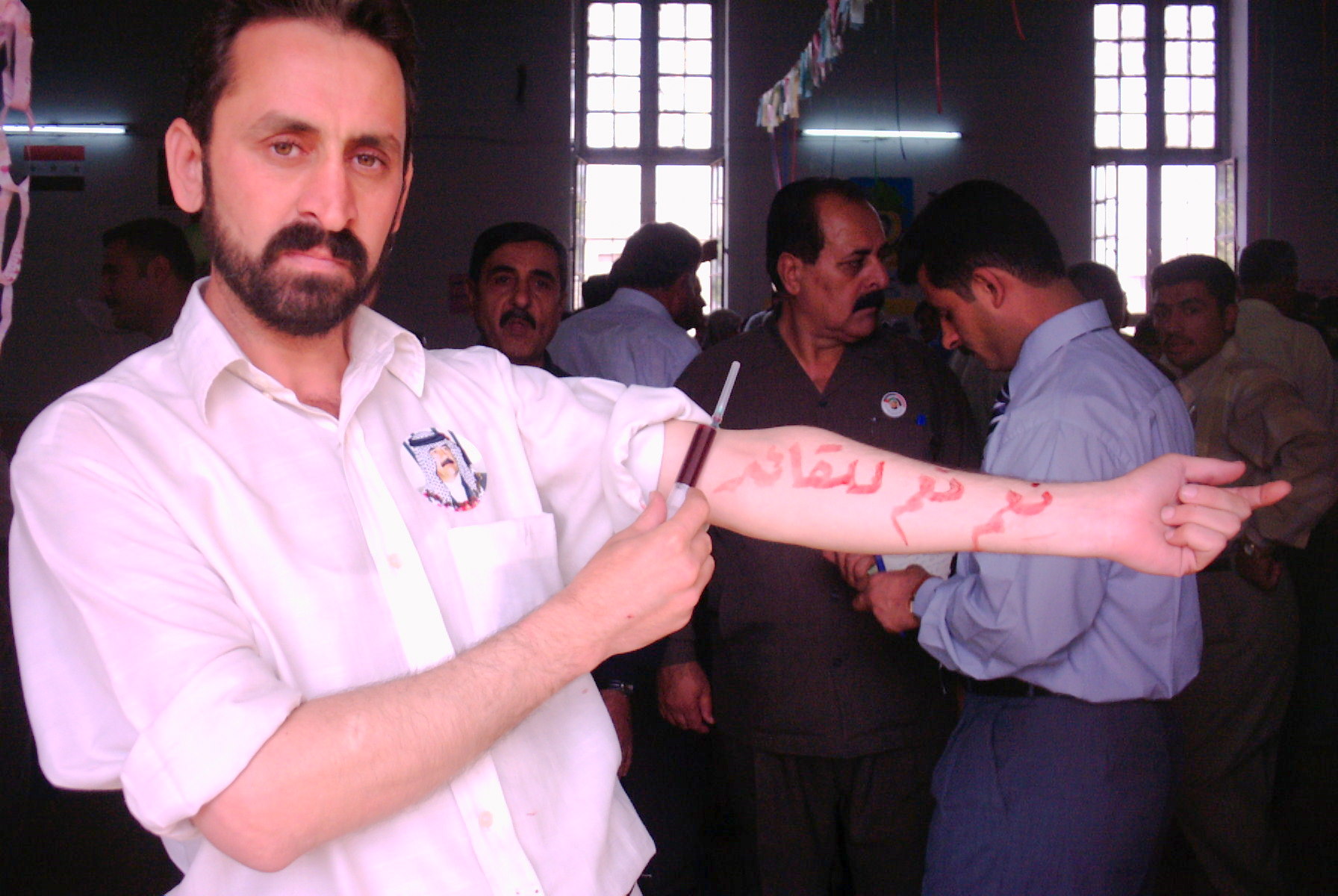
This Iraqi of Mosul drew a syringe full of his own blood to write on his arm “Yes, Yes to the Leader”. Did he genuinely love Saddam? Did he hate Saddam, but fear that Baathist commissars suspected his disloyalty? Was it all a show for visiting foreign correspondents? Any answer might have been right in the crazed atmosphere as Saddam demanded and extracted 100 per cent support for his rule in an October 2002 referendum. How could we explain in short, hurriedly reported stories the many layers of a Saddamized Iraqi reality to a suburban American newspaper reader, far away in every respect? And how could we explain that if this average American had been through the traumas visited upon Iraq in recent decades, that he or she too would likely have become similarly psychologically disturbed? Photo: Jessica Lutz
As Gelb and Zelmati say, grand publications still have the resources, expertise and vocation to be key examiners of government policy; that Administrations and Congress cannot be trusted to give an unbiased version of their own role in events; that think tanks can be superficial and ideological; and that news stories often stress politics above understanding of policy, usually due to non-specialist writers’ lack of substantive knowledge. I also welcome the finding that stories by reporters in the field stand up better to the test of time than those written from cubicles in Washington DC.
The authors’ recommendations are also fine as far as they go: editors should support reporters to mount challenges to the system; news should be analysed more; field reporters should be rotated through Washington; and journalism schools should do more succinct, quick analysis of coverage. Still, as I try to explain in the caption of the accompanying photo, foreign correspondents like me faced more fundamental issues as we tackled the onrush of the Iraq war, problems that are endemic in reporting anything about the Middle East in a U.S. newspaper.
These include the fact that readers like, and editors look for, stories with American characters, transparent motivations and happy endings, which build a quite unrepresentative picture of the region. We often pulled punches in order not to disturb Americans’ comfort zones, minimizing the bloody side of the violence, caricaturing the boiling hatreds, and stepping lightly round the Western role in stoking up at least 15 major wars and revolutions that have devastated Middle Eastern societies over the last century.
We thus all played small roles in constructing artificial narratives instead: an Arab-Israeli “peace process” that has never proceeded anywhere, a misleading scenario of regional struggle between “moderates” and “radicals”, a myth of American neutrality and analysis confused by one-size-fits-all labels like “Islam”, “Arab world” and “terror”. Over decades, the “elite press” has thus helped build a wall of incomprehension between American readers and the realities of the Middle East. Unsurprisingly, the average American has a hard time understanding what’s going on anywhere in the region, let alone in Iraq.
Additionally, in the specific case of the Journal, readers’ and policy makers’ opinions in the run-up to the war were surely swayed by long, regular and prominent articles in the opinion pages by hard-line Israelis, making what soon proved to be fallacious assertions about America’s interest and duty to invade Iraq. At the same time, for much of the 2000-2002 period, the Journal‘s news pages didn’t even have a dedicated Israel correspondent.
It was hard to see all this while working in the field, and I only came to this fuller realization of what lay behind our 2002/2003 frustrations while writing Dining with al-Qaeda. At the time, being a reporter trying to alert the U.S. to the folly of the Iraq war felt like being a blade of grass flattened by a gale force wind of pro-war sentiment. I often just felt depressed, even emasculated, and understood how tempting and empowering it must have felt to be able to join the pro-war charge.
It is humbling to realize that this flattened-grass effect is how journalists in authoritarian regimes feel all the time. I remain thankful that, unlike them, and unlike the man from Mosul above, I was not trampled underfoot as well. In the Journal‘s news pages, my editors were honest and rigorous, and they did usually print my dissident stories, even if the problems mentioned above tended to distort, diminish and delay our coverage.
For instance, it was only in January 2003 that I started working up a full analysis of the historic folly of invading Iraq (or any other Middle Eastern country). It was two months before we could all agree that it was ready to grace the front page of the newspaper. That was on 19 March — the day before the tanks started rolling in.
There’s one line in the Publishers Weekly review of Dining with al-Qaeda— the one about the “exquisite photographs” —that made me expecially proud. The reviewers at PW even took the rare step of publishing this image (only viewable in their print edition):
Iranian baseeji volunteer bids farewell to his daughter before leaving for the Iraq war front – Tehran 1985 (Photo: Hugh Pope)
When I first sent the book to the publısher there was no talk of any ıllustratıons or photographs, but I thought I’d go through all those boxes piled high in the cupboard anyway. I’d always enjoyed taking photos, but didn’t have a proper camera when I first decided to head to the Middle East a month after finishing university. I remain grateful to a long-lost Oxford acquaintance, Mark, who conducted me to Mornington Cresent in north London to buy a second-hand 1962 copy of a Leica, the Canon 7S. I still have it and love using it.
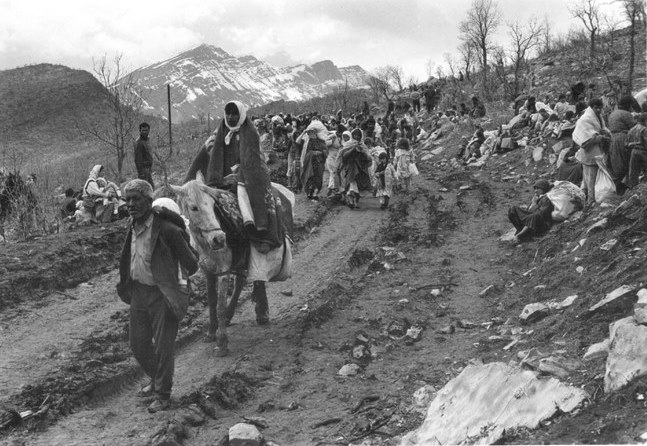
As a working journalist, especially for the Independent, a good image really helped to win publication of a story. Also, the need to get that photograph forced me to spend time looking at the characters and situation from new angles. I kept negatives and prints of nearly everything. The only ones that were lost were some of the most dramatic, taken when I hired a plane with some colleagues to get quickly down to the Kurdish refugee emergency of April 1991. I sent them to London by a series of couriers, but the Independent then lost one or more of the negative rolls. Stıll, they had made some prints at the time, and this resulted in three or four grand front page photographs.
In the end I had several thousand photos to go through. I whittled the selection down to the 35 or so that I reckoned best illustrated the themes of Dining with al-Qaeda. The editors at Thomas Dunne really liked them too, so they are now sprinkled through the text. (A couple of splendid prints in the boxes came from then UPI colleague Jack Dabaghian – thanks again to him for giving me permission to use them too). Many didn’t make the final cut, either because they repeated the same idea as other photos or simply because I was shy of making the book any longer. Here are three more that this blog gives me space to share:
An Armenian fez maker stands by his heavy iron moulds in Aleppo, Syria, in 1982. I reckon he must already back then have been one of the last men in the Middle East to produce the traditional Ottoman headgear (Photo: Hugh Pope)Syrian artillery shells were exploding in the streets outside the last hideout in Tripoli, Lebanon, of Palestinian leader Yasser Arafat, when this picture was taken in 1983. A few days later he was forced to leave on a chartered Greek Aegean islands ferry. Ironically, the Israelis had forced him to leave Beirut much the same way a year before. (Photo: Hugh Pope)Line of Iraqi Kurdish refugees pours into Turkey after the collapse of their post-Gulf War rebellion in 1991 (Photo: Hugh Pope)
John Ash writes poetry that I really love, and his new collection “In the Wake of the Day”, just published by Carcanet, once again offers great moments of hovering between East and West, ancient and modern, the personal and the historical.
Ash nearly drops his pose of elegant nonchalance once or twice when he edges close to the vicious sides of the contemporary Middle East and the insouciant West’s share of responsibility for the mess. “Babylon” asks the reader to “remember the shattered windows of the stores,/the blood smeared on torn newspaper … tank tracks are driven over Babylon.” More representative of the typical Middle Eastern condition, perhaps, is “The Cut,” as people rush home on a snowy winter evening and the lights go out – again. “The grid overloads. The power fails./It is like this often. We shift and change,/Slipping to a poor, third place.” And Ash has all his pithy poise at hand in this short meditation:
Olives
In the lands to the west of the Jordan
Olive groves were guarded by the soldiers of the kings
By night and day, and the destruction
Of a single tree was punishable by death
Or mutilation. This is no longer the case,
But I am not convinced of the improvement.
We’re neighbours in Istanbul, so I guess that it’s no surprise that we share many of the same perspectives, which I try to capture in down-to-earth, anecdotal prose in Dining with al-Qaeda. I wish I could get away with the grand historical sweep beloved by Ash, as here in “Difficult”, a poem in which he mocks his incurable name-dropping of ancient oddities, then unrepentantly wraps his poem up with the couplet:
The French rights to Dining with al-Qaeda have already been sold! The translation will be done by Les Presses de l’universite Laval in Quebec, a respected Canadian university press. PUL will soon also be publishing a translation into French of my second book Sons of the Conquerors as well.
The distributor of their French-lanugage edition in U.S./Canada is PROLOGUE INC., +1 450 434-0306, and in France it’s SODIS, +33 1 60 07 82 00.
The penultimate chapter of Dining with al-Qaeda focuses on my experiences during the Iraq war with the Yezidi community, who straddle the northeastern corner of Iraq and patches of southeast Turkey. These 500,000 people seemed to me to be as representative as any of the other pieces of the Iraqi mosaic before, during and after the 2003 invasion that toppled Iraqi tyrant Saddam Hussein. Their fate seemed particularly unfair to me, since they had laid good plans for the future. Like many Iraqis, any hopes of quick improvement were dashed.
I also chose to write about them because, thanks to my Kurdish interpreter and fixer Sagvan Murad (see picture left), a Yezidi activist in his regular life, I had privileged access to the community. A strange aspect of the Yezidi faith is that even its adherents know little of the exact tenets of their religion — except for emphatic denial of outsiders’ prejudice that they ‘worship the devil’. Ultimately they are monotheists with a special reverence for their protector, the Peacock Angel.
One of the outsiders who knows the Yezidis best – Eszter Spät of Hungary, author of one of the only good books on the community – has now put together an intriguing website illustrating Yezidi holy objects from their peacock standards to the religious ceremonies surrounding their traditional undershirts. Through photographs (click on them to make them bigger), she and her collaborators show how straightforward observation and photographs gets as close to the truth about the Middle East than any formal history, theorizing or journalistic shorthand.
Spät’s website also set me straight on one thing about the black snake on the wall of the shrine of Yezidi divine Sheikh Adi in Lalish (visible on the photo here too). Nobody knows quite what it symbolizes, but Yezidi myths have it that a black snake led Noah and his ark of animals to safety. Yezidis had previously joked with me that this snake was kept black with shoe polish. According to Spät, however, it’s really done with the soot of the holy oil lamps…
The oil is still stored in ancient amphorae deep in the shrine, where, equipped with my trusty headlamp, Murad and I explored the inner recesses and stone-carved underground spring. Murad taught me how to make a wish in the amphora store by tossing an old rag backwards over my head to land on a ledge (I was successful on my third attempt). One of his wishes must have come true: while things have been pretty tough for Yezidis since 2003, he’s now risen high to become acting chief of protocol for Iraqi President Jalal Talabani!
This photo — from Turkish photographer Sıtkı Kösemen‘s fun new album of Istanbul photographs Today is Today — sums up a lot about what I’m trying to say about the many faces of Islam in Dining with al-Qaeda. What do you think these girls represent?
Sometimes I feel that for Americans, the dramas of the Middle East play out in parallel universe. It was with fascination, therefore, that I saw that the Berkeley Daily Planetin California had spun into an intergalactic war as it tried to bring debate about the region down to earth.
I bring this up because a principal idea I want to get across in my book Dining with al-Qaeda is how hard it is for reporters covering the Middle East to frame the story right. This is especially true when issues dealing with Israel, anti-Semitism, or terrorism come up.
The mismatch of perception and reality that has built up over decades can trip up even a local American newspaper. The Daily Planet,which published letters critical of Israel, was the subject of this story in the New York Times in November 2009.
BERKELEY, Calif. — For the last six years, The Berkeley Daily Planet has published a freewheeling assortment of submissions from readers, who offer sharp-elbowed views on everything from raucous college parties (generally bad) to the war in Iraq (ditto).
But since March, that running commentary has been under attack by a small but vociferous group of critics who accuse the paper’s editor, Becky O’Malley, of publishing too many letters and other commentary pieces critical of Israel. Those accusations are the basis of a campaign to drive away the paper’s advertisers and a Web site that strongly suggests The Planet and its editor are anti-Semitic.
“We think that Ms. O’Malley is addicted to anti-Israel expression just as an alcoholic is to drinking,” Jim Sinkinson, who has led the campaign to discourage advertisers, wrote in an e-mail message. He is the publisher of Infocom Group, a media relations company. “If she wants to serve and please the East Bay Jewish community, she would be safer avoiding the subject entirely.”
I assume that both journalist and the New York Times were acting in good faith, just as was the case of my experience in the Middle East. Yet this account showed again how successful lobbying groups have been in developing U.S. newspapers’ particular approach to Israel.
First the headline: “In a Home to Free Speech, a Paper Is Accused of Anti-Semitism” Note: not something neutral like “Paper in Home of Free Speech Attacked for Publishing Anti-Israel Letters.” An anti-Semitic slur is slung, and the mud sticks. A headline-hopping reader gets the message that anti-Semitism is taking root in America and must be stopped. It sets the tone for the whole article, legitimizing the idea that publishing material critical of Israel – apparently the main problem — is necessarily anti-Semitic, as does the choice of quote for the third paragraph.
As the story eventually points out in its concluding paragraphs, the local Jewish community in fact wants little to do with this campaign against the supposedly anti-Semitic Daily Planet. The community does rightly protest an unpleasant letter from an Iranian student in India claiming that Jews brought persecution upon themselves – the only item cited that backs up the anti-Semitic charge in the headline. Indeed, the Times points out that the Daily Planet‘s owner, Ms. O’Malley, later firmly distanced herself from this “nasty” view in her paper.
I’d like to stress again that I mainly want to draw attention to the way the Times article is constructed. Much of the information for a fully-aware reader to make a judgement is there, just lower down in the story. Better late than never, Ms. O’Malley is cited as pointing out (in print) her reason for making her readers aware that criticism of Israel is out there.
I still don’t think that keeping sentiments like [that of the Iranian student in India] out of The Daily Planet will make him or people like him go away.
Ms. O’Malley is quite right. Airbrushing out uncomfortable realities helps nobody. Israel’s overpowering conduct in its dispute with the Palestinians, and U.S. support for its actions, have stirred public opinion not just in California but to a far greater degree in Middle Eastern countries. Framing can also go too far the other way, as broadcasters like al-Jazeera spin scenes that inflame Middle Eastern viewers. This poisonous mix has fed distorted, sometimes perverted and disgraceful views of Jews, Israel and America. It certainly underpinned the motivation of several of the 9/11 hijackers.
My late Journal colleague, Danny Pearl – a Jewish victim of this wave of hatred, killed by real anti-Semitic extremists in Karachi in 2002 – had wanted to write a story after 9/11 that exposed the way Middle Easterners had persuaded themselves that the attacks on the U.S. were actually organized by the Israeli secret service, Mossad. He wished to explain how it was that the whole Muslim world was ready to believe conspiracy claims emanating from a small Jihadi group, not the clear reality of an al-Qaeda terrorist attack on the United States evident to the whole world. The Journal’s editors declined to publish it. Pearl was furious, believing that they avoided the story because it would inevitably have raised the issue of Israel’s conduct.
And so it was that yet another light mile was added to the outer space of ignorance that separates Americans from the reality of the Middle East — a gap in public knowledge that that is policed by campaigns like the one reported by the Times against the Daily Planet.
Dining with al-Qaedawill be featured at venerable Washington DC bookshop Politics & Prose on 31 March 2010. I’ve been invited to do a reading, discussion and book signing at 7pm – hope to see you there!
Politics & Prose
5015 Connecticut Ave NW
Washington, DC 20008
(202) 364-1919
Many thanks to trade reviewer Kirkus Reviews for enthusiasm and praise for Dining with al-Qaedain their 12 December 2009 assessment!
British journalist Pope (Sons of the Conquerors: The Rise of the Turkic World, 2005, etc.) shares deeply engaged dispatches from the Middle East hotspots he visited during his long career.
The author organizes the narrative topically around the big stories he covered as a journalist in the Middle East. The son of a scholar of ancient texts and a “handsome Englishwoman of the indefatigable school,” Pope was studying Oriental languages at Oxford and became enthused with the romantic idea of becoming a Middle Eastern journalist in the style of Times correspondent Robert Fisk, “so close to the action, so clear in [his] moral vision”—however not overly concerned with factual precision. The author first got a job at the Egyptian Gazette in Cairo, embellishing news out of a sense of perverse boredom. He became a stringer in Turkey for the Independent in 1991 when the Gulf War broke out, before being expelled for something written by Fisk. Pope subsequently worked for the UPI in Syria covering the Palestinian crisis of the early ’80s; Reuters in Lebanon and Afghanistan at the time of the Soviet withdrawal of 1989; and the Wall Street Journal, serving as the Middle Eastern reporter in the ’90s based in Istanbul, until 9/11 abruptly challenged his sense of invulnerability. The author is a charming writer, intensely sympathetic of the Arabic people he moves among and eager to make known their voices, especially in terms of their resentment of imperial powers and Israeli aggression. In between his newsmaking interviews with Yasser Arafat, young King Abdullah of Jordan, an al-Qaeda operator in Saudi Arabia and a Taliban ambassador in Kabul, Pope offers intimate glimpses inside the Arab world, including his study of the beloved medieval Persian poet Hafez as a means to help decipher Iranian political rhetoric.