
My notebooks long seemed to me to be priceless. For 43 years, they helped me pin down the chaotic rush of war zones, wise words from unexpected people and the gist of long discussions that might stretch deep into the early hours.
By the end, their number grew to some 200 notepads and booklets, spanning all shapes, colours, sizes and qualities of paper. They had ranged over more than 30 countries, crossing and recrossing borders hundreds of times. They had moved with me from homes in Damascus to Beirut, Manama, Tehran, Nicosia, Istanbul, and, finally, to five boxes in my attic in Brussels.

I never thought I’d take my leave from these core ingredients of my working life. The notebooks were survivors. Even briefly misplacing one on a reporting trip would trigger a traumatic panic, as if the whole journey risked being in vain. Yet when I needed to make space in my attic this summer, most of them did not pass the final edit. To my great surprise, I was able to bid farewell to all but a shoebox-full of them.
Home-made shorthand
A lot has changed to make me ready to let them go. For a start, many were probably only fully understandable by me. Sometimes I scribbled stuff down without dates, without full names, without places. My handwriting is not always that legible, and reading my home-made shorthand, which omits the vowels, takes some practice. I can still work most of it out.
But as I leafed through each notebook, considering its fate, I realised the contents were highly fragmented. I never focused for long on one topic or one country. Many notebooks bounced between several countries, like one that jumped from Saudi Arabia, to Lebanon, to Washington DC, then to the Turkish Republic of North Cyprus.
My dependence on them in pre-digital days was augmented by the back page or two that tracked my treasure hunt for contacts in each new location. Names, telephone numbers and addresses were culled from chance meetings, trips off the beaten track, friendly colleagues, local journalists, stringers and diplomats. Stuck into one notebook from Sudan, I found a mimeographed list of the entire government. (I only managed to reach one of them, the prime minister, in his lounge at Khartoum airport late one night. Then, before we’d exchanged a full greeting, the power cut out and all went black – and silent. No notes needed.)
It dawned on me too that the forces propelling me on those journalistic journeys were usually random. There were few sustained trails of enquiry that would be useful to me or any future researcher. My magnets were the zig-zagging pinball of the news, which country had finally surrendered to my faxes begging for a visa, or the determination of my editors that I serve up new topics and places that I had never written about before.
That’s why I often reported on idiosyncratic subjects. A Soviet aluminium smelter in Tajikistan that history had forgotten. How Albanians dealt with their leader’s obsession with concrete bunkers. What happened when reconstruction experts, wanting an authentic floor for a new version of Shakespeare’s Globe Theatre in London, went to Turkey looking for hazelnut shells. I greatly enjoyed tracking down such stories, but my reporting notebooks added little to what was published.

Notebooks, too, were mostly just a starting point for me. The closest I usually got to long-form writing in them were a few drafts of lead paragraphs while sitting in a taxi on my way to my office or hotel, a pointless record at the best of times. Blinking green computer terminals had just arrived when I started in the trade, and when I couldn’t use one I chose either normal paper or, rarely, my typewriter.
Only once do I remember writing anything in a notebook that was intended to last. That was when I found myself in an Iranian helicopter streaking low over a southern desert war front into banks of smoke and exploding Iraqi bombs. I began scribbling a goodbye note to my first wife. I was too terrified to make any literary or even emotional sense, and stopped half-way through. As I sifted through the stacks, I found the right notebook. But the fond farewell had disappeared. In some previous editing, I had already torn it out.
Just once or twice, I found a page where I couldn’t resist writing in real time. Here I am on board the Azerbaijani ship Ghassan Aliev after it docked in Baku, ending my three-day struggle in 1993 to get out of the Turkmen port of Krasnovodsk (now Türkmenbaşy) and across the Caspian Sea.
“Huge crush of sweating Azeris trying to find places to get off. Enterprising lads and one old man leap over to a flying pontoon at deck level. “Hey,” shouted one man. “You’re not in Turkmenistan now.” It was a premature call to order as we heaved through. Material-wrapped baggage bombarded the quayside, causing the crewmen lowering a stairway to join in the frequent swearing of “what animals.” After that, crew abdicate responsibility for order completely. In the bar/restaurant/purser’s lobby, one man shouts “What a stupid nation we are.” Last remnants of Soviet order are commands that snap through the intercom at all times of day and night: “No smoking except in the restaurant.”
That page seems born of a rare situation where I had extra time on my hands. I soon gave up any idea that there might be literary passages worthy of a hero writer. They are different. For instance, take Ernest Hemingway.
In 1956, Hemingway unexpectedly recovered his notebooks about life in 1920s Paris from a trunk he’d forgotten that he’d left in the Ritz Hotel. Later published as A Moveable Feast, he talks of watching a beautiful woman with hair “black as a crow’s wing” from his seat in a café. Then he jots down: “You belong to me and all Paris belongs to me and I belong to this notebook and pencil.”
Perhaps my relationship with my notebooks would have been deeper if, like Hemingway, my work had involved haunting Paris cafés drinking Rhum Saint James and downing Portuguese oysters. I can only console myself in the knowledge that Hemingway used school notebooks too.
Living in the moment
The lack of grand asides, emotional depth or narrative context in the notebooks was also because the notes were meant to feed stories written up within a few hours or days. I felt little motivation to jot down any sights, sounds, smells, or my side of any conversation, especially since I was often busy taking photographs too. Even the date did not feel necessary. I’m observant and have a fair memory. I was living in the moment, everything seemed obvious. I knew I would remember it all while writing my piece.
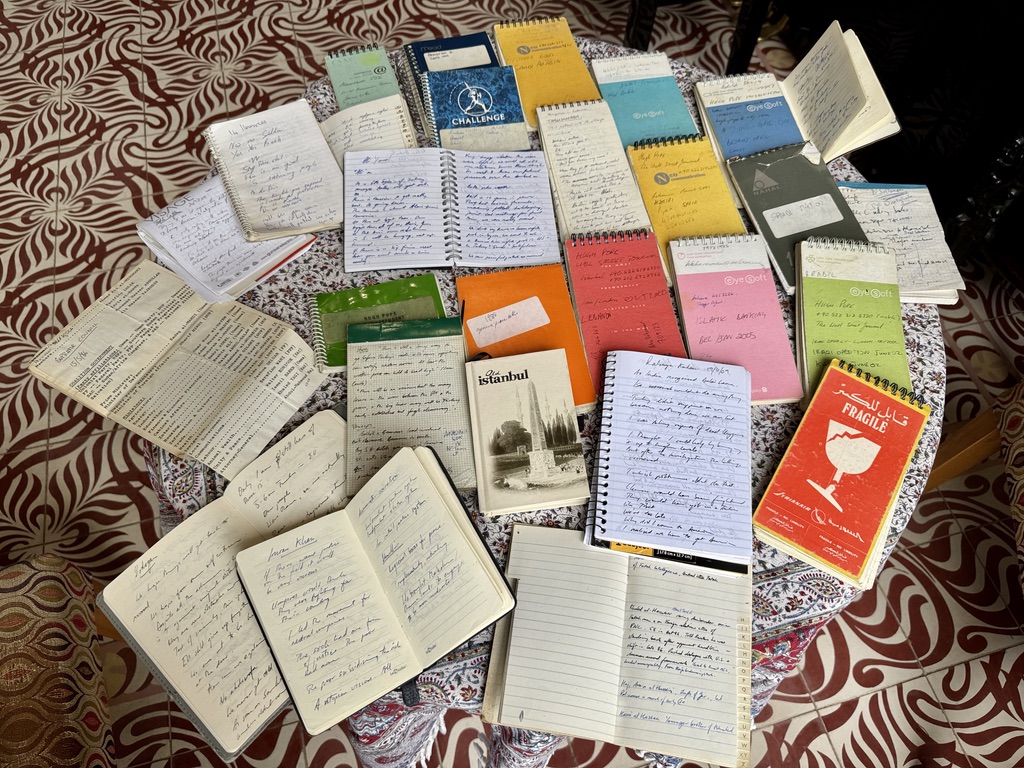
The passage of time hasn’t wiped out such memories, some of which returned as I handled my old companions on the road. But each of the many stories has moved far, far on. The notebooks seemed to have gone past their expiry date. They added little intriguing or new.
Another big reason for my sense of the notebooks’ disposability is doubtless that most of them have already had an afterlife. If there was a logic to where I went and what I did beyond the news, it was my quest to fill in gaps in more personal, longer-form narratives. The notebooks had already refreshed my memory as I wrote books in the 1990s and 2000s on Turkey, Central Asia and the wider Turkic World, and the Middle East. The scene in Baku port, for instance, features in Sons of the Conquerors. But even back then, I noticed that my on-the-job jottings were less inspirational or complete than I expected.
Also, I religiously kept the published versions of my articles, even though I know that they too are only part of the overall story. I once had a lot of my first drafts as well. Especially when writing about the Middle East, I found these of more long-lasting value than the long, highly edited, front-page stories that appeared in a publication like The Wall Street Journal. In fact, the way the editing process produced a pattern of omissions became an unexpected but critical part of the narrative of my Middle East memoir Dining with al-Qaeda.
In either case, notes taken for ephemeral daily news stories or longer-form books were now unable to tell a compelling story on their own. Reading the notebooks again sometimes felt like coming back to an untidy kitchen counter after making a meal that I have already eaten.
The changed mechanics of reporting
What I found on the pages before consigning them to yellow garbage sacks also made me realise how much has changed in the way we work.
A traveller or reporter now would find it hard to imagine how difficult the mechanics and context of foreign reporting could be in the 1980s and early 1990s. Landing somewhere for the first time before cell phones and the internet would mean becoming almost completely detached from your previous bubble and total absorption in a new one. Even if available, communicating in real time with the office or home could be ruinously expensive.

My 1990s notebooks prominently featured obscure international telephone numbers and log-on codes. Reporters of my generation had to spend many, many futile hours trying to make technology work. To get a better line to our newspaper’s computers to file our stories, many of us learned to dismantle the wall sockets behind our hotel beds and then attach crocodile clips from our computer modems to the bare telephone wires.
Indeed, the stories written from these notebooks went back to newsdesks in a great variety of ways. Early on, I handed letters to people in queues in airports, sent telegrams, endlessly typed telex tapes, wore out my thumb on an amateur radio transmit button, hunted for Kurdish militias with satellite faxes and dictated to the legendary blind transcriber at the old Los Angeles Times (overall, one of the fastest and most accurate methods). I once even bought a half-barrel of diesel to power a generator so that two Sudanese Army radio operators could send my story by morse code (it was diligently transmitted, but never arrived).
Before the vast pool of knowledge in personal computers, Google maps and the internet, one also had to keep track of basic facts for oneself. For a trip to the northern front line of the 1980-88 Iran-Iraq war, I had stapled a smudged and incomprehensible photocopy that supposedly showed where the border was. Alongside the notebooks were hundreds of neatly filled cards in boxes to collect, say, tidbits about Iran and Islamic revolutionaries. There were also slim green hardback notebooks with pages sorted by the letters of the alphabet. One of these tracked the rival factions of the Palestine Liberation Organisation. Another kept my mind sharp on Arabic political terminology.
Early notebooks logged many long-dead conversations with foreign diplomats. We used to look in awe at Western embassies as critical sources of not just international perspectives but also guidance and wisdom about a country. That gradually wore off, and disappeared after the invasions of Afghanistan and Iraq. Even so, many of the Middle Easterners we interviewed still thought we were, at best, just another representative of their old colonial oppressors or, at worst, another kind of spy.
Quality not quantity
As I went from news agency reporter to newspaper correspondent to an analyst for the International Crisis Group, my taste in types of notebooks seems to have improved. I started off in Syria, Lebanon and Iran with notebooks that differed wildly in quality, from some that were little better than kitchen paper to others that were as good as parchment.
When I joined the hallowed Wall Street Journal and was given one of their bottomless American Express credit cards, I moved on to high quality reporting pads. Later, as I transitioned to analysing ideas for peace-making at Crisis Group, a European consul general invited me to lunch in his country’s Istanbul palace and told me how he felt free to speak since I was no longer a journalist. I felt self-conscious about my ever-present spiral notepad. I decided to go upmarket to the Moleskine-style writing books that I saw some diplomats using, now that they were actually visiting me in my own office.

Looks and experience made no difference to how many of those notebooks I kept. Diplomats might now be talking to me more freely, but, as far as I could tell, the substance of what they said was mostly the same. In fact, the lack of on-the-ground reporting made the contents less interesting. However clever it sounded at the time, second-hand geopolitical analysis does not age well.
Selecting samples
My decision to let my notebooks go was also informed by my experience of a far more daunting task over the past two years: trying to put some order into 50 boxes of letters, diaries, loose photographs, albums and commonplace books accumulated on both sides of my family over more than 200 years.
These included the papers of my late father, Maurice Pope, a classics professor and author with wide interests. I had to prepare these for Cambridge University’s Department of Classics archives. Before taking them there in April, I asked archivist Rebecca Naylor what she wanted.
“You should put in all varieties of record. But remember, no archivist keeps everything,” she said. “To control the sheer volume of material, our final and essential step is to make sample selections.”
A lot might not be kept, in other words. “Archives are never used as the depositor expects them to be exploited,” Rebecca explained. “The hope is that interesting, intelligent, observant people embody a repository of experiences of an era that is no more.”
“Even about small things?” I asked. “My great-grandmother May’s account of her honeymoon is just a few lines a day, and she gives away almost nothing about herself. She just lists things like boarding the boat across the English Channel, catching the horse-drawn ‘diligence’ where the railway line ends, and attending Anglican church services in German hotel drawing rooms.”
“Well, people do discard stuff because there is Just So Much of It,” she replied. “So as centuries roll on, the exasperated winnowing means eventually very little is left of what ultimately becomes the deep past. Imagine if you now had the account of a Tudor honeymoon, if honeymoons were even invented by then! The burden is not on us to ‘get it right’ for all perpetuity, just to fashion our own chapter of recollection and reflection, then pass on the baton to the next generation.”
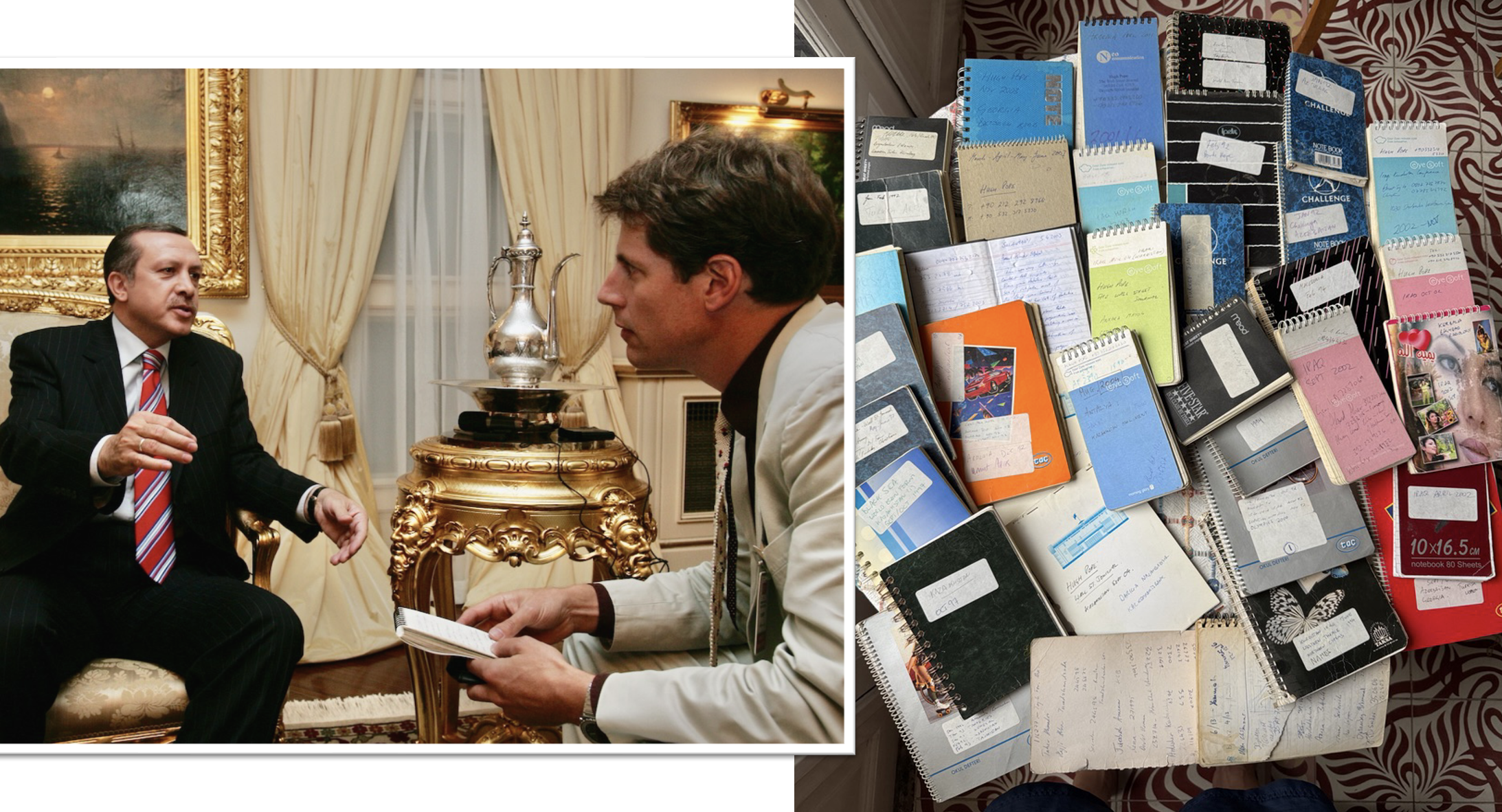
I kept the sample of my notebooks only partly in hope of saving the geopolitical equivalent of a Tudor shopping list. I mostly wanted reassurance that I was right to break with my hoarding habit. As I took farewell photographs of them all on a table, I also realised that what I wanted most was not to read them, just to see them again.
Letters and diaries
I was also guided by more of archivist Rebecca Naylor’s advice: “The genre most people cull before they donate to an archive is letters. But these are often the most valuable records, in terms of information.”
The same applied to my reporting notebooks, I realized. My letters, diaries and photographs from the same time are much better at bringing the past back to life. That’s not all. Going through all those family papers quickly taught that if diary entries are too functional, if a photo doesn’t have the names or place on the back, if a letter isn’t clearly dated and properly signed, if an album has no captions, their content loses most of its meaning.
Indeed, by far and away the best notebooks from my four decades on the reporting road were the rare ones I kept in diary form. Once was while trying to avoid trouble in Iraqi Kurdistan while I waited for the 2003 US-led invasion to start. Even better were the ones from surrepetitiously reporting in 1999 on Xinjiang in western China, where foreign journalists weren’t supposed to work. While talking to the deeply oppressed Uighur community, my then travelling companion (and future wife) Jessica Lutz and I would hurry back to our hotel to write down everything while our memories were absolutely fresh.
In these diaries, we both found that we gave a better account of what was said to us and noted details absent from other reporting books: the clapping wings of startled doves, the angry eyes of a horse being shod while suspended in the air from a mediaeval wooden frame, our Uighur interlocutors’ shockingly deep fear of the Chinese, the explosive tang of Chinese flash-fried chunks of snakes and snails at a roadside stall, and the thick, soft satisfaction of Uighur noodles. Perhaps most importantly, I had something missing from my other notebooks: what I actually said or thought to myself.
I kept these diaries and letters, of course. I decided that the rest of my much-loved notebooks had now served their purpose. The cutting room floor could be swept. As I move on, I’m already writing more letters and being much more diligent about keeping a diary.
 Hugh Pope
Leave a comment