Writer of books on Turkey, the Middle East and Central Asia. Formerly Director of Communications & Outreach and Turkey/Cyprus Project Director for International Crisis Group. Ex-Turkey & Middle East staff correspondent for The Wall Street Journal.
I’d like to make a bet that Türkiye – the official name for Turkey since 2021 – is about to make a comeback after years of disastrous economic policies, fear-mongering leadership and regional turmoil.
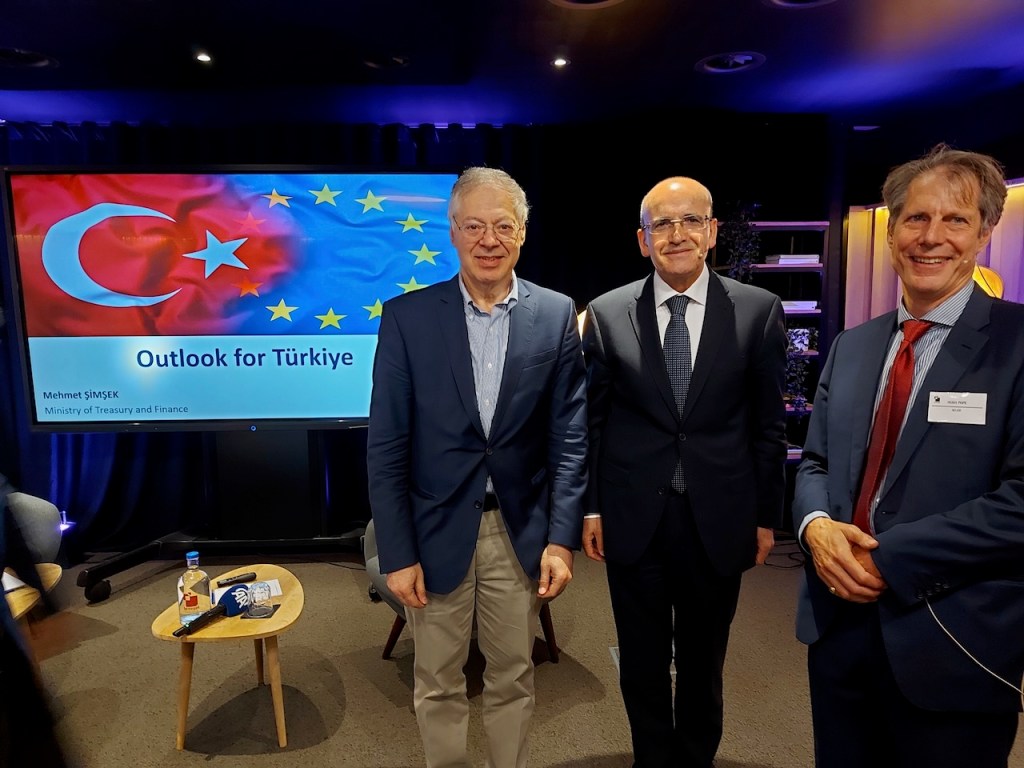
Being invited this week by the Bruegel think-tank in Brussels for a discussion with Turkish Treasury & Finance Minister Mehmet Şimşek felt like reliving the start of a memorable upswing back in the late 1990s. Back then, against the odds, Ankara quelled years of political chaos, conquered runaway inflation and successfully wooed the EU for an invitation to join the club.
If we believe Minister Şimşek, President Erdoğan has abandoned an economic ideology that kept interest rates artificially low and drained foreign currency reserves. Şimşek says he is getting a grip on inflation, promising it will decline after peaking at 70% this month. His past year running the budget has already brought an improved balance of payments, inflows of cash and a lower cost of borrowing. Similarly to the self-imposed stabilization package of the late 1990s, he seemed to have a good economic outlook to talk about.
When I asked him whether any political reforms would follow his recent budgetary measures, he talked up the long-moribund Turkish candidacy to join the EU. He invoked a longing for a “European anchor”, the EU’s “rules-based system” and an “engine” to bring the country back into a “virtuous circle.” His numbers showed how close the two sides remain in economic terms: for instance, the EU accounts for two-thirds of inbound Turkish investment, 41% of Turkish export sales, and 41% of tourists to the country.
The Turks have had a rough decade, going through the crushing of the country’s Kurdish movement, alarming wars close by, the inflow of 3.6 million Syrian refugees, a terrible earthquake in February last year and (as ever) financial crisis. But already during my most recent visit in April, I had the impression an upswing is in the offing. It isn’t just that the opposition swept to power in key municipal elections in March and – despite much Islamification of public spaces over the past two decades – Islamic sloganeering is not such a central fixture. From digital government, to a lack of power cuts, to better roads, to how people talk, things just seemed to be working a bit better.
In Brussels, Şimşek answered questions openly and showed a gentler side of the country long missing from the public stage. “We’d like to mend fences,” he offered.
I asked Şimşek if anyone he met officially in Brussels or other European capitals had responded favourably to his message that “Türkiye is ready”. The minister demurred. Such European encouragement as he received, he said, was more personal than institutional. But “they seem constructive”, he added, and “markets are coming round.”
Just as in the 1990s, a good portion of Şimşek’s Q&A discussed the question of whether Turkish leaders really wanted to join the EU at all – and vice versa. The minister himself preferred, like many Turkish leaders in the past, to plea to focus on “the process”, not the end goal, to see what happened if and when convergence worked.
European participants in the audience seemed to doubt that EU leaders would go that far. When it came to re-embracing the goal of Turkish membership of the EU, “Europe is not ready,” said economist André Sapir, my fellow panelist and a Bruegel Senior Fellow. Former top EU official and ambassador to Ankara, Stefano Manservisi, noted from the audience that even the unique 1995 customs union with the EU was invented to keep the country out.
Indeed, Türkiye’s EU progress report for 2023 points out that accession talks are “at a standstill” since at least 2018. The report is stiff with phrases like “no progress”, “backsliding,” and “serious deficiencies.” As in the 1990s, issues of human rights and rule of law stand out as big obstacles to any normalization.
At the same time, much has changed. One of Şimşek’s slides showed how the old unspoken European prejudice that the country was “too big, too poor and too Muslim” is now at least partly wrong. While purchasing power per capita was just 40% of the European average in 2001, it’s now reached 74%.
Indeed, when I started living in Istanbul in the 1980s, there were just 30 often ageing planes in the Turkish Airlines fleet. That’s about the number of planes I saw last month from one window of Istanbul’s vast new airport, possibly the biggest in Europe. Turkish Airlines says that today’s fleet of over 440 planes serves 272 destinations in more countries than any other carrier in the world.
That’s not all. An economy whose leading exports were hazlenuts and figs in the 1980s now sells drones that change the course of foreign wars. Compared to the 1990s, little armed conflict now happens inside the country. And the 3m-4m people of Turkish origin in EU states are now far better integrated and rising in European societies, changing perceptions of their mother country.
It may be that if technocrats like Minister Şimşek can get Türkiye’s act together, European leaders may accept his revival of Ankara’s old argument that collaboration with a country with its size and growth could be an advantage for the EU, whose combined GDP has now fallen to 17.5% of the global total from 28.6% in 1980. It’s possible too that Europeans can learn to look with new eyes at a richer, potentially better-run, and, dare I say, still relatively secular country.
I remember the December 1999 moment that the EU issued its invitation to join, an amazingly proud and happy day for many Turks. It kick-started years of real progress. Perhaps a more constructive approach from both sides could be an opportunity to bring back those happier days again.
+++
Postscripton 15 October 2024. I think I won my bet. Four months after writing this, The Economist published this article (10 October 2024):
Setting interest rates in Turkey is like skiing in pre-lift days. Going down is the easy part. Climbing back up is gruelling, and takes ages. The country’s central bankers have been doing so since the summer of 2023, and they still need more time.
They do have something to show for their pains….The economic team he appointed has won back the trust of foreign investors…”
It’s nice to see the country’s economy stabilize. Unfortunately, it’s no quick cure for the pain of constant transitions and uncertainties that continue to bedevil the lives of many ordinary Turks.
“All those who would trust a Citizens’ Assembly to take decisions for them, stand up!”
Half of the 50-strong audience rose to their feet in response to the question posed by Bridie Nathanson, co-founder and joint animator of the Brussels debating club Full Circle.
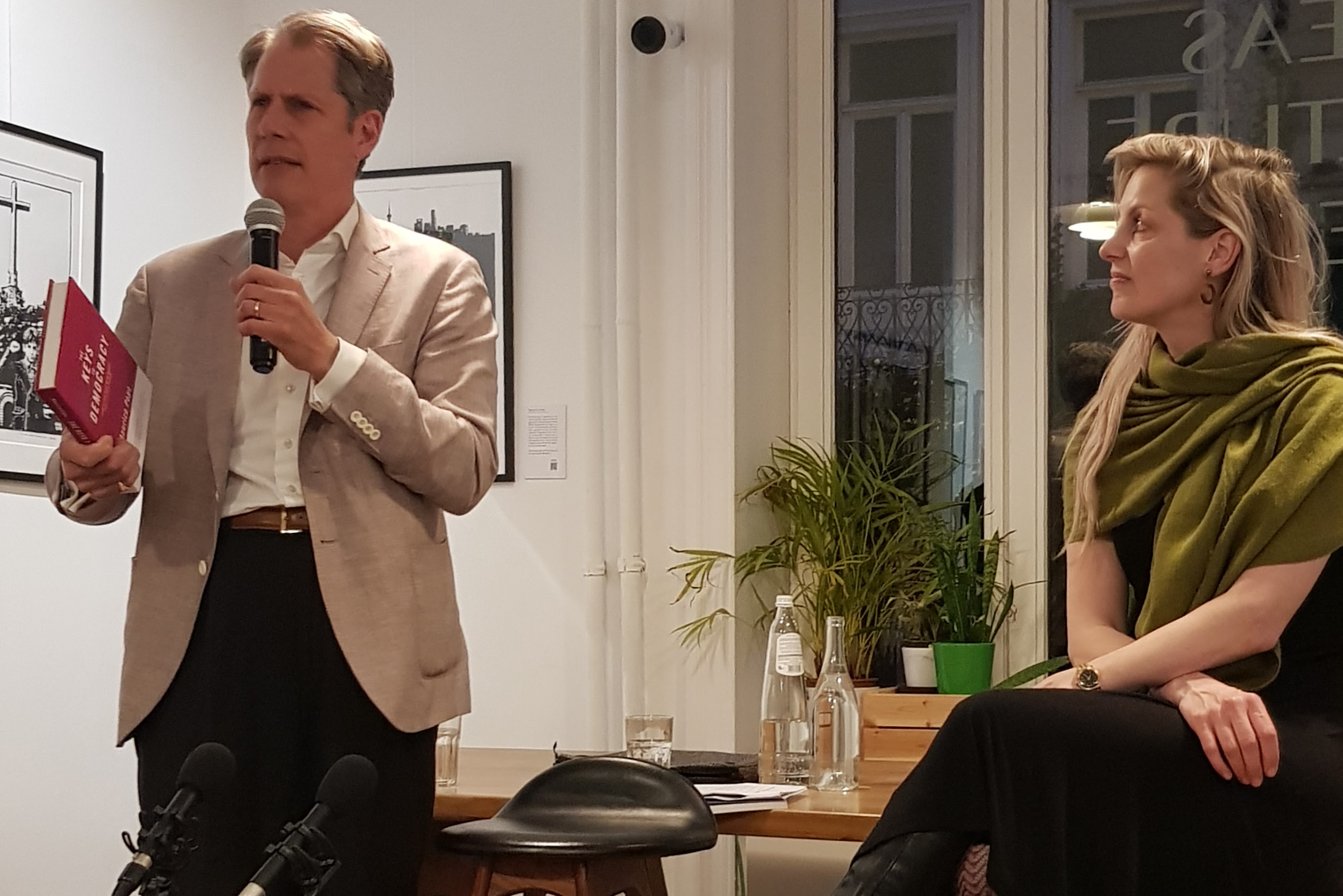
A sign of changing times? The unexpected endorsement of deliberative democracy came before my fellow pro-Citizens’ Assembly presenter and I had even begun to speak: Eva Rovers, co-founder of the Dutch deliberative democracy organizers Bureau Burgerberaad, and myself, co-editor of my father Maurice Pope’s posthumous book, The Keys to Democracy: Sortition as a New Model for Citizen Power, published exactly a year ago.
Ideas do sometimes travel faster than you realize. One of them is certainly that of the Citizens’ Assembly: the idea that good policy proposals to solve polarizing problems can come from a group of people randomly selected from a community. This method is also known as sortition. The randomly selected members meet, inform themselves, deliberate with the help of facilitators, hear everyone’s views and find new ways forward.
When my classicist father first typed a manuscript proposing similar kinds of assemblies in the 1980s, as a modernized version of ancient Greek democracy, none of his usual publishers would touch the work. Now there have been at least 800 sortition-based Citizens’ Assemblies around the world since the first one in British Columbia in 2004, most of them in the past decade.
Belgium, where I live, has a permanent Citizens’ Assembly for the German-language community, and the city of Paris has one too. The German Bundestag is running a series of three. In Britain, columnists and podcasters are increasingly referencing, even approving of the concept. It even (briefly) surfaced as a 2024 UK election campaign issue when a Labour Party adviser said these assemblies were a good idea.
Photo by Julius Proost
When Bridie gave me the floor, I spoke a little about how my mother Johanna found the lost manuscript of The Keys to Democracy in the family library after my father’s death in 2019, the publishers Imprint Academic took it on and it is now endorsed by many in the fast-growing field of sortition studies. But mostly I spoke about the experience of being an official observer at France’s recent Citizens’ Assembly on the End of Life.
I wanted the audience to hear and feel how inspiring it was to see ordinary people from a cross-section of society – from an immigrant baggage handler at Charles de Gaulle Airport to a high official of the French Central Bank – all contribute to discussions and reach a clear decision. Over 75 per cent of the 184 citizens endorsed the idea of possible assisted death, but 95 per cent – that is, including those who were against it – endorsed the report, because it had taken their views on palliative care and other mitigating alternatives into account.
The Assembly was inspiring too because of the sense of collaborative joy shared by the citizen participants. I spoke of my amazement that my father, a proud but shy person who spent most waking hours in his library, had understood how random selection would empower people to simply represent themselves. “Democracy liberates,” he foresaw (p. 171). “The less that people feel belittled and the more that they feel they belong to society, the greater will be their zest for life and the more fruitful the energy that they will display.”
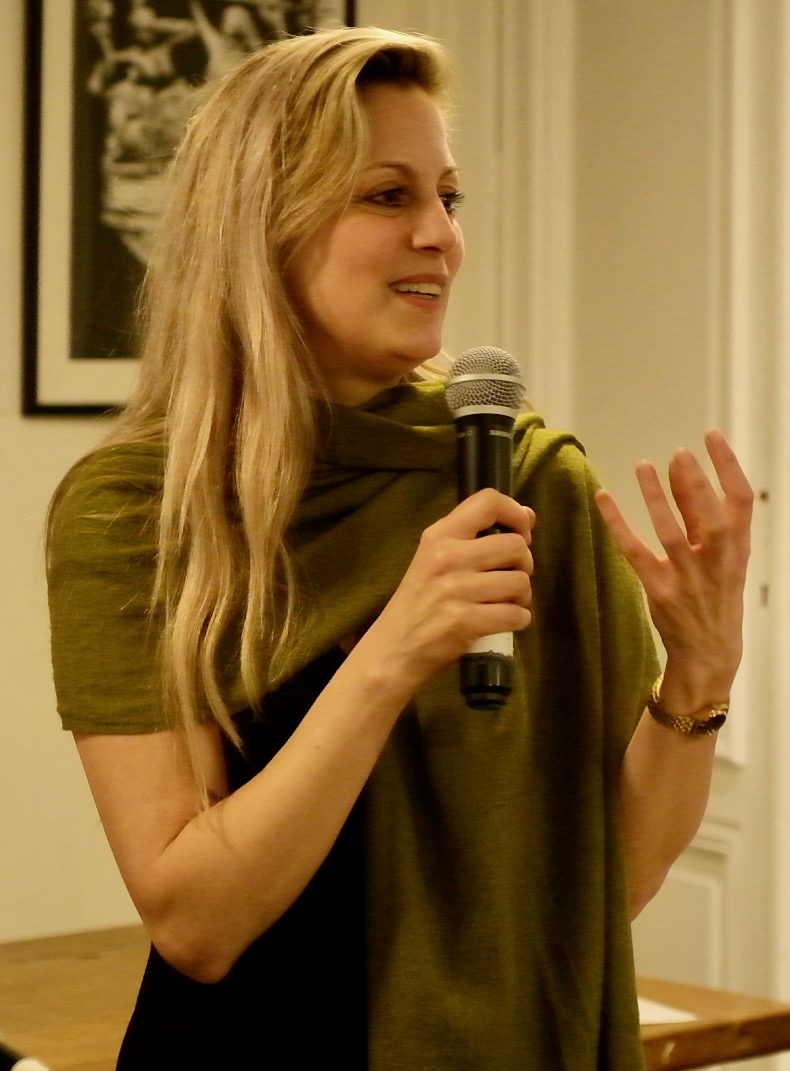
Eva Rovers, photo by Julius Proost
Eva Rovers told the story of how she pivoted from art history to deliberative democracy in response to what she saw as the failure of the current government system to come up with policies to deal with the climate emergency. The organization she leads is at the forefront of Citizens’ Assemblies taking off in municipalities all over the Netherlands.
Organized well, she said, Citizens’ Assemblies are proving good at finding innovative solutions to tricky problems. She gave the example of how one Assembly discussing the expansion of a nuclear power plant came up with an unexpected formula to quell disquiet in the coastal province of Zeeland. One of the ideas it suggested was that housing for workers should, after the completion of the project, be offered for occupation first to families of local people. “No architects would ever have thought of that on their own,” she said.
Our Full Circle discussion afterward seemed intrigued by deliberative democracy, even if not all participants were convinced that Citizens’ Assemblies could ever replace elections. My view, refined over my past year of book talks, is that any change will of course take time. Limiting the power of kings started (in England, anyway) 800 years ago; originally aristocratic parliaments took centuries to become the locus of power; and when parliamentary electorates began to expand beyond the elites, it took nearly two centuries to get to universal suffrage in most countries.
But it’s been more than a decade now that groups like Freedom House have recorded backsliding in the long global expansion of elected representative government. Polls show how many people are frustrated at the failure of elected bodies to make decisions in the public interest. I also argued that if we don’t find a path to more efficient government by expanding democracy beyond the confines of party politics and elections, even more people will be attracted to another seemingly more efficient alternative: authoritarian rule.
For sure, it may take many more decades before a majority of the population accepts the idea of giving Citizens’ Assemblies (or whatever develops from them) the full right to make recommendations, let alone have decision-making power. But engaging with so many people open to new ideas for better public decision-making, and seeing several more copies of my late Dad’s once-spurned book on sortition being sold, I feel it is not crazy to hope that change is on its way.
One day, a Turkish colonel bellowed at me across a hushed meeting table around which sat 43 representatives from 19 Turkish government departments: “Mr. Pope!” he roared. “Your report talks about peace. But they are burning my flag! If terrorists burned your flag, what would you do?”
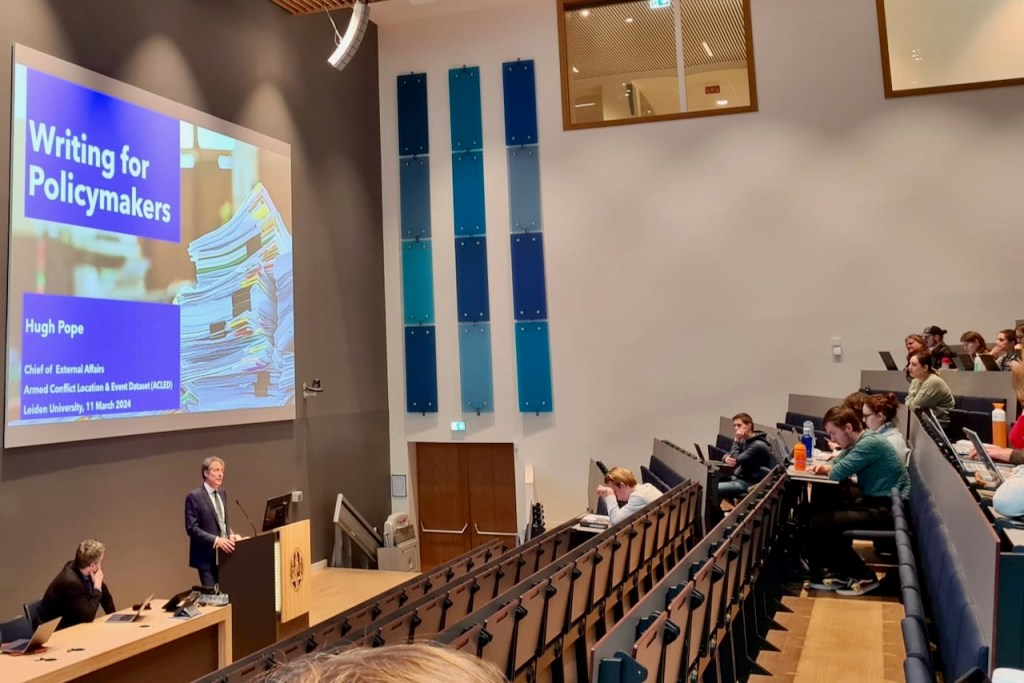
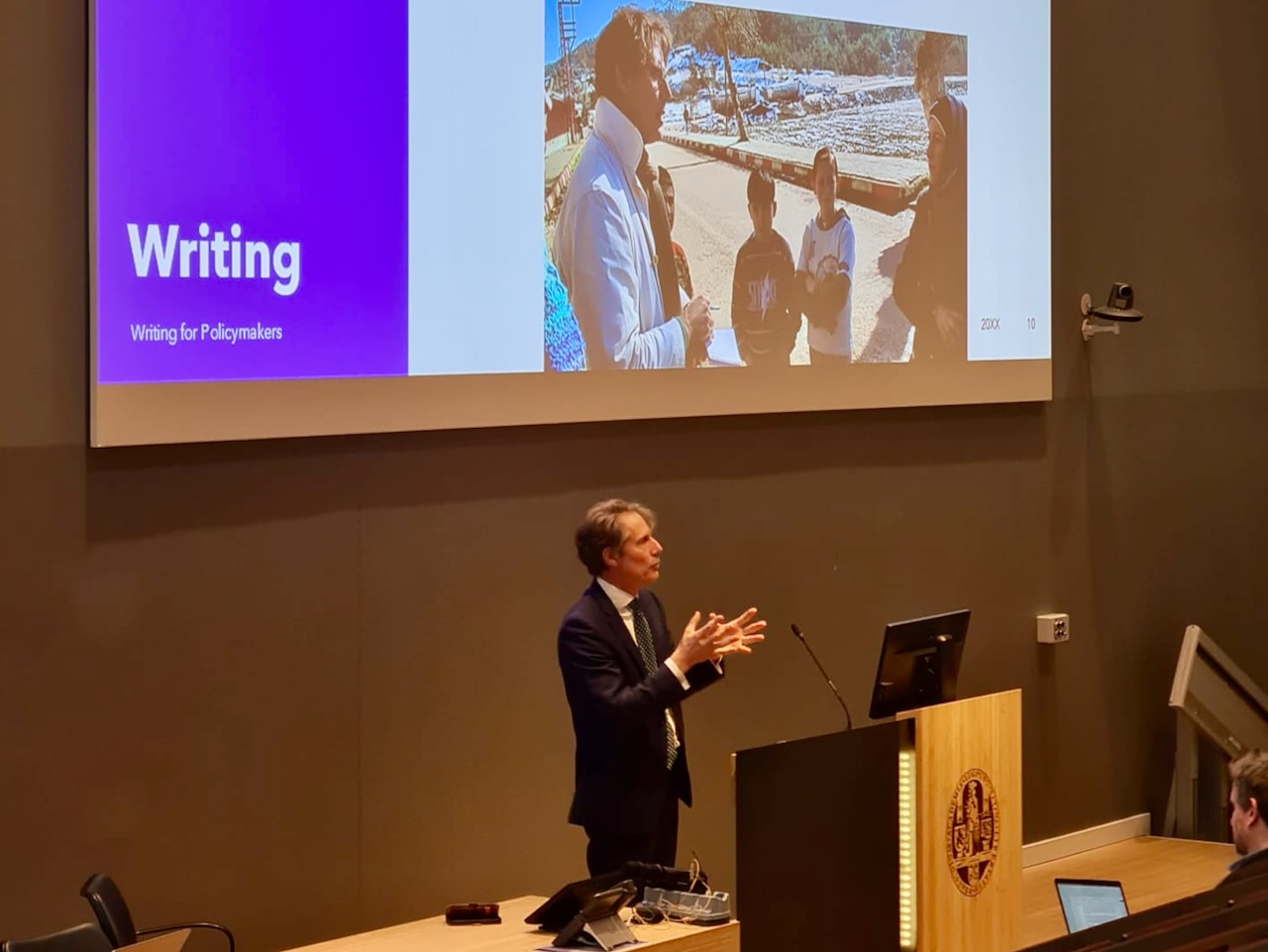
It’s the beginning of one of the stories I told this week in a lecture about “Writing for Policymakers”, given to final-year students of Security Studies at the University of Leiden in the Netherlands. It’s the third year they ask me to their campus in The Hague to talk about my experiences reporting on and trying to mitigate armed conflict. This time there was a special challenge, since among the audience was my youngest daughter Scarlett and her fellow last-year friends. As ever, I was struck by how much more aware and diverse students are today than at least I was back then (whenever that was).
I told them that writing for decision-makers is the art of getting a message across to people who have little time to read – and who sometimes don’t even want to listen. So planning is needed. I structured the talk along the four elements I argued are essential: how to focus on realistic goals; choose the right content; know your audience; and think through which tools to use.
The same bill of fare applies to many forms of commentary on the topic that I normally address, armed conflict. It doesn’t matter whether it’s advocating a specific policy or policies, which I used to do for the International Crisis Group, or the more subtle art of presenting data and analysis that could inform policy, which is the mission of my present job at the Armed Conflict Location & Event Data Project (ACLED).
Among the things I try to stress:
Timing – not just catching the news wave, but realizing that, in a crisis, most ministry advisers have wrapped up their position papers by early in the morning
Keeping it short, clear and simple – often only possible after you’ve made yourself a master of the subject in a long-form report
Having patience – sometimes for years
Practicing your lines – and honing and repeating them until your audience has learned them too
Personal outreach – few people change their minds through reading something by someone they haven’t met
Talk to everyone in the room – and everyone they listen to as well, be it TV, radio, podcasts or just their friends
Along the way I wove in stories about situations where things worked well and not so well for me. Like the way I was completely non-plussed about the Turkish officer’s question about flag burnings. In my home country, after all, people wear the national flag on their underwear.
“Colonel!” I riposted, in a voice as close to his roar as I dared. “You’re right! It is a terrible thing to burn a country’s flag. But this is a trap to make you act as angry as you feel inside! I urge you to see this as a provocation, to rise above it and not be deflected from the wisest course of action.”
This may have had little if any long-term impact on making Turkey, now Türkiye, a country in which everyone – Turks, Kurds and many less numerous ethnicities – can live happily under one flag. Terrible fighting resumed three years later. But that day, as our high-powered meeting broke up for tea and cakes, for once I had the feeling that the message had landed.
I’m writing with news of something I’ve helped work on for over the past 18 months with one of my heroes, American writer and ex-international correspondent Jonathan Randal. It’s called the Kurdistan Mental Health Project. It’s a ray of hope at a time when people are enduring several conflicts around the world that once again are killing, maiming and uprooting lives.
Thanks to this project, a gift in the name of the foreign correspondents and researchers who have covered Iraqi Kurdistan’s ordeals, 30 young psychology graduates and practitioners will begin on 16 January 2024 being trained across Iraqi Kurdistan at the start of a two-year course on Cognitive Behavioural Therapy.
This ‘talking’ treatment is a first step to help Kurds move sustainably beyond their traumatic history: brutal campaigns by Saddam Hussein, the genocidal Islamic State assault on the Yezidis and other violence that has scarred the region. Despite Kurdish society’s pressing need for access to contemporary psychological treatment, there is not much beyond medication and/or denial being done to overcome the personal and collective damage done by these ordeals.
You can find out more about the Kurdistan Mental Health Project here on the website of the Anglo-Kurdish charity that thought up the project. The therapy is being taught online by a group of teachers linked to Oxford University and being coordinated on the ground by an Iraqi Kurdish training center.
The first two years of the project are being paid for by an anonymous gift in the name of friends of Kurdistan, many of them journalists, who researched in or reported on the region. In part, this is a ‘thank you’ to all the Kurds who so generously helped those who travelled there. Despite the risks, they ensured our access to people and safety getting in – and out – of Kurdistan to inform the outside world about their long-suppressed cause.
Ideally, the project will find new backers to run four years more, at which point we hope the Kurdistan Regional Government will keep it going. You can scroll down to the bottom of the page from here to sign up to a newsletter that will post occasional updates about the project. Or if you like, click here to find out how to make a private donation, if you like.
We’d love it if you would please help spread the word, which we hope would attract support from outside governments (some are already interested) and the bigger foundations already present in Iraqi Kurdistan. Such institutional funding is likely the best way to get the Kurdistan Mental Health Project on its legs.
Please do forward a link to this post to anyone you think might like to hear about this, or post a few of your own words on social media with a link to project’s page on the charity website, perhaps accompanied by a picture of yourself in action in Iraqi Kurdistan and the hashtag #kurdistanmentalhealth. These would both be wonderful ways to show solidarity with this initiative.
Hugh Pope (then a freelancer mainly with The Independent), Jonathan Randal (the Washington Post) and John Pomfret (then with the Associated Press) rediscovering Iraqi Kurdistan in 1991 after it had shaken off the rule of Iraqi President Saddam Hussein. At that time, there was surprising hope amid the newly liberated ruins of villages razed to the ground by Saddam’s forces. But the shocking legacy of decades of oppression endures.
A new year, a new organization, a new job! I feel very lucky and wish everyone a wonderful new start in 2024 as well.
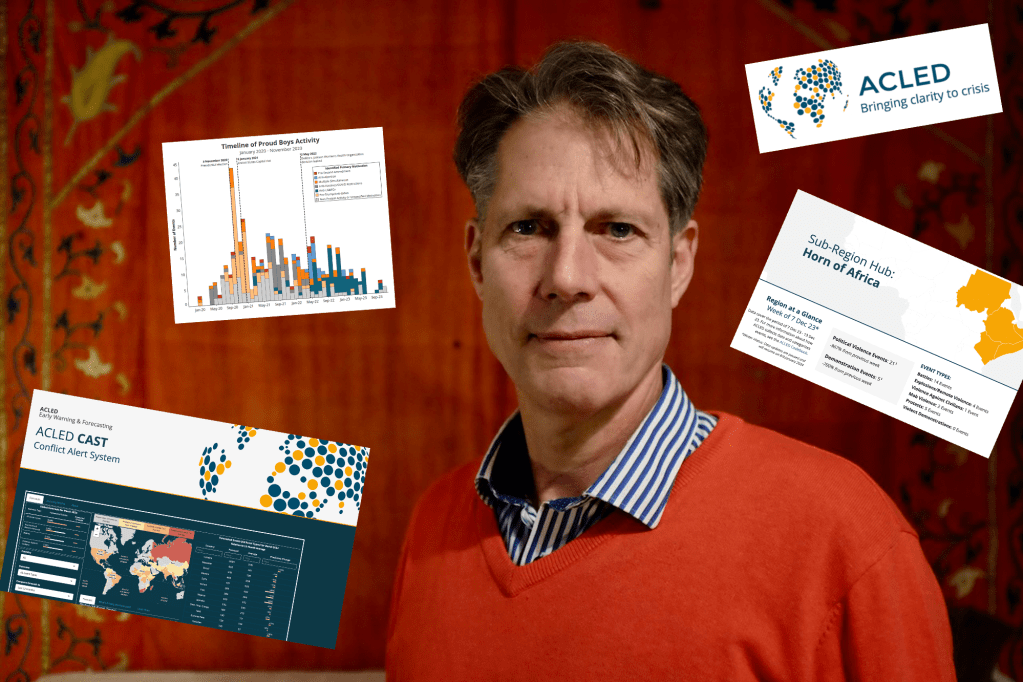
From today, I’m joining ACLED, the pre-eminent global researchers, analysts and publishers of data on political violence. I’ll be Chief of External Affairs, coordinating public-facing workstreams like publishing, communications and direct organizational outreach.
The new role is part of the rapid expansion of ACLED – short for the Armed Conflict Location & Event Data Project – as its unique database of conflict events gains traction with strategists, policy-makers and assessors of risk. The dataset was started just 18 years ago by the chief executive Clionadh Raleigh, also professor of political violence and geography at Sussex University, as part of her PhD work on six West African countries. She and executive director Olivia Russell have now presided over ACLED’s growth to cover all of the world’s 243 states and territories.
That now includes the United States. In fact, ACLED’s most recent publication Riding the Tide: the Shifting Identity of the Proud Boys since the Capitol riot profiles that country’s far-right groups ahead of elections in November. ACLED data shows exactly how groups like the Proud Boys are on the up and the Oath Keepers are down, and how the Proud Boys jump opportunistically onto far-right political bandwagons: for instance, first demonstrating in support of Trump in 2020-2021, then against abortion in early 2022, and then mainly anti-LGBTQ+ in late 2022-2023.
On top of widening and deepening its rich treasure chest of data, ACLED now wants to build up its presentation of what it finds, its own analysis of what it means, its support for data literacy and its reputation beyond its home audience in the data elite. I’ve already had fun meeting my new colleagues while working part-time over the past several months, even if I do now feel somewhat daunted by the challenges of my first fully remote workplace: some 250 collaborators in 50 countries all over the world and not a single office.
As we build up our young communications department, we are hiring, too, so do check out the careers section of ACLED’s website. If you or anyone you know would like to help us to spread the word about how policy and other decisions can be made better if based on what’s actually happening on the ground, please do apply or encourage others to do so!
My new job brings to a close a delightful two-year sabbatical after my 15 years with the International Crisis Group. I spent much of the time editing and getting published my late Dad’s long-lost book on The Keys to Democracy: Sortition as a New Model for Citizen Power. I was also fortunate to be inducted into the world of sortition-based democratic reform, which actually has great potential for defusing conflicts too. (Above is a picture after a presentation of the book in Belfast in October with Art O’Leary, the Irish government’s electoral commission chief, Polish academic Joanna Podgorska-Rykoka and Trinity College Dublin sortition expert Peter Stone). I will be unable to stop myself blogging from time to time about breakthroughs in the use of groups of randomly selected citizens to deliberate and take decisions in the public interest.
But for now, at least, it’s back to trying to understand armed conflict and, I hope, helping people find new ways to make the world a more peaceful place.
Random selection popped up again in a favourite weekend read, the London Review of Books, where a reader in the 7 September 2023 edition raised a non-political application of lotteries that is dear to my heart: the allocation of elite university places.
Reacting to an article on affirmative policies in top U.S. academies like Harvard University, Donald Gillies from London suggested that lotteries would be the best way to solve the question of who gets chosen by such institutions, including the University of Oxford and Cambridge in the UK. He noted correctly that the system works well for medical training in the Netherlands.
It reminded me of a page from my late Dad Maurice Pope’s posthumous book The Keys to Democracy: sortition as a new model for citizen power. Beyond advocating a return to the random selection of political decision-makers, as in ancient Athens, he proposes a radical version of sortition for universities too. A former professor himself, he points out how choosing candidates randomly from among those who meet the minimum qualifications for each department could have a revitalising impact on academic life as a whole.
“Sortition could provide a cure for the snobbery associated with universities. According to the current doctrine of meritocracy, though it is not usually spelled out so plainly, the thirty best physics students of the year go to Cambridge or Leiden or MIT or wherever the most prestigious centre in the country is. The other students are more or less officially labelled as second-best, third-best or fourth-best, as the case may be. The farther down the line the students are, the more inferior the university will be and the lower their sense of self-esteem may fall. They will be classified by society not only as academically but also as socially inferior for having attended an inferior university. Luckily it does not work out quite like this. The doctrine is frustrated in practice both by ignorance among potential students as to which the best university is supposed to be and by inefficient selection and examination procedures on the part of the professors, which means that the best students often miss the best university. Nobody therefore has cause for despair. But if the meritocratic theory of centres of excellence were actually to work, it would be insupportable. In order to encourage the students and the faculties in the reputedly inferior universities, some other way of allocating places would have to be invented. The only fair procedure would be by lottery, the students who qualified for a university place being apportioned at random. An immediate effect might be a lowering of top standards, but only might be, since genius does not always work as examiners and bureaucrats think it ought to. Another effect, equally immediate, would be a raising of morale in all university faculties bar one and a raising of the general standard among graduates.” [p. 171]
My own experience as one of those lucky enough to get into Oxford makes me agree. My getting in was already pretty random: I was no more or less clever than hundreds of other applicants who were turned away. (I don’t mean the brilliant scholars, just the ordinary students!) My subject was pretty eccentric – by my fourth year I was the only one in the whole university studying Persian with Arabic – but in the teaching of mainstream courses I couldn’t see much difference in outcome between Oxford and other good universities. The erratic essay/tutorial system may be one reason that Oxford graduates are notorious for what might be politely described as bluffing. Otherwise, I fail to see why I deserved what turned out to be a lifelong golden key in the perceptions of possible employers and other counterparts.
As my father says, choosing places by lottery would remove both any undeserved sense of entitlement for getting in and also any stigma for not having been accepted. He doesn’t mention this, but as a Cambridge scholar and Greek poetry prize-winner, I guess he would agree with me to let universities continue to give scholarships to people they really wanted.
My father and I in the early 1990s when I picked up my MA – to qualify for which, in the entitled Oxford of the time, I only had to survive for ten years after my BA graduation.It was about the same time as my father finished, but could find no publisher for, The Keys to Democracy.
You can get a flavour my Dad’s radical view of the potential of random selection in his additional suggestion for a sortition-based system that would show which sports club is truly the best.
“Randomisation … is an antidote to specialisation and to discrimination and has a part to play wherever these exceed their proper boundaries. Suppose, for example, that there was public concern over sport in schools and uni- versities becoming more and more professionalised. Sermons against the hiring of coaches, the granting of athletic scholarships and the increasing gap between pupils and players are not likely to be effective. But if it was genuinely desired to have a system in which all pupils could participate equally, then randomisation could provide it. If it were the rule that teams should be chosen by lot from among all players of the sport, then the school or college would have to give them all equal encouragement and equal training. Matches, instead of showing which institution had the best coach or the best wing-forward or the best coxswain, would show the one in which the general level of the sport was highest.” [p. 170]
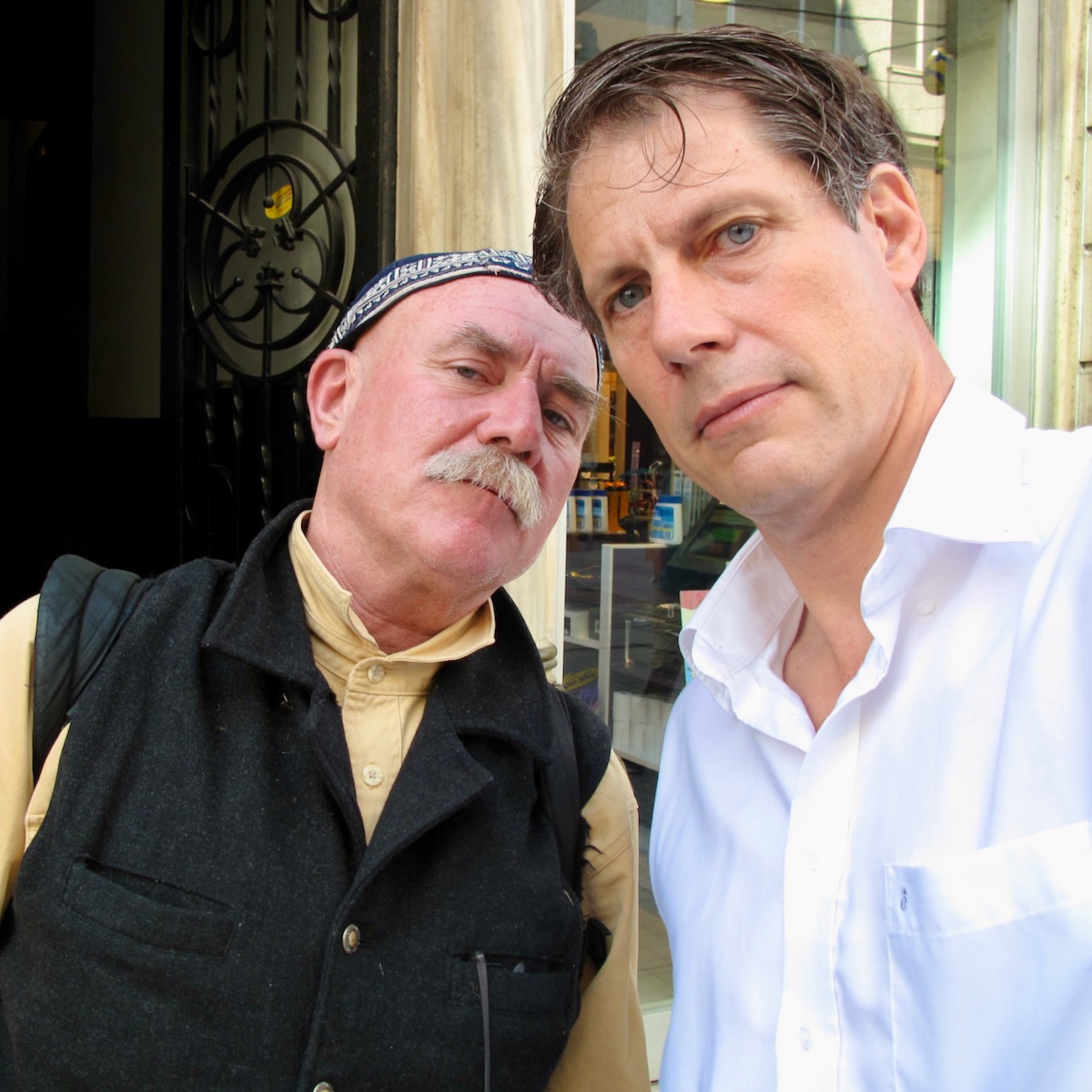
Few reporters could match the outsize life of Thomas Goltz. He was fearless, unfailingly generous and utterly committed to getting out the news: his version of events, from right up close. He gave an undivided loyalty to any unjustly treated people whose cause he stumbled upon, whether they be Turks, Iraqi Kurds, Chechens, native Americans or the people of Azerbaijan.
The American reporter and writer died on 29 July in Montana after a long illness, aged 68. To some, he may have seemed over-bearing, a maverick or even a recklessly unguided missile; for many more, like me, Thomas will be deeply missed as a unique, funny and loyal friend and story-teller who made a virtue of never accepting any limits.
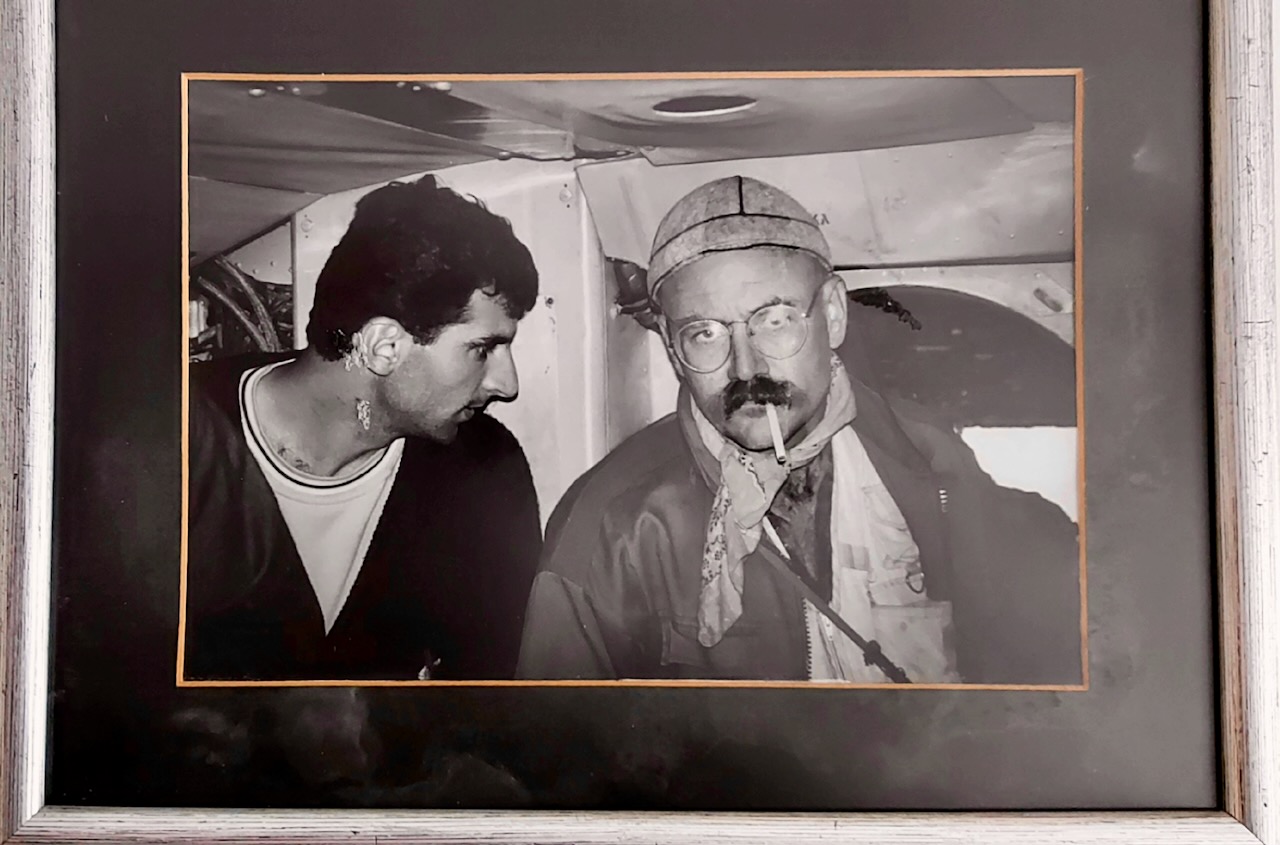
Thomas Goltz taught me how to enter this Soviet-era helicopter through the side porthole after the main door was blocked by Georgians fleeing a defeat in the Abkhaz war. Mountains above Sukhumi, 1993. Photo: Hugh Pope
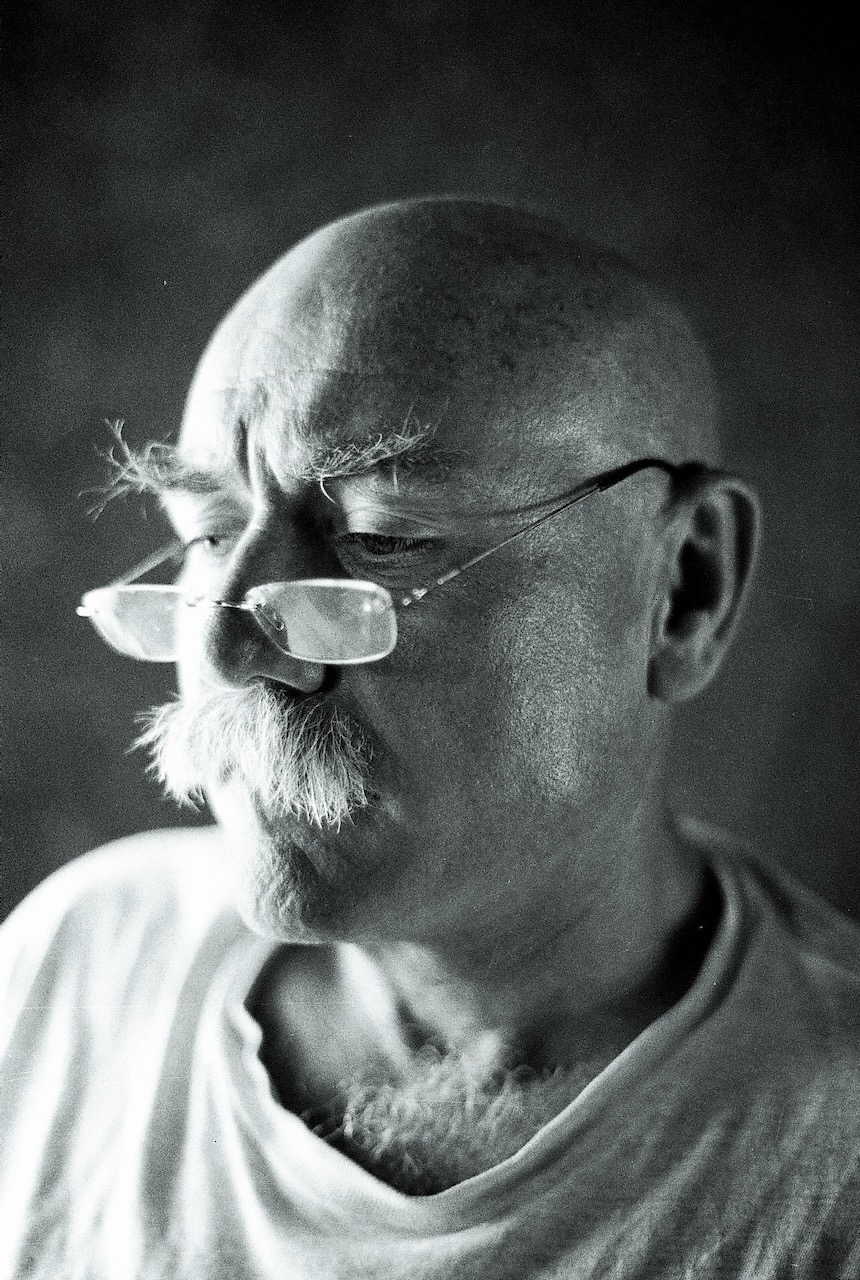
Sporting the bushy moustache of a 19th century German general and topping his smoothly shaved head with a variety of Turkish and Caucasian caps, Thomas was an inimitable, all-in reporter.
Here’s one vignette: during a 1992 moment in the war over Nagorno-Karabakh, an Azerbaijani pilot offered us a flight into a besieged town called Khodjaly. I refused, noting that the helicopter was peppered with fresh bullet holes from the town’s attackers. But Thomas did not hesitate to join a chaotic group of traumatised townspeople for the risky ride back into the maelstrom and impending massacre. I watched him clamber aboard among shopping bags, boxes of ammunition and a canary in a cage, never looking back or having a thought about how he would arrange his return to safety.
Thomas’s life matched his work. He didn’t just do press-ups, he did them while he was in a handstand, pushing himself up perpendicularly and doing a dozen at a time. He didn’t just write books, they poured out of him, and woe betide the computer keyboard that tried to resist his finger-punching. No good conversation was complete until the volume of his voice had reached that of an amused or outraged outcry.
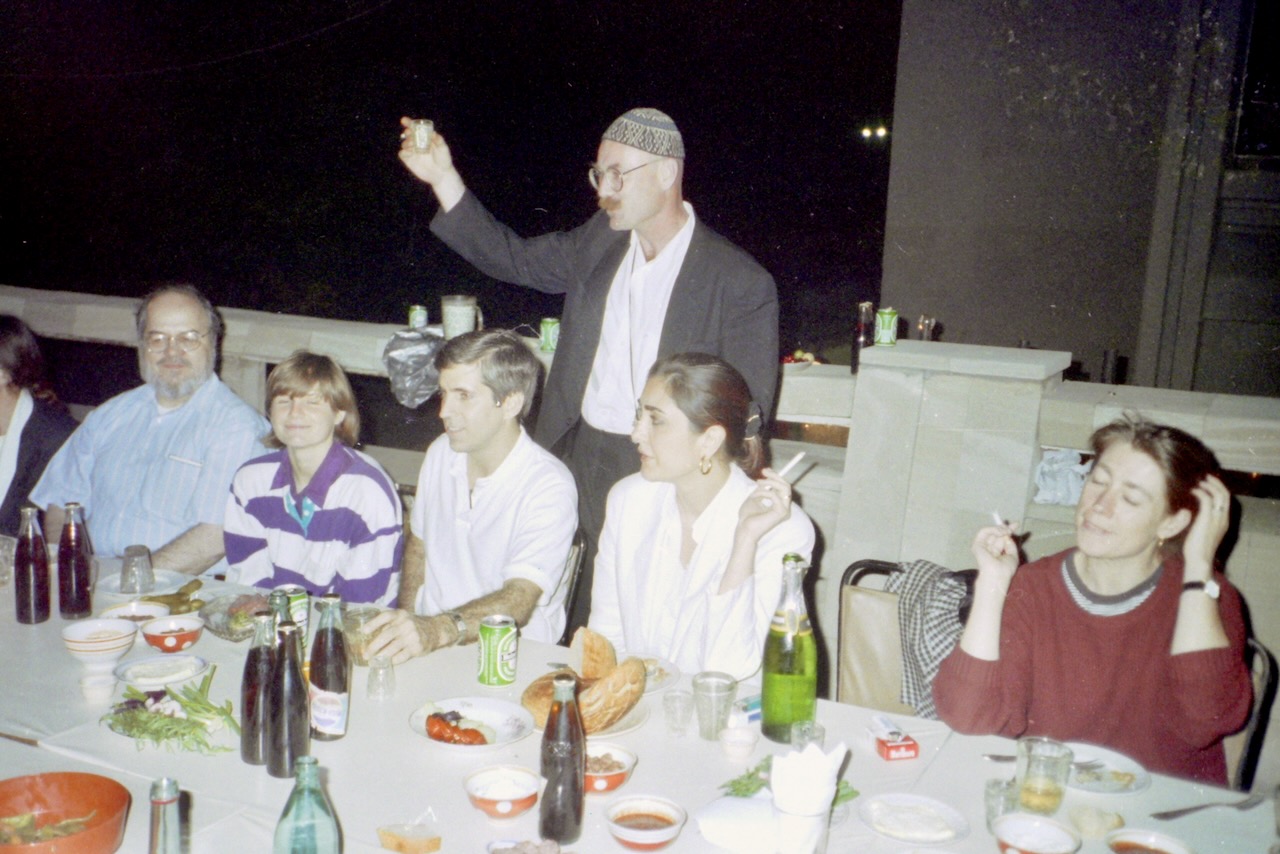
Thomas the toast-master regaling another feast. Baku, c. 1992. Photo: Hugh Pope
“I discarded stage acting to embrace real life theatre,” Thomas told Conversations with History, an hour-long interview with Harry Kreisler of the University of California at Berkeley. Luck, fate and simply being the right person with the right skills at the right time in the right place was what propelled him, Thomas said, to give his heart and soul to the chance stories that crossed his path. He was inspired by people resisting unjust, overwhelming force.
“I also sallied forth with the pretence of changing the world,” he told Kreisler. “This is common to many journalists, young and old, that that article that you write, that that television program that you do, will be so effective that the viewer, the reader, will stand up and shout: ‘Stop, stop this war! Stop this madness!’ …. Otherwise, it would be almost impossible to do your job in these extremely difficult situations.”
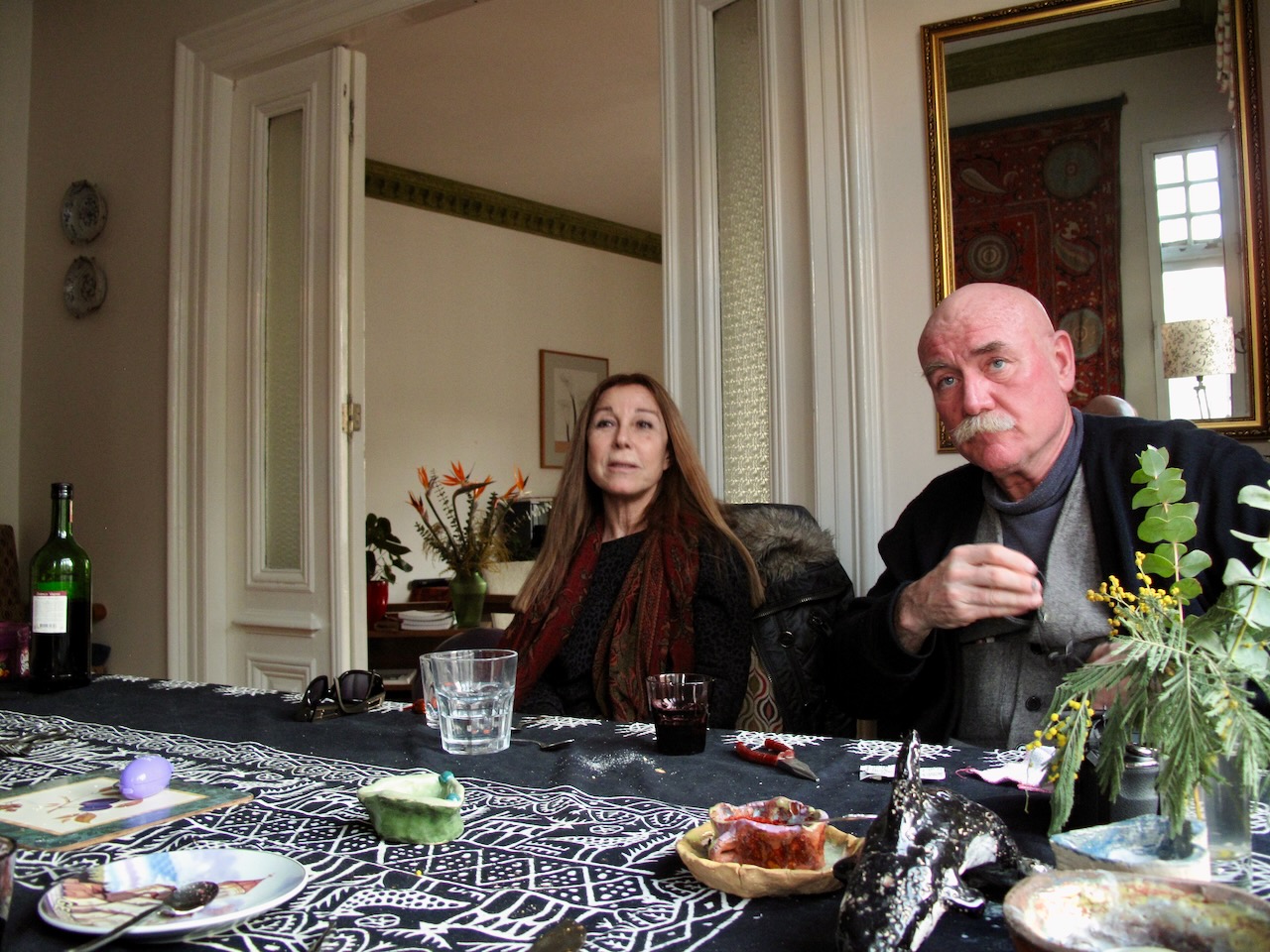
Hicran and Thomas Goltz, Istanbul 2014. Photo: Hugh Pope
I first met Thomas when he was one of the only American reporters working out of Ankara, Turkey, in its isolated, post-military coup era of the late 1980s. I remember raucous evenings with him and his thoughtful and equally determined Turkish wife Hicran, a doctor. She was to share several of his adventures in far-flung places and stuck by him to the end, despite his solitary exploits and the self-destructive drinking that interspersed them. I regret – having enjoyed his unaccompanied, no-holds-barred riffs on rock singing – that I never saw him perform as part of a foreign correspondents’ band. But I think it’s for the best that he and Hicran abandoned keeping their one-time pets, a plodding crew of un-house-trained tortoises.
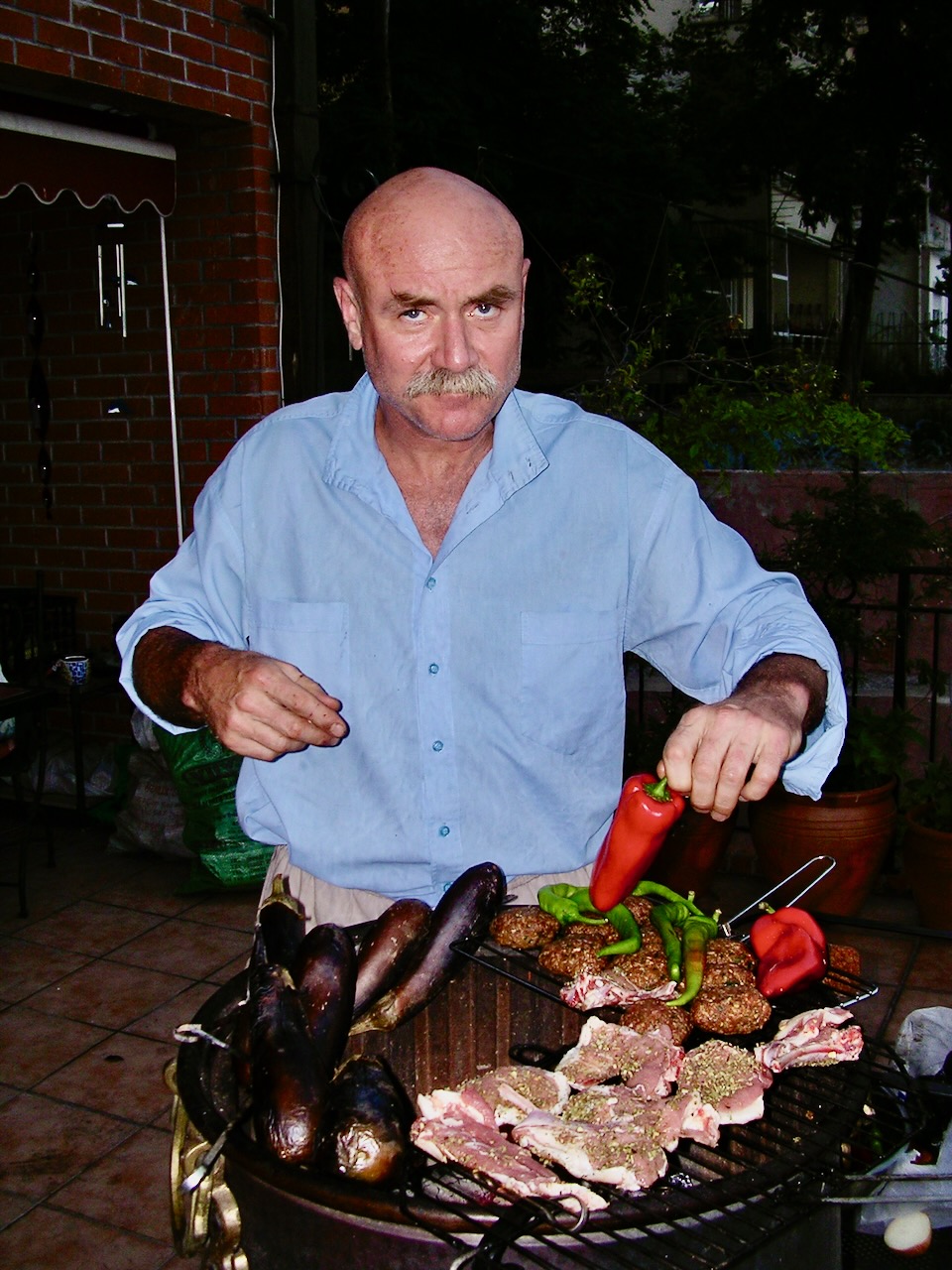
Thomas Goltz never shared with me his magical method for preparing glaze, but venison bone marrow was a critical ingredient. Istanbul, c. 2004. Photo: Hugh Pope
Thomas preferred being a host to being a guest – probably so that he could claim the dominant position of what Georgians call the tamada, or toast-master, leading unending rounds of glasses raised to all and sundry – and was an astonishingly good cook, especially of his trademark dish of glazed and barbecued venison. He rarely missed a hunting season in his adopted home of Livingstone, Montana, and would regularly pass through Istanbul with frozen hunks of deer that he had personally shot and carefully butchered in the Montana woods and hills.
Thomas Goltz was a great friend, making up for his dependable unreliability with tremendous loyalty. Photo: Hugh Pope(R)
After he moved to the former Soviet Union around 1990, we did much together in the heady early years of independence for Azerbaijan and Georgia. I was the visitor and he was always generous with hospitality, information and contacts. Any rivalry was restricted to my claim to the first outsider to meet the future President Haidar Aliyev, in his native Nakhichevan, back in October 1990; Thomas’s that a year later, he was the first outsider to take a news photograph of the founder of what became Azerbaijan’s ruling dynasty. During our frightening visits to the chaotic front lines of the war over Nagorno-Karabagh, Thomas was always out in front.
Thomas treasured his finalist’s place in the 1996 Rory Peck awards for his one-person video diary about Russian attacks on a Chechen village, Samashki, and the consequences for its people. He was also thrilled to be given an honorary doctorate recognizing his advocacy on behalf of Azerbaijan, which started long before it became an oil-rich state. He would also have been proud of a glowing obituary in The Caspian Post and an encomium from Azerbaijani President Ilham Aliyev, who said “the articles, books he wrote and films he made about the Armenia-Azerbaijan Nagorno-Karabakh conflict … made an invaluable contribution to conveying the true voice of Azerbaijan to the world.”
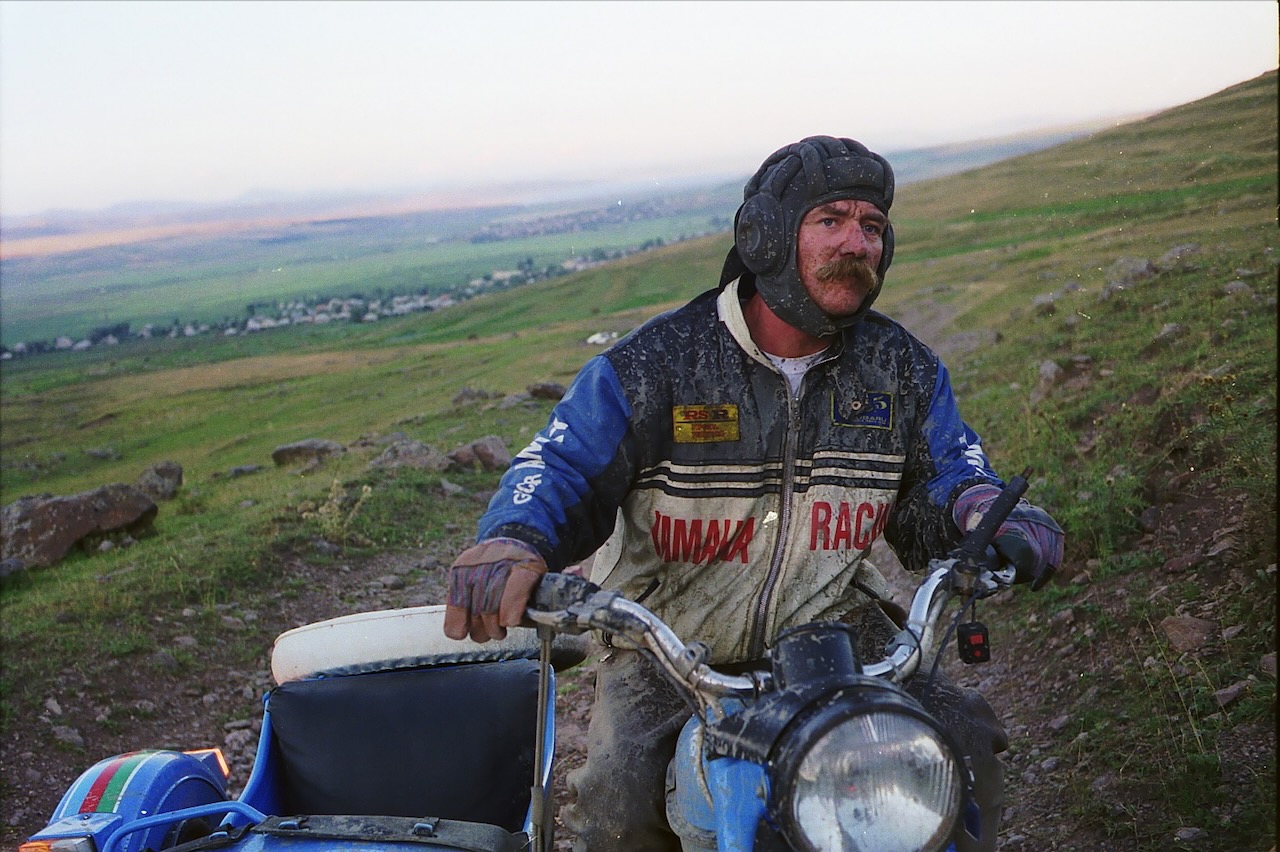
Thomas Goltz posing on his Ural sidecar motorbike during the quixotic Oil Odyssey that he organised along the putative route of the Baku-Tbilisi-Ceyhan pipeline.Photo courtesy of Robert Mason.
Thomas brushed aside any cricitism about his no-holds-barred embrace of those he reported about. “A journalist is not a perfectly neutral vessel. We pretend this,” he told Harry Kreisler. “When someone is feeding and protecting you and housing you by definition this will engender loyalties and a certain spin or twist. [There should be] a profound sense of responsibility to one’s subject. There’s no ‘wham, bam, thank you, ma’am’ …. The overriding lesson must be that you, O journalist, must take responsibility for having been there.”
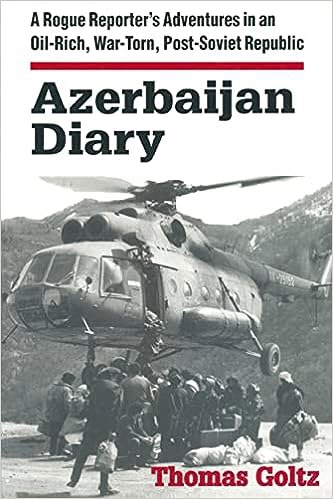
Books followed his reporting, accompanied by his often excellent photographs. The Caucasus inspired Thomas’s trilogy of ‘Diary’ books on Azerbaijan, Chechnya and Georgia, to which he later added a collection of essays on Türkiye (Turkey). An unfortunately lightly-edited collection of his essays on his years in the Middle East, Zakhrafa, includes tales of his hair-raising encounter with a dissident fellow patient in a Damascus hospital who knew he was about to be killed and his offbeat months as a self-appointed relief worker in Iraqi Kurdistan. My favourite is his Assassinating Shakespeare, an account of his overland journey aged 21 from Berlin to Cape Town earning money part of the way doing (as ever) one-man shows with wooden puppets representing Romeo and Juliet, Othello or King Lear.
Unusually among reporters, Thomas was also a passionate American patriot. He loved his country, his family from North Dakota, his home and friends in Montana, and would have liked nothing better than to serve the national interest. One of the deep disappointments of his life, he once told me, was how the onset of troubles in his nervous system ultimately ruled out his offer to work alongside U.S. forces in Afghanistan.
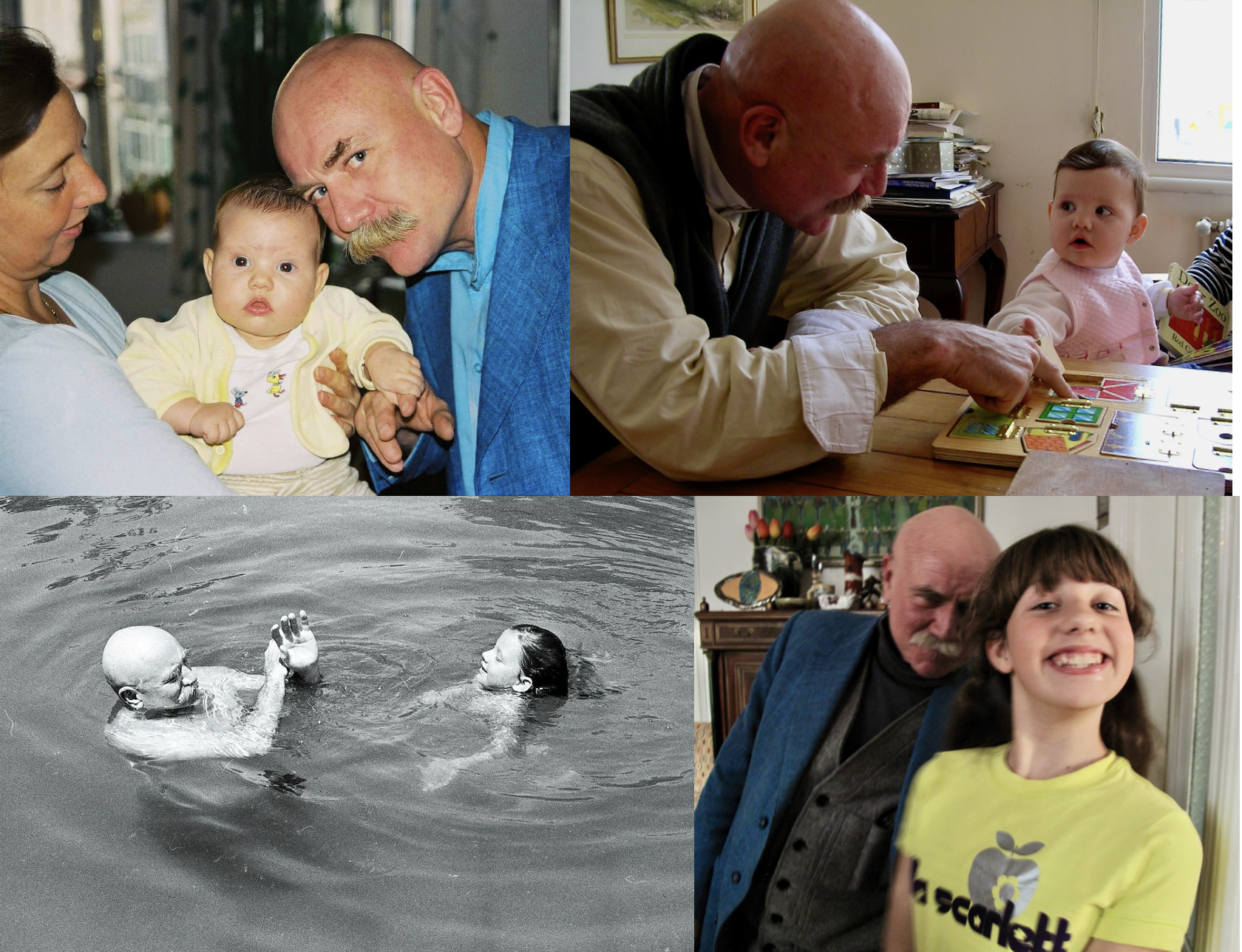
Thomas Goltz enjoyed his role as honorary godfather to Scarlett, my daughter with Jessica Lutz. She remembers being particularly impressed by his impersonation of the dragon lying under the immortal fires of the Chimaera in Olympos, Turkey. Photos: Hugh Pope
Whether Thomas’s outspoken, outsider style would have lasted long in any official institution is questionable. His bust-ups with newspaper employers were legendary, often after long phone calls in which he excoriated his editors for not sharing his sense of critical urgency.
Paradoxes abounded elsewhere. Thomas thought telling the story was far more important than any financial reward, yet would anger at how hard it was to get paid. He was a gorgeous writer, but skimped when it came to the critical work of editing. He longed for public applause, but sometimes had difficulty adapting to what his audience was ready to hear. He was an individualist unwilling to travel with translators or what he called the hack-pack, yet he wanted to convert the mainstream to his views.
Above all, he threw himself into danger as a war correspondent, while hating the likely pointlessness of risking his life.
“A whole string of people have run up against the brick wall of impossibility, the futility of … changing the world with that one article, or that television program,” he told Harry Kreisler. “At that point you wonder if you are only being an entertainer and that violence is your tool to entertain.”
Wherever you’ve gone now, Thomas, I’m sure you’re entertaining them still. Nobody will be calling me “Hugolinavitch!” down here any more , but I hope one day I’ll meet you somewhere again to hear that happy cry.
Thomas Goltz in Olympos, Turkey, c. 2008. Photo: Hugh Pope
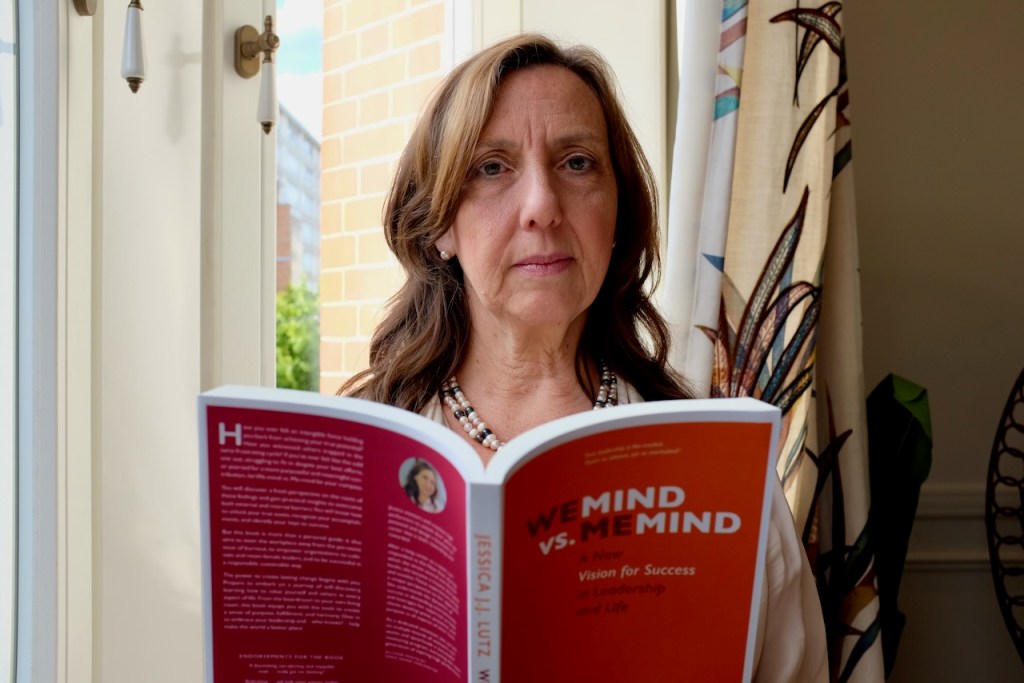
Perhaps because I accompanied my wife and author Jessica Lutz as she found, tested and ordered her ideas over the past seven years, I need little to convince me that her latest book contributes a powerful new way both to understand and also to run our human world.
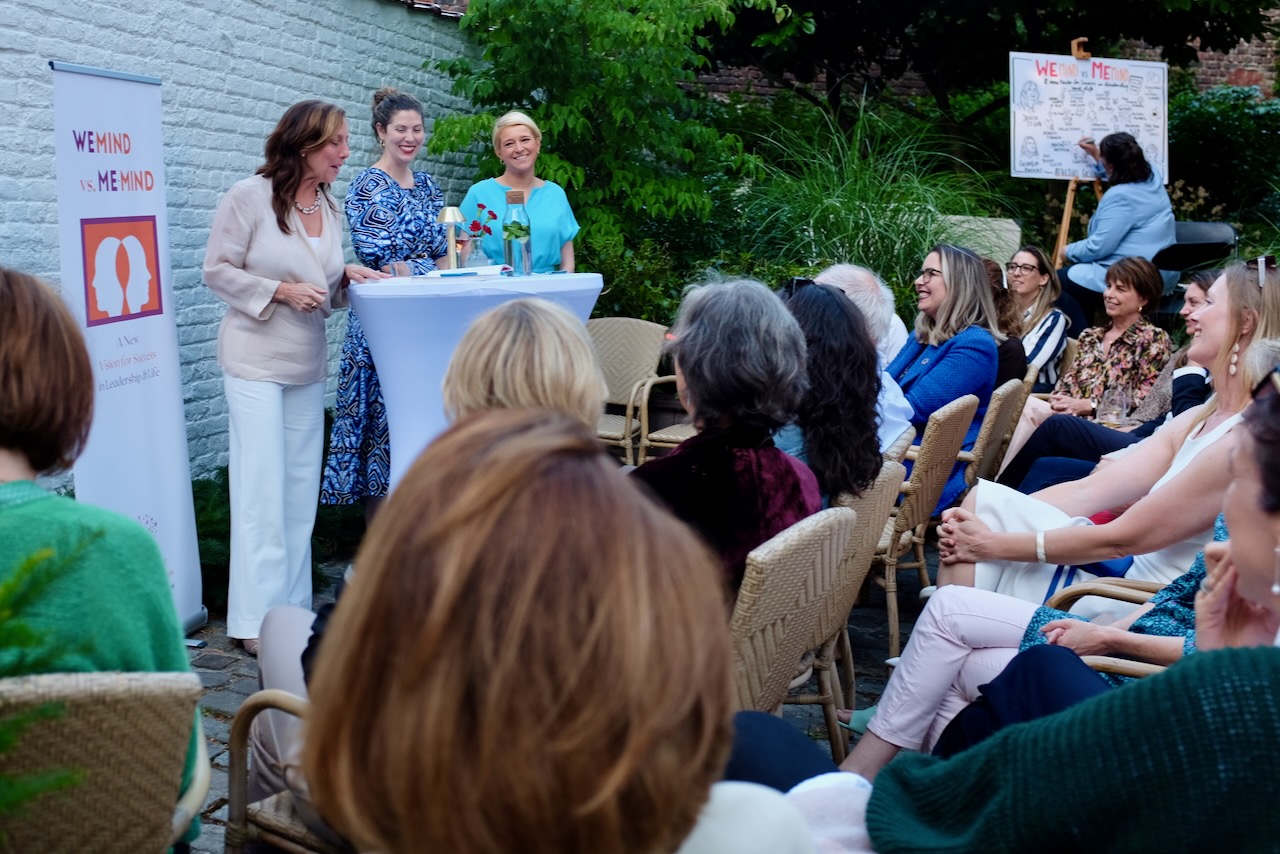
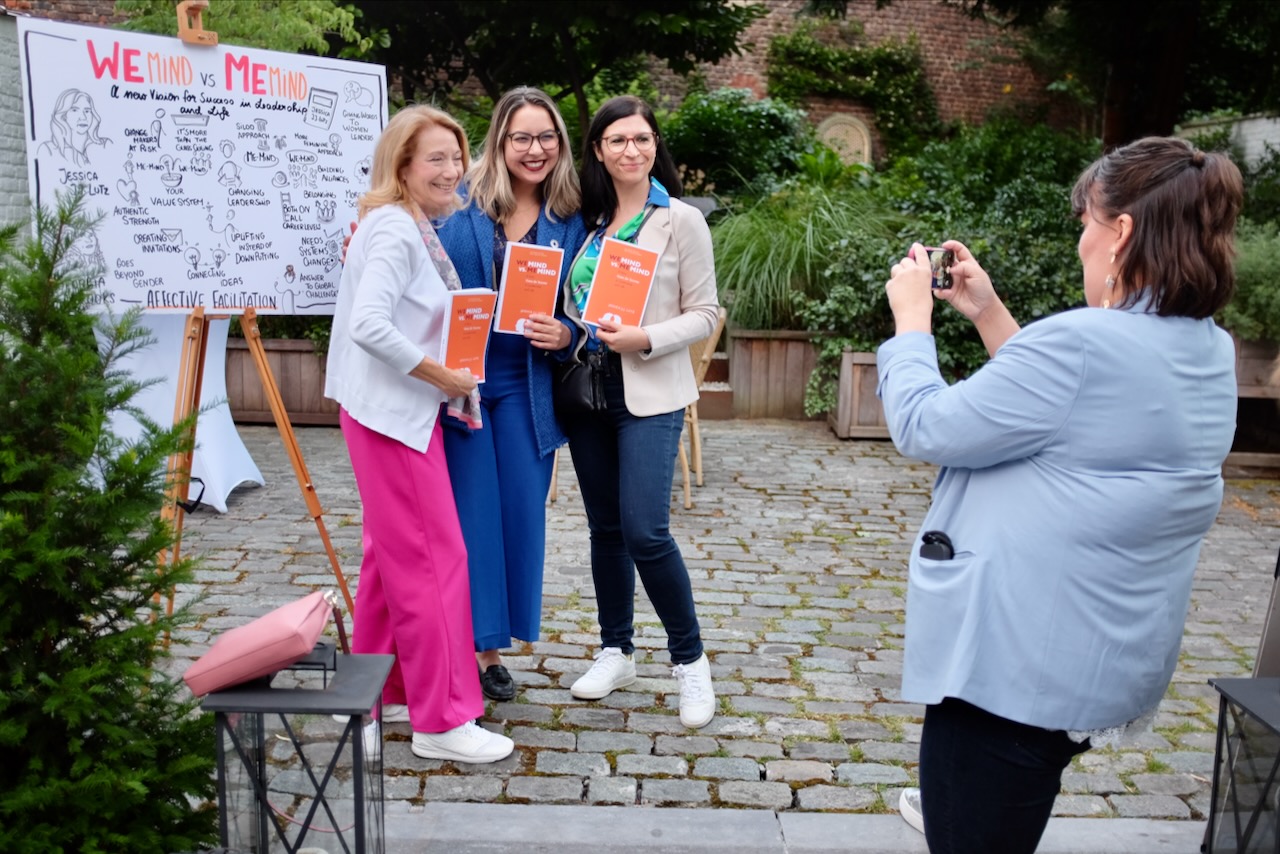
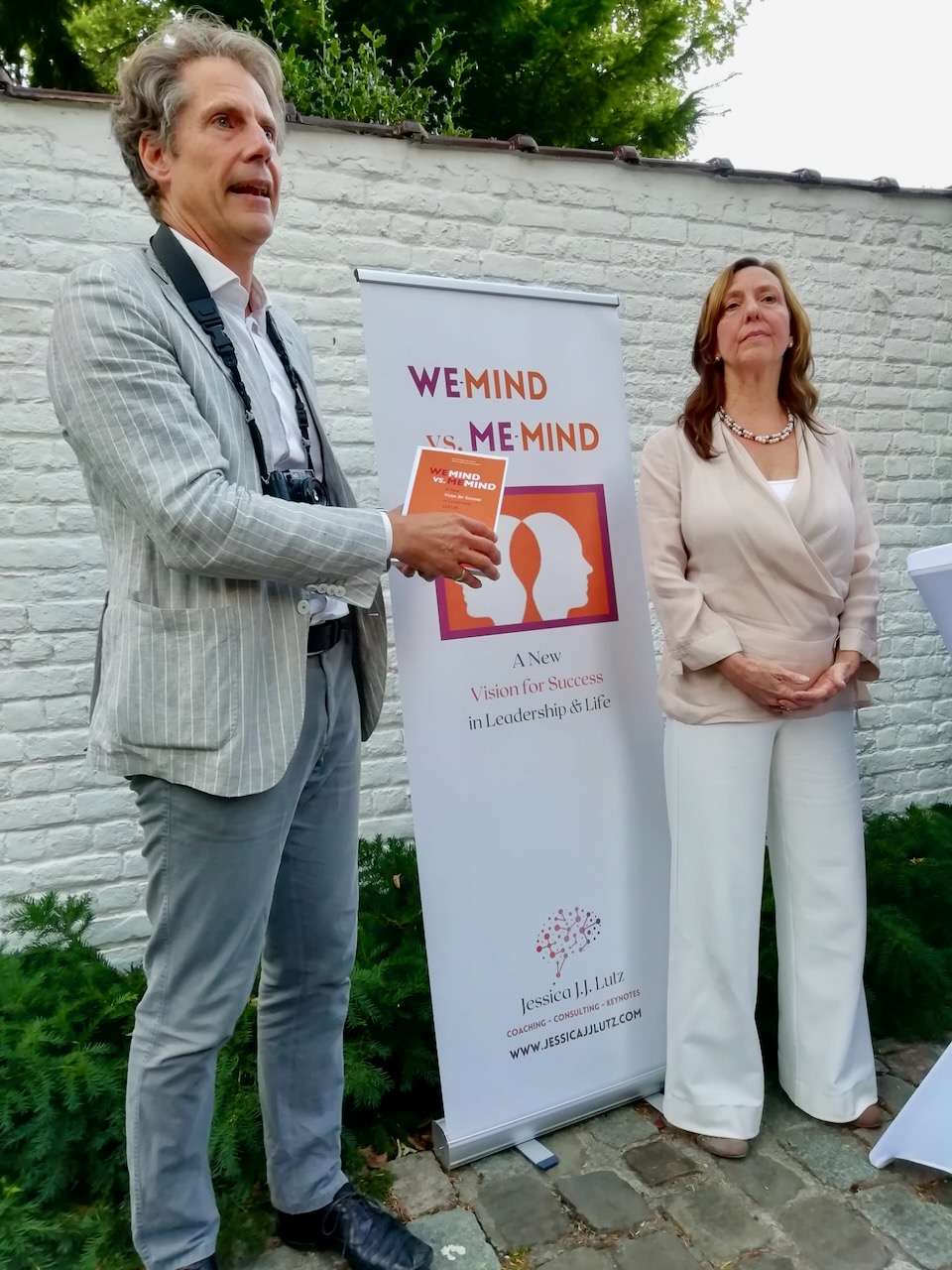
Still, I was in for more than one surprise at the 6 July publication launch of We-mind vs Me-mind: A New Vision for Success in Leadership and Life here in Brussels. Most of all, I was bowled over by how the strong women guest speakers had already made Jessica’s breakthrough language their own.
Jessica Lutz, Georgia Brook and Helene Banner
First up was Helene Banner, from Germany and the youngest person ever appointed a EU spokesperson. After a successful decade in European institutions, she has now, like Jessica, dedicated herself to solving the dilemmas faced by many women leaders as they fulfil their ambitions for promotion but lose faith in the often blinkered, hierarchical organisations they serve. Because of the mismatch she felt in the workplace – always being pressured to speak, act and even laugh differently from what came naturally to her as a woman – she gave her new platform a tongue-in-cheek name: Let’s Just Be Imperfect, Ladies!
Beyond the gender lens
Helene Banner
“I felt, when reading your book, as if you were speaking from my heart,” said Helene. “You are finding words here for what many us women feel. So many of us feel represented and recognised by this term that you have coined, the We-mind rather than the Me-mind. This is what I call the more feminine approach to leadership: leading by building alliances rather than thinking in hierarchical terms; building teams; working for win-win situations with women’s empathy and their sensitivity to others, acknowledgment and anticipation of what others may think. When you coined it as the We-mind vs the Me-mind, I was like: Thank you so much! You found a term to go beyond the gender lens. That is such a breakthrough!”
Next to speak was Georgia Brooks, whom the newspaper Politico had just two days before named one of the most influential 40 people in Brussels. Of British and Egyptian heritage, Brooks founded and leads The Nine, a club for women members only, and she had invited Jessica to launch We-mind vs Me-Mind in the garden of The Nine’s beautifully re-appointed belle époque townhouse barely one hundred metres from the European Commission. Georgia fully agreed with what Helene and Jessica were trying to get across.
Georgia Brook
“The tide is changing. People are waking up to realise that we have to do something,” Georgia told the capacity audience. “The great resignation is happening. Middle to high managers, female, are leaving …. If companies really want to attract and keep their strong female talent it is a question of training and work culture. You come in as a young woman, you are ambitious, you are keen to progress. Then there’s a little bit of, like: No, no, stay down stay in your box. We are taught to stay in our lanes, be good girls, colour within the lines. Then [others] are rewarded for being a little bit cheeky, a little bit naughty, breaking the rules. [Former British Prime Minister] Boris Johnson is a great example of someone [who is] so Me-minded.”
Reframing leadership
My second surprise was how much Helene and Georgia agreed with something that I had tried and failed to argue against while Jessica was writing the book. For me, the idea of We-mindedness seemed most useful as a new way of looking at human interactions, which might then nudge us all to a more collective approach. Jessica disagreed. She firmly believes that We-minded leadership can become a credo of an active, whole new style of management for both women and men. So did her two co-speakers, I discovered.
“What Jessica does very well is to reframe ‘What is leadership?’, ‘What is success?’ and to move beyond the more gendered stereotypes and roles,” Georgia said. “It is very important for women to own the room and to step into their power and presence. Which is not to say we have to be like men …. It’s more about the team spirit, it’s about all of us who can … move the conversation together as opposed to individuals on plinths, the very siloed approaches and individualistic goals.”
Including men was another argument that resonated strongly. As Jessica points out in the book’s preface, her inspiration to write the book after returning to Europe from a reporting career in Turkey followed her surprise “that the battle for equality was still not settled in the West. At the same time, it bothered me that usually the only explanation given was to blame the men, the ‘patriarchy’, for blocking us with a glass ceiling. I had worked among men all my life, and always enjoyed it. I love men. So that argument didn’t sit well with me, even though I’m the first to acknowledge that sexism can seriously hamper a woman’s career.”
Jessica wanted her years reading up on the science of it all to find language that would go further than the usual debates. “Many men switch off the moment we start talking about gender. I do too,” she said. “This is more about two different value systems, that we all have. We all have a We-mind and a Me-mind. We lean to one of the two sides. Men tend to lean more to the ‘me’ side. But that’s not a dogma. There are 40 percent of men who are more We-minded, and 15 percent of women who are more Me-minded … Our definition of leadership is very Me-minded. I believe, and I think I have also found scientific grounds to say that the We-mind can be just as good as a leader as the Me-mind.”
Helene also spoke of her frustration at the way men usually felt as if the question of differences between men and women’s approach to life and work were nothing to do with them, either because it was unfamiliar territory that made them nervous or because they believed that quotas for women managers were blocking their careers. Jessica’s approach, she believed, offers a new way forward.
“Thank you for introducing us to language we can use to share how we feel as leaders in our workplaces … Thank you for finding the words and for speaking on behalf of so many women who often go to work stumbling [against] the glass ceiling, thinking: I’m not tough enough yet, I have to become more assertive, I have to hide my emotions, I need to cry in the bathroom not the boardroom,” she said. “In your book, you are giving us permission to be in our We-mind, to feel confident as We-minders to change the world and workplaces.”
My third surprise
My own many discussions with Jessica over We-minded values have left me in no doubt that giving them more weight would improve the state of the world. Indeed, her research and writing has buttressed my own enthusiasm for the ultimate tapping into our common We-mind: democratic reforms that would give everyone a chance to contribute to policy making through random selection, or sortition.
But none of this prepared me for my third big surprise of the launch event. It is traditional in the Netherlands, from where Jessica comes, to give a first copy of the book to somebody whose contribution the author truly values. In the months before the event, Jessica had discussed a few names – for instance, Belgian Prime Minister Alexander de Croo, whom Jessica met at the launch of his book The Age of Women: Why Feminism also Liberates Men – but I didn’t know what she had done about it.
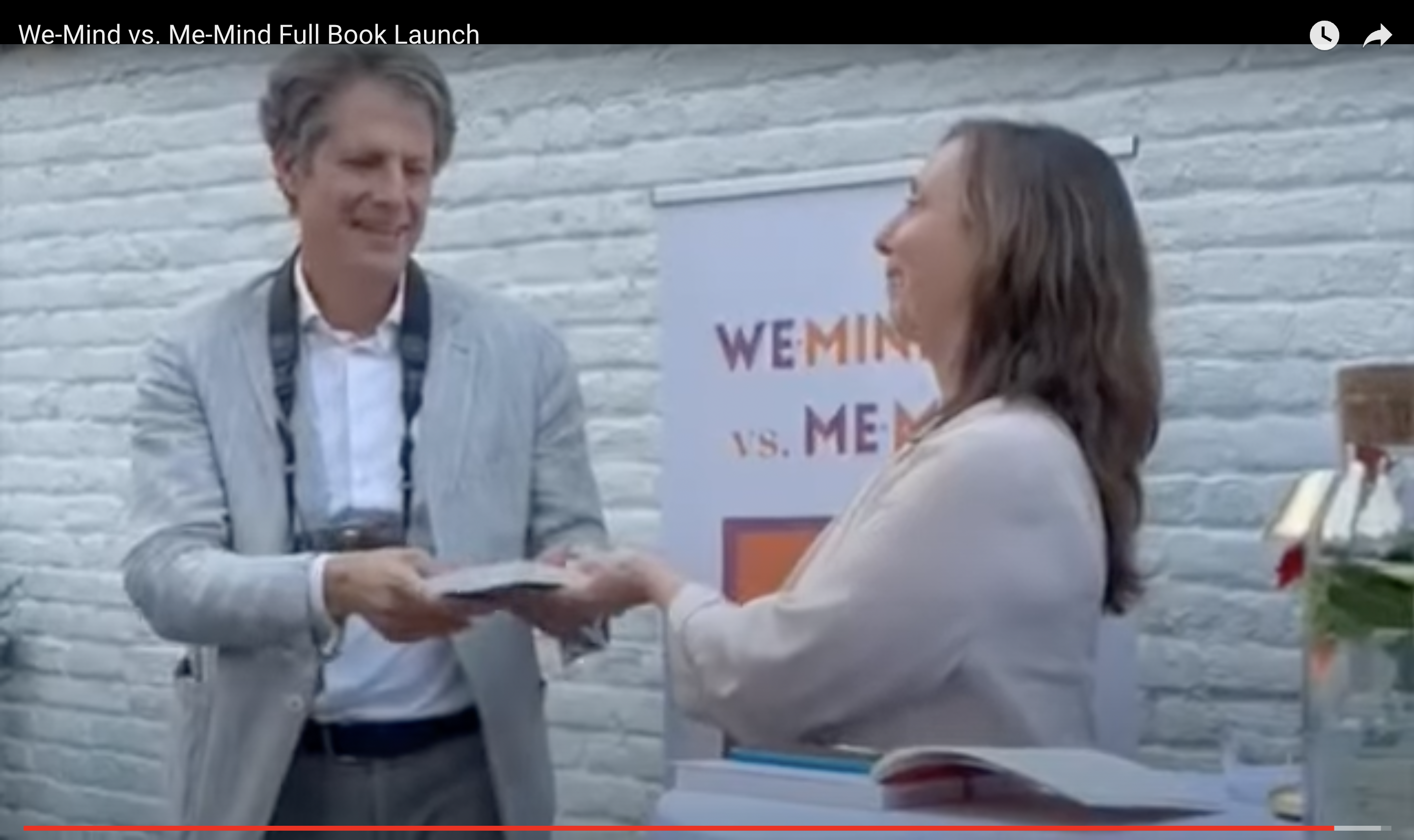
So, after she told the audience how the Prime Minister had declined her invitation, it was a shock to hear Jessica calling me up to be that honoured person. Suddenly there I was: a somewhat Me-minded man standing in front of an audience largely of women to receive a book mainly about women from a woman. My eyes were not dry as I stammered through my admission that indeed Jessica had long converted me to her way of thinking. But neither, our daughter Scarlett informed me later, were the eyes of several others in the audience.
Long live that moment that Jessica formally delivered her We-minded idea to the world in such a We-minded way.
Where did my late father get the idea that random selection could fix our broken politics? This is one of the most frequent questions I’ve been asked after working on editing Maurice Pope’s book The Keys to Democracy: Sortition as a New Model for Citizen Power, published in March.
As far as I know, when my Dad was writing the book in the mid-1980s, he knew of nobody else working on sortition, that is, deliberation and decision-making by randomly selected, ordinary citizens. (In fact, there were some, but in those pre-internet days few of them knew each other either). He was a diligent scholar and he would surely have cited anyone he’d heard of on the same track.
So I could only look back in his own work. And after publication of The Keys to Democracy, Prof. Josine Blok, a former colleague of my father’s pointed out his 1988 academic paper “Thucydides and Democracy“. The paper contradicts traditional arguments that the meticulous classical Greek historian took the side of oligarchy and (to me, at least) proves its thesis that Thucydides “is not a hostile witness to democracy.” My father openly sides with (ancient, sortition-based) democracy, stating that “indeed, I believe in it.” Already in his 1976 book The Ancient Greeks: How they Lived and Worked, he had launched a robust defence of Athenian democracy against its “scornful dismissal” by mainstream academic experts.
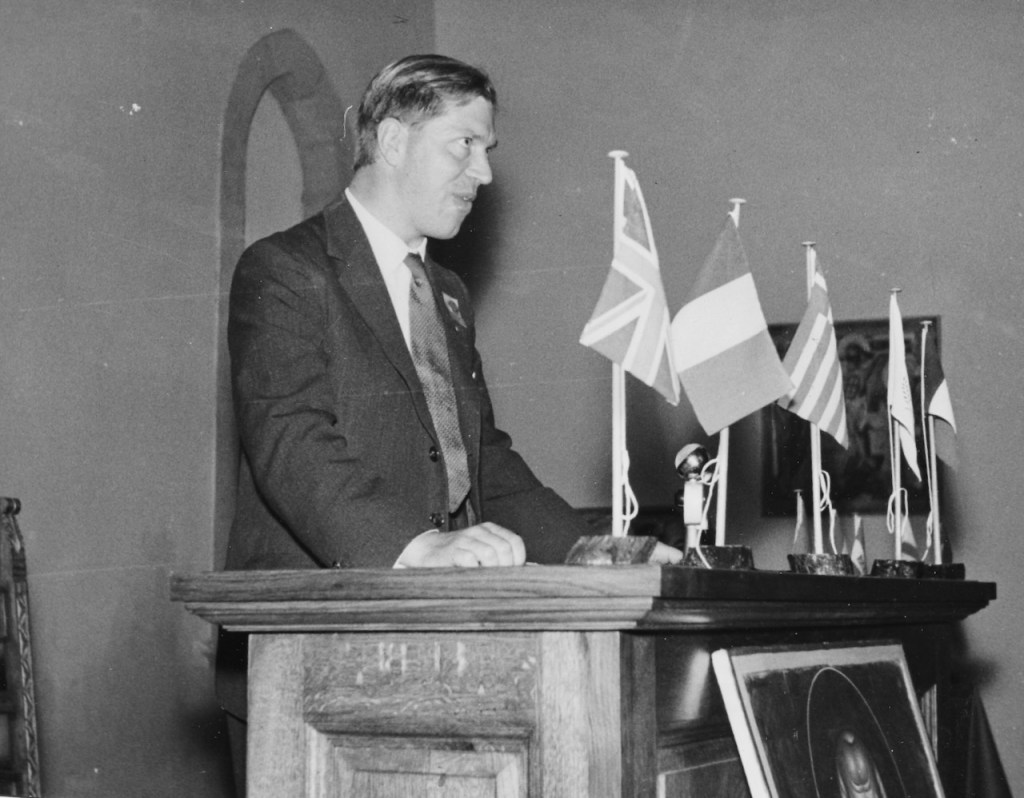
Prof. Maurice Pope addresses a classics convention in Crete in 1962
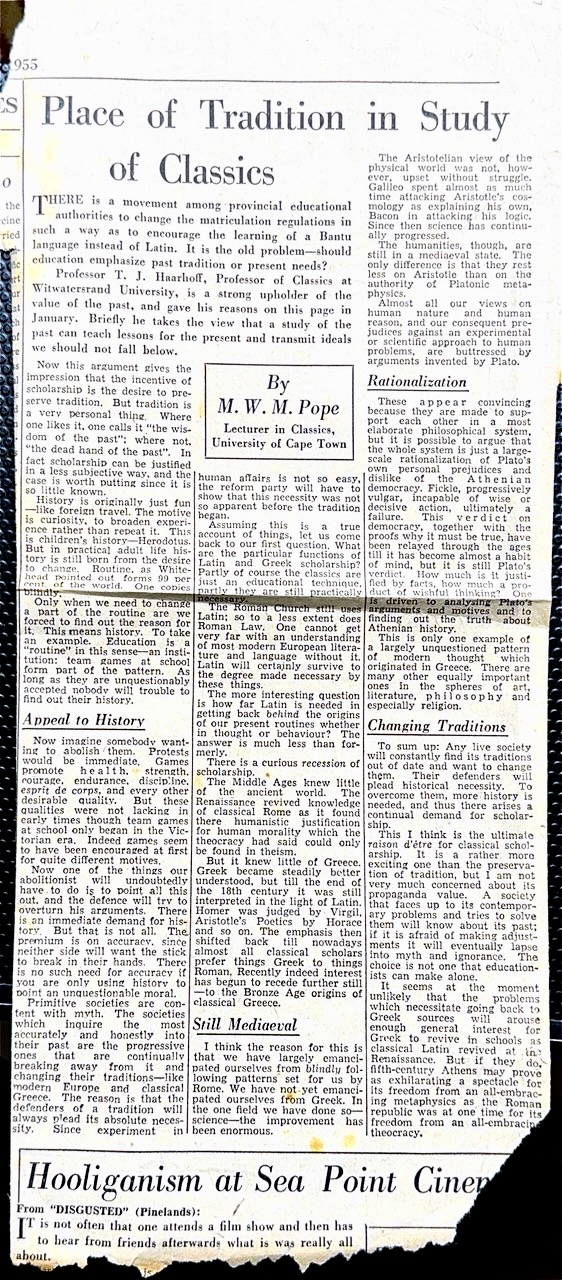
But his convictions dated even further back. Recently, sifting through his papers prior to sending them on to the archives of Cambridge University’s Department of Classics, my mother chanced upon an essay from 1955 in which my Dad voices many of the same points of view. In this opinion article published in the Cape Times of South Africa about the teaching of Latin – he was then a professor at Cape Town University – he is clearly already rehearsing the pro-sortition themes that reach full bloom in The Keys to Democracy.
This text is taken from his best draft. I have only added the Cape Times’ headline, a little punctuation and some context/missing words. There’s an explanation of his time in South Africa here.
+++++
Place of tradition in study of classics
By Maurice Pope
“There is a movement among [South African] Provincial Educational Authorities to change the matriculation [exam] regulations in such a way as to encourage the learning of a Bantu language instead of Latin. It is the old problem: should education emphasise past tradition or present needs? Professor Haarhoff is a strong upholder of the value of the past, and gave his reasons on this page in January. This was some time ago and I do not want now to analyse them. Briefly, he takes the view that a study of the past can teach lessons for the present and transmit ideals we should not fall below.
“Now this argument gives the impression that the incentive of scholarship is the desire to preserve tradition. But tradition is a rather personal thing. If one likes it, one calls it ‘the wisdom of the past’; if not, ‘the dead hand of the past’. In fact, scholarship can be justified in a less subjective way, and the case is worth putting, since it is so little known.
“History is originally just fun – like foreign travel. The motive is curiosity, to broaden experience rather than repeat it. This is children’s history – Herodotus. But in practical adult life, history is still born from the desire to change. Routine, as [philosopher Alfred N.] Whitehead pointed out, forms 99% of the world. One copies blindly. Only when we need to change a part of the routine are we forced to find out the reason for it. This means history. To take an example, education is a routine in this sense, or an institution. Team games at school form part of the pattern. As long as they are unquestioningly accepted, nobody will trouble to find out their history.
“Now imagine somebody wanting to abolish them. Protests would be immediate. [People would say that] games promote health, strength, courage, endurance, discipline, esprit de corps and every other desirable quality. But these qualities were not lacking in early times, though team games at school only began in the Victorian era. Indeed, games seem to have been encouraged at first for quite different motives. Now, one of the things our abolitionist will undoubtedly have to do is to point all this out. The defence will try to overturn his arguments. There is an immediate demand for history. But that is not all. The premium is on accuracy, since neither side will want the stick to break in their hands. There is not such need for accuracy if you are only using history to point an unquestioned moral.
“Primitive societies are content with myth. The societies which enquire the most accurately and honestly into their past are the progressive ones that are continually breaking away from it and changing their traditions – like modern Europe and classical Greece. The reason is that the defenders of a tradition will always plead its absolute necessity. Since experiment in human affairs is not so easy, the reform party will have to show that this necessity was not so apparent before the tradition began.
“Assuming this is a true account of things, let us come back to our first question. What are the particular functions of Latin and Greek scholarship? Partly, of course, the classics are just an educational technique. Partly, they are still practically necessary.
“The Roman Church still uses Latin; so to a less extent does [Rome]. One cannot get very far with an understanding of most modern European literature and language without it. Latin will certainly survive to the degree made necessary by these things. The more interesting question is how far Latin is needed in getting back behind the origins of our present routines, whether in thought or behaviour? The answer is: much less than formerly. There is a curious recession of scholarship. The Middle Ages knew little of the ancient world. The Renaissance revived knowledge of classical Latin, as it found there humanistic justification for human morality, which the theocracy had said could only be found in theism. But it knew little of Greece. Greek became steadily better understood, but [even] at the end of the 18th century it was still interpreted in the light of Latin. Homer was judged by Virgil, Aristotle’s Poetics by Horace and so on. The emphasis then shifted back until nowadays almost all classical scholars prefer things Greek to things Roman. Recently, indeed, interest has begun to recede further still – to the Bronze Age origins of classical Greece.
“I think the reason for this is that we have largely emancipated ourselves from blindly following patterns set for us by Rome. We have not yet emancipated ourselves from Greek. In the one field [we] have done so – science – the improvement has been enormous. The Aristotelian view of the physical world was not however upset without struggle. Galileo spent almost as much time attacking Aristotle’s cosmology as explaining his own, Bacon in attacking his logic. Since then, science has continually progressed.
“The humanities though are still in a mediaeval state. The only difference is that they rest less on Aristotle than on the authority of Platonic metaphysics. Almost all our views on human nature and human reason – and our consequent prejudices against an experimental or scientific approach to human problems – are buttressed by arguments invented by Plato. These appear convincing because they are made to support each other in a most elaborate philosophical system.
“But it is possible to argue that the whole system is just a large-scale rationalisation of Plato’s own personal prejudices and dislike of the Athenian democracy as fickle, progressively vulgar, incapable of wise or decisive action, ultimately a failure. This verdict on democracy, together with the proofs why it must be true, have been relayed through the ages until it has become almost a habit of mind. But it is still Plato’s verdict. How much is it justified by facts, how much a project of wishful thinking? One is driven to analysing Plato’s arguments and motives, and to finding out the truth about Athenian history.
“This is only one example of a largely unquestioned pattern of modern thought which originated in Greece. There are many other equally important ones in the spheres of art, literature, philosophy and especially religion.
“To sum up: any live society will constantly find its traditions out of date and want to change them. Their defenders will plead historical necessity. To overcome them, more history is needed and thus there arises a continual demand for scholarship.
“This, I think, is the ultimate raison d’être for classical scholarship. It is a rather more exciting one than the preservation of tradition, but I am not very much concerned about its propaganda value. A society that faces up to its contemporary problems, and tries to solve them, will know about its past; if it is afraid of making adjustments, it will eventually lapse into myth and ignorance. The choice is not one that educationalists can make alone.
“It seems at the moment rather unlikely that the problems which necessitate going back to Greek sources will arouse enough general interest for Greek to revive in schools as classical Latin revived at the Renaissance. But if they do, fifth-century Athens may prove as exhilarating a spectacle for its freedom from an all-embracing metaphysics as the Roman republic was at the time for its freedom from an all-embracing theocracy.”
++++
For me, this essay shows that my father was into random selection from the beginning of his working life. And at least by his late 20s, he had developed a mission to push back against Platonic ideas, if not Plato himself. Or as my Mum puts it: “your father was always talking about sortition.”
In Chapter 8 of The Keys to Democracy, ‘In Defence of Randomness’, he makes his main attack on Platonic or ‘noumenalist’ ideas. This doctrine holds that true reality can only be found in ‘noumena’, or things that exist in themselves and can be understood only by intellectual intuition, without the aid of the senses. Overturning this philosophy goes the heart of what he was trying to achieve by rehabilitating sortition and putting ordinary citizens in the driving seat. As he put it in The Keys:
The noumenal approach is also covered by the early twentieth-century English mathematician and philosopher Alfred N. Whitehead’s remark that “the European philosophical tradition … is a series of footnotes to Plato.” Its origins go back to the late fifth century BC when the intellectual battle between democracy and oligarchy was at its height. Its political bias is manifest. As soon as we accept that there is a distinction to be made between mind and matter, soul and body or appearance and reality, we can hardly avoid taking sides and assuming that the former of each of these pairs is superior and comes first. Ideas are perfect as ideas, but are spoiled when they are translated into practice. Spirit is pure, flesh is gross and sullied. Knowledge exists (in heaven or in theory) and answers are right or wrong depending on how closely they approximate to that knowledge. These noumenal notions, embedded not only in our philosophy but in our everyday language, encourage a model of society in which wisdom, conferred by knowledge, is the preserve of the few at the top while the many down below have only unorganised desires...
There has only ever been one school of thought that has ever tried to work these attitudes of mind into a coherent system of philosophy, including ethics and metaphysics: that of the Epicureans. They derived the principles of moral conduct from the satisfaction of instinct, which they called pleasure. They accounted for the existence of the world not, as Aristotle had done, by assuming a single prime mover behind everything, but by the opposite, an infinite number of prime movers each endowed with the ability to initiate an infinitely minute spontaneous movement...
… It may be thought that one of the consequences of noumenalism is just as damning to its claim to be taken seriously as the picture of the Epicurean atoms with their unpredictable swerve. The discrimination which asserts that mind is superior to matter can be used to distinguish man from animal, civilised man from savage, sage from fool. It can then be continued within ourselves. Reason, our godlike faculty, can be distinguished from appetite. It can then be asked, whereabouts in us the reason is located: in the heart, in the head, or in some other part? …
… the whole hunt is also absurd. Reason, if it exists at all, must exist not statically in a particular place, but dynamically as the function of an organism. The chase now goes into reverse. Organisms are complex entities themselves and exist within a context of others. There can be no such thing as an organism that functions in isolation. This is true all the way up the scale. There cannot be a brain without a body. The purest philosopher is not independent of his hormones for either the strength or the direction of his thought, nor is he independent of his environment. He is affected by language, time and place, by the opportunities offered by his society and by its constraints. So is everybody. But it works the other way too. For in the shaping of society, all members of it, philosophers and fools, young and old, living and dead, have played or are playing some part, however miniscule.
Furthermore, nobody, whether philosopher, poet, scientist or politician, can tell what is going to influence his thoughts in the next three days or weeks, let alone in the next three or thirty years. All that he can be certain of is that, if he is going to be alive and operational at all, the remarks, writings and actions of other people will be constantly affecting him. He will certainly not be occupied the whole time in making pure deductions from his existing store of experience or (as Bacon put it) in spinning cobwebs out of his own substance. We are all members one of another. We all may affect each other. Such interactions are not confined to human beings. The unforeseen act of an animal, an insect or a wave on a beach may either dramatically or minutely alter the course of our lives.
Seen in this perspective, the Epicurean model of the myriad upon myriad of infinitely small, unmoved movers begins to look less absurd and less remote. It is not obviously less true to reality than the noumenalist one of mind, purpose and knowledge. And when we put flesh on the Epicurean vision and adapt it to the political world, of course it gives a democratic picture. It shows us all the members of a society contributing, each a little, to its total life. In the noumenalist picture, by contrast, the lives of the many have no value except as instruments to execute the designs of the leaders.
[pp. 118-20, abridged]
Can we really blame it all on Plato? I don’t know, but American philosopher Richard Farr wrote a nice, short, skeptical take on the question here.