Writer of books on Turkey, the Middle East and Central Asia. Formerly Director of Communications & Outreach and Turkey/Cyprus Project Director for International Crisis Group. Ex-Turkey & Middle East staff correspondent for The Wall Street Journal.
The main public event to launch Dining with al-Qaeda in New York will be held at Strand Book Store, 7pm-8pm, on Tuesday, 30th March 2010. (See Strand calender here).
I’ll be discussing the book and its principal themes – including American media coverage of the Middle East, and perhaps modern-day Orientalism as well – with Professor Khalidi, the Edward Said Professor of Modern Arab Studies at Columbia University and the author of Sowing Crisis: The Cold War and American Dominance in the Middle East.
The event will also be broadcast live on STRAND TV.
STRAND BOOK STORE
828 Broadway (at 12th St.)
New York, NY. 10003-4805
212-473-1452 Phone
212-473-2591 Fax
Directions
Take the NRQW456 or L train to Union Square. Walk two blocks South to 12th street.
[Originally, Leslie H. Gelb, formerly of the Council on Foreign Relations and the New York Times, kindly agreed to discuss the book with me at this event — he has researched U.S. media coverage of before, during and after the invasion of Iraq, published here with Jeanne-Paloma Zelmati as ‘Mission Not Accomplished’ in the Summer 2009 edition of Democracy: A Journal of Ideas. Unfortunately, Gelb has had to cancel in order to follow a course of medical treatment.]
Thomas Crampton, who calls me a ‘recovering journalist’, perhaps because he is one himself (from the other stable, the New York Times), came for tea and left with my first instant video interview. In his new capacity as Social Media Guru (for Ogilvy, the advertising agency), he whipped out what I thought was his cellphone, told me there would be no editing and then opened up with his battery of rapid-fire questions. He had lost none of his reporting skills and in those few minutes managed to get me to say much that I wanted to share in Dining with al-Qaeda. The resulting video can be seen here.
PALESTINE is yesterday’s news, sighed a bored editor as he rejected Hugh Pope’s offering. It was a familiar reaction. Mr Pope, a principled and thoughtful reporter, tramped the Middle East for 30 years in a forlorn bid to decipher its subtleties to a Western readership encased in its own prejudices: moderates versus radicals; an Arab-Israeli peace process that would work were it not sabotaged by Palestinian violence; Islamic Iran as the mortal enemy of Western civilisation. After his long time on the road, Mr Pope’s sad conclusion is that all the words he wrote, and all the risks he took, had made no perceptible difference to the crude way a largely insensitive and meddling West views a dysfunctional region.
But his travels have made a very good book. “Dining with al-Qaeda” is a collection of stories and essays, in no very clear order, garnered from Mr Pope’s life as a journalist, from his beginnings as a wet-behind-the-ears freelancer in Syria through his appointment in 2000 as the sole Middle East correspondent for the Wall Street Journal. His beat stretched from north Africa to Afghanistan. He was to be based in Istanbul, contribute a story or two a year on Saudi Arabia and the Gulf and keep an eye on everywhere else—a grand solitary status that was all too soon exploded by events.
Too gentle and cautious to probe indelicately for his stories, Mr Pope is an excellent linguist (speaking fluent Persian, Turkish and Arabic), a good listener and a cultured observer. What you see in Iran, he says, is not what you get. He tries to explain that when Iranians say “Death to America” they sometimes mean “Please America, show me more love.” In Shiraz he embarks on an improbable attempt to explain Iran’s “full complexity of inner truths and multiple meanings” through the works of its great 14th-century poet, Mohammad Hafez. He has learned conversations about religion in Mecca and reports a clever Saudi dissident saying: “The Wahhabis say ‘al-Qaeda is not us’ and it’s believable. But for me it’s the difference between Marlboro and Marlboro Light.”
The episode that provides the book’s title has its comic aspects even though it took place in Riyadh a couple of months after September 11th 2001 and even though the interviewee, a young missionary for the Wahhabi faith, sporting “an unhappy” beard, remarks at an early point, “Shouldn’t I kill you?” Mr Pope dissuades him by quoting the Prophet’s diktat that those with permission to be among believers should enjoy safe passage. The missionary had attended al-Qaeda training camps in Afghanistan, not learning to fight but spreading his fundamentalist faith to all nationalities. He claimed to know some of the September 11th terrorists, calling them “wonderful boys”. At a second meeting, they repaired to a Chinese restaurant, where he poked a spring roll without eating it. He was a rather absurd young man. But his defence of terrorist action against the West was serious, and much less familiar then than it is now.
The Journal declined to publish a report on this meeting because the missionary was unidentified, only a walk-on al-Qaeda actor and a bit flaky with it. Mr Pope had a plum job and respects the Journal for being an honest newspaper. But all the same he had deep trouble with its editing criteria, especially regarding anything destined for its coveted front page. By means of omissions and headlines, editors, in his view, would turn out finished stories that were politically correct in the context of America’s pro-Israeli and anti-Islamist beliefs. The demand, particularly concerning Arab-Israeli affairs, was for upbeat stories reporting good news about what the author calls the “virtual world” of the peace process.
Mr Pope’s frustrations intensified in the months leading up to the invasion of Iraq, as he struggled to report what he saw as the truth to a country led by a government fixated on overturning Saddam Hussein. He managed to get a long prophetic story on the dangers ahead onto the front page of the Journal (whose editorials, like others, including those of The Economist, supported the war), but a delay meant that it appeared only a day before the tanks rolled in. He spent the war reporting from Iraqi Kurdistan. Pleasantly self-deprecating, he acknowledges that he is not always right. But he usually is.
From The Economist print edition Dining with al-Qaeda: Three Decades Exploring the Many Worlds of the Middle East. By Hugh Pope. Thomas Dunne; 352 pages; $26.99 and £18.99. Order among others from amazon.com or amazon.co.uk.
"Dining with al-Qaeda" reaches its author's hands in Istanbul
The arrival of the first properly printed copy of a book is a sweet moment indeed. After years of work, it’s been fired, glazed and is as good as I could make it. Hard covers, embossed dust jacket, author photo … it’s finished! For the first time, I can read the text for pleasure, not as another editing exercise. Perhaps I’m just blowing my own trumpet – my wife Jessica certainly thinks so – but I’m proud and want to share the first fruit of all my labours!
I moved to Turkey in 1987, somewhat accidentally, since opening a Reuters news bureau in Istanbul was the first job I found after claustrophobia got the better of me in Beirut. But I have never left the country for more than a few months since then.
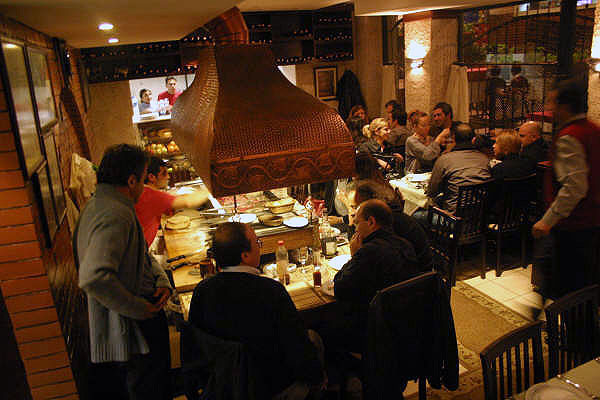
Dining alone in Ankara one evening last week, I was reminded of one of the reasons why: the ocakbaşı, pronounced odjakbashy, and meaning ‘the head of the hearth’.
Some people love Turkey’s Bosporus-side fish restaurants and their mezze appetizers, drenched in olive oil. Others like Turkish pide pizzas, calorie-packed döner kebabs or choosing from great steaming trays of ready-cooked meals. What really accelerates my appetite, however, is the ocakbaşı’s aroma of charcoal-roasted meats, watching blue smoke curling up under great brass hoods, and above all, the warm fug of jovial closeness of waiters and waited upon. This is the kind of place where men relax, ties are loosened, and hardened hearts open up.
In Ankara that night, I had stumbled on an ocakbaşı a few steps from my new hotel. I knew I was ready to fall in love when offered an opening teaser of tender sweet onions bathed in pomegranate essence and delightful newly-dried thyme. I asked its provenance from the usta, or master chef, gleaming from his exertions behind the glowing mound of charcoal. The thyme came specially from Konya, he said, three hours to the south over the high, rolling hills of the Anatolian plateau. Then he dug me out a great handful of the herb and wrapped it in a newspaper for me to take home.
My favorite ocakbaşı in Istanbul, Zubeyir's in Beyoğlu. For more, click on the picture …
Next came the salad known as gavurdağ, or ‘infidel mountain’, a potent mush of closely chopped rocket, lettuce, tomatoes, pomegranate essence and, in this case, walnuts. Turks assert the name has nothing to do with its close resemblance to carnage on a battlefield. That seems about as likely a story as that of the high official I met earlier that day. He told me that, as Turkey continues its striking political-economic comeback across the Middle East, neighbouring states need not fear neo-Ottoman hegemonic intent. “We feel the imperial reflex,” he said, and then laughed. “But we don’t tell them about it.”
Soon came my main dish of Adana kebab, gently spiced mince roasted on a flat sword of a skewer. The meats in an ocakbaşı are so irresistibly salty, seared and fresh, that I can sometimes go on to order three or four different courses. I cleared my palate with another sharp sip of rakı, the Turkish version of the aniseed spirit popular round the Mediterranean. This too is of a new generation. Only ten years ago I visited a state rakı factory where the manager complained that he was really a beer brewer and hated his job. He despised his ten-times over-manned factory, the public sector workers who slept instead of keeping watch on liquor runs from the stills, and the farmers who with impunity delivered loads of aniseed that were outweighed by earth. He even admitted that the rough “lions’ milk” that Turks were so proud of back then was one third French grape alcohol. Now, the alcohol market has been de-monopolised and Turkish rakı can be as velvety as the Lebanese arak I love so well.
Plate after plate of extras arrived, roasted eggplant, a balloon of new-baked unleavened bread sprinked with sesame seeds, strained yogurt with spices and then … mysteriously … a roast quail.
I couldn’t possibly eat any more, but the usta whispered in my ear that it was a gift from Osman Bey, over there. I followed his eyes and saw a plump, cheery figure in a red jumper enjoying his meats side-by-side with a friend as they watched the football on a flat-screen TV on the opposite wall. I nodded respectfully. The man smiled back. No choice but to eat it now, and the little bird was gamey and succulent. The dish was then whisked away to make space for a panorama of sliced fruit.
Completely overstuffed, I surrendered. I called for my bill, paid up and stopped to offer my thanks to the man with the red jersey. He was smiling serenely as he and his boon companion took another pull on the stubs of their enormous cigars. Over the past year European bans on smoking have been imposed with success in most Turkish public places, and his friend registered my look of surprise.
“This is the owner,” the man explained.
“The quail was delicious. You have a wonderful restaurant,” I said.
“We want people like you here,” said Osman the owner, by which he meant, international-looking customers, coming to the point of his generosity with exemplary Turkish frankness. He took in the conspiratorial, male-dominated clientele: “I’d like to see more women here too.”
“The restaurant is just his hobby, actually,” the boon companion said slyly. “He’s really an arms dealer, you know, guns, military equipment.”
That was more disclosure than even I expected, and thought I should stake out my position.
“That’s odd. I work for International Crisis Group, the conflict-prevention organization. I’m here as part of our work to try to help solve the problems over Cyprus and around the region!”
“Don’t end them all!” Osman Bey cheerfully retorted.
We all laughed. Yet I couldn’t feel any hostility. He hadn’t roasted a white dove of peace and sent it over. The mantra of the Middle East is that a human connection can beat an ideological contradiction. Still, I wondered if I had betrayed my calling, or whether I had been too prim.
After all, it has been my job to eat with many kinds of people – Western intelligence agents, goons from Saddam Hussein’s tyranny, Israeli settlers, and, as the title of my new book Dining with al-Qaeda records, a jihadi Saudi missionary from the Afghanistan camps where al-Qaeda’s 9/11 plot matured. I had once been in the pay of a newspaper that was high-minded and excellent, but also lost in the misguided pursuit of something quite wrong, the invasion of Iraq.
As I walked back to my hotel through the dry, cold Ankara night air, I contemplated the Middle East’s lack of moral clarity. I also thanked the stars for the culture of the ocakbaşı. Here at least there can be a temporary truce, where I need only nod in half-protesting happiness as an assiduous usta reaches over the bed of hot coals and presents yet another plate of charcoal-scorched heaven, sprinkled, if I’m lucky, with the best Konya thyme.
What’s an author to do when he hears that, before his new book is even printed or presented, it’s been sold in the charity shops for a couple of bucks?
I love being a writer. I wouldn’t want to be anything else. But sometimes my trade feels like an uphill struggle.
My first commercially published article, a purple portrait of the Syrian village where I moved in 1982 to try to perfect my Arabic, took me three agonizing weeks to write.
In my twenties, I felt guilty that I couldn’t write that brilliant young man’s book that my father always said I should. When I turned 30, a potential London publisher finally offered a meagre 200 pounds sterling for my first idea. He never paid up, yet a few months later he was stalking me round my house, asking for it back. That episode set me back five years.
In fact it took me at least a decade to work out how that first book should be and what it should say. As the Turks put it, to be a real expert, first you should first have eaten your way through ten bakeries’ weight of bread.
Then comes the search for publication. Floating a book idea always feels like going against the grain — after all, if it is a really new approach to a subject, no publisher can be expected to have heard of it or believe in it. But self-publishing is not a real option, being like talking to the mirror — and even T.E. Lawrence went deep into debt when he tried it with Seven Pillars of Wisdom.
The first time round, I was lucky (thanks again, Gail Pirkis) to be signed up under the gaze of Lord Byron’s portrait at the fine old house of John Murray in London’s Mayfair. The next time, two publishers actually wanted me to do books on new horizons in Central Asia. Too busy to think, I tried to merge the two ideas. I ended up losing both contracts and having to return my advance. (Don’t believe that business about ‘they can’t get it back’).
And writing takes time, so much time. Books don’t pay enough to be a day job, so you end up working through the night. Still, I persevered, straining relationships, blaming problems on flighty agents, and piling up inadequate and unpaid leaves of absence.
At last, the manuscript is ready. Sending off a first draft, however, always turns out to be just a new beginning. Months of agonized waiting ensue as I wonder if my work will be liked or not. When the text finally returns, either the editor has done so little I feel he couldn’t possibly care, or she has really made the text fly, making me feel subtly inadequate and possibly illiterate.
All along, of course, I continue to pester friends and family to read the great work and make comments, which they almost never do. Frustrations mount and it usually takes a whole year for a book to be properly edited, published and marketed (and I count myself lucky – my poet friend John Ash is typically writing two or three volumes ahead of his publisher, who lags several years behind).
And then, miraculously, as rivals are conquering market share and the subject slides out of fashion, the book’s inner meaning suddenly becomes clear to me. I find myself begging the publisher to accept yet more alterations that might delay things yet again.
Months of worrying follow about who to ask for an endorsement, whether or not a third reminder message is appropriate, and whether it is a bad sign that half the people that say they will send a blurb never actually do. Control slips further as the author experiences the agony and the ecstasy of Great Review Lottery. Then comes the organization of a book launch week– and these days, that’s a lucky bonus — in which 200 people might present themselves for a creamy soiree at the Smithsonian, or in which just three people turn up for a bookshop signing, including the visiting relative, the tipsy functionary and the passer-by.
In short, by the time the actual publication date looms close, the author almost has no energy to keep the fire burning under any remaining hopes of high-flying speaking engagements, multinational book tours and best-seller fame.
At exactly such a moment in the trajectory of Dining with al-Qaeda, fate chose to deal a new authorial blow below the belt.
A friendly acquaintance in the State Department, two months before publication of my new book, and indeed before it had even been printed, cheerfully sent a message to say he had bought a copy and was half-way through it already.
How on earth?! I asked.
It turns out that the first copy of Dining with al-Qaeda knowingly sold is one of the galley proofs, sent off earlier to someone on the publicist’s list of the great and the good, and apparently just as rapidly passed on to a second-hand bookshop.
My friend vows that he wants buy the proper edition, and I know I should just be grateful he’s so keen to read it. Perhaps I should be happy that even one of those galleys – floppy, and with ink that rubs off the cheap paper pages – has some resale value.
Still, it hurts to see any new sign that an author should never expect that writing books will ever be more than a hobby, and that I should treat any actual income as a happy surprise.
So why do we do it? We writers can’t help pouring out reams of words, gushing like oil wells or blathering like bloggers. If we stop, there’s always somebody else ready to gush instead. And if anyone had found a way to make regular money out of books, the publishing industry would not look like it has done for so long.
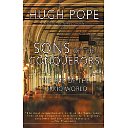
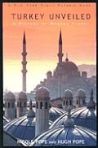
The secret, perhaps, is what my former boss Gareth Evans used to call ‘psychic income’ (useful in all respects when it could substitute for real income in our NGO, International Crisis Group). A book can produce plenty of that. I got lucky when I heard that my Turkey Unveiled was on President Clinton’s reading list as he headed to Turkey, or when a Kazakh student in America sent a touching message to say that while reading my second book Sons of the Conquerors, he discovered an important and unknown part of his Turkic self.
My charity shop-visiting diplomat friend also well knows the value of a morale-boosting dose of this miraculous substance, and succeeded in soothing my ruffled authorial feathers: “Needless to say,” he purred, Dining with al-Qaeda“is a very good read.”
And indeed, what more can a writer want or hope for?
David Byrne, the New York-based musician, artist and bicycle balladeer, not to mention former song-writer and front man for the Talking Heads, has offered this endorsement of Dining with al-Qaeda:
Full disclosure: I distributed a printout of a Wall Street Journal piece Hugh Pope had written at my Apollo Theater concert 2 weeks after 9/11. Unfortunately the juggernaut had already begun its relentless and disastrous crawl, and no amount of “fact-based reasoning” (as the Bush administration disdainfully called it) was going to derail this monster. This was not a screed from some lefty blog or the blame America fringe, this was a heartfelt cry for reason, empathy and understanding from the headquarters of capitalism.
A similar call for connection infuses ‘Dining with al-Qaeda’, and maybe folks are willing to listen now. What a great book! Pope’s enthusiasm and curiosity as a young journalist and over three decades of reporting in the Middle East drives a narrative thread through two dozen countries. Much better than the sadly thin news we get most of the time, he gives us portraits of the places and people behind now cliched news events, as well as the depth, the quirks, and humanity that go a long way to explaining why things happened, and why they will continue to happen. His anecdotes, probing, curiosity, humor (yes, sometimes there is humor in the Middle East), idealism, and sometimes naivite, all give a soul and face to what is too often treated as a distant, abstract and hostile
Back in those confused days of September 2001, I had just returned from an al-Qaeda chasing trip to Dubai, Ras al-Khaimah and Tehran when I saw David Byrne’s message offering to give his concert-goers copies of the story I’d written with my colleague Peter Waldman.
In that front-page Journal story on 21 September 2001, ‘Worlds Apart: Some Muslims Fear War on Terrorism Is Really a War on Them’, we tried to tell America the background to the disaster that had just hit them. Back then, for a precious few weeks, the shock of the attacks gave rise to a genuine questioning about what on earth was going on. Then the U.S. government went on the offensive, and the rest is history.
When I read the message I sent back to David Byrne and his team at the time, I see that I was already mentally preparing to write Dining with al-Qaeda:
this article has touched off more reader response than any other story I’ve ever had anything to do with. [The response] was overwhelmingly positive, and people kept saying ‘thank you.’ I think it shows just what a thirst there is for a new approach to reporting on Middle East affairs, and how tired, confused and possibly disatisfied people are with the mainstream narrative we usually stick to.
The Audiobook CD of Dining with al-Qaeda will go on sale shortly after the book is published on 16 March. The reader is Paul Boehmer, a soft-spoken American theater actor acclaimed for his ability to give voice to everybody from Thai police detectives, pimps and prostitutes to reading out Samuel Huntington’s Clash of Civilizations. The CD will be available here from 29 March 2009.
New York’s Foreign Affairs magazine on 23 September 2009 listed the book’s account of my Central Asian and other Turkic journeys first among the 20 titles judged essential for ‘What to Read on Turkish Politics’ (see here).
Reviewer Ian O. Lesser found it
an erudite and readable history of the Turks as a people, from their origins on the Eurasian steppes, through the Ottoman ascendancy, to their modern geopolitical reach. Along the way, it also says a lot about Turkey’s political and strategic culture.
At sixth on the list, Foreign Affairs also recommends my first book, Turkey Unveiled: A History of Modern Turkey (John Murray 1997, Overlook Duckworth 2004), alongside books by former New York Times correspondent Stephen Kinzer and former Swedish Ambassador Ann Dismorr.
Dr. Lesser says all three are
by authors with long experience covering the country and its neighbors. These three offer a solid background on the rise of the Justice and Development Party (AKP); changing secular, religious, and civil-military dynamics in Turkey; and the tremendous expansion of the Turkish economy … all three volumes are refreshingly free of polemic about Turkish identity.
One of the Arab world’s leading international magazines, al-Majalla, gave its readers a heads-up about the forthcoming publication of Dining with al-Qaedain the new titles section of its 9 January edition.
The 30 years Pope has spent living and travelling in the Middle East, from a 1980 visit as an Oxford student through a decade-long stint as a correspondent for the Wall Street Journal, color this reflection on the region’s recent history. Moving back and forth through time in vignettes set in Syria, Sudan, Afghanistan, and Saudi Arabia, this fascinating memoir of his career tackles subjects as varied as the sexual attitudes of Middle Eastern men, the murder of Daniel Pearl, the Iraq-Iran War, and the poetry of the mystic Persian poet Hafez.




 Hugh Pope