Hugh Pope

Author, Reporter, Editor

  • Revolutionary flags on the Taksim monument
    Revolutionary flags on the Taksim monument

    [This post written on 10 June, the day before the 7am police intervention that took control of Taksim Square, the Atatürk monument and the Atatürk Culture Centre. On 16 June, the police took control of Gezi Park as well. For the aftermath, see below].

    I still couldn’t believe my eyes as I wandered this weekend round Taksim Square, along with thousands other visitors who thronged there this weekend to take in this extraordinary moment in Turkey’s political life. Even a few days ago there were just a few people camping out in what was once the small, unfrequented park, from where Turkey’s protests over the uprooting of a few trees blossomed into a national protest movement. A carnival atmosphere has now spread out from the park to include most of the square itself, a fair in which an alphabet soup of often little-known Turkish organizations have set up shop. There are revolutionaries, Marxists, Kurdish insurgents, anti-capitalist Muslims, environmentalists and many, many more.

    Like all new-borns, a rush is on to name and define the wave of protests. Are they “a few looters”, in the inimitably dismissive comment of Prime Minister Erdogan? But if not that, then what? A Turkish Spring, a poll tax turning point, an “occupy” movement, Piraten or indignados? A political earthquake, sure, but on which of Turkey’s many fault-lines: secular-Islamist, rich-poor, new urban vs old urban, left-vs-right, Kurdish nationalist vs Turkish nationalist, Sunni Muslim vs Alevi, authoritarian vs anarchist, environmentalist vs shopping mall builder? Of course, the answer is all of the above and all of no one of them. As some leading lights of the small old leftist opposition parties put it, the demonstrators themselves probably have as little idea as the government about what  exactly the protests are about. Whatever the final judgment of history, there is already a “revolution museum” in a commandeered hut from the now suspended roadworks around Taksim. And while they wait, protestors take time out at “The Looters’ Cafe and Reading Room”,  stock up on supplies at the “Brigand Market”, and get their souvenir stickers from the “Taksim Commune”.

    "Don't bow down" T-shirts being advertised by a penguin on Taksim Sq (a national symbol after Turkish TV news channel aired a penguin documentary instead of the peak of the protests).
    “Don’t bow down” T-shirts being advertised by a penguin on Taksim Sq (a national symbol after a Turkish TV news channel aired a penguin documentary instead of the peak of the protests).

    A “Taksim Solidarity Platform” has built a stage in the heart of the park for hosting groups like the “Looters’ Chorus” and is trying to rally its disparate members to agree reasonable demands – 35 groups mid-week, 80 groups now – and its officials rush about in union-style printed overshirts. Merchandising is putting its mark on proceedings: Turkish flags with secular republican founder Ataturk superimposed are popular; a T-shirt saying “don’t bow down” is everywhere; there is also a a scarf demonstrating unity in protest between all three of Istanbul’s main rival football clubs. There are many references to the “looters”, or çapulcu, including a T-shirt with the Turklish phrase “Everyday I’m chapuling”.

    This is a rare time in which international media are interested in Turkey as Turkey, not as part of the usual effort to pigeon-hole the country as part of the Middle East, Europe, or the Islamic World. The only other time I can remember this happening is during the massive 1999 earthquake around Istanbul, when more than 40,000 Turks were probably killed and the outside world forgot its prejudices about the country and real empathy was on offer. Similarly, visitors from Europe say the “Occupy” atmosphere is suddenly making Turkey looking very European. Unfortunately, the muzzled way Turkey’s national media initially covered the events was a reminder of the non-European limits Turkey’s places on freedom of expression.

    Something in the scene reminds me of the liberated atmosphere in 1996, when the UN’s Habitat Conference was held in Istanbul and Turkey’s non-governmental organisations were allowed to gather in an Ottoman barracks opposite the Hyatt Hotel . The idea of anything being allowed to organise legally outside direct state supervision was then very new (Turkey is still digging its way out from being so long the West’s own East bloc government). It was the first time many of the NGOs were really aware of the existence of other such groups, and all derived a great sense of solidarity as they met and talked. Another comparison would be with the first political chat shows in the early 1990s, when Turkey stayed up until dawn to watch people debating their way out of the country’s old black-and-white, enemy-or-friend view of life.

    Today, the whole country is now talking about the protests, the new generation of  students who are its leading element, and the way there is a sense of happy, humorous liberation in the air. If only for this reason, I hope the authorities take a European view of this and continue to let this outpouring of democratisation run its natural course in Taksim Square – and that the protestors do find a consensus to take down the barricades, open the square up to traffic and allow all normal municipal functions to resume.

    Still, nobody knows how this will end, only that how it ends will define much of the next decade. There are hardline revolutionaries among the protestors’ groups who do want to smash the Turkish establishment in the name of various ideologies. Still, they are far from the mainstream of the protestors, and it seems inconceivable that the security forces should launch sudden violent action against the currently large group of people in the square; yet everyone knows that one day the other foot will fall, perhaps not directly, but indirectly through the ongoing arrest-and-release campaign against social media ‘provocateurs’ or leaders’ public threats and intimidation of domestic and (openly now) foreign media.

    The problem for the authorities is that now the protests are not just about Taksim, nor one small social class in Istanbul, nor even Istanbul itself. This movement has taken root all over the country. I was passed on the Istiklal Street pedestrian boulevard leading to Taksim by a band of young men who’d travelled all the way from the southern Taurus Mountains to march to Taksim to protest a dam being near them. And in the working-class dock district of Hasköy, I watched a squad of forty schoolchildren set off for the miles-long march to Taksim with matching blue flags and outfits.

    So here are some more photos of the big party, even as we all wonder what form the hangover will take.
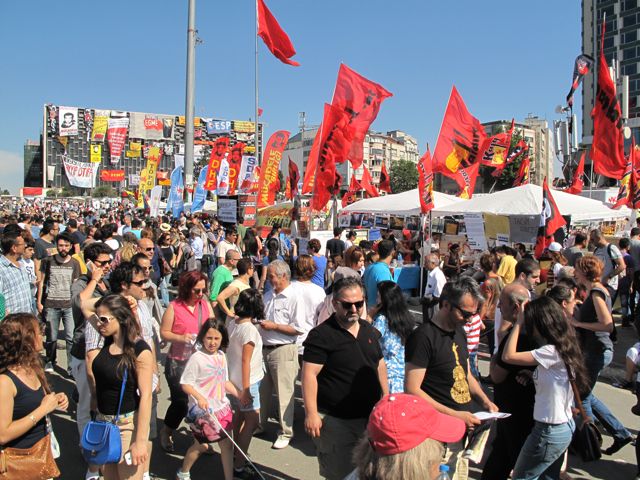
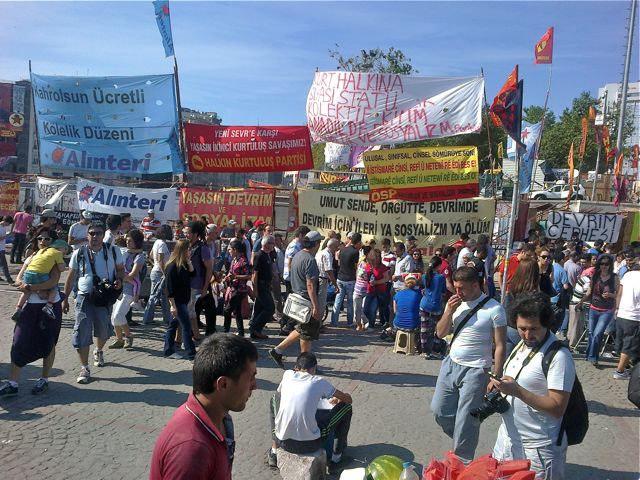
    A line of stands in Taksim Square in front of the old Ataturk Culture Centre, now a corkboard of revolutionary slogans
    A line of stands in Taksim Square in front of the old Ataturk Culture Centre, now a corkboard of colourful protest and revolutionary slogans.
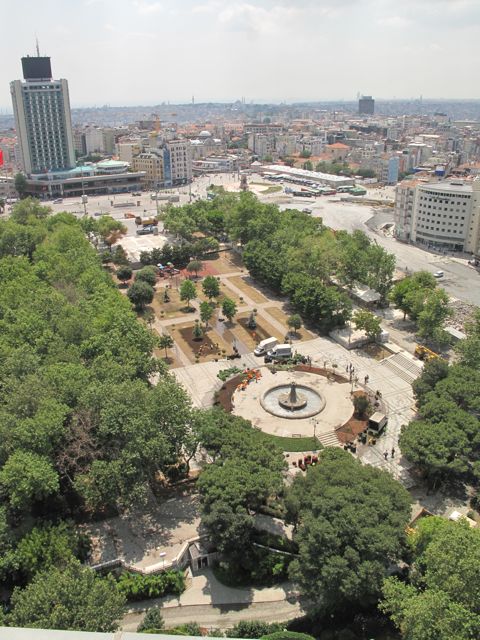
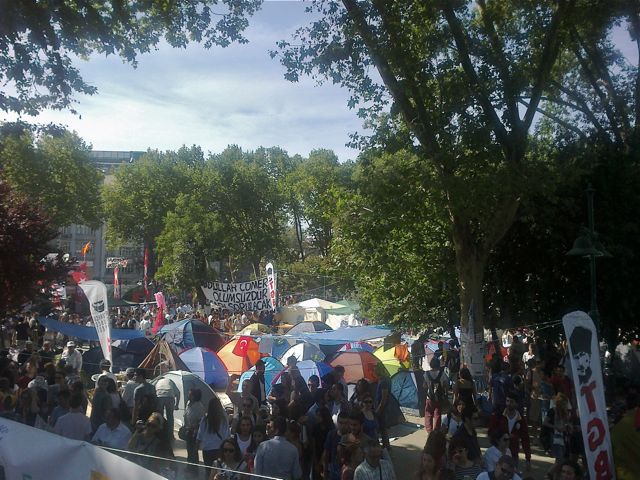
    Gezi Park on Taksim Sq is now full of people sleeping in tents, often students, and drew tens of thousands of visitors from all over the city over the weekend.
    Gezi Park on Taksim Sq is now full of people sleeping in tents, often students, and drew tens of thousands of visitors from all over the city over the weekend.
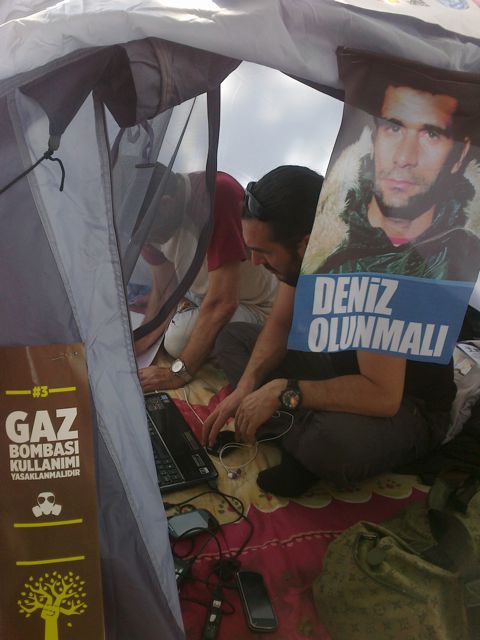
    Student activist networks from his tent. Gezi Park now has its own FM radio station too.
    Student activist networks from his tent. Gezi Park now has its own FM radio station too.
    A pick-up truck overturned in the first night of protests has become a wish-list of protestors' demands - typically, an end to the concrete covers up 98.5 per cent of the city.
    A pick-up truck overturned in the first night of protests has become a wish-list of protestors’ demands – typically, an end to the concrete covers up 98.5 per cent of the city.
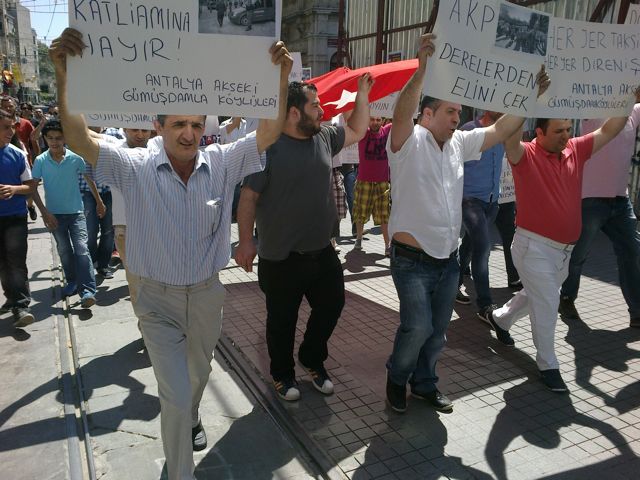
    This group arrived from Antalya Province, 12 hours by bus, to protest a hydroelectric dam that will destroy their Tauros Mountain valley.
    This group arrived in Istanbul from Antalya Province, 12 hours by bus, to protest a hydroelectric dam that will destroy their Tauros Mountain valley.
    2013-06-08-408
    Sample slogans from the political fair on Taksim Square: “Damn the Wage-Slave Order” (from an organisation called ‘Sweat’); “Against the New Sevres [a 1920 Treaty carving up Turkey by the imperial powers] – Long Live Our Second Liberation War” (from the People’s Liberation Party); “Long Live Revolution and SOCIALISM”; “Political Status to the Kurdish People [unreadable]…Mother-Language [Education]” (from the Freedom and Socialism Party); Hope is in You, the Organization, the Revolution; Forward for Revolution, Socialism or Death” …
    The Museum of the Revolution
    The Museum of the Revolution
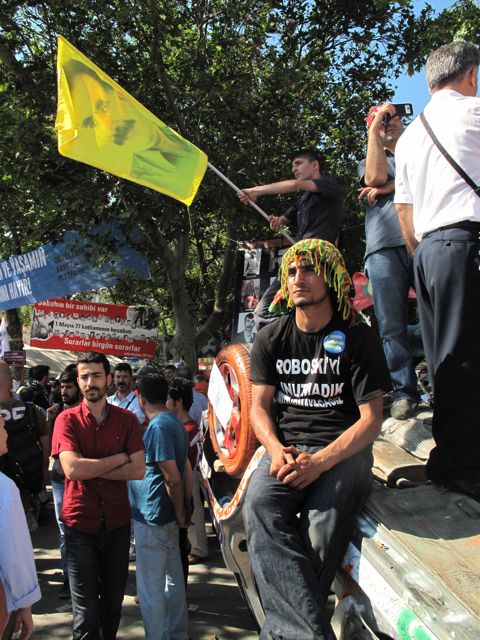
    The Kurdish nationalist movement has carved out its own corner of the square, where flags showing the jailed leader of the Kurdistan Workers' Party (PKK) are waved as here from an overturned police car.
    The Kurdish nationalist movement has carved out its own corner of the square, where flags showing the jailed leader of the Kurdistan Workers’ Party (PKK) are waved as here from an overturned police car and activists dance in long lines.
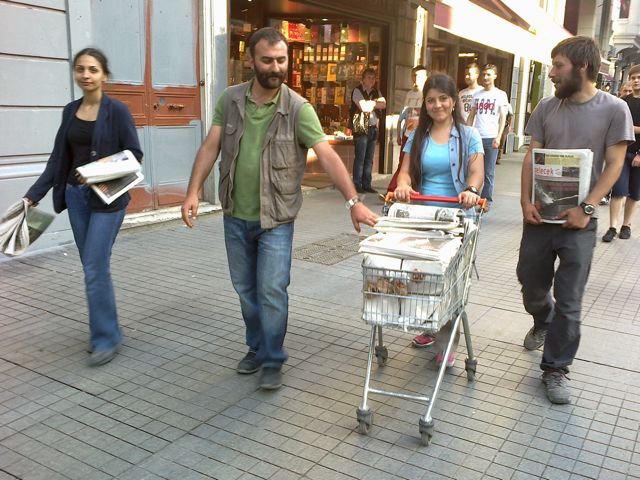
    Left-wing groups are rushing to show their relevance by handing out free copies of their hard-to-read publications against capitalism and shopping malls - here delivered to the Taksim Square in a doubtless liberated supermarket trolley.
    Left-wing groups are rushing to show their relevance by handing out free copies of their hard-to-read publications against capitalism and shopping malls – here delivered to the Taksim Square in a liberated supermarket trolley.
    IMG_7620
    Merchandising the revolution: The “We are looters but we feel good about it” scarf scores points off Prime Minister Erdogan’s dismissive labelling of the protestors
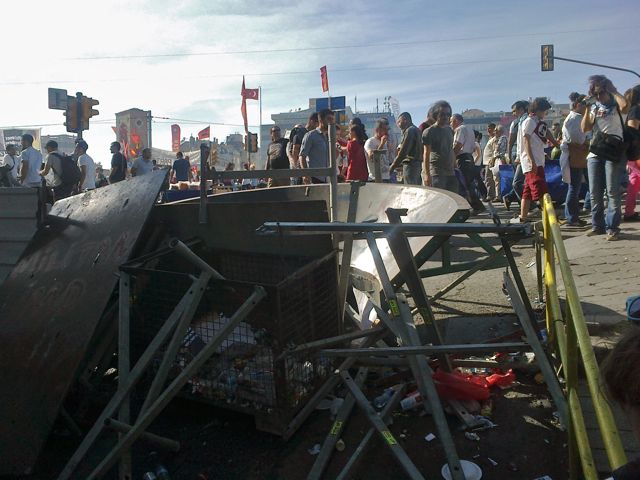
    The square is 'defended' by numerous but pretty flimsy barricades put up by protestors.
    Taksim Square is ‘defended’ by numerous but pretty flimsy barricades put up by protestors.
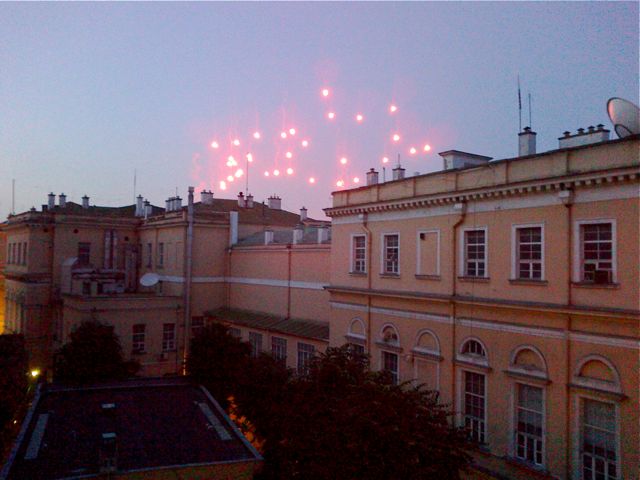
    Paper hot air balloons lit with big candles float into the air each evening from Taksim Square, here seen rising over the 19th century bulk of Istanbul's Russian Consulate-General.
    Paper hot air balloons lit with big candles float into the air each evening from Taksim Square, here seen rising over the 19th century bulk of Istanbul’s Russian Consulate-General.

    POSTSCRIPT

    The day after these photos were taken, on June 11, the police pushed the protestors off Taksim Square. The protestors responded with stone throwing, fireworks and in the case of one small group, Molotov cocktail throwing. The police then used high-pressure hoses and tear gas and tore down flags and banners. The police said they wouldn’t intervene in Gezi Park itself, but eventually, on the evening of June 16, they pushed them out of there too. Both sides accused each other of bad faith – the government saying protestors gave into radicals who only wanted a fight and refused to leave the square, and protestors who said they needed more time and commitments from the government. Once again, the police used force and tear gas in overwhelming measure. Protestors tried to win back the square on June 17, when the photos below were taken, but the police took strong measures to prevent that happening.

    A tough column of protestors from the Turkish Communist Party moves through Nevizadeh restaurant street after a confrontation with police.
    A tough column of protestors from the Turkish Communist Party moves through Nevizadeh restaurant street after a confrontation with police.
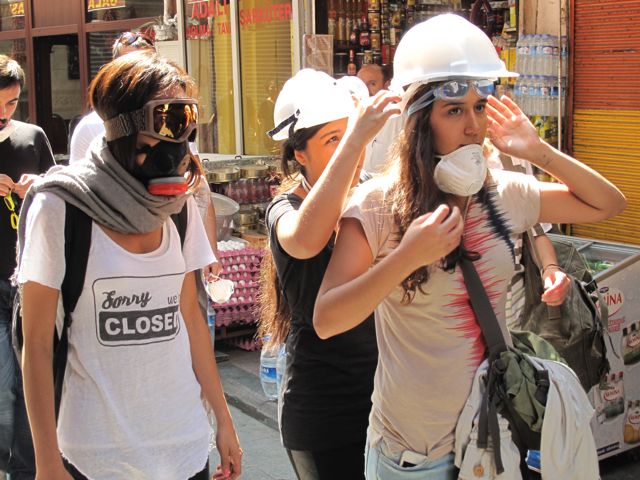
    Middle-class girls fix their gear as they try to find a way past police lines to recover Taksim.
    Middle-class girls fix their anti-gas gear as they try to find a way past police lines to recover Taksim.
    Police in control of Gezi Park
    Police in control of Gezi Park
    Gezi Park and Taksim Square, back under government control
    Gezi Park and Taksim Square, back under government control
    Fixing the Gezi Park flowerbeds, the morning after the Taksim Commune was ejected.
    Municipal gardeners fixing the Gezi Park flowerbeds, the morning after the Taksim Commune was ejected.
    The debris of the revolution
    The Taksim Commune RIP
  • Chestnut seller to the protestors, on Istiklal St. on 1 June.
    Chestnut seller at the height of the protests, on Istiklal St. on 1 June.

    The world’s media has descended on Istanbul to find out more about our Turkish unrest, an extraordinary long weekend in which the secular middle class lost its complacency, overcame its fears and discovered political protest. A new sense of humour joined the usually stern-faced national narrative, people are somehow walking taller and it is amazing to hear great, spontaneous waves of clapping spreading among pedestrians walking up and down Istiklal St outside my house. Everything changed, even if the baleful music from the music shop opposite unfortunately emerged from the day of rioting stuck the same gloomy rut (Ol-muyooor, ooool-muyor, “It just isn’t happening…”).

    The analysis is flowing fast. Here are just some good pieces in English I saw flashing past: Frederike Geerdink in Diyarbakir excellently explained why Kurds feel detached from the Istanbul excitements – a perspective that shines light on where Turkey as a whole really is today. Piotr Zalewski gave a fine account of the big day on Taksim. Henri Barkey pointedly noted how much he thinks this is about Prime Minister Erdoğan and his “yes men”, and the sharp wit of Andrew Finkel laid out how the PM needs to open up to local involvement in local decisions. Claire Berlinski’s acid take is a bracing antidote to mainstream news on Turkey. Nadeen Shaker had a fascinating interview with a perceptive activist, Ozan Tekin, about what the Taksim Square protests do and do not share with Cairo’s Tahrir Square.

    At Crisis Group’s Istanbul office, we couldn’t resist adding our voice to the hubbub, putting together what we hope is a balanced distillation of how we find ourselves answering questions from the sudden inrush of new and regular visitors. You can find our “Turkey Protests: the Politics of an Unexpected Movement” on the Crisis Group website here. I also did a commentary for Bloomberg urging Mr. Erdoğan to engage the protestors. Watching the novel, calm, empathetic outreach of Deputy Prime Minister Bülent Arınç at a news conference on 4 June, I felt that if Prime Minister Erdogan can execute one of his famous U-turns and do the same, it would do much to absorb the tensions.

    I also attach some images from the scene on Taksim Square and Gezi Park, mostly from Monday 3 June. The upbeat mood was much the same in most places in Turkey. The country is an amazingly resilient place that actually enjoys a good crisis – it’s normality some people have trouble with! Still, ordinary folk are almost competing to get things ‘back to normal’ wherever they can by cleaning up and fixing the few broken shopfronts.

    Still, nightly police-protestor confrontations that last for hours on the front lines have been frighteningly violent at barricades in Istanbul’s Beşiktaş district near the prime minister’s office, and in central Ankara. The new slogan rolling up from my street last night was a boisterous one: “Tyrant, Resign!” So for now we wait for the prime minister to return from his north African tour, and to discover whether we are now looking at the aftermath of an emotional outburst of popular sentiment, or whether the current precarious stand-off is just an interlude.

    Where it all began - the corner of Gezi Park on Taksim Square, where an excavator's work on May 27 to clear space for a new pedestrian pavement brought a group of environmentalists to protest - and where, when police intervened by burning their tents and tear-gassing them, a national movement was born. (The plan to build a shopping mall on the park is real but was not actually why the trees here were going to be uprooted).
    Where it all began – the corner of Gezi Park on Taksim Square where an excavator’s attempt on May 27 to clear space for a new pedestrian pavement brought a group of environmentalists to protest – and where, when police intervened by burning their tents and tear-gassing them, a national movement was born. (The plan to build a shopping mall on the park is real but was not actually why the trees here were going to be uprooted).
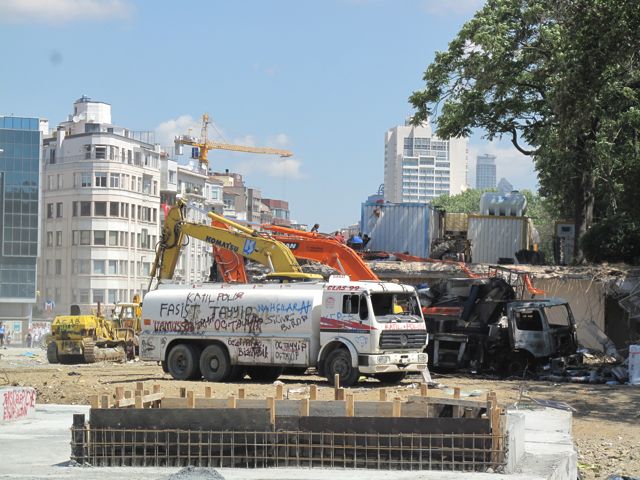
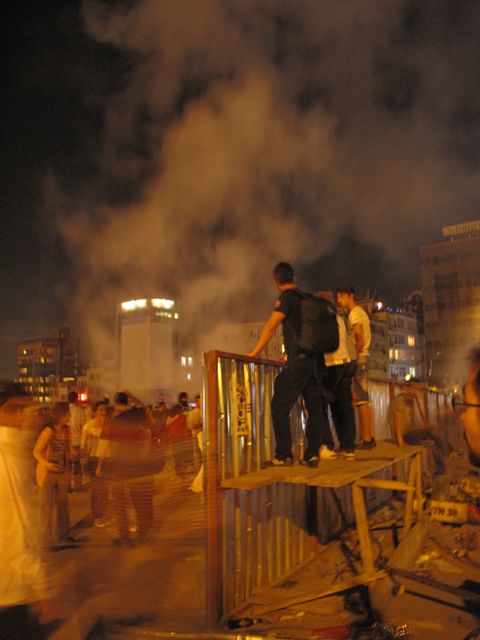
    While protestors in Taksim largely avoided looting and vandalism, they did target the work machinery for the new underground tunnels in Taksim Square, a first stage in the government's top-down redesign of modern Istanbul's most important public space.
    While protestors in Taksim largely avoided looting and vandalism, they did target the work machinery for the new underground tunnels in Taksim Square, a first stage in the government’s top-down redesign of modern Istanbul’s most important public space.
    Still, there's going to be quite a lot of clearing up to do on Taksim Square!
    There’s still quite a mess to clear up on Taksim Square.
    An overturned police car on Taksim Square. However, I don't think more than a dozen vehicles were damaged in the first days at least.
    An overturned police car on Taksim Square. Not many vehicles were wrecked like this one in the first days, but Interior Minister Güler said on 6 June that by that time a total of 280 workplaces, 103 police cars, 259 private cars, one house, a police station, 11 AKP political offices and one CHP political office had been damaged.
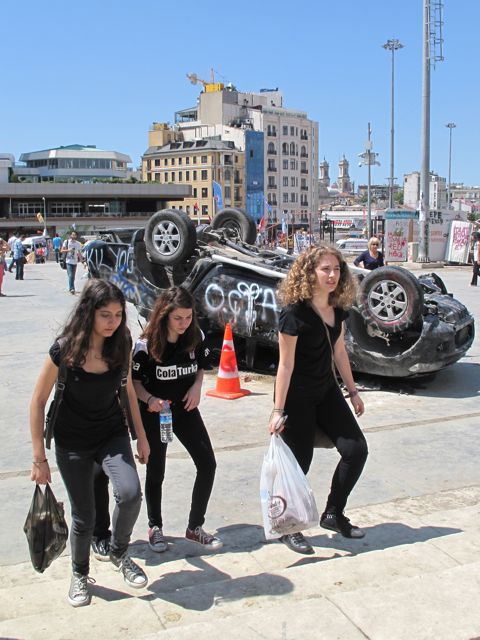
    Another overturned car on Taksim Square, quite a contrast to a typical group of well-brought-up girl protestors, wearing the signature black of the protests.
    Another overturned car on Taksim Square, quite a contrast to a typical group of well-brought-up girl protestors, wearing the signature black of the protests.
    This group of high-school students skipped class for the third day (and didn't tell their families where they were off to either).
    This group of high-school students in Taksim Square’s Gezi Park skipped class for the third day to follow the ebb and flow of protest (and didn’t tell their families where they were off to either).
    University students moving off to man the barricades after meeting, singing and dancing under the trees of Gezi Park.
    University students moving off to man the barricades after singing and dancing under the trees of Taksim Square’s Gezi Park.
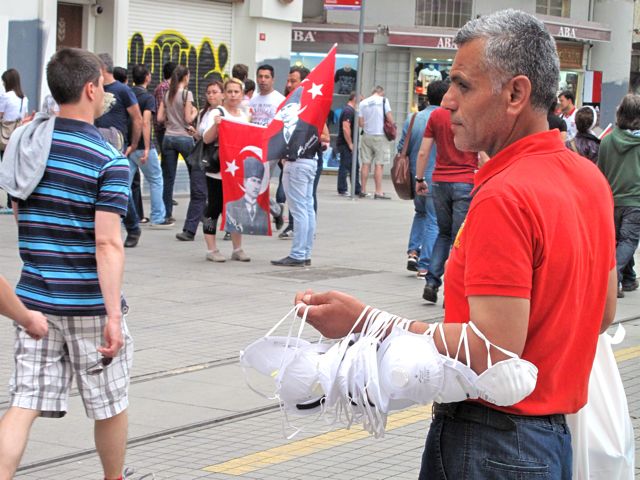
    Turkey is a resilient country and people quickly sought to take advantage of any new opportunities - here a man finds a new market in surgical masks protestors use to protect themselves from tear gas.
    Turkey is a resilient country and people quickly sought to take advantage of new opportunities – here a man finds a market for surgical masks protestors use to protect themselves from tear gas.
    The big clean up by the shops on the central pedestrian boulevard of Istiklal St. was particularly swift and impressive. The biggest problem was graffiti everywhere - some of it injecting an unusual sense of humour: "The Revolution Will Not Be Televised" (a dig at mainstream media failure to cover much of the protests), "This country is beautiful when It gets angry", or "I've been a faggot for 40 years, but I've never seen [unprintable]".
    The cleanup by shops on the central pedestrian boulevard of Istiklal St. was particularly swift and impressive. The biggest problem was graffiti everywhere – some of it injecting an unusual sense of humour into Turkey’s often self-important politics: “The Revolution will not be televised” (a dig at mainstream media failure to cover much of the protests), “This country is beautiful when it gets angry”, or “I’ve been a faggot for 40 years, but I’ve never seen [unprintable]” (More here).
  • At dawn of the morning after the night before, a flock of pigeons was picking on the debris from an amazing 48 hours outside my home on Istiklal St, the pedestrian boulevard through the heart of Istanbul. It was littered with trash, broken beer bottles and the odd ornamental tree yesterday’s protestors dragged into the middle of the road to act as a barricade against police forces. A few stragglers were still drifting away from a boisterous all-night celebration in Taksim Square of what they see as their victory over the police and government. Protestors and police apparently have clashed again briefly in at least one place elsewhere in the city, Beşiktaş, but for now things are quiet here, although a tang of tear gas lingers in the air.

    By 10am this 2 June, municipality cleaning trucks had got most of the street clean. Vans are coming to restock shops – or perhaps to see if the shops survived. Every few minutes in the blue sky above us, as they did even when clouds of tear gas billowed down the street during the battles yesterday, passenger planes make their final approach to Istanbul airport. But absorbing what happened on 1 June – and getting back to business as usual – is going to take a while longer than that.

    What are the long-term implications of having the heart of Turkey’s touristic, commercial and cultural capital captured by young people walking up and down most of the night shouting to Prime Minister Recep Tayyip Erdogan: “Tayyip, Resign!”? How impressive is it that these demonstrations spread to half of Turkey’s 81 provinces? Is this the beginning of a new democratic era of brave youth confronting an inflexible authority, or should we focus on an early taste of some frightening anarchy and looting? How much real political water is there behind this dam burst of secular sentiment in Istanbul, a flood which swept the flags of innumerable marginal and not-so-marginal left-wing groups to the heart of Taksim Square? How did a polls-obsessed government misjudge the mood so much? Does an ideology that consists in part of turning Turkey into a country in shopping malls linked by dual-carriageway highways not satisfy the people?

    I’m not yet sure about all these big questions, except to note once again that the government still won power in 2011 with 50 per cent of the vote, that it did not order its own probably far more numerous supporters out onto the streets of this city of more than 10 million people, that its cementing over of green spaces is nothing new in Turkish urban planning, and that under this administration, the parks and roadside flowers have looked better than anything previously. And for once in the first three days of the demonstrations themselves, the security forces and police, however excessive their use of tear gas and despite more than 100 people injured, miraculously killed nobody.

    So while thinking about those big unknowns, I think I’ll just share some pictures from the Istiklal St scene at about 11pm last night.

    IMG_7405
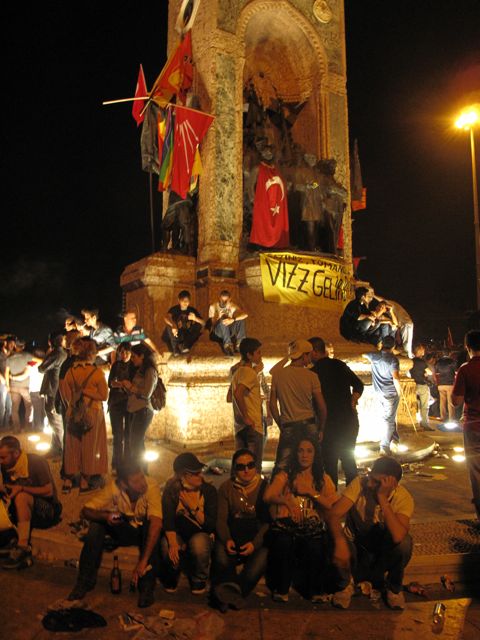
    The party at the central Taksim monument in Istanbul
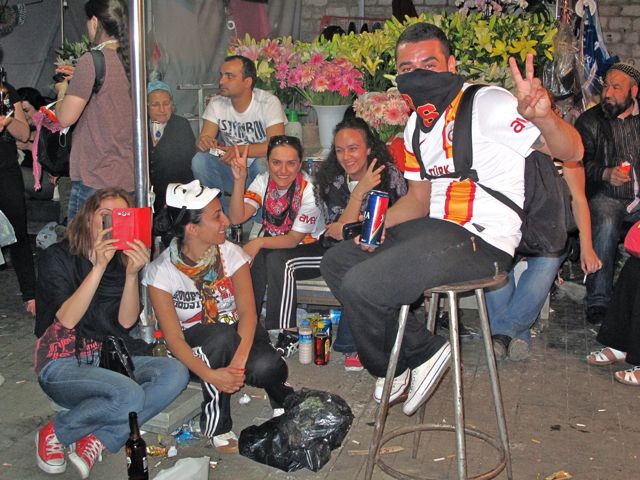
    Protestors celebrate in front of a Taksim Square flower stall
    Protestors celebrate in front of a Taksim Square flower stall
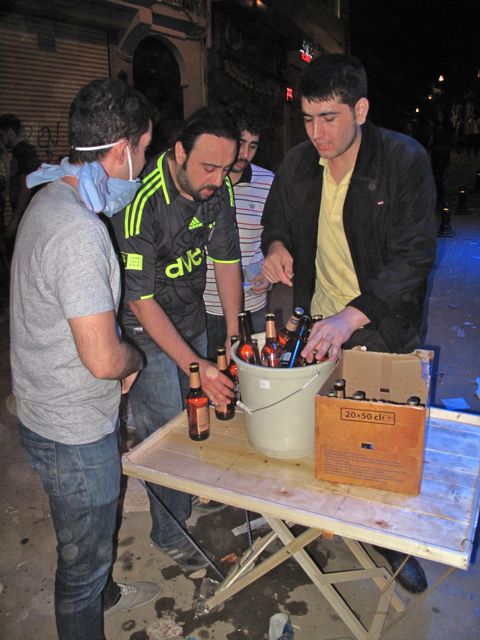
    The beer stand
    The beer stand
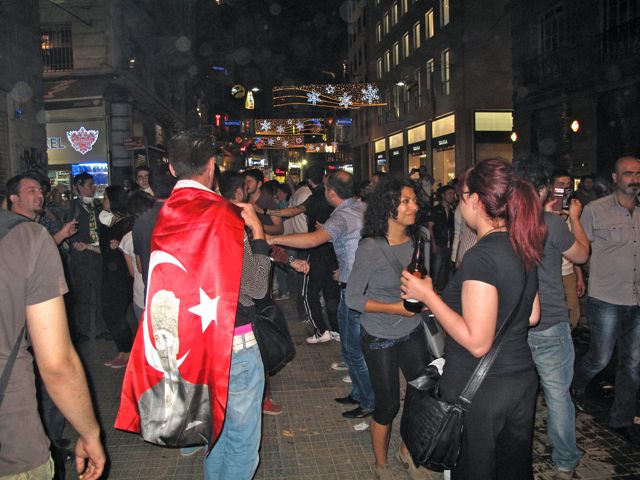
    Party time on Istiklal St - many people carried Turkish flags
    Party time on Istiklal St – many people carried Turkish flags
    The mess
    The mess
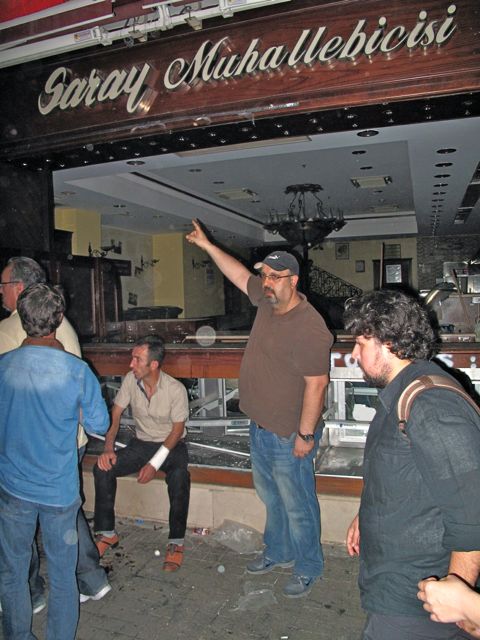
    Amid plenty of superficial damage and cracked display windows, the only shop on Istiklal that was truly pillaged was the pastry shop owned by Istanbul Mayor Kadir Topbaş
    Amid plenty of superficial damage and cracked display windows, the only shop on Istiklal I saw that was truly pillaged was the pastry shop owned by Istanbul Mayor Kadir Topbaş
    This prortestor wore her riding cap to the demonstration - for all the left-wing party flags, most of the protestors seemed to be middle class folk.
    This prortestor wore her horse riding cap to the demonstration – for all the left-wing party flags, most of the protestors seemed to be middle class folk.
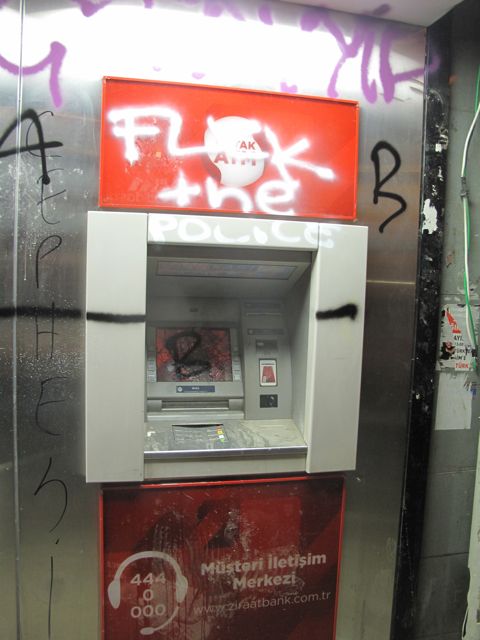
    Many ATMs close to Taksim were vandalized.
    Many ATMs close to Taksim were vandalized.
    Protestors seemed particularly focused on attacking and breaking up the worksite for putting Taksim Square traffic into tunnels.
    Protestors seemed particularly focused on attacking and breaking up the worksite for putting Taksim Square traffic into tunnels – presumably seeing it as part of the shopping mall complex that the government is still intent on building in some form on the Gezi Park in Taksim.
    The door of the French Consulate-General near Taksim. Here a slogan in French declares "Poetry in the Street - 1 June 2013"
    The door of the French Consulate-General near Taksim. Here a slogan in French declares “Poetry in the Street – 1 June 2013”
    Smiley vandalism
    Smiley vandalism
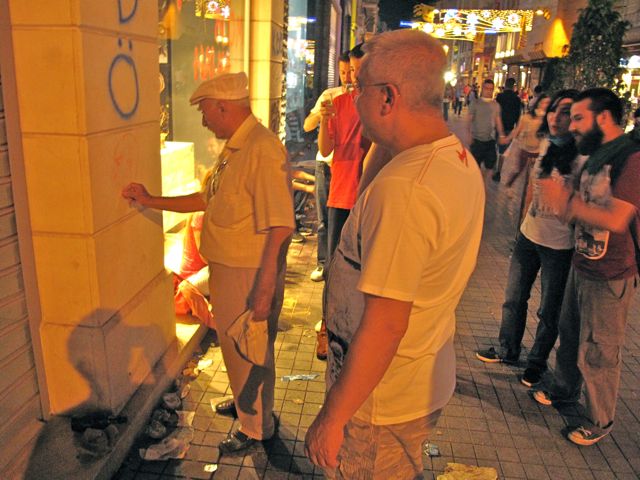
    Group claps as an old man draws a picture on the wall of the Paşabahçe glassware shop of republican founder
    A group of protestors clap as an old man draws a picture on the wall of the Paşabahçe glassware shop of republican founder Mustafa Kemal Atatürk
    Many left-wing slogans have appeared on the Istiklal St. shops - here 'Death to Fascism, the only way is Revolution. (Signed:) The Bolshevik Party"
    Many left-wing slogans appeared on the Istiklal St. shops’ blinds – here ‘Death to Fascism, the only way is Revolution. (Signed:) The Bolshevik Party”
    Zara hosts graffiti of a slogan with "Istanbul, Byzantium, Constantinople: Istanbul is Ours!"
    Zara hosts graffiti: “Istanbul, Byzantium, Constantinople: Istanbul is Ours!”
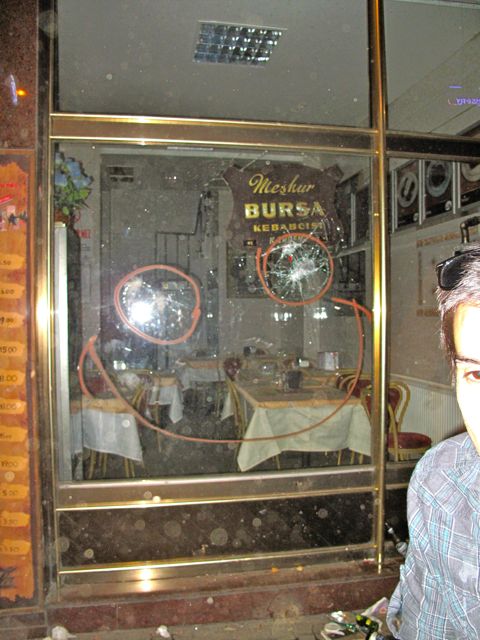
    About a dozen shops had their fronts or display windows broken; remarkably few - I only saw one - had been seriously looted (the one belonging to the mayor of Istanbul)
    About a dozen shops had their fronts or display windows broken; remarkably few had been seriously looted (I only noticed one, which belongs to the mayor of Istanbul)
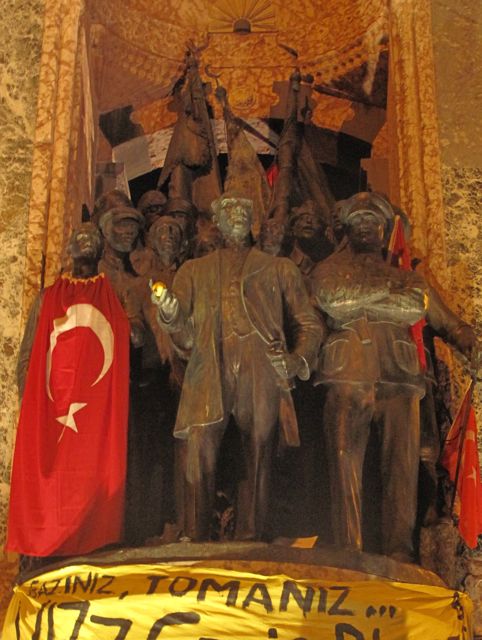
    And to end with - the statue of Ataturk on Taksim square, holding a lemon to help him deal with the tear gas
    And to end with – the statue of Ataturk on Taksim square, holding a lemon to help him deal with the tear gas
  • Living right on Istanbul’s main pedestrian boulevard of Istiklal St, 1km south of central Taksim Square and the now legendary Gezi Park, has given me a ringside seat to the wave of unrest that has gripped the city over the past 48 hours.

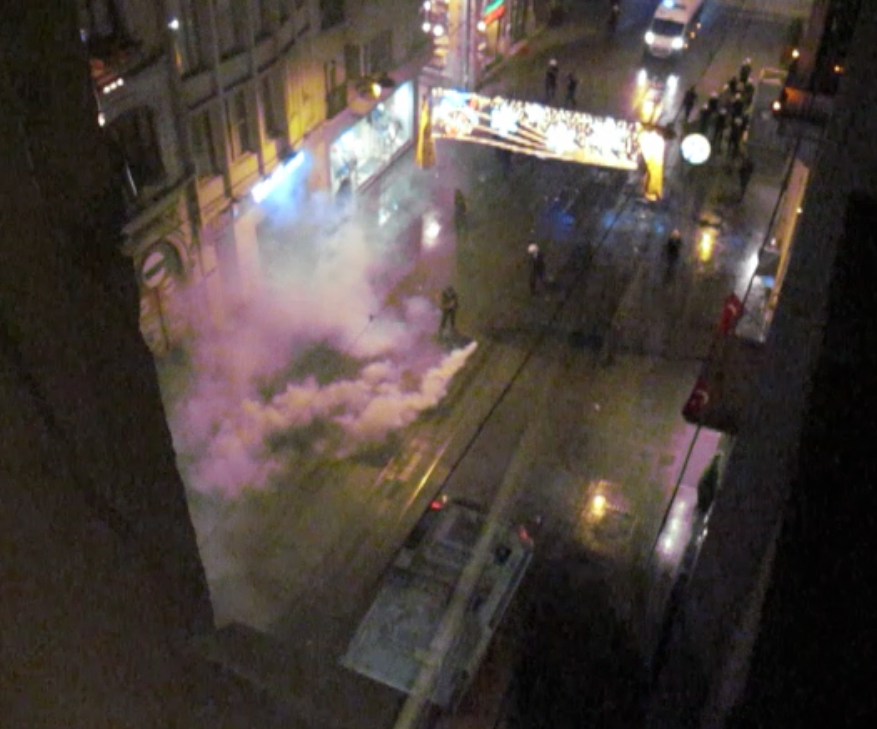
    Police clear street with gas on Istiklal St. near Tunel, c. midnight 31 May, 2013
    Police clear Istiklal Street with gas near Tunel, c. midnight 31 May, 2013

    At times everything seemed normal, even if the passers-by were fewer than on a usual weekend. Until late last night the music shop opposite was still churning out its usual Istiklal St. dirges. Then a group of protestors entered stage right, retreating from Taksim (slogans included: “We are the soldiers of Mustafa Kemal [Ataturk]”, “You’re all sons of whores”, “Government Resign”, “Shoulder to shoulder against fascism”…), the first of several waves usually  pursued with a strange theatricality by a group of police with an ugly water cannon truck — water from its high pressure hose scattering people like the whip of an angry mythical beast – and a posse of riot squaders. A few explosive pops from the tear gas launchers, and gas would stream out of canisters where they landed, the smoke unfurling in ribbons down the street. At our third-floor height it usually only burns the eyes and nose. We closed the windows for a few minutes before opening them up again for a better look at the next wave of attack and counter-attack.

    Police drive back crowd on Istiklal St south of Galatasaray, 11:45 on 1 June
    Police drive back crowd on Istiklal St south of Galatasaray, 11:45 on 1 June

    Early this morning, all seemed quiet. Municipality cleaning trucks had left the pedestrian precinct immaculately clean, the vans that restock the Istiklal St. shops turned up, and middle-aged north American tourists wandered down in new white sneakers & their pink, plum, and orange cottons, taking in the sights. But there was an odd silence in the street that did not bode well for the day ahead.

    At 10am, a first group of protestors came running  down the street, chased by another police patrol spraying water left and right, popping off gas canisters and chasing demonstrators into side-streets. One group who took refuge in a shop got a special, almost casual gassing by passing police. At 10:30am, small groups of demonstrators gathered again. One came from the south, built a barricade outside our building to try to stop the police vehicles chasing them, and then headed off for Taksim. Throughout this, the seller of Turkish simit sesame bagels from a little red nostalgic ‘Beyoglu’ cart remained firmly at his post – doing steady business just meters from where the skeins of gas fumes were floating around. But even he fled at 1:15pm, when the police charged more strongly and fired a dozen gas canisters, some aimed high and sent spinning down this late 19th century boulevard like javelins on a battlefield. Everyone scattered into sidestreets. (My wife Jessica Lutz filmed it, here). Ten minutes later, they were back with even more people filling the pedestrian district, with even more scornful slogans about “Killer AKP” (the ruling party). At 2pm, the police counter-attacked, even more dramatically. The crowd regrouped, its slogans turning into low howls of anger; at 2.45pm the police pushed back again from behind a thick screen of gas. This time they also faced a barrage of stones from some protestors, among the very front lines of which could be seen the red flag of the Turkish Communist Party and even a lone flag of the Kurdistan Workers Party (PKK).

    At 4pm, after a last flurry of gas canisters near Galatasaray, the police reportedly received orders to allow demonstrators through to Taksim. Gradually the crowd – mostly cheerful, ordinary folk with no obvious political affiliation who filled the breadth and length of Istiklal St’s southern half – moved forward to Istanbul’s central square in celebratory mood.

    So what’s new in all this? Social media, for a start. Many of my Turkish friends are glued to their Facebook accounts, sharing pictures of the worst police outrages – a remarkable one shows a policeman dousing a protestor with a device like an insect spray gun, as the protestor holds up a sign saying “Chemical Tayyip” [Erdogan] — and spoof posters like an ad for the “Istanbul Gas Festival”, “We can’t keep calm, we’re Turkish” and so on. The spontaneous look of the small groups of protestors coalescing and dispersing in the street outside is quite unlike the usual formal protests organized by unions and political parties, and lacks the angry, violent edge to the pop-up parades by radical left-wing groups. Mostly young and middle class, they include people in shirts for all Istanbul’s big rival football clubs, young women in headscarves, groups of white-coated medical volunteers, and a young man with a big bag of lemons, selling them to the crowd as an tear gas antidote.

    On the other hand, Turkey had the same banging of pots and pans in anti-government neighbourhoods in the 1990s, which was widespread on the Asian side of Istanbul last night; and in my district of Beyoglu, every year or two a big issue brings angry demonstrators and policemen with gas weaponry that is used to clear people away. While the government is clearly rattled this time round, after four days, perhaps the only obvious long-term political consequence I can predict so far is that all this will be remembered when Prime Minister Erdogan launches his expected quest for the presidency in an election next year.

    The demonstrations are already about a lot more than sympathy for condemned trees in a street-widening scheme at the Gezi Park, and have taken on a distinctly anti-government tone. Reasons for the protests I’ve heard from friends over the past 48 hours include: a reaction to the ruling party’s focus on building shopping centers everywhere, even in Istanbul’s last patches of green, like the future mall planned for Gezi Park; how the half of the population that didn’t vote for the government resents what it sees as its increasingly high-handed, majoritarian, we-know-best style; among secularists, a sense that the ruling party revealed a Islamist agenda that could infringe its lifestyle with sudden new regulations this month on alcohol consumption (my blog on that here); among the 10 per cent Alevi minority, anger at this month’s choice of Ottoman Sultan Selim the Grim’s name for a third bridge over the Bosphorus, since he killed many Alevis; the general feeling that there is little transparency in what the government plans and does, and that the media is under great pressure not to discuss real events or who benefits financially from projects (one mainstream TV program during last night’s was about radiation on Mars!); and above all, a sense of powerlessness, and frustration at the inadequacy of the main political opposition parties, which have left the bulk of secularists of Istanbul with a feeling that they’ve had no real political representation for years.

    There’s a lot of talk among my Turkish friends of the Gezi Park demonstrations being a “turning point”, and today it feels that way, with growing numbers of demonstrators in the streets, many cities in Turkey protesting in sympathy, and the unscripted nature of proceedings. Normal patterns have been drastically changed in recent days, not just in  traffic but also in many peoples’ lives. Phone calls with friends in the center are often about “my street is all mixed up now, can’t talk for long”. If anyone gets killed, rather than 100 or so already injured, that will sharply escalate the situation. Here’s hoping the government manages to handle the next 24 hours more sensitively than the last. A good first move would be to get some traction by letting state television give a full version of events – currently, people are consuming a diet of wild rumors and partial views on social media, which can only add to the current escalation.

  • I got a surprise yesterday at lunch at the restaurant round the corner from my office, where I’d agreed to do a book talk for half a dozen of the city’s journalists from Spain. The surprise was not so much that each of them graciously bought a copy of Dining with al-Qaeda. (This makes Spain my country of the week!) Rather, the shock was caused by what suddenly was not on the menu, in one of the touristic hubs of Istanbul.

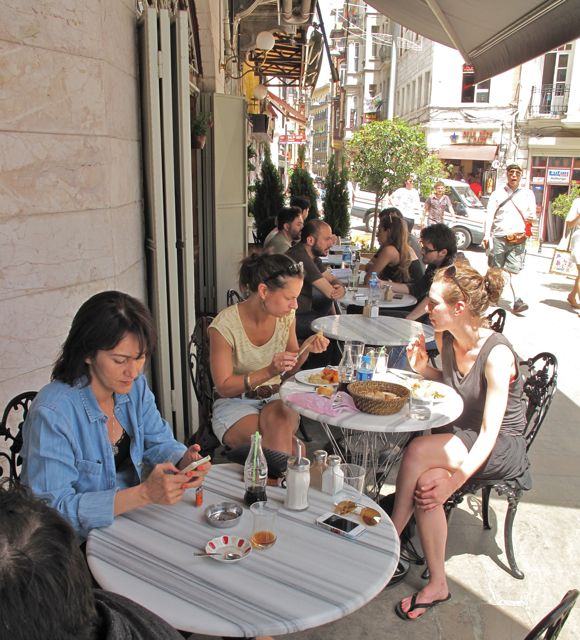
    The pavement tables are back, but the booze has gone.
    The pavement tables are back, but the booze has gone.

    “Beer?” asked a Spanish TV correspondent, newly arrived in Turkey from China.

    “Maalesef (sorry),” said the waiter.

    “Wine?”

    “Can’t do it.”

    “But here …”

    “It’s the new law.”

    So the axe has fallen at last. Or has it? I could see the Spanish reporter looking at the menu in puzzlement, not yet used to the way that in Turkey, what you see is not always what you get. I think I’m accustomed to that after 25 years in Istanbul. When I read in the papers that parliament in Ankara is talking about new laws, for instance, I assume it will make little difference to my daily life, or at least not anytime soon. Yes, the new law said that alcohol can’t be sold within 100 meters of a mosque or educational building. But I thought there had been an ordinance like that since Ottoman times, and that it was evidently unenforceable.

    This latest edict has got the bar and restaurant crowd running scared, however.

    “I paced the distance myself,” said the son of the establishment’s owner. “We’re 70 meters from a mosque that way, and less than 100 meters on the other side.”

    “Did you get a written order to stop serving drinks?”

    “No, we saw it on TV. We’re trying to work out what to do … This will mean quite a loss.”

    Indeed, it’s not just this restaurant under the Galata Tower that may suffer losses from the new law now awaiting approval by the president, and which also foresees a ban on shop sale of alcohol between 10pm and 6am and a complete ban on advertising (see Today’s Zaman on its acceptance by parliament on 24 May, here). It looks like being in Istanbul may — officially at least — really get a bit more bracing and clear-headed for everyone.

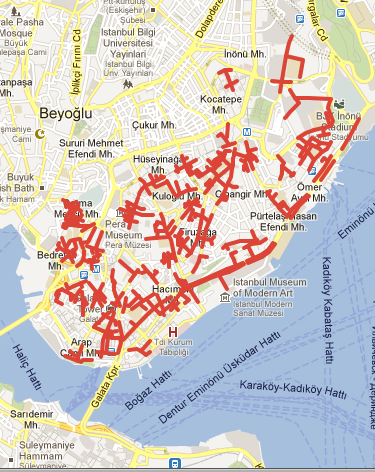
    Dov Friedman's map of the district of Beyoglu, with the 100m from a religious establishment and school shown in red
    Dov Friedman’s map of part of downtown Beyoglu, showing in red which streets are less than 100m from a religious establishment and school

    Pro-government newspapers disingenuously present the change as the adoption of either European rules or a 100-yard law that New York apparently has too (see Sabah, here); apparently the law will only apply for new licences. But just because the late leader Turgut Özal gave Istanbul a 212 dialing code two decades ago doesn’t make the two places the same. New York is a place designed on entirely different scale to the jumbled maze of inner Istanbul. Perhaps some spots in the historic central mahalles are more than 100 meters from a school, mosque, church or synagogue, but these look like pretty obscure dead angles on a map speedily drawn up by Turkey pundit Dov Friedman here.

    I hardly ever drink anything at lunch, and I don’t want to be defined by alcohol consumption. But I’d certainly like to have the right to order a beer if I wanted in this multinational heart of Istanbul. (Postscript: I should add that many parts of Turkey today don’t have the European culture of drinking alcohol in public places, and most people in the country don’t drink it anyway – the Organization of Economic Cooperation and Development says Turks drink one seventh to eighth the average intake of Americans and Europeans!) I also wondered too whether the new law was also the reason that my local supermarket recently ran down its stocks of wine, which new taxes and exploitative wineries have been making steadily more expensive in recent years.

    “We’ll fix the problem”, the owner’s son said, in that vague tone of “it’ll all be fine” fatalism that plagues so many projects in the country. After all, the law’s regulations will probably exempt tourism areas. Turkey may be a religious-minded place, but there are limits to how much damage any government can do to business. Also, at a next-door-neighbour restaurant – still serving alcohol, but worried about the effects of the new ban – the head waiter thought that in fact my usual restaurant had never had a full alcohol licence, hence its owners’ extreme caution now.

    Whatever the exact truth of this particular case, the anti-alcohol drive is unquestionably gathering momentum. I accepted a serving of my delicious foamy yoghurt-and-water ayran, the age-old Turkish refreshment that the prime minister recently announced is now Turkey’s national drink. This new title was a clear swipe at the heady old aniseed liquor, rakı, the lions’ milk beloved of republican founder Kemal Ataturk and the national drink for many other secular-minded Turks.

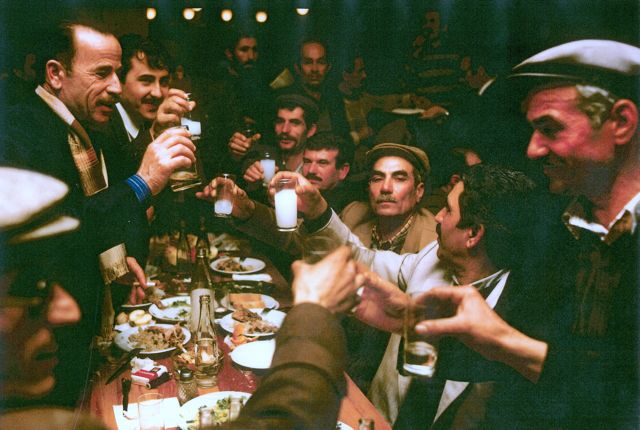
    Camel owners in western Turkey toast each other on the eve of a camel wrestling tournament. Photo by George Simpson
    Camel owners in western Turkey toast each other with rakı on the eve of a camel wrestling tournament. Photo by George Simpson

    Devout Muslims, of course, believe alcohol is banned by the Qoran. But one of the endearing characteristics of the Turks is that many would take offense if someone said that occasional indulgence in it made them any less Muslim than the rigorously abstinent.  Indeed, I told the group from Spain that when I wrote Dining with al-Qaeda I tried to minimize using the word “Islam”, preferring the more individual “Muslim”, since interpretations of what Islam means vary so much between persons and countries. But the arrival of the anti-alcohol campaign on our street corner may mean that a decade after the Justice and Development Party came to power, I may at last have to start conceding that the government does sometimes have an Islamic religious agenda. Indeed, justifying the government’s measure to his party on 28 May, Prime Minister Erdoğan said there was no question of banning alcohol but asked “why do people respect a law made by two drunkards [presumably, republican founders Ataturk and Inonu], but feel the need to reject a law ordered by religion?”

    As my new Spanish book club and I philosophized over fine lentil soups, spicy kebabs and soft Turkish pide pizzas, however, I wondered again. Maybe this anti-alcohol gambit is just a clever political smoke screen to hide new Byzantine intrigues. Presidential elections are in the offing, a daring constitutional change is in the air, and the government’s Syria policy has provoked much unease. The opposition is gaining a little traction. At similar junctures in recent years, the prime minister has briefly distracted the national agenda and made gestures to his core constituency with “Islamic” initiatives about divorce, abortion, headscarves and the like. He seemed in similar form in support of the anti-alcohol campaign, waxing rhetorical about saving a generation from being one that “drinks day and night and wanders around in a haze.”

    A couple of years ago, after all, the government banned outdoor tables from the pavements of Beyoğlu, despite scuffles with angry restaurant owners. Now, as if nothing had happened, the tables that don’t get in pedestrians’ way are back on the street, including outside my local restaurant. It’s democracy, Turkish style: the government shoves, the people push back and the state re-adjusts — but only so much. With small steps those at the top can keep advancing a cause, and ten years in power, after all, is a long time.

    Other informative stories on this question can be found here, focused on the drop in Turkish beer companies’ outlook by Bloomberg’s Benjamin Harvey, and here, by the Wall Street Journal’s Emre Peker about reactions to the ban. 

    POSTSCRIPT: The restaurant mentioned at the top of this article did in fact finalise its alcohol licence a few months later – despite it’s proximity to a mosque – under a provision to encourage touristic establishments. So all’s well that ends well there, especially since it now serves draft Guinness. But farther from the touristic beat, I suspect that the new puritanism is still spreading.

  • Jean-Pierre Thieck, RIP
    Jean-Pierre Thieck, RIP

    The opening scene in Dining with al-Qaeda is in a brothel in Aleppo, where my first Middle East mentor, the late Jean-Pierre Thieck, took me in March/April 1980 as an undergraduate to introduce me to life in Syria. Appropriately, the very next morning, the Syrian army invested the town for three days of shooting, strike-busting and carting citizens off to torture/detention cities on the outskirts of town in open trucks in pyjamas. Plus ça change. And far from meeting any Syrian madames, even though I would have welcomed that, as Jean-Pierre’s side-kick I was in fact introduced to his parallel life of gay adventure. So I was fascinated to read the experiences of of a gay couple whose very different voyage to the east is described in Jack Scott’s book Perking the Pansies: Jack and Liam Move to Turkey. As I point out in this review I did for Istanbul’s Hürriyet Daily News, Jean-Pierre’s many “Turkish and Syrian counterparts would rarely have viewed themselves as homosexual, and, paradoxically, I was always astonished at how normal and even socially acceptable Jean-Pierre’s extraordinary behavior was considered. As in Europe, Middle Eastern societies have much more trouble with the idea of a stable, loving, explicitly homosexual marriage.”

    Book by gay couple provides new view on

    same-sex marriage in Turkey.

    By Hugh Pope

    Turkey is stuck between East and West, which is why I like living in Istanbul. It’s also why I get frustrated each time I see the headline “Where is Turkey going?” as if the country was about to run off somewhere. So it was fun to read a book that included both a fundamental challenge to Turkey’s status quo and accepted the country as it is. More surprisingly, “Perking the Pansies: Jack and Liam move to Turkey” is also the story of one of the first overtly gay married couples to set up house and home here.
    Moving to Bodrum

    To be precise, Jack Scott and his spouse moved to the Bodrum peninsula, a hedonistic enclave on the Aegean coast that some Turks barely think of as really being Turkey, or at least where some Turks go in order to escape from the rest of Turkey. It’s hard to imagine their openly homosexual household lasting long in many other places in the country. But they managed, for a year or two anyway. Their experience makes for a compelling and enjoyable read, if you’re broad-minded enough for some in-your-face emotion and choppy BBC sitcom dialogue. Scott is always empathetic, respectful to the country and people that became his host and pretty acute about Turkey’s politics, society and foibles.

    It was nice to see someone else agree, for instance, that “there are more parallels between Britain and Turkey than many realize … anchored to the edge of Europe but chained to it economically.” Living in the Turkish provinces opens his eyes to something those trapped in the bubbles of Istanbul high life or Ankara government rarely see: “How could Turkey ever hope to become an industrial powerhouse if they couldn’t keep the bloody lights on?”

    Despite limited Turkish, his insights are sharp: “Turkish arguments are different: loud, passionate, sometimes physical and ultimately pointless. No one gives in, no one wins and no one loses.” And he has a great answer to that most difficult question: what’s Turkey like? “Amazing. Educational. Terrible. Surreal. All four.”

    Jack Scott
    Jack Scott

    Scott is amusingly merciless in his dissection of British expatriates – one category is the VOMITs, well-off, middle-aged nymphs who become “Victims Of Men In Turkey,” including a VOMIT subgroup of MADs, those who have persuaded themselves that “My Ahmet is Different.” But such diversions were not enough to keep the couple interested in staying for long. Any frictions over their open gayness seem not to have been the main reason for leaving Turkey, but a bigger, less-defined disorientation and missing of home, a realization that without family, language and roots, “our life in Turkey wasn’t real. Not really. We were drifting around in an extraordinary expat bubble with people we didn’t know or really care about.”

    The gay angle on Turkey was of particular interest to me. My first visit to Turkey was with a fellow student at Oxford, the remarkable, warm, generous French polyglot Pierre Thieck, who died of AIDS in 1990. This brilliant Arabist also introduced me to his Middle East of addictive homosexual encounters, often several times a day. But his Turkish and Syrian counterparts would rarely have viewed themselves as homosexual, and, paradoxically, I was always astonished at how normal and even socially acceptable Jean-Pierre’s extraordinary behavior was considered. As in Europe, Middle Eastern societies have much more trouble with the idea of a stable, loving, explicitly homosexual marriage.

    Model was ‘making a real difference’

    Scott and his spouse bravely hoped that their pioneering model was “making a real difference.” It was difficult for them, especially when one of their Turkish homosexual friends in Bodrum was murdered. Scott points out how hard it was to understand repressed, contradictory attitudes in a country “where sexual ambiguity is an art form … my gaydar [gay radar] malfunctioned as soon as I entered Turkish airspace … I was left in a continuous state of disarray, thrown by the intensive penetrating stares and contradictory playful signals from the swarthy men around me. I never played the game because I never got the rules.” In his epilogue, Scott suggests that “a respect for difference won’t destroy” the many old-fashioned qualities of Turkey, and a parting message: “It’s okay to be queer. It won’t bring down the house, though it might bring in a little more style.”

    Hugh Pope is the author of “Dining with al-Qaeda,” “Sons of the Conquerors” and “Turkey Unveiled.” After 25 years in Turkey, Scott would probably define himself as part “emiköy” (the village type of expatriate with chickens) and part “vetpat.”

    March/22/2013

    Original article here

  • Screen shot 2013-03-11 at 18.06.12The French edition of Dining with al-Qaeda, Rendez-vous avec al-Qaida, has won its first plaudit in French media! The review in Le Monde diplomatique’s February 2013 edition is by none less than Jean-Pierre Filiu, a professor at Sciences Po in Paris and a globally published author on jihadi/al-Qaeda matters. I’ve attempted a translation below, but first I checked with a French friend what to think. Initially, Prof. Filiu’s judgments looked to me as though they might be pretty ambivalent. My friend reassured me that in fact “the review was extremely laudatory. you should know that us french don’t indulge in hyperboles or even positive language generally. when asked how he is doing, a frenchman says ‘pas mal’ or ‘on fait aller’. you just got a ‘pas mal du tout’ which is quite something”. For what it’s worth, the book’s page on amazon.fr soon announced that only one copy was left. Hooray!

    Screen shot 2013-03-11 at 17.41.33Screen shot 2013-03-11 at 17.51.03Hugh Pope a couvert le Proche-Orient pendant une trentaine d’années, essentiellement pour le Wall Street Journal. C’est cette expérience qu’il livre — sous un titre inutilement réducteur —, entraînant le lecteur du Caire à Islamabad, d’Istanbul à Djedda, au fil des crises et des reportages. Pope assume ses contradictions avec un humour faussement candide. Britannique et pro-palestinien, opposé à l’invasion de l’Irak en 2003, ayant refusé de rejoindre ses confrères « embarqués » dans les unités américaines, il mesure tout ce que représente le Wall Street Journal dans cette partie du monde. Il souligne les limites du volontarisme du général David Petraeus, devenu commandant de la région de Mossoul, et n’est pas plus tendre pour la « liberté artistique » prise avec la réalité factuelle par le célèbre reporter Robert Fisk. Sa propre conception de la profession est à la fois plus sobre et plus exigeante : il recherche les angles morts de la curiosité occidentale, chez les Yézidis du Kurdistan, dans la ville sud-soudanaise de Wau, ou à Kaboul à l’heure des talibans.

    Jean-Pierre Filiu

    And here is my translation – any suggested improvements welcomed!

    Hugh Pope covered the Middle East for three decades, mainly for the Wall Street Journal. It’s this experience that he describes – under an unnecessarily simplistic title – as he takes the reader from Cairo to Islamabad, from Istanbul to Jeddah, on the trail of crises and reporting trips. Pope tempers its contradictions with a humour that is deceptively innocent. British, pro-Palestinian, opposed to the invasion of Iraq in 2003, and refusing to join his fellow reporters “embedded” in American units, he takes the measure of everything that The Wall Street Journal represents in this part of the world. He underlines the limits of the get-up-and-go of General David Petraeus, the commander of the Mosul region, and is no more merciful about the “artistic license” taken with factual reality by the celebrated reporter Robert Fisk. His own understanding of the profession is both more sober and more demanding: he seeks out the blind spots of Western curiosity, with the Yezidis of Kurdistan, in the south Sudanese town of Wau, or in Kabul in the days of the Taliban.

  • A poster of Lawrence's portrait defaced on an Istanbul street with the words "English Spy"
    A poster of Lawrence’s portrait (advertising an Orientalist exhibition in Istanbul) defaced with the words “English Spy”

    The one thing I couldn’t persuade the publishers of Dining with al-Qaeda to change as we edited the text was their leading phrase in the jacket-sleeve blurb, which referred to the author as “Following in the footsteps of Sir Richard Burton and Lawrence of Arabia …”

    In January, for the magazine The Majalla, I finally got to write down the full reason why I felt a reference to Lawrence wasn’t appropriate for a book like mine, which is in large part about how difficult it is to set facts straight about the Middle East. I’ve complained about modern journalists who claim to be strictly reporting what happened and yet do not always stick to the non-fiction high road (more here). “Faction” is of course not uncommon – some books of Ryszard Kapuściński were so light-footed they were dubbed “magical journalism” (more here). To be sure, both Kapuściński  and Lawrence appear to have told their friends that they were not trying to recount plodding facts. But the problem for me remains that most people don’t realise that, and most publishers are not in a rush to tell them.

    Lawrence of Legend

    The lost critic and the legend of Lawrence of Arabia

    Hugh Pope’s discovery of a long forgotten book; Lawrence of Arabia: A Biographical Enquiry by Richard Aldington unravels the hype and fabrication behind the Lawrence story.

    The Majalla, 28 January 2013

    T.E. Lawrence (left) and American publicist Lowell Thomas
    T.E. Lawrence (left) and American publicist Lowell Thomas

    When I was spending summer afternoons copying Arabic lettering off the blackboard at Oxford University’s Oriental Institute, I would often catch myself staring out of the dull, aluminum-framed windows. Where were the sweeping skylines pricked with minarets, the romantic deserts, the bustling bazaars of my imagined Middle East? Where were the clash and drama of newspaper coverage of wars and revolutions? Much of the Arabic syllabus seemed to peter out around the time of the Ottoman Empire’s conquest of Constantinople in 1453, and their takeover of the Arab World soon thereafter. Strangely, it seemed to me, even Britain’s extraordinary twentieth century moment in the Middle East was almost never discussed in my university classes.

    In those days, soon after the publication of Edward Saïd’s Orientalism, our teachers were also determined to avoid the Orientalist label. Sweeping vistas were out. The fashion was for minute, detailed study of manageably small events and narrow themes—and, for me, those impossible-looking curves and dots scratched in chalk on the blackboard. One result was that I began to nurse a secret love of the breezy memoirs and letters of the British who passed through the history of the East and could write well about it: Lady Wortley Montague, dragomans and ambassadors; or officials like John Bagot Glubb (dubbed “Glubb Pasha”), Sir Mark Sykes and Sir Harry Luke, even a glossy vision of Iraq that leaped from the pages of the 1955 yearbook of the London-based Iraqi Petroleum Company, a treasure I discovered on an upper floor of Baghdad’s old book market.

    The most glamorous of them all, of course, was T. E. Lawrence—Lawrence of Arabia—and his voluptuous literary feast, theSeven Pillars of Wisdom. This promised and delivered “the sweep of the open spaces, the taste of wide winds, the sunlight and the hopes.” Before going up to Oxford I had bought a copy of this account of the 1916–1918 Arab Revolt. I thrilled to his desert guerrilla raiding as a semi-amateur British army officer, his seamless acceptance into a different world to which I aspired to belong. I admired his promotion of the oppressed Arabs’ cause, and the selfless sacrifice of his status when London betrayed their promises of Arab independence. This work seemed to be considered almost pornographic by the Oriental Institute dons, but since we never studied the period or discussed the book in any depth, I never learned why.

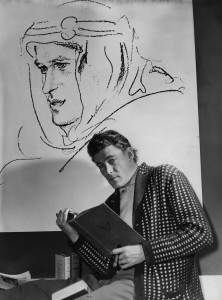
    Actor Peter O'Toole studying for his part in the film Lawrence of Arabia
    Actor Peter O’Toole studying for his part in the film Lawrence of Arabia

    Then one recent day in Edinburgh, I came across the plain black cover of the first edition of Richard Aldington’s Lawrence of Arabia: A Biographical Enquiry, a book I had never heard of. Here, in the folds of what I judged was measured prose, was concealed a jeweled dagger of a polemic. It led me into a whole world of debate about the Lawrence story—the great film, the (lack of) sex, his genius, his psychology—of which I am no scholar. But Aldington’s arguments did ring startlingly true as he portrayed Lawrence as one of my bugbears, a writer who exploits the confusion and magical reputation of the Middle East to play fast and loose with the facts.

    Aldington was ambitious, seeking to deconstruct “the legend of Lawrence,” and to prove that key parts of his work were “heightened, exaggerated, faked, boastful and sometimes entirely without foundation,” making the British hero “at least half a fraud.” Even Lawrence’s trade-mark blowing up of Hejaz Railway trains, he said, was just “a wartime intensification of a constant peacetime nuisance,” and what other British and French officers equally proficient in such guerrilla actions lacked “was literary skill to write up their achievements.”

    Aldington acknowledges that Lawrence’s lyrical description of the march to capture the Red Sea anchorage of Al-Wajh is “one of the admired set pieces of Seven Pillars,” with much singing, bouncing camels and barbaric splendor. But he then notes that Lawrence brought his men up two days late for the fight, during which British navy ships and men did the real fighting while the Bedouins hung back or looted. As for the ramshackle capture of the Red Sea harbor town of Aqaba—“another Gallipoli,” according to Seven Pillars—it had been done twice before in the war.

    Later, the final British race through Palestine to Syria in 1918 was won thanks to old-fashioned bludgeoning by General Edmund Allenby’s main army columns, with Lawrence and his light raiders at most slightly distracting the Ottoman-German command with skirmishing on the desert flanks. It is sickening to read Aldington’s indictment of the massacres of retreating Ottoman and German troops by Lawrence and his Bedouin irregulars, even if Lawrence admitted the slaughter. As for the great price on his head that Lawrence suggested was offered by his enemies, Aldington can find no evidence for it—nor indeed any mention of Lawrence in any of several accounts published by German or Ottoman officers who served in the Arabian peninsula.

    Aldington also challenges a central pillar of the Lawrence legend. Lawrence told one of his biographers, Basil Liddell Hart, that “since about sixteen years of age [he had been] filled with the idea of freeing people and had chosen the Arabs as the only suitable ones left.” Later, Lawrence said he resigned from government service because Britain betrayed promises forwarded by him to the leaders of the Arab revolt, or as he puts it in Seven Pillars, “an Arab war waged and led by Arabs for an Arab aim in Arabia.”

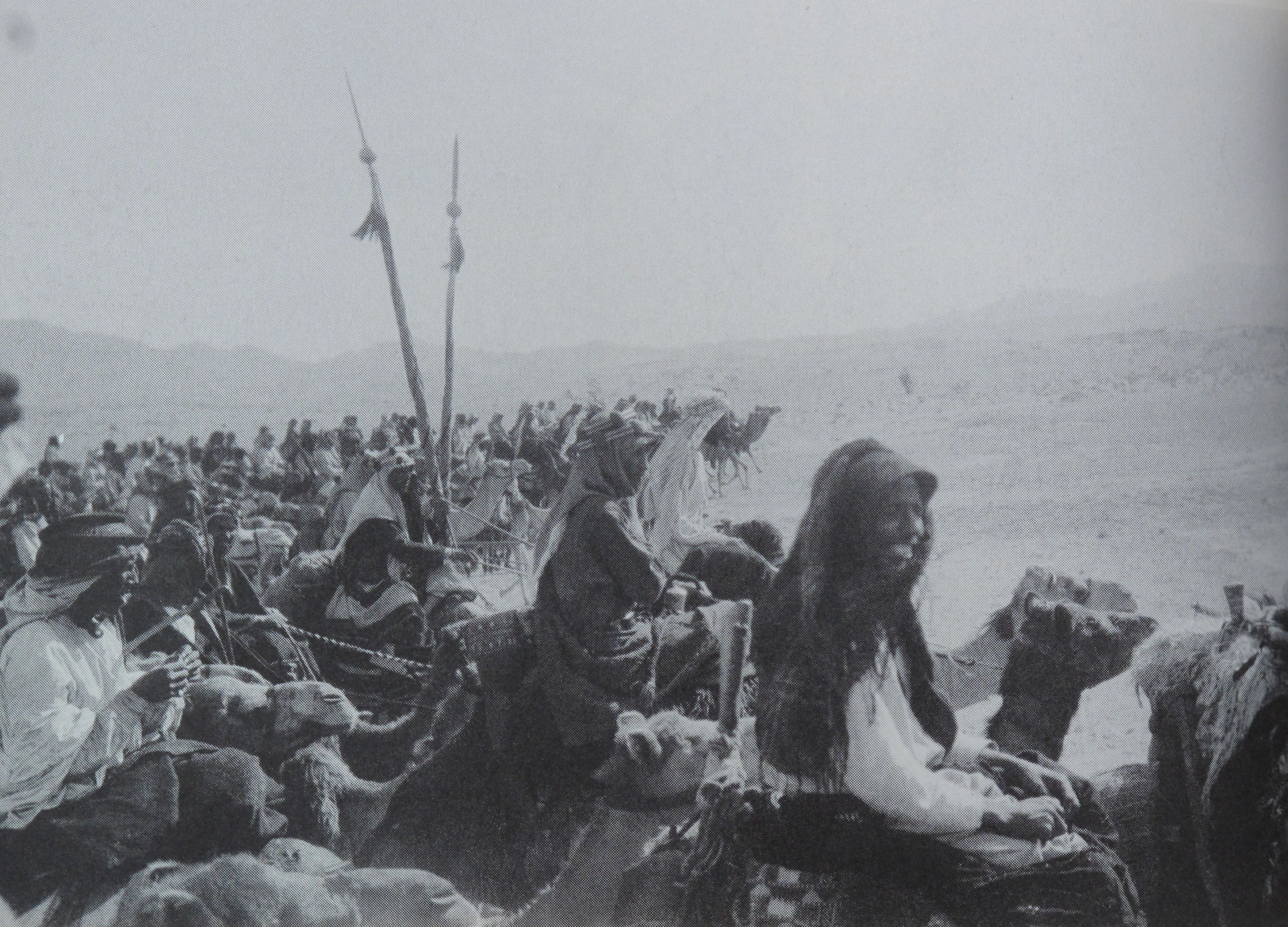
    An indisputably great photo by Lawrence of the Arab army on the march
    An indisputably great photo by Lawrence of the Arab army on the march

    Perhaps Lawrence was torn between a pro-Arab commitment and official instructions, but Aldington finds no proof that any authority ordered him to make any promises. Surprisingly, he even finds evidence that Lawrence’s Arabic was far from fluent. While Lawrence and the British faction to which he belonged may have had sincere sympathy for the Arab cause, Aldington believes “these causes were in the main British camouflage for . . . excluding the French.” As Lawrence put it in one letter, British policy should be to “biff the French out of all hope of Syria . . . won’t the French be mad if we win through?”

    Aldington shows too the extraordinary degree to which Lawrence—not known to public opinion during the First World War itself—was catapulted to fame due to a delayed-action trick of US wartime propaganda. An American team out to boost morale, reporter Lowell Thomas and photographer Harry Chase, had tried the Western front but there, as Aldington puts it, “the drab butchery . . . did not lend itself either to thrilling photography or to eloquent narrative.” The pair then hit upon the idea of the Arabian front, where they found a ready and photogenic Lawrence.

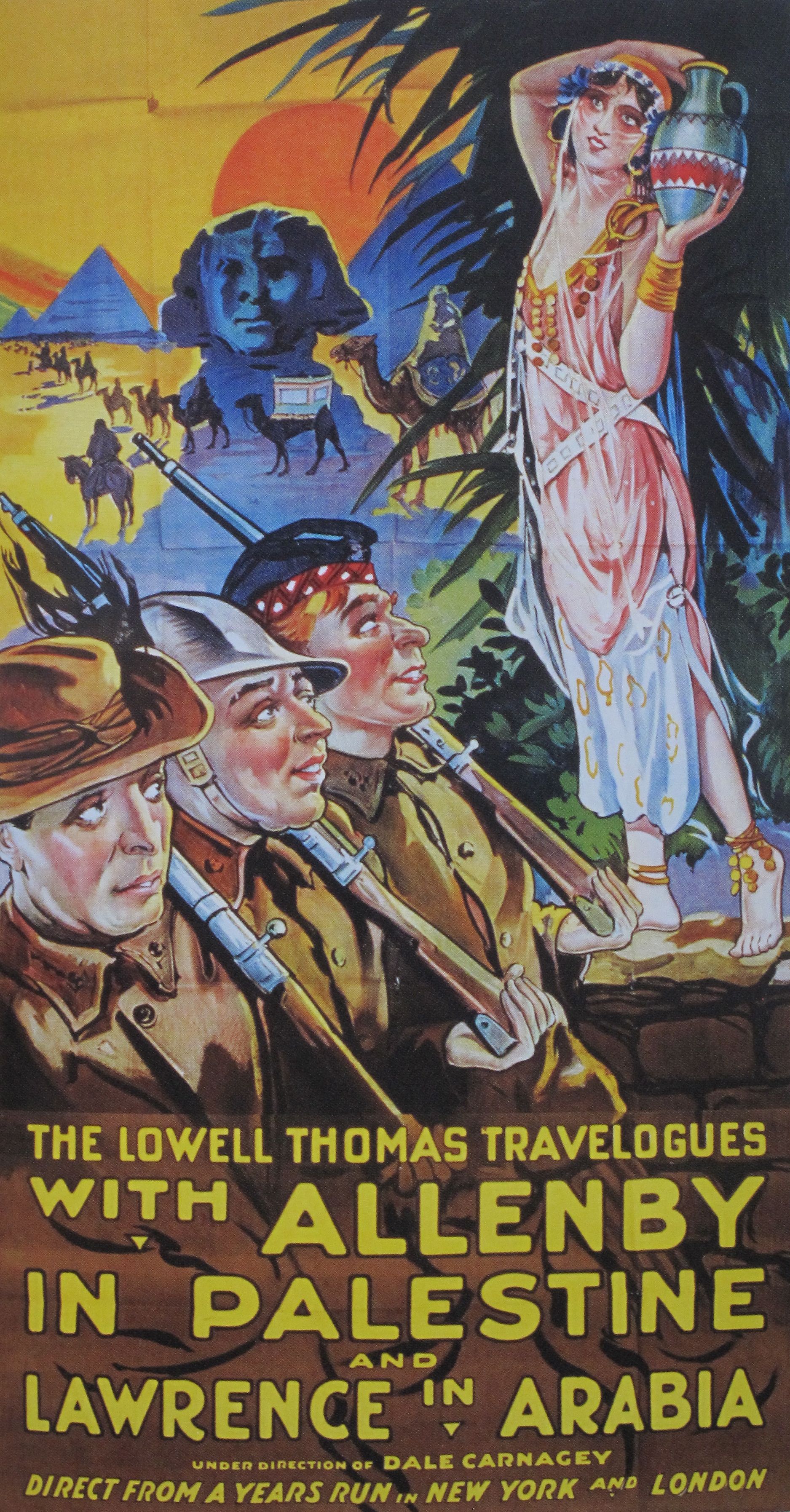
    Poster shotThe resulting show, eventually entitled With Allenby in Palestine and Lawrence in Arabia, was only ready in 1919, after the war was over. After a modest beginning in New York, the lecture tour became a sensation in the English-speaking world, with two thousand performances over four years. It was a true feast for the Orientalist imagination. In London, the promoters borrowed a “Moonlight on the Nile” scene from an opera set, a Dance of the Seven Veils was performed, and an Irish tenor off-stage sang a musical version of the Muslim call to prayer. Aldington says this was irresistible to a British public still in shock from the war:

    What was now wanted was a success story, and who could give it better than an American, for whom success is a national duty? The technique was hardly understood at all in England, where advertising seldom rose above a flat monotony of uninventive mendacity—‘Ponsonby’s Picklesare the Best’ . . . Anyone who has seen a Japanese judo expert throwing hundredweights of London policemen about a stage will realize what Lowell Thomas did mentally and emotionally with those naïve British audiences.

    The spectacle’s focus on Lawrence went so far as to include an inaccurate film subtitle stating that Lawrence dynamited the Hejaz Railway while other British officers remained at base. Lawrence’s own Seven Pillars of Wisdom followed, published in various public editions from 1926 onwards. In the introduction, Lawrence strikes a modest pose:

    My proper share was a minor one, but because of a fluent pen, a free speech, and a certain adroitness of brain, I took upon myself, as I describe it, a mock primacy. In reality I never had any office among the Arabs: was never in charge of the British mission with them.

    But for all Lawrence’s later denials, Aldington painstakingly shows he was deeply involved in helping Thomas create the show that put him front and center. As Lawrence told Thomas, “History isn’t made up of truth anyway, so why worry?”

    Screen shot 2013-02-28 at 22.10.30
    Richard Aldington

    Aldington says he began his commission with no particular feelings about Lawrence. Aldington was a minor poet of the 1910s imagist school, dedicated to replacing romantic abstractions with exact observed detail and apt metaphors, and one of sixteen First World War poets commemorated in London’s Westminster Abbey. He had also edited a literary magazine, written a successful novel based on his grueling years in the trenches of the Western Front, and published a prize-winning biography of the Duke of Wellington.

    Yet publication of his unexpected findings about Lawrence gravely damaged Aldington’s reputation, book sales, and health. Britain was not ready to see its only hero to emerge from the morass of the war toppled, and many disapproved of his revelation of Lawrence’s probably “humiliating and painful” feelings about his illegitimate birth. When Aldington died in July 1962, seven years after publishing his Lawrence book, his obituary in The Times said he was “an angry young man of the generation before they became
 fashionable; he remained something of an angry old man to the end.” It called his attacks on British middle class values “shrill” and suggested that his Lawrence of Arabia book would be “better forgotten.”

    And forgotten it was, a mere footnote now in the Lawrence legend industry. For a few—Richard Aldington and Lawrence of Arabia: A Cautionary Tale, by Fred Crawford—it proves how hard it is to attack a national idol. More usually—as in John Mack’s Prince of our Disorder, which won a Pulitzer in 1976—Lawrence remains “a great man and an important historical figure . . . [who] strongly influenced the [war’s] military outcome and the political aftermath.” Mack allows that Lawrence was at times “less than completely accurate” and “had some tendency to exaggerate his role and importance.” But Aldington’s work, he says, was a “flagrant example of the use of psychology . . . for denigrating purposes.”

    Michael Korda, author of the most recent biography Hero, says Aldington was “obviously” wrong to dispute Lawrence’s claim that he was offered the prestigious top British job in Egypt after the war. But the proof of this is missing—indeed he implies Aldington was right in a way, saying any such offer was not serious—and Korda exaggerates in saying that Aldington’s “whole case” rests on this “idée fixe.” Nevertheless, Korda dismisses Aldington’s findings as “minor stuff” and a “sad object lesson in the perils of obsessive self-righteousness.”

    Still, even Korda allows that “somebody was bound to come along and correct the balance” after the previous biographical “panegyrics . . . without any serious effort at independent research.” And Aldington does not accuse Lawrence of treachery, as one of Lawrence’s loyal fellow officers has suggested. He just draws attention to grandiose misrepresentation of Lawrence’s role, partly due to Lawrence’s own efforts, partly because everyone wanted to believe it.

    Some writers on the Middle East have always doped up narratives, shaped up stories for audiences, or appropriated others’ work as their own. Such self-serving sensationalism is hard to expose, since normal people want to trust colleagues, newspapers and government figures—especially those heroically caught up in great events. Fact-checking is also difficult in this tumultuous region, and few in the Western audience can compare what they read with personal experience. It is precisely these generations of repeated inaccuracies that have widened the gulf of understanding between the region and Western public opinion.

    Aldington was bravely ready to show that reality counts, and paid a great price for showing that a fabulous legend was an extraordinary but hyped-up story. No wonder those Oxford academics preferred digging up matters that are buried in a deep and less sensitive past.

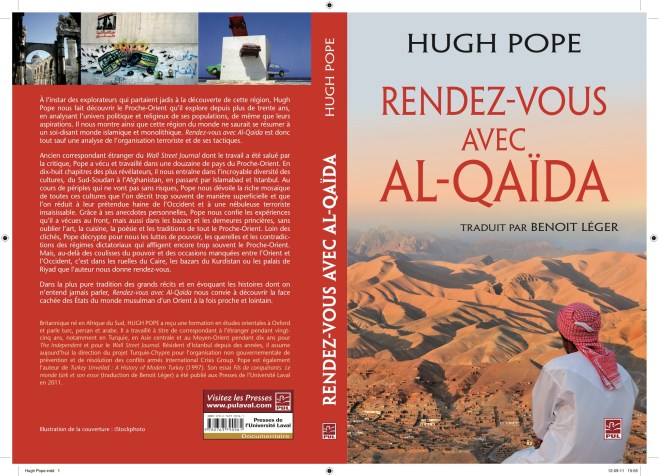
  • The French edition of Dining with al-Qaida is now out, available from bookshops, amazon.fr (here) or direct from the publisher, Presses de l’Université Laval!

    I guess I have to resign myself once again to the book being symbolised as a lonely man in Arabian costume, perched on a mountain ridge, and contemplating the naked but empty nobility of his desert homeland. Of course, this French-language version does echo the cover of the U.S. edition. The other pictures chosen for the back cover here better make the point of Middle Eastern diversity that I hope the book brings to the reader – a lovely glimpse of the Ummayad mosque in Damascus from upstairs in a carpet seller’s shop in the Souq al-Hamidiyeh, a piece of ‘revenge!’ wall graffiti of a bus bomb sprayed onto a wall in Gaza by Hamas, and some very risque sculpture on the Jeddah Corniche. Even more fortunately, with the help of translator Benoit Léger, there was nothing in the publishers’ blurb this time about my “following in the steps of Lawrence of Arabia”…

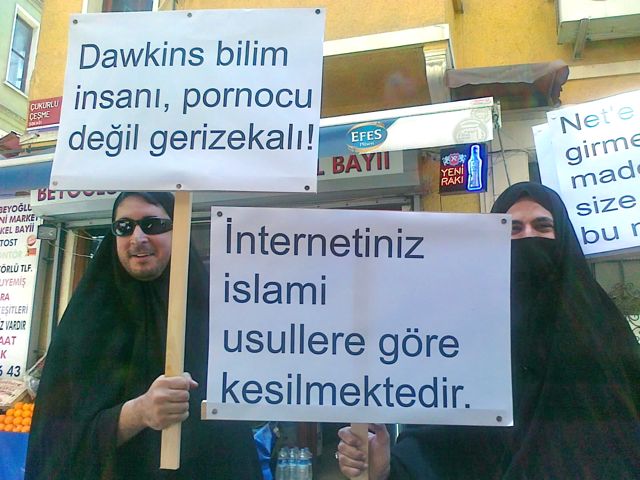
  • Turkish men dressed in chadors get ready for the ‘Hands Off My Porn’ protest against internet censorship on Istiklal St in Istanbul, 2011

    Outside my window overlooking Istanbul’s main pedestrian Istiklal St. rowdy recent demonstrations have given vocal testimony to the fragmentation of Turkey’s self-image between the West and the Middle East: secularists condemning America, Islamists condemning Russia, others decrying Syria, Israel, Kurdish insurgents, the ruling government in Ankara (and lots more besides, see right). At the same time, Istanbul is also acting as an incredible magnet for a new generation of young adventurers from Europe, America and beyond.

    This new diversity of Istanbul has a digital dimension too. The term “expat” makes my orientalist toes curl, but it took breakthrough expatriate website Istanbul Eats to catch the spirit of Turkish street food , and a new launch, Yabangee (from the Turkish for ‘foreigner’, yabancı), seems to me to be the first English-language publication ever to be written entirely by and for the city’s English-speaking residents. (A true mirror to the narcissism of Turkey’s political culture, Turkey’s English-language newspapers are mostly translated from Turkish source material, and, remarkably, most of their readers are actually Turks seeking to improve their English). Anyway I hope their enterprise fares well and here’s my interview with one of Yabangee’s up-and-coming editors:

    Expat Interview: Hugh Pope, Crisis Group Writer and Author of Turkey Unveiled

    “People are always asking ‘Where’s Turkey headed?’”. Author and journalist Hugh Pope and I are sitting in one of Beyoğlu’s packed bars, and he’s shouting so that I can hear him above the almost deafening combination of music and chatter. “But I’ve stopped worrying,” he continues. “Turkey is Turkey – and it will just carry on being itself.”

    Pope certainly is an authority on the subject of Turkish politics. He’s lived in Istanbul for 25 years and speaks fluent Turkish, in addition to the Arabic and Persian he picked up while at Oxford University. He first came to Istanbul to work as a journalist in 1987, but had visited Turkey a few times before, first as a student in 1980 and on breaks from Middle Eastern conflicts. “After so long, do you become Turkish?,” I half-jokingly ask. “No, you become a sort of semi-Levantine!,” he replies.

    A British national but born in South Africa, Pope never really felt at home in England after moving there aged nine. “When I left university in 1982 there was a deep recession, and it was difficult finding a job,” he explains. Yet I suspect he’s making excuses; he probably would have been eager to leave even if the economy had been stronger. “I was offered a job working as a journalist at the Tehran Times, but I couldn’t get a visa”. Rather than return to London, Pope booked a one-way ticket to Syria, aged 22.

    He covered the region working as a freelance journalist until, in 1987, Reuters offered him a position based in Istanbul. “They put me in this amazing flat in Arnavutköy, overlooking the Bosphorus.” But it wasn’t all positive. The traffic at the time was terrible – worse than it is today, he tells me – and the brown coal pollution in winter was so bad that sometimes you couldn’t see more than a few metres in front of you. “It was like the London smog of the 19th century,” Pope explains.

    Old Istanbul from the Golden Horn

    Leaving Reuters in 1990, Pope returned to freelance work. “During that time I worked for a range of media; the Independent [a British newspaper], the BBC, the LA Times, and the Wall Street Journal.” But it was with the Independent that Pope felt he could write stories as he wanted, and he leapt at the chance when the paper retained him as a nearly full-time Istanbul correspondent in 1992.

    In the late ‘80s and early ‘90s there was a lot of coverage on human rights and other ‘bad news’ stories, so Pope would look for more positive stories to try to break up any negative stereotypes. And life as a foreign correspondent was certainly busy, especially since, before live TV news, seeing things mattered. “Once I went to Ankara twice in one day,” he tells me. “That was when Turkish Airlines gave journalists flights for $30. I went out to do a story in the capital, then there was a bomb in Istanbul, which I raced back to cover, before heading back out to Ankara”.

    I ask him whether he ever thought of leaving Istanbul. He not only thought about it, but did leave; it was 1995, and he left Turkey to return to South Africa as the Independent’s correspondent. But the move didn’t bring what he was looking for, and so he returned to Istanbul three months later.

    “I came back with a contract to write a book about modern Turkey, which I did with my ex-wife Nicole. I loved the chance to research for that book, reading for a year.” The result was Turkey Unveiled, which was recently released in its fourth edition, is an account of Turkey’s politics from Atatürk up to the present day. What was it like to have co-authored a book? “We shared the same views on Turkey so it was no problem. And we had a great editor; the text flows even though there were two authors.”

    Turkey Unveiled was first published in 1997, following which Pope started an eight-year stint working full time for the Wall Street Journal. The thoroughness of their editing came as a shock. “Americans are much harder working than Brits,” he says. “And they’re obsessed with getting every factual detail. But the editing process did sometimes remove nuance, ‘flattening’ the articles.”

    But it was a positive experience, and Istanbul was his base for covering, at one point, 30 countries in the region; at least, up until the Iraq War in 2003. Pope says he lost heart covering the story, and that the Journal’s editorial pages went ‘war mad’. “I became disillusioned,” he explains. By 2005, he had become fed up with traveling to the Middle East to write stories in which the American audience expected a viewpoint that Pope found it increasingly difficult to deliver.

    Pope took an unpaid year off, and got out of Istanbul. With his wife Jessica Lutz, a Dutch novelist, he built a house in the mountains above Olympos, in south-western Turkey, expecting to have the option of returning to work at the end of the year. However the Journal had other ideas. Following a downsize, the job was no longer there and he was demobbed with a half year’s pay.

    But as the saying goes, it’s darkest before dawn. The negative stereotypes of the Middle East that had formed since 9/11 gave Pope the inspiration for his next book, Dining with Al Qaeda [published 2010]. This memoir brought to life his Middle Eastern adventures; in one instance, Pope had to ‘argue’ for his life with a Saudi cleric who had tutored several of the 15 suicide bombers of 9/11. That Pope is still alive today is surely testament to his Arabic skills. But the fact that he then made friends with the cleric and took him out for a Chinese meal in Riyadh makes me think there’s more to Pope than meets the eye.

    Nowadays Pope seems content with life here in Istanbul. But the pace hasn’t slowed. Since 2007 he’s been the Turkey / Cyprus project director for the International Crisis Group, which seeks to prevent worldwide conflicts. Does have he have any thoughts of England? Pope, “the semi-Levantine”, threatens to visit his brother in the South-West of England, where he went to school. “I love the countryside there and I keep promising I’ll visit soon. I have to take up a voucher for a free lesson at Sherborne’s croquet club”. But I can see he’s in no hurry.