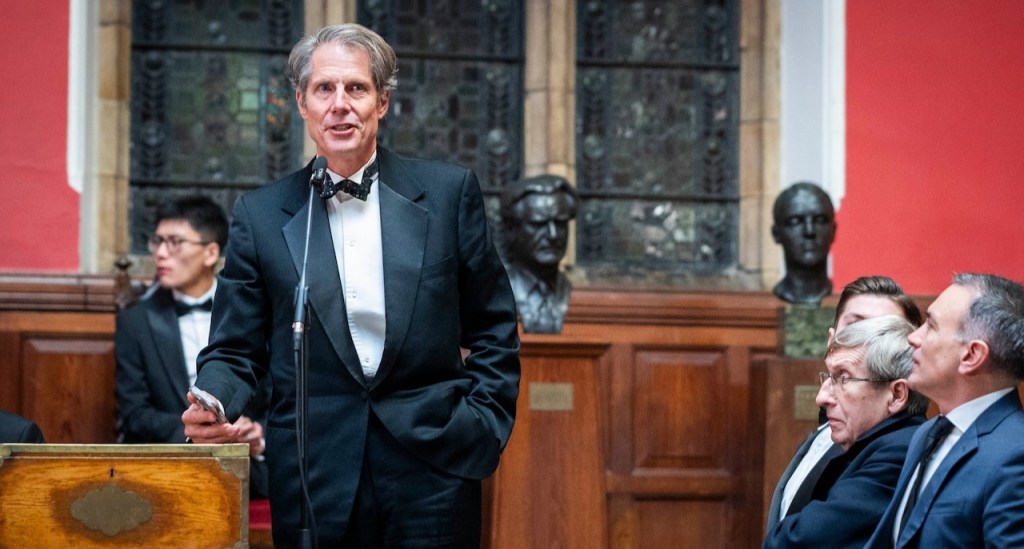
To hammer home the universal relevance of deliberative democracy, I treat every speaking opportunity as a possible nail. Hitting this one cleanly, though, was a challenge: my comments were to be made from the front bench of an Oxford Union debate about the Ottoman Empire.
Oxford University’s famed debating club invites speakers for and against a topic, and the audience then votes for one side or the other. The motion set for us was “this House regrets the demise of the Ottoman Empire.” The topic was familiar: I lived, reported, and wrote books about Turkey for more than three decades. When I stood up in the chamber on 20 November, the essence of my argument was that:
- Regretting the past is futile and blocks thinking about ways to progress
- Histories show it’s a myth that the Ottoman Empire brought centuries of peace, justice and equality
- All empires are sustained by oppressive force.
- None of the Ottomans’ dozens of subject peoples regret the demise of this top-down political construct, including the Turks
- The Oxford Union, like the British political system of which it is a part, should move on from old-style duelling debates to deliberation on topics of real relevance to its members and the public interest
- Voting against regret and imperial nostalgia would be a vote for new, improved democratic practices, like decision-making by randomly selected citizens’ assemblies.
The full text of my speech is at the end of this article. You can see photos from the evening here. The full debate will be shared here in a couple of weeks.
The arguments
On our big night in Oxford, I shared the opposition bench with four others. An Australian student, Oliver Douglas, went first, rejecting all forms of empire. Historian Attila Pók then talked of how his native Hungary still viewed Ottoman occupation as a national tragedy. Constantinos Filis said the same for Greece. The Ottomans had earned their demise, he added, as they fell deep into debt and lost control of their sovereignty. Turkish author Kaya Genç quietly and persuasively showed how Turks today have no wish to resurrect the past.

The star on the bench for the proposition was Ayşe Osmanoğlu, a writer and descendant of the defunct Ottoman dynasty. Her ancestors may not have been perfect, she said, but gently asserted that they ruled over a wide geography for centuries, brought peace, gave rights to minorities and avoided forced integration. American academic Carter Findley then talked about his books on the long-running themes of Turkish history. The bravest speech of the evening came from Turkish film director Atıl İnaç, who, tragically, had heard a few hours before that his mother had unexpectedly died. Clearly in shock and unable to get back to Turkey that evening, he courageously went on with the show.
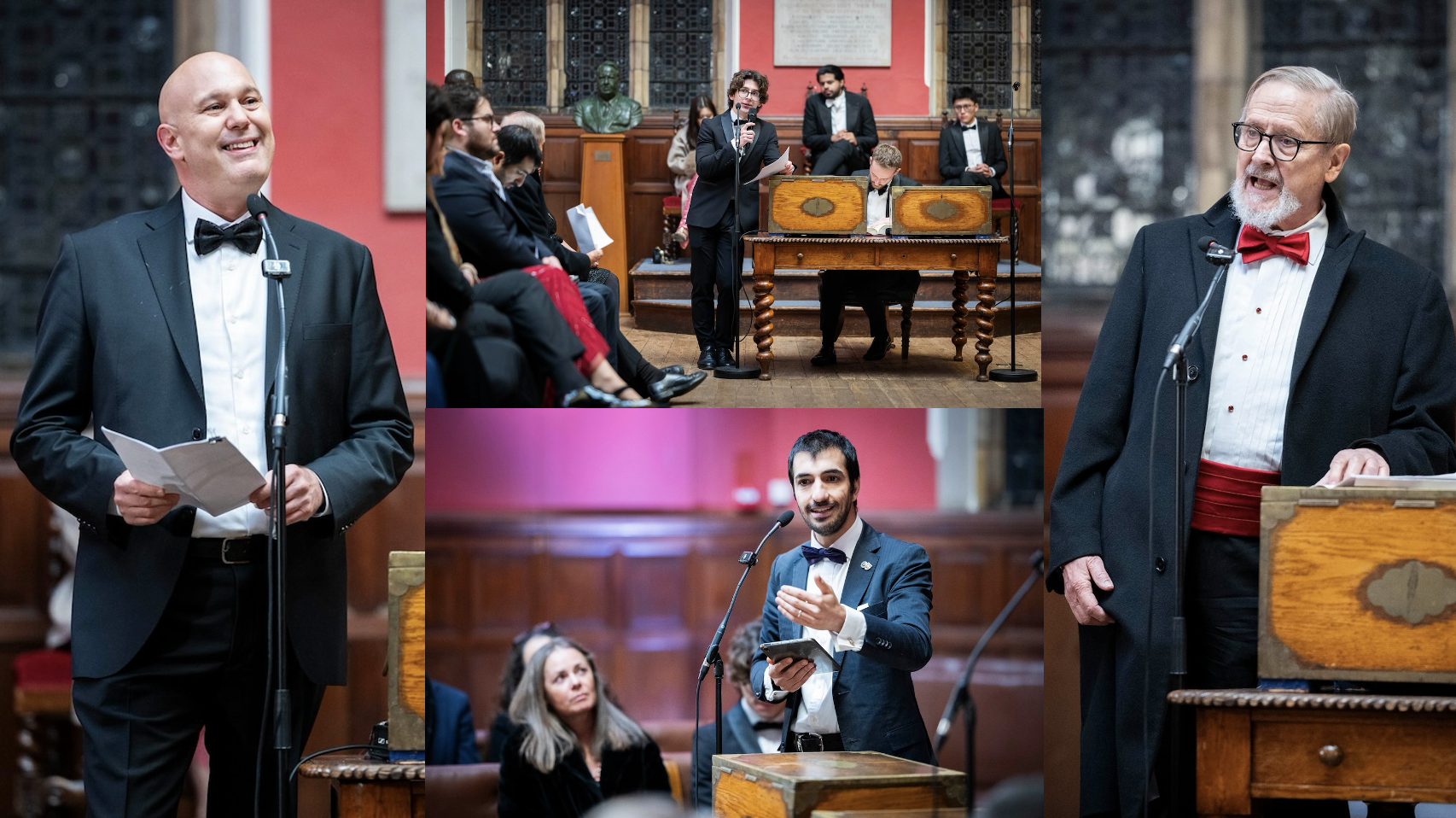
Their comments were bracketed by two Turkish students, Ege Havlucu and Kubilay Ahmet Küçük. Havlucu asked the House to regret not the Ottoman regime, but the traumatic bloodshed as the Ottoman Empire collapsed and as the republic was born. Küçük rehearsed with passion the assertion that the Ottomans were much better and more tolerant than their historical peers.

Our side won the debate. 196 people rejected the motion to regret the Ottoman Empire’s collapse, walking through the left side of the great gothic door to the chamber labeled “Noes”. 111 people chose the right hand side to vote with the “Ayes” in favour.
Debate vs deliberation
The evening was intense and lots of fun. We heard several clever people making points I hadn’t considered before. Three of the students made short, clear, powerful interventions, luckily supporting our side opposing the motion. But ever since co-editing and finding a publisher in 2023 for my father’s posthumous book The Keys to Democracy, my eyes have been opened to the benefits of deliberation. I was ultimately frustrated by the process of a “debate” focused on such an I’m-right-you’re-wrong outcome.

The main speakers were not expected to respond to each other. There was little sign of coordination between them to streamline the information flow. The occasional rhetorical flourish made the chamber come alive, but these seemed more entertaining than persuasive. A significant amount of what was said consisted of broad assertions mixed with too few facts, or too many obscure facts drowning out a structured assertion. The couple of hundred people in the audience had little chance of distinguishing between the two. Distractingly, between speeches, a good portion of those attending churned in and out of the chamber.
Oddly, Ayşe Osmanoğlu was the only woman among the ten speakers. Although women were well-represented among the Union officials and the audience, no women were among the half dozen students who made comments from the floor.
If faced with a real-life decision made in this old-style parliamentary manner, I wouldn’t have wanted to obey it. The yes-or-no debate only strengthened my faith in citizens’ assemblies, the epitome of deliberative democracy. These consist of a group of ordinary citizens randomly selected and mandated to solve a big, knotty problem for their organisation, community or country. Guided by impartial facilitators, they are briefed by accredited experts from all sides of the question, deliberate in small groups and then vote on a new policy. Only what achieves a two-thirds majority counts and the assembly’s final report takes minority opinions into account.
Forging a new Oxonian elite
There was more for a deliberative democrat to learn from observing the Oxford Union, perhaps the most famous training ground for the UK’s political elite. Some surprises were refreshing. If earlier on in its 200-year history the club’s members were stalwart champions of imperial expansion, the former British Empire has certainly now struck back.
The union’s president, Moosa Harraj, scion of a political family in Punjab, is the fourth Pakistani to hold the post. Incoming treasurer Matthew Chiu is from Hong Kong. Student speakers came from Australia and North America. And these are only the ones from Britain’s former dominions. Looking back later, I realised that of all the Oxford Union officers I personally met or speakers I heard, I was probably one of only two who were “mainly” British. But I was born in South Africa, am also a Belgian, and have lived in all kinds of places but Britain for more than four decades. So the most born-and-bred British person of this group was arguably Ayşe Osmanoğlu, the princess wearing a necklace of Ottoman stars and crescents and the Order of the House of Osman. Her perfectly pitched speech would have been the one most at home on a highbrow BBC radio program.
This multi-ethnic, international mix will in the coming years doubtless transfer to London to enrich the diversity of Britain’s rulers. The elite of Oxford’s student groups did just the same move after my time at the university. Now as then all had seamlessly assimilated the breezy Oxonian corporate culture.

Confidence amid chaos was at the heart of it. Union committee members showed their officer calibre, shuttling their confused guests through a fast-moving succession of drinks parties, a three-course dinner, formal photographs and processions. Something cut the power supply to the debating chamber a couple of hours before the debate. But a generator was found and the lights went back on. The 150-year-old building was still brain-crampingly cold, forcing people to pull on coats over their formal wear. One speaker donned his safari hat too. “I thought I’d left power cuts behind in Pakistan,” Harraj muttered into his microphone.
The club juggles its guests with insouciance. Flattered by our speaker invitations, at least two guests had flown all the way from the US for the evening. But we were just bobbing sticks in a stream of celebrity showboats that Oxford students see all the time. Former US Vice-President Mike Pence had dropped by a couple of days before. And the real guest of honour at our debate dinner was Korea’s Hwang Dong-hyuk, creator of the Squid Game. Even though his world-conquering Netflix series is all about winner-takes-all survival, he sometimes seemed as bewildered as us by these high-powered students and their laser-sharp focus on network and careers.
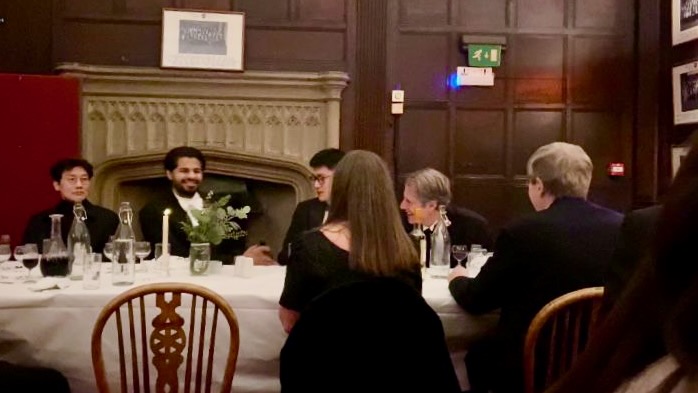
Back in my day, I had little idea that such contacts might open great doors in the future. As I tried and failed to catch the eyes of students to talk to in the Union bar, I realised how blasé my attitude must have seemed to visiting grandees. Indeed, nothing holds a student’s attention like a fellow student, who might prove useful right now. “Even to get elected to the committee, you end up spending your whole life trying to win support on Instagram messenger,” Union official Boldizsar Paladi-Kovacs confided as he guided us round the premises. “That’s why I gave up thinking of going for Union president.”
My pro-sortition convictions deepened as we passed the photo portraits on the walls of past Union officers whose victories in student elections had paved their paths to national power. “Ah, there’s Boris Johnson when he was president of the union,” one union official said, pointing out the former prime minister’s infamous mop of pale hair. “Of course, you all know the story about how votes for his opponent [when he failed to win election the first time round] were found in a chimney here.”
A school for power
The photos present more proof of the Union’s intimate role in the British establishment. During the Cold War, the British secret service insisted that the faces of Union officers be rubbed out, in case Soviet spies spotted them. Every face in some frames is wiped out with a white blotch. Weirdly, the names were all left in. It reminded me of the grassy bank of the Cherwell river running through Oxford that was known as Parsons’ Pleasure. Here we used to punt past often elderly, naked male sunbathers. The clever ones, my late father enjoyed pointing out, would bury their faces in their newspapers, but leave everything else hanging out. “After all, your face is how you are normally recognised,” he’d explain.
It’s hard for a visitor not to be in awe of the Union’s Victorian grandeur and its ingrained pomp and circumstance. Unshakeable traditions feature white-tie-and-tails costumes for top officials and a great crescent-shaped table that Prime Minister William Gladstone designed for Cabinet meetings a century and a half ago. Its curves were clearly designed to allow one person to dominate and epitomised the top-down culture of British imperial power. “Gladstone wanted to look into all his ministers’ eyes to see if they were lying,” our guide Paladi-Kovacs suggested.
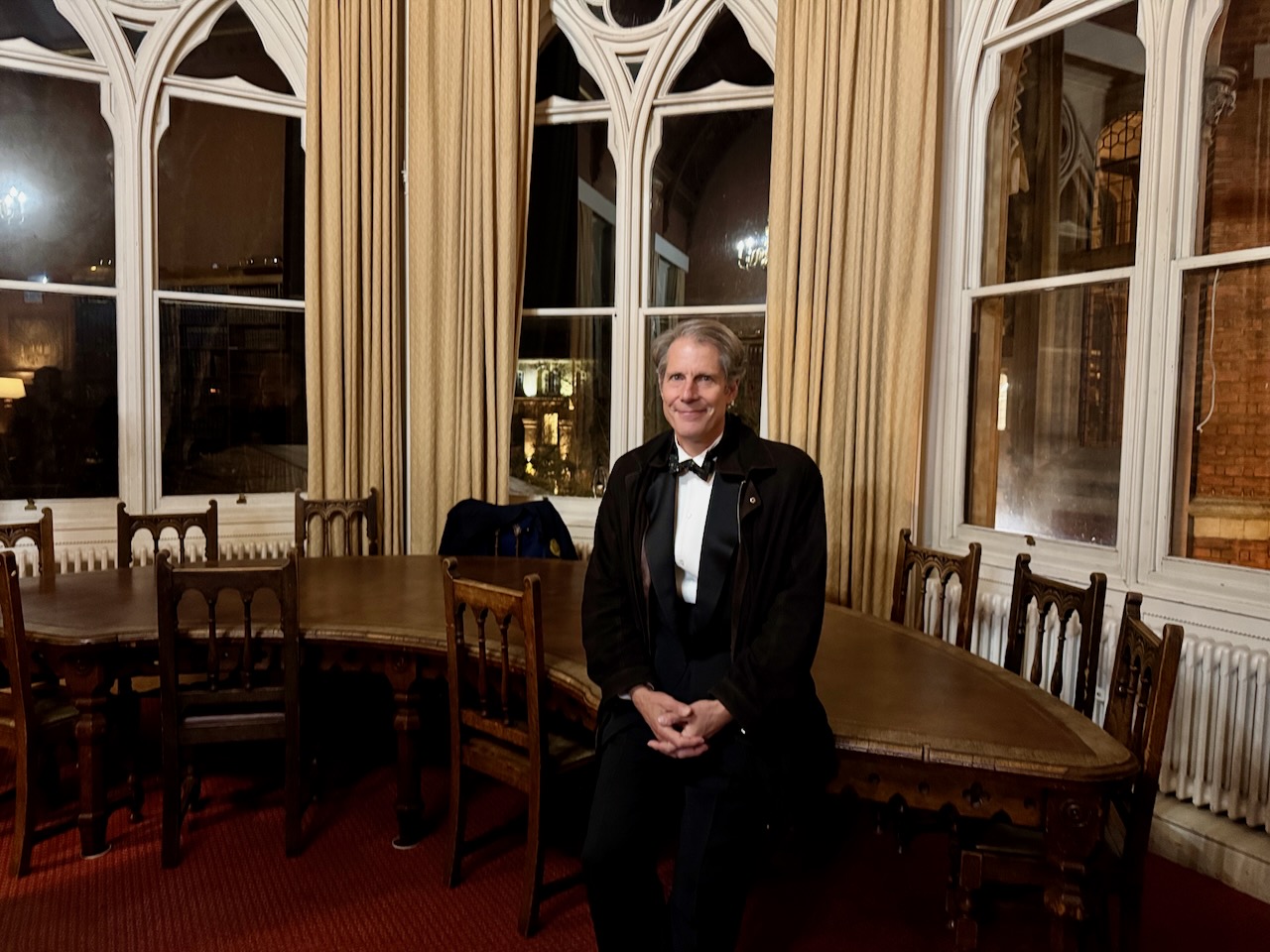
This sense of being suddenly in the power of the Oxford Union was reinforced by the just-in-time experience of visitors. It wasn’t just us outside speakers who weren’t sure what was going to happen next, one student explained. The president is elected for just one term, and committee members have to stand for re-election every term. “Unsurprisingly, there’s little continuity,” they said.
There were reasons too that our hosts might be distracted. The Union is in the grip of a very British scandal. Harraj’s would-be successor next term, George Abaraonye, was voted out of office after he gloated on social media over the September shooting of US right-wing activist Charlie Kirk. Even Harraj has had to fight to keep his presidency. Top speakers cancelled Union appearances, new memberships dropped by a quarter and revenues were badly hit. Overspending on our debate dinners, apparently, was part of the problem. This high drama will doubtless further prepare everyone involved for future UK political life.
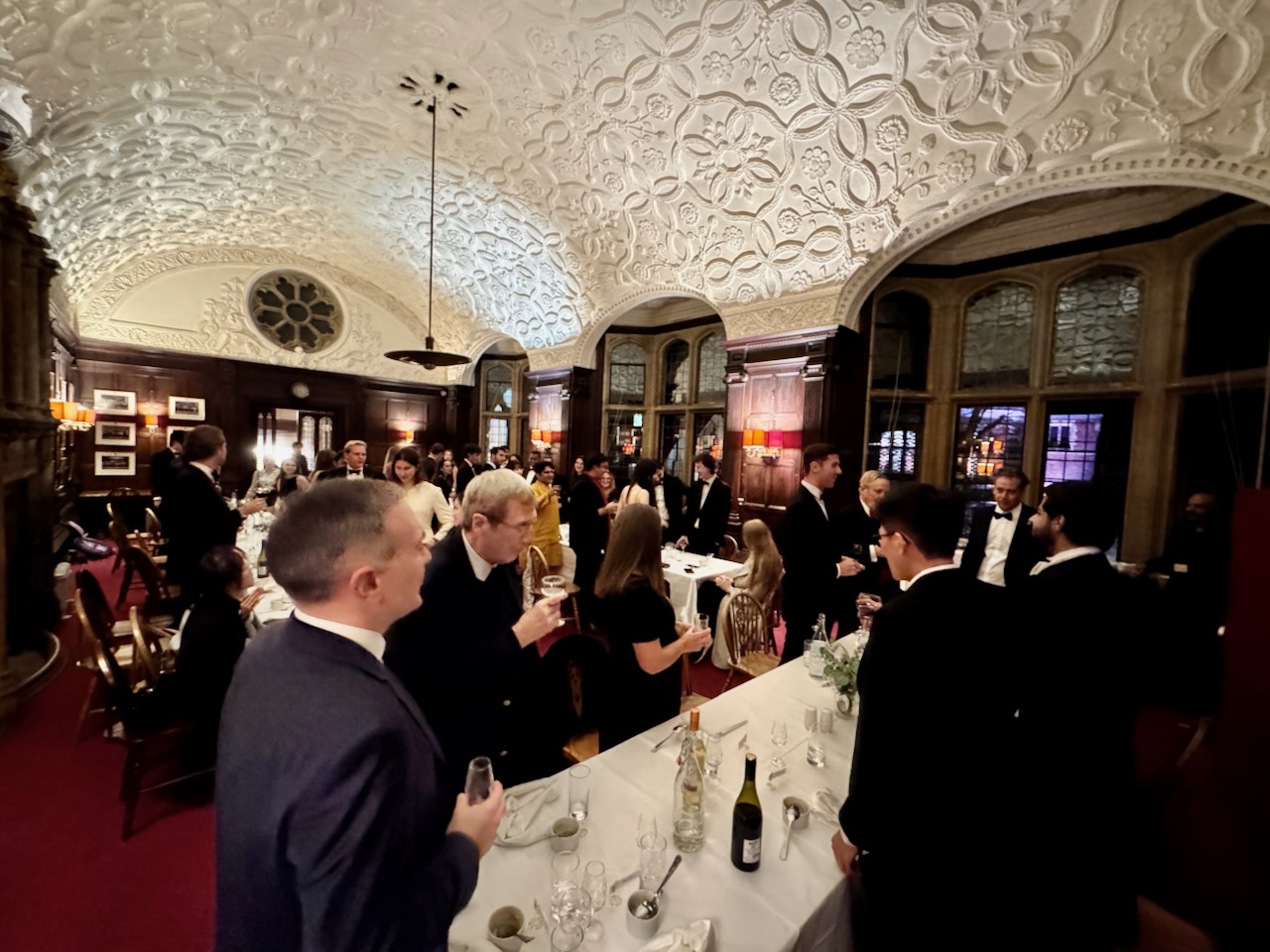
The recent scandal brought another rite of passage. Raising a glass of port, Union President Harraj reserved his last toast after dinner for “my girlfriend, Rosalie”. That was apparently a reference to misogynistic, dismissive tabloid coverage of his partner. In fact, Rosalie Chapman’s robust social media posts celebrate the fact she’s the first in her family to go to university, recently got one of the top degrees in her subject, can give a fine speech and has been elected multiple times to committee positions in the Oxford Union.
Something to believe in
Watching the construction of this new elite as a visitor was certainly less stressful than actually being one of the students. Back then, I did join the Oxford Union in my first term, but I rarely went. I was put off by the febrile politicking of ambitious students and never saw much difference between power-hungry political parties.
I now felt glad that fate had led me to something I could believe in, namely deliberative democracy and random selection. I enjoyed planting the seeds of these ideas in my speech, even if I don’t know how these landed with the union officers or the bulk of the chamber.
But I did learn a new word after my final appeal for “this House” to stop regretting the end of oppressive empires. My guest for the evening, my teenage niece Hazel Pope, overheard two students in the audience react to my final proposal to embrace new citizens’ assemblies, not regret old imperial rulers. “Based” was the word they whispered. This expression has moved from describing a cocaine user, Google says, to becoming “a compliment to show approval of someone’s confident, courageous, and authentic behaviour.”
Our side’s victory in defeating the pro-empire proposition of the debate felt good. But hearing of this openness to new ways of doing things tasted sweet too.

My speech
Here’s what I wrote for my speech, more or less as delivered:
Good evening ladies and gentlemen. It’s a great honour to be here.
Before we get into what to think about the Ottoman Empire, I want to draw your attention to a paradox.
Most of us in this room are or have been members of Oxford University. I daresay those of you still studying here are quite enjoying the experience.
But here’s the thing. To “regret the demise of the Ottoman Empire” is to choose a world that is run as some kind of eternal groundhog day.
If you are an undergraduate, say, the question before you tonight is like asking you whether or not you want to live in student digs forever. I am sure you would all agree that the novelty would soon pall.
In short, a vote for this motion means a vote never to change, never to develop, never to progress.
I put this choice in stark terms to underline this point: when we talk about the demise of the Ottoman Empire, we are talking only about the collapse of a political construct. A construct that, like all empires, was based on conquest, force, elite rule and extortion.
We are not being asked if we like the style of this or that palace, the cadences of a ghazal poem, or the beauties of an Iznik tile. The question begins and ends with, do we wish that this constitutional arrangement had persisted until today?
Our argument is that it could not have survived, and should not have survived.
The gallant proponents of the motion on the other side of the aisle have painted charming pictures of various aspects of life in Ottoman times. Some of them genuinely believe that the Ottoman Empire brought peace, integration and justice. The reality for its subject peoples was different.
Most evidence-based surveys of the Ottoman Empire – present company included – show that there was no pax ottomana. Fighting was a constant on the Ottoman frontiers and internally too. As Ayşe Osmanoğlu’s fine books point out, her own ancestors were locked up for decades in a palace by the Bosporus.
Full justice was impossible because non-Muslim minorities were, by law, second-class citizens. The empire also often lashed out at Muslims who did not adhere to the orthodox Sunni version of the faith. In short, Ottoman pluralism didn’t offer equality, it was a strategy for imperial control.
Similarly, there was no single Ottoman realm or Ottoman citizenry. It was a patchwork of peoples, faiths, provinces and autonomous satrapies that masked all kinds of inequalities.
Foreign visitors to the Ottoman capital, Constantinople, now Istanbul, often wrote of their thrill at its cosmopolitan vibrancy. But I would like to share with this House the published view of Edhem Eldem, a wise academic and another descendant of the Ottoman dynasty. Because of domestic inequalities and oppressive rule, he says, the city may always have been wonderful for foreigners to visit, but it was so difficult for its native people to live in that they often just wanted to leave.
I am sorry that we won’t be hearing from Zülfü Livaneli on the proposing team this evening. I feel that, like many of Turkey’s intellectual elite, he could only have helped our opposition to the motion.
This famous writer and singer made a fine film in praise of the man who deposed the sultans, Kemal Ataturk. He is an outspoken member of Ataturk’s Republican People’s Party. He is a free spirit who sings songs with titles like “Oh Liberty!”. He is not known for laments called “Oh my lord sultan of all the horizons, how I miss you!”
Sympathy in Turkey for the republic is strong indeed. While researching my own book on the country, Turkey Unveiled, I met the late Hümeyra Özbaş, a grand-daughter of the last sultan. She ended her days holding court in the Kismet hotel on Turkey’s Aegean coast. Hümeyra told me that many members of her family were secretly proud of the way Kemal Ataturk beat off the invading forces of Britain, France, and Greece to create a truly independent state of Turkey.
Now, there has been a recent fad for films in Turkey that portray early Ottoman sultans as all-conquering heros. This neo-Ottomanism is often not historically accurate. But to some extent it succeeds in its main aim. This is to add a veneer of glamour and legitimacy to the current Turkish government and its strongman leader.
That’s why the phenomenon of neo-Ottomanism should not be taken as evidence of Turkish regret for the past. The only regret I feel is the way the Turkish authorities have made some historic parts of Istanbul, like Eyüp, look like a kind of Ottoman Disneyland. They have stripped centuries-old mosques of their patina and scrubbed them as clean as shopping malls. This is just another way to manufacture an Ottoman-themed endorsement for strong, central rule. It’s why the current government of Turkey, not all of its people, would be with the ayes tonight.
Don’t just take it from me. In the 100 top-grossing films of all time in Turkey, there’s only one with such an Ottoman theme. It’s called “Conquest 1453.” Despite having one of the biggest budgets in Turkish film history, it comes in only at number 48.
There is also one minor Turkish film, the Ottoman Republic, that imagines what the country might have looked like had Ottoman rule survived. It is a farcical comedy, the sultan is presented as a bumbling incompetent and the country as a small, unimportant stretch of Anatolia under US mandate and European control. Again, no regrets here.
As you listen to the other side, please remember that dozens of countries and peoples emerged from the Ottoman collapse. And in none of them – Arabs, Serbs, Greeks, Bulgars, Yezidis or Alevis – is there any sign of significant nostalgia for its demise.
Of course, there is admiration of today’s Turkey in the region. Turkish Airlines flies to more places than any other airline. Turkey’s diplomatic outposts around the world rival those of the US and China. Turkish companies build metros, shopping malls and kitchen appliances for half the neighbourhood. But these are achievements of the Turkish Republic after it freed itself from the shackles of the past.
Even the Turks do not regret the Ottomans’ passing. For sure, invasions by Britain, France, Russia and Greece a century ago made the transition to a republic bloody and deeply traumatic. But the overall improvements since then are so clear that I could find no polls on the question we are discussing tonight. I could find a proxy, however. A 2024 Pew Research poll shows that 56% of adult Turks want, if they could, to join the European Union. Sounds to me like they’ve moved on.
Let’s probe a little deeper. Who is doing the regretting that we are so earnestly debating? I suppose we imagine ourselves as “the right-minded people of the world”. But we speak of “this House”.
“This House” is in many ways a descendant of another empire, the British one. Many politicians who ran that Empire sharpened their rhetorical skills in this same chamber. The British forces under their command played a critical role in bringing down the Ottoman Empire. And the last sultan slipped out of Istanbul in 1922 aboard a British warship.
“This house” must therefore be honest with itself. Yes, there may have been brief tactical alliances between Britain and the Ottoman Empire, as during the Crimean War.
These British policies had little to do with the inhabitants of the Ottoman Empire itself. They were about domestic politics (busts of Gladstone and Disraeli), commercial interests and the goals of superpower diplomacy like building British maritime power and limiting the reach of Russia.
An institution like this House, so entwined with the British establishment, cannot airily undo the past and easily regret the demise of an Empire it did so much to destroy.
Tonight you may hear counter-factual imaginings about how the Middle East might have remained more peaceful if only the Ottoman Empire had remained in control. Please put these fanciful ideas to one side. Wars and uprisings were endemic.
Indeed, the Ottoman Empire had already shown it could not resist early pressure from the two biggest drivers of Middle East conflict in the 20th century: the creation of the state of Israel, and the lust for control over Middle East oil.
So the real point to focus on is that the world needs to move on from all empires, which have always relied on force to maintain control. We should not be regretting the passing of authoritarian despotisms.
What this House should be channeling is the naturally egalitarian, collaborative instincts of our fellow humans.
Seeing the yes-or-no format of the debate in this House tonight makes me feel even more strongly that we should all be moving on from this binary, polarised duelling about policies.
We should be trying to create new structures for decision making around the world, like randomly selected citizens’s assemblies.
We should hurry forward with humanity’s journey from point-scoring debates to deliberation in the public interest, from inherited hierarchies to full equality, and from empire to self-government,
So I appeal to this House to reject this motion. Let the past be what was, frankly, a not-so-attractive past. Please vote for all of us to be free to embrace a more equal, democratic future.

 Hugh Pope
Leave a comment