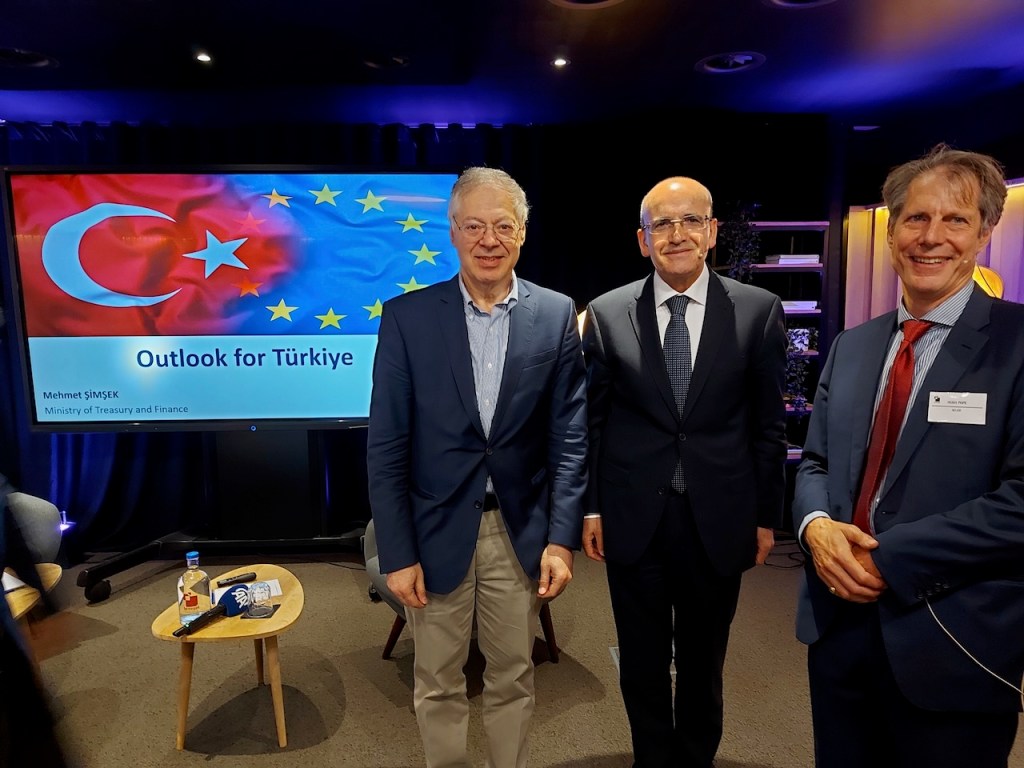
I’d like to make a bet that Türkiye – the official name for Turkey since 2021 – is about to make a comeback after years of disastrous economic policies, fear-mongering leadership and regional turmoil.
Being invited this week by the Bruegel think-tank in Brussels for a discussion with Turkish Treasury & Finance Minister Mehmet Şimşek felt like reliving the start of a memorable upswing back in the late 1990s. Back then, against the odds, Ankara quelled years of political chaos, conquered runaway inflation and successfully wooed the EU for an invitation to join the club.

If we believe Minister Şimşek, President Erdoğan has abandoned an economic ideology that kept interest rates artificially low and drained foreign currency reserves. Şimşek says he is getting a grip on inflation, promising it will decline after peaking at 70% this month. His past year running the budget has already brought an improved balance of payments, inflows of cash and a lower cost of borrowing. Similarly to the self-imposed stabilization package of the late 1990s, he seemed to have a good economic outlook to talk about.

When I asked him whether any political reforms would follow his recent budgetary measures, he talked up the long-moribund Turkish candidacy to join the EU. He invoked a longing for a “European anchor”, the EU’s “rules-based system” and an “engine” to bring the country back into a “virtuous circle.” His numbers showed how close the two sides remain in economic terms: for instance, the EU accounts for two-thirds of inbound Turkish investment, 41% of Turkish export sales, and 41% of tourists to the country.
The Turks have had a rough decade, going through the crushing of the country’s Kurdish movement, alarming wars close by, the inflow of 3.6 million Syrian refugees, a terrible earthquake in February last year and (as ever) financial crisis. But already during my most recent visit in April, I had the impression an upswing is in the offing. It isn’t just that the opposition swept to power in key municipal elections in March and – despite much Islamification of public spaces over the past two decades – Islamic sloganeering is not such a central fixture. From digital government, to a lack of power cuts, to better roads, to how people talk, things just seemed to be working a bit better.

In Brussels, Şimşek answered questions openly and showed a gentler side of the country long missing from the public stage. “We’d like to mend fences,” he offered.
I asked Şimşek if anyone he met officially in Brussels or other European capitals had responded favourably to his message that “Türkiye is ready”. The minister demurred. Such European encouragement as he received, he said, was more personal than institutional. But “they seem constructive”, he added, and “markets are coming round.”
Just as in the 1990s, a good portion of Şimşek’s Q&A discussed the question of whether Turkish leaders really wanted to join the EU at all – and vice versa. The minister himself preferred, like many Turkish leaders in the past, to plea to focus on “the process”, not the end goal, to see what happened if and when convergence worked.
European participants in the audience seemed to doubt that EU leaders would go that far. When it came to re-embracing the goal of Turkish membership of the EU, “Europe is not ready,” said economist André Sapir, my fellow panelist and a Bruegel Senior Fellow. Former top EU official and ambassador to Ankara, Stefano Manservisi, noted from the audience that even the unique 1995 customs union with the EU was invented to keep the country out.
Indeed, Türkiye’s EU progress report for 2023 points out that accession talks are “at a standstill” since at least 2018. The report is stiff with phrases like “no progress”, “backsliding,” and “serious deficiencies.” As in the 1990s, issues of human rights and rule of law stand out as big obstacles to any normalization.
At the same time, much has changed. One of Şimşek’s slides showed how the old unspoken European prejudice that the country was “too big, too poor and too Muslim” is now at least partly wrong. While purchasing power per capita was just 40% of the European average in 2001, it’s now reached 74%.

Indeed, when I started living in Istanbul in the 1980s, there were just 30 often ageing planes in the Turkish Airlines fleet. That’s about the number of planes I saw last month from one window of Istanbul’s vast new airport, possibly the biggest in Europe. Turkish Airlines says that today’s fleet of over 440 planes serves 272 destinations in more countries than any other carrier in the world.
That’s not all. An economy whose leading exports were hazlenuts and figs in the 1980s now sells drones that change the course of foreign wars. Compared to the 1990s, little armed conflict now happens inside the country. And the 3m-4m people of Turkish origin in EU states are now far better integrated and rising in European societies, changing perceptions of their mother country.
It may be that if technocrats like Minister Şimşek can get Türkiye’s act together, European leaders may accept his revival of Ankara’s old argument that collaboration with a country with its size and growth could be an advantage for the EU, whose combined GDP has now fallen to 17.5% of the global total from 28.6% in 1980. It’s possible too that Europeans can learn to look with new eyes at a richer, potentially better-run, and, dare I say, still relatively secular country.
I remember the December 1999 moment that the EU issued its invitation to join, an amazingly proud and happy day for many Turks. It kick-started years of real progress. Perhaps a more constructive approach from both sides could be an opportunity to bring back those happier days again.
+++
Postscript on 15 October 2024. I think I won my bet. Four months after writing this, The Economist published this article (10 October 2024):
Turkey ’s long hard struggle with inflation: High interest rates are starting to do the trick
Setting interest rates in Turkey is like skiing in pre-lift days. Going down is the easy part. Climbing back up is gruelling, and takes ages. The country’s central bankers have been doing so since the summer of 2023, and they still need more time.
They do have something to show for their pains….The economic team he appointed has won back the trust of foreign investors…”
It’s nice to see the country’s economy stabilize. Unfortunately, it’s no quick cure for the pain of constant transitions and uncertainties that continue to bedevil the lives of many ordinary Turks.
 Hugh Pope
Leave a comment